
For U.S.-spec Toyota Tacomas, the correct differential fluid depends on model year, drivetrain, axle, and the component being serviced. In the 2023 and 2024 Toyota owner documentation checked for this update, the front and rear differentials specify Toyota Genuine Differential Gear Oil LT 75W-85 GL-5 or equivalent. A 4WD transfer case is different: Toyota specifies Toyota Genuine Transfer Gear Oil LF or equivalent, with SAE 75W viscosity for these examples.
Quick Answer
For the 2023 and 2024 U.S. Tacoma specifications verified for this guide, the front and rear differentials use Toyota Genuine Differential Gear Oil LT 75W-85 GL-5 or an equivalent meeting the same requirement. The 4WD transfer case uses Toyota Genuine Transfer Gear Oil LF or equivalent, SAE 75W—not the same 75W-85 differential oil. Capacities and procedures vary by model year and configuration, so confirm your exact truck before buying fluid.
By GomyReview Editorial Team · Last updated: September 19, 2026 · Fluid specifications and maintenance guidance were cross-checked against Toyota owner and maintenance documentation.
Key Takeaways
- Confirm the exact fluid specification in your model-year owner’s manual before buying gear oil.
- Do not assume that differential oil, transfer-case oil, and manual-transmission oil are interchangeable.
- Remove the fill plug before opening the drain plug so you know the component can be refilled.
- Use new sealing gaskets and the Toyota torque specification for your exact truck.
- Towing, heavy loading, mud, water crossings, and repeated off-road use can justify earlier inspection or model-specific special-use service.
Generation note: Toyota introduced an entirely new fourth-generation Tacoma for the 2024 model year. Do not automatically apply a 2016–2023 capacity, tool size, or torque value to a 2024-or-newer truck. Select your year and model in the Toyota Manuals and Warranties portal.
What Differential Fluid Does a Toyota Tacoma Take?
Toyota specifications differ by generation and configuration. The following U.S.-market examples show why checking the exact model year matters. Capacities are reference figures; use the manual’s fluid-level procedure as the final fill check.
| Model-Year Example | Front Differential | Rear Differential | 4WD Transfer Case |
|---|---|---|---|
| 2023 Tacoma | 75W-85 GL-5; about 1.6 qt (1.5 L) | 75W-85 GL-5; roughly 3.1–4.2 qt depending on transmission, axle, and differential configuration | Toyota Transfer Gear Oil LF or equivalent, SAE 75W; about 1.1 qt (1.0 L) |
| 2024 Tacoma | 75W-85 GL-5; about 1.4 qt (1.3 L) | 75W-85 GL-5; about 4.8 or 5.0 qt depending on configuration | Toyota Transfer Gear Oil LF or equivalent, SAE 75W; about 1.2 qt (1.1 L) |
These figures are examples, not a universal Tacoma chart. Toyota changed axle capacities between generations, and rear-differential capacity can vary within the same model year. For 2025–2026 trucks or any configuration not shown above, check the exact Toyota manual rather than assuming the 2024 figures carried forward unchanged.
Selection rule: Identify the model year first, then the component, drivetrain/axle, required viscosity, Toyota or API specification, capacity, and fill-level procedure. A partial match such as “GL-5” is not enough by itself.
How to Properly Change Differential Fluid in Your Tacoma
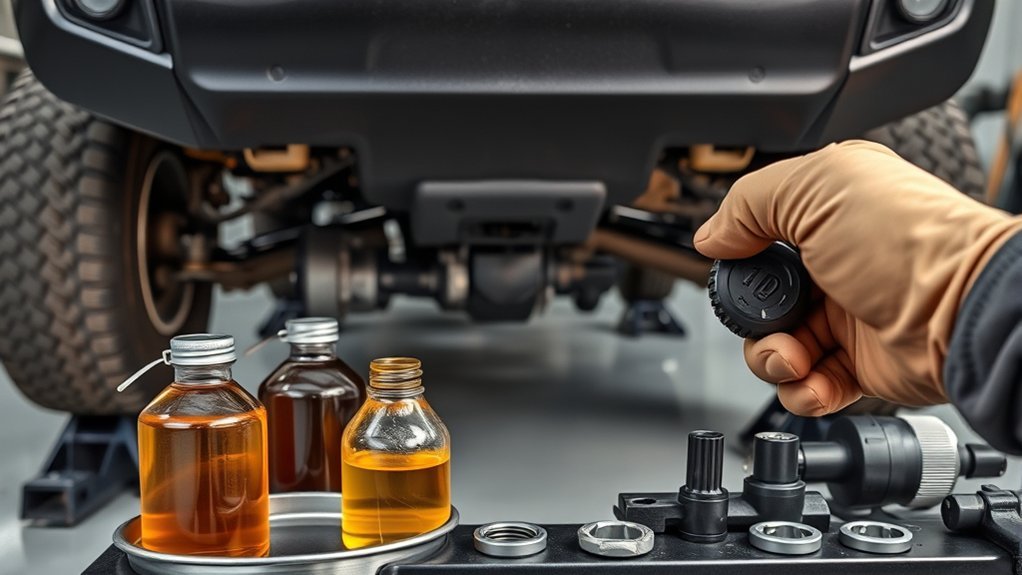
A differential fluid change is manageable for an experienced DIY owner, but preparation matters. Confirm the fluid, capacity, plug type, sealing-gasket part number, and torque values before lifting the truck.
At a Glance
| Time Required | About 60–90 minutes for one differential, depending on access and skid plates |
| Difficulty | Moderate DIY maintenance |
| Tools Needed | Wheel chocks, drain pan, correct sockets or hex bits, breaker bar, torque wrench, fluid pump, gloves, and shop towels |
| Cost | Varies by fluid quantity, specification, number of components serviced, and whether tools are already available |
Warning: Never work beneath a Tacoma supported only by a hydraulic jack. Park on a firm, level surface, chock the wheels, and use correctly rated jack stands at approved lifting points. Gear oil may also be hot after driving, so let the drivetrain cool enough to handle safely.
Tools and Supplies
- The exact fluid required for the component and model year
- Enough fluid to meet the manual’s listed capacity
- New drain- and fill-plug gaskets or crush washers
- Correct socket, hex bit, or specialty plug tool
- Ratchet or breaker bar
- Torque wrench covering the required torque range
- Fluid-transfer pump or hose
- Drain pan with enough capacity
- Brake cleaner or suitable parts cleaner
- Nitrile gloves, eye protection, and shop towels
- Wheel chocks, jack, and jack stands when additional clearance is needed
Step 1: Verify the Component and Specification
Identify whether you are servicing the rear differential, front differential, or transfer case. A two-wheel-drive Tacoma does not have a driven front differential or a four-wheel-drive transfer case. Fourth-generation configurations also include both part-time and, on certain i-FORCE MAX Limited models, full-time four-wheel-drive systems, so identify the exact drivetrain before selecting service information.
Use the owner’s manual or the applicable repair information from the Toyota Technical Information System to confirm the fluid specification, capacity, plug type, gasket, and torque.
Step 2: Warm the Fluid and Park Level
A brief drive can warm the gear oil and help it drain. Avoid beginning the service immediately after heavy towing or off-road driving because the housing and oil may be extremely hot.
Park the truck on level ground. The vehicle must remain level during filling because the fill opening is commonly used to establish the correct fluid level.
Step 3: Clean the Plug Area
Clean dirt and mud from the fill and drain plugs before loosening either one. This reduces the chance of debris entering the housing.
If a skid plate blocks access, remove it with the correct tools for your model. Do not assume every Tacoma uses the same skid-plate fasteners.
Step 4: Remove the Fill Plug First
Loosen and remove the fill plug before touching the drain plug. This confirms that you can refill the differential after draining it.
Pro Tip: If the fill plug is tight, make sure the tool is fully seated and square to the plug. Dirt inside a hex recess can prevent full engagement and increase the chance of rounding it.
Step 5: Drain the Old Fluid
Place the drain pan beneath the housing and remove the drain plug slowly. Allow the oil to drain until it falls to an occasional drip.
Inspect the drained oil for water, foam, burnt odor, or unusual debris. Milky fluid can indicate water contamination. Fine gray paste on a magnetic drain plug may reflect normal wear, but sharp flakes, chips, or chunks need professional diagnosis.
Step 6: Clean the Plug and Install a New Gasket
Clean the drain plug, including its magnet when fitted. Replace the sealing washer or gasket rather than reusing a flattened or damaged seal.
Inspect the plug threads and housing threads. Stop if either is damaged, cross-threaded, or heavily corroded.
Step 7: Reinstall and Torque the Drain Plug
Thread the drain plug in by hand first. Tighten it with a torque wrench to the exact value listed for your Tacoma’s model year and component.
Do not rely on a universal Tacoma torque value. Front, rear, and transfer-case plugs can use different specifications.
Step 8: Add the Correct Fluid
Use a pump to add the specified fluid through the fill opening. Follow the manual’s fill-level procedure. Toyota differential procedures commonly specify a level at or within a few millimeters of the lower edge of the filler opening, but use the exact procedure for your truck.
Do not overfill by raising one end of the truck to force in extra oil. Too much or too little oil can cause lubrication problems, leakage, or other driveline issues.
Step 9: Install the Fill Plug
Fit a new gasket to the fill plug, thread it in by hand, and tighten it to the specified torque. Clean residual gear oil from the housing so a future leak is easier to identify.
Step 10: Recheck for Leaks
Reinstall any skid plates, lower the vehicle safely, and take a short drive. Inspect both plugs and the surrounding housing for fresh oil.
Check again after several days, especially if a plug, gasket, or thread showed corrosion during service.
Dispose of Used Gear Oil Properly
Transfer the drained oil into a clean, leak-proof container. Do not mix it with coolant, brake fluid, fuel, or solvents. The U.S. Environmental Protection Agency’s used-oil guidance recommends taking used automotive oils to an appropriate recycling facility, waste collection program, or automotive service business.
Understanding Differential Fluid Types for Your Tacoma
The words on a gear-oil bottle describe different properties. The SAE grade, such as 75W-85 or 75W-90, describes viscosity behavior. A performance designation such as API GL-5 describes the type of gear service the oil is designed to handle.
You must match the complete requirement. A bottle labeled GL-5 but carrying a different viscosity is not automatically equivalent to the Toyota-specified 75W-85 fluid.
| Component | Verified Late-Model Pattern | What You Must Verify |
|---|---|---|
| Rear differential | The 2023 and 2024 U.S. manuals checked specify Toyota Genuine Differential Gear Oil LT 75W-85 GL-5 or equivalent. | Year, axle/differential configuration, viscosity, capacity, gasket, and torque. |
| Front differential | The verified 2023 and 2024 4WD examples also specify 75W-85 GL-5. | Year, drivetrain, viscosity, capacity, fill level, and plug procedure. |
| Transfer case | The verified 2023 and 2024 examples use Toyota Genuine Transfer Gear Oil LF or equivalent, SAE 75W. | Exact Toyota specification, viscosity, capacity, drivetrain, and fill procedure. |
| Manual transmission | Uses a transmission-specific lubricant and is not part of a differential-fluid service. | Transmission code, required fluid, viscosity, capacity, and synchronizer compatibility. |
Why Does Toyota Specify GL-5 Gear Oil for Tacoma Differentials?
GL-5 gear oils are intended for heavily loaded gear sets, including hypoid differentials. Hypoid ring-and-pinion gears experience substantial sliding contact, so they need the extreme-pressure performance specified by the manufacturer.
When Toyota specifies GL-5, using a properly qualified oil of the required viscosity helps maintain the lubrication characteristics the differential was designed around. The goal is to match the complete Toyota requirement rather than simply choosing the highest GL number on the shelf.
Do not assume GL-5 is the correct answer for a manual transmission or transfer case. Those components can have different viscosity, friction, material, and lubrication requirements.
Why the Correct Transfer-Case Fluid Matters
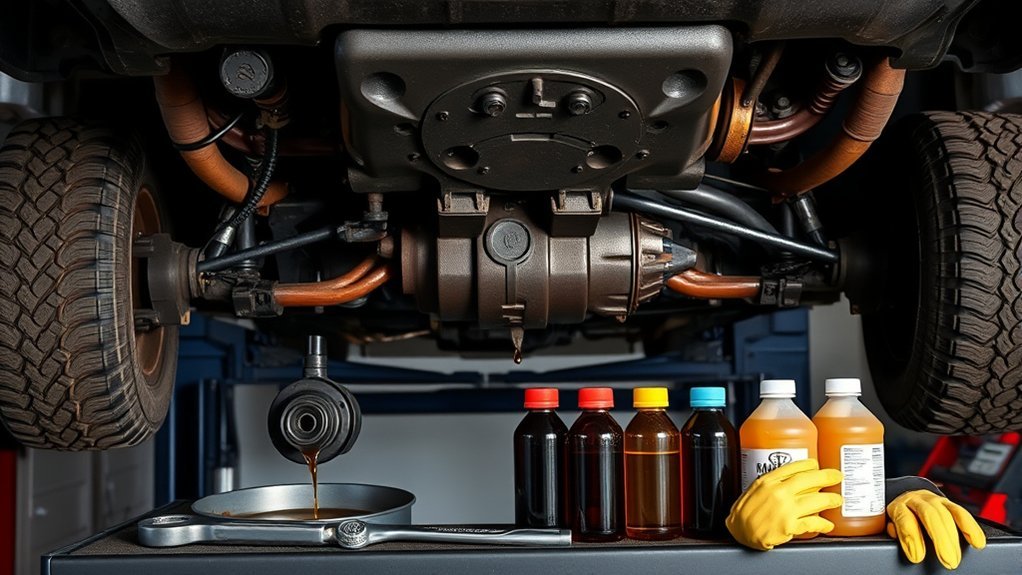
The transfer case directs power through the four-wheel-drive system. Its gears, bearings, seals, and other internal components are designed around a specific lubricant.
For the 2023 and 2024 U.S. examples verified for this guide, Toyota specifies Toyota Genuine Transfer Gear Oil LF or an equivalent of matching quality, with SAE 75W viscosity. That is not the same specification as the 75W-85 GL-5 differential oil.
Do not choose transfer-case fluid solely because a bottle says GL-4 or GL-5. Match Toyota’s named specification, viscosity, and application for the exact model year and drivetrain.
OEM vs. Aftermarket Fluid for a Tacoma
Toyota Genuine fluid offers a straightforward way to match the specification named in the manual. An aftermarket fluid can also be suitable when its current technical data clearly identifies compatibility with the same viscosity, performance requirement, and intended application.
Use This Selection Checklist
- Match the component: front differential, rear differential, transfer case, or transmission.
- Match the complete viscosity grade.
- Match the required performance category or Toyota specification.
- Confirm that the product is recommended for your model year and drivetrain.
- Check whether an older or aftermarket mechanical limited-slip differential requires a friction modifier.
- Do not assume an electronic locking differential automatically needs limited-slip additive.
- Buy enough fluid for the manual’s stated capacity, allowing a small margin for pumping losses.
- Keep the receipt and product technical information with your service records.
Do not select oil because one grade is cheaper, thicker, or described as heavy duty. A fluid can be high quality and still be wrong for your Tacoma.
How Often Should Tacoma Differential Fluid Be Changed?
No single replacement interval applies to every Tacoma. Toyota maintenance schedules separate routine inspections from replacement required under specific operating conditions, and those requirements vary by model year.
Start With Toyota’s Maintenance Guide
Do not automatically adopt a 30,000-mile, 60,000-mile, or 100,000-mile rule from a forum or generic maintenance chart. Check the Warranty and Maintenance Guide for the exact truck.
As one documented example, Toyota’s 2021 Tacoma maintenance guide calls for front differential oil on 4WD models and rear differential oil to be replaced at the 15,000-mile service when the truck is driven primarily while towing, using a car-top carrier, or under heavy vehicle loading. Other model years and operating conditions must be checked separately.
For normal use, Toyota schedules commonly emphasize inspection for level, leakage, and condition rather than presenting one universal replacement mileage for every Tacoma.
Factors Affecting Frequency
Earlier inspection or model-specific special-use service can be appropriate when the truck regularly experiences:
- Towing or heavy payloads
- Repeated low-speed four-wheel-drive use
- Rock crawling or sustained off-road driving
- Deep mud, sand, or dusty roads
- Water crossings or suspected submersion of an axle
- Very hot operating conditions
- Long periods of high load
- A leaking seal or damaged differential vent
After a deep water crossing, inspect the fluid instead of waiting for the next mileage milestone. Milky or foamy oil can indicate water contamination and should be addressed promptly.
How to Choose a Tacoma Differential Fluid
The correct fluid is the one that matches the complete specification for your exact Tacoma. Brand name, synthetic labeling, price, and owner recommendations come after compatibility.
Does the Fluid Need to Be Synthetic?
Synthetic gear oils are widely available in the viscosities used by Tacoma differentials, but “synthetic” alone does not establish compatibility. Toyota Genuine and aftermarket lubricants can be suitable when the current product documentation matches the required viscosity, performance grade, and application.
Companies such as Toyota, AMSOIL, Red Line, Ravenol, and others sell multiple gear-oil formulations. Verify the exact product specification rather than relying on the brand name.
Can You Use a Heavier Gear Oil for Towing?
A lower price or heavier viscosity does not justify departing from Toyota’s specification. Compare products only after confirming they meet the same requirement.
Do not automatically substitute 75W-140, 80W-140, or 85W-140 merely because the truck tows or travels off road. A heavier oil changes viscosity behavior and may not meet the requirement Toyota specified for the axle. Use a different grade only when Toyota or the installed axle/differential manufacturer explicitly authorizes it.
How Much Differential Fluid Does a Tacoma Need?
Capacity changes by generation, front or rear housing, transmission, axle, and differential configuration. For example, the verified 2023 U.S. specifications list about 1.6 qt for the front differential and roughly 3.1–4.2 qt for the rear depending on configuration. The verified 2024 specifications list about 1.4 qt front and 4.8 or 5.0 qt rear depending on configuration.
The transfer case is separate: the verified 2023 example holds about 1.1 qt, while the verified 2024 example holds about 1.2 qt. Both use Toyota Genuine Transfer Gear Oil LF or equivalent, SAE 75W.
Published capacities are reference quantities. During a routine drain and fill, some old oil may remain in the housing, so follow Toyota’s fill-level procedure as the final check. Never force the full published quantity into a component after the specified level has already been reached.
Signs the Differential Needs Inspection
Have the differential or transfer case inspected if you notice:
- Fresh oil around a plug, seal, axle tube, or housing seam
- Whining or howling that changes with road speed
- Clunking during acceleration or deceleration
- Chatter or binding during turns
- A burnt gear-oil odor
- Milky, foamy, or water-contaminated fluid
- Large metal flakes or pieces on the drain-plug magnet
- Repeatedly falling fluid level
A fluid change cannot repair damaged bearings, worn gears, excessive backlash, a blocked vent, or a failing seal. Diagnose the cause instead of trying to mask the symptom with thicker oil.
Related Guides
Frequently Asked Questions
What kind of differential fluid does a Toyota Tacoma take?
The 2023 and 2024 U.S. Tacoma owner documentation checked for this guide specifies Toyota Genuine Differential Gear Oil LT 75W-85 GL-5 or equivalent for the front and rear differentials. Older and later configurations can differ in capacity or other service details, so verify the manual for your exact model year and axle.
Can you use 75W-90 instead of 75W-85 in a Toyota Tacoma?
Do not assume so. The 2023 and 2024 U.S. Tacoma specifications checked here call for 75W-85 GL-5 differential oil. Use 75W-90 only when Toyota documentation for your exact truck permits it or the lubricant manufacturer explicitly documents compatibility with the complete Toyota requirement.
What differential oil does Toyota use?
Toyota lists component-specific genuine fluids in its owner’s manuals. The 2023 and 2024 Tacoma examples verified here specify Toyota Genuine Differential Gear Oil LT 75W-85 GL-5 or equivalent for the conventional front and rear differentials.
Can I use 75W-140 instead of 75W-90?
Not unless Toyota or the installed axle or differential manufacturer explicitly permits 75W-140. The heavier grade changes viscosity behavior. Towing alone does not automatically make 75W-140 the correct fluid.
Does a Tacoma locking differential need a friction modifier?
Do not add a friction modifier merely because the Tacoma has an electronic locking differential. An electronic locker is not automatically the same as a clutch-type mechanical limited-slip differential. Use an additive only when Toyota or the manufacturer of an installed aftermarket differential specifically requires it.
Should I change the fluid after a water crossing?
Inspect it promptly if the axle or transfer case may have been submerged. A damaged, blocked, or poorly positioned vent can allow water into the housing. Milky or cloudy fluid, foam, rust, free water, or an unexpectedly high level can indicate contamination and justify prompt service.
Conclusion
Your Toyota Tacoma needs fluid selected for its exact model year, drivetrain, axle, and component. The 2023 and 2024 U.S. examples verified for this guide use 75W-85 GL-5 in the conventional front and rear differentials, while their 4WD transfer cases use Toyota Transfer Gear Oil LF or equivalent, SAE 75W. Capacity changes substantially between configurations and generations.
Before servicing the truck, confirm the manual, keep the vehicle level, remove the fill plug before the drain plug, install new sealing gaskets, and use the correct torque. If the truck tows, carries heavy loads, crosses deep water, or works off road, also check the special-operating-condition maintenance requirements for its model year.
Sources
- Toyota Manuals and Warranties — model-year owner’s manuals, warranty guides, specifications, and maintenance information.
- Toyota Technical Information System — official repair information, component procedures, capacities, and torque specifications.
- Toyota Tacoma Owner’s Manual OM04041U — fourth-generation differential, manual-transmission, and transfer-case specifications used for the 2024 examples.
- 2021 Toyota Tacoma Warranty & Maintenance Guide — normal and special-operating-condition maintenance requirements.
- Toyota USA Newsroom: 2024 Tacoma — fourth-generation drivetrain configurations, including part-time 4WD, electronic locking rear differentials, and full-time 4WD on the applicable i-FORCE MAX Limited.
- U.S. EPA Used-Oil Guidance — collection, handling, and recycling guidance for used automotive oil.
