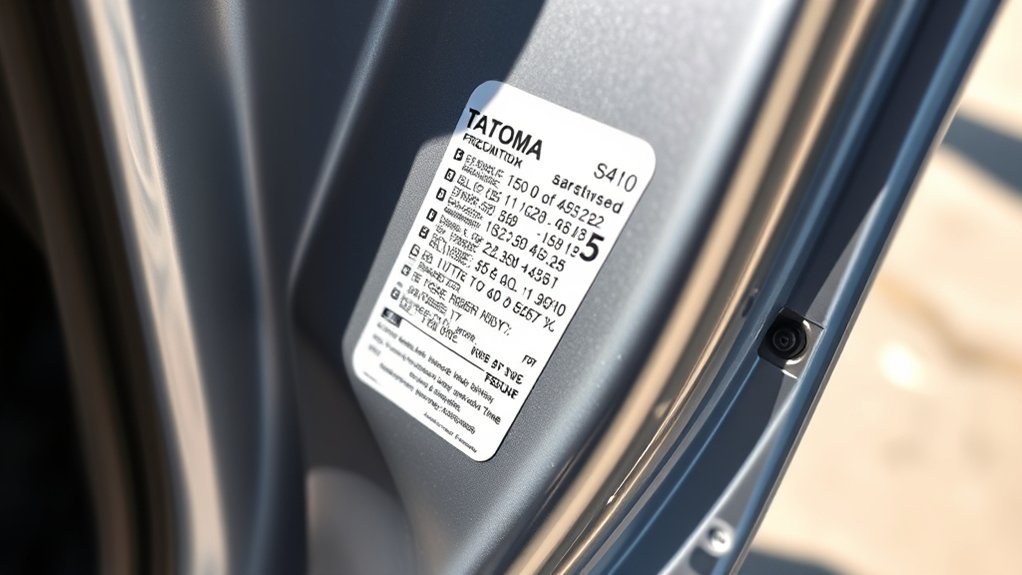
The correct Toyota Tacoma tire pressure is the recommended cold inflation pressure shown on your truck’s tire-and-loading label, usually on the driver-side door jamb. Do not use a generic Tacoma PSI or the maximum pressure molded into the tire sidewall as your everyday target. Tacoma specifications vary by model year, tire size, trim, and factory configuration, so check your own label first and verify it against the owner’s manual when needed.
Quick Answer
Set your Toyota Tacoma’s tires to the cold PSI printed on the driver-side tire-and-loading label. Some factory Tacoma configurations use pressures in the 30–35 PSI range, but there is no single PSI for every Tacoma. The tire sidewall shows a tire limit, not your truck’s normal inflation target.
Key Takeaways
- Use the Tacoma’s door-jamb cold-pressure specification, not a generic online PSI.
- Check pressure before driving or after the truck has been parked long enough for the tires to cool.
- Do not bleed air from a properly inflated tire simply because its pressure rises while driving.
- Cold weather may lower the measured PSI, but your target remains the manufacturer-specified cold pressure unless Toyota gives a different instruction.
- Towing, aftermarket LT tires, wheel changes, and off-road airing down require configuration-specific guidance rather than a universal PSI adjustment.
At a Glance
| Time Required | About 5–10 minutes for all four road tires |
| Difficulty | Easy |
| Tools Needed | Accurate tire-pressure gauge and compressed-air source |
| Cost | Usually free if you already own a gauge and have access to an air pump |
What Tire Pressure Should You Use on a Toyota Tacoma?

Your Tacoma does not have one universal tire pressure that applies to every model year, trim, wheel, and tire combination. The correct everyday starting point is the recommended cold tire inflation pressure printed on your truck’s tire-and-loading label.
As a real manufacturer example, Toyota lists several different cold pressures for factory-equipped 2024 Tacoma tire configurations. Depending on the original tire size and configuration, Toyota specifies 30, 32, or 35 PSI for the road tires. This is why a generic statement such as “every Tacoma should run 32 PSI” is unreliable.
| 2024 Tacoma OE Tire Example | Toyota Recommended Cold Pressure |
|---|---|
| 245/70R17 | 35 PSI on listed factory configurations |
| 265/70R17 | 30 PSI on listed factory configurations |
| 265/65R18 | 32 PSI on listed factory configurations |
Those figures are examples, not replacements for your own label. Model-year specifications can change, and Toyota publishes separate owner information for each Tacoma year. Always use the specification that matches your truck.
Note: The spare may have a different required pressure from the four road tires. Some compact or temporary spares operate at substantially higher pressure, so check the spare specification separately instead of assuming it matches the other tires.
Where to Find Your Tacoma Tire Placard and What Each Line Means
Open the driver’s door and look on the door edge or door-jamb area for the Tire and Loading Information label. This is the first place to check before adjusting pressure.
| Label Information | What It Tells You | Why It Matters |
|---|---|---|
| Front tire size and cold PSI | Factory-designated front tire size and recommended cold pressure | Provides the normal inflation target for the front tires |
| Rear tire size and cold PSI | Factory-designated rear tire size and recommended cold pressure | Provides the normal inflation target for the rear tires |
| Spare information, when listed | Spare tire size and/or pressure | Prevents assuming the spare uses the same pressure as the road tires |
| Seating capacity | Number of designated seating positions | Part of the truck’s loading information |
| Combined occupants and cargo limit | Maximum combined weight stated on the label | Helps prevent overloading the vehicle |
Do not treat the label as a list of every aftermarket or alternate tire size that can fit the Tacoma. If your truck has wheels or tires that differ materially from the original specification, additional load-capacity and inflation evaluation may be necessary.
Cold PSI vs. Tire Sidewall PSI: Which Number Matters?
For normal road use, follow the Tacoma’s recommended cold inflation pressure. The number molded onto the tire sidewall serves a different purpose. It relates to that tire’s own load and inflation limits and is not automatically the pressure Toyota wants in that tire when installed on your truck.
- Use the vehicle’s recommended cold PSI as the normal road-pressure target.
- Do not inflate a tire to its sidewall maximum simply because that number is higher.
- Check pressure when the tires are cold whenever possible.
- Do not release air from a hot tire merely because pressure rose during driving.
- Never exceed the limits specified for the tire, wheel, or vehicle.
Warning: Incorrect tire pressure can affect handling, braking, tire temperature, tread wear, and tire durability. If a tire is repeatedly losing pressure, inspect it for a puncture, valve leak, wheel damage, or another fault instead of repeatedly topping it off without finding the cause.
Why a New or Serviced Tacoma May Show the Wrong Pressure

A Tacoma can occasionally leave a dealer, tire shop, or service visit with pressures that do not exactly match the vehicle label. Do not assume a pressure is correct simply because someone else recently handled the tires.
When the tires are cold, check all four road tires with your own reliable gauge and compare the readings with the driver-side label. Correct any mismatch to the manufacturer-specified value unless Toyota provides a different instruction for your particular configuration or operating condition.
This is especially worth doing after buying a truck, installing tires, rotating tires, repairing a puncture, changing wheels, or seeing a tire-pressure warning.
How to Set and Check Your Tacoma’s Tire Pressure
Checking tire pressure is simple, but timing matters. A tire heats up while driving, which normally raises its pressure. For the most useful comparison with the door-jamb specification, measure the tires cold.
When to Check
Check your Tacoma’s tire pressure at least monthly, before long trips, after major temperature changes, and any time a tire looks low or the TPMS warning appears. A cold reading generally means the truck has been parked for about three hours and has not recently been driven enough to warm the tires significantly.
- Check all four road tires when cold.
- Check the spare according to its own specification.
- Compare each reading with the driver-side label.
- Add air if a cold tire is below its specified pressure.
- Release a small amount of air if a cold tire is genuinely above the specified pressure.
- Replace each valve cap after checking.
Pro Tip: Keep a tire gauge in the Tacoma. Comparing readings with the same known-good gauge makes it easier to notice a slow leak or an unusual change in one tire.
Tools You Need
You need an accurate tire-pressure gauge and a compressed-air source. A digital, dial, or quality stick gauge can work if it is accurate and in good condition. A portable 12-volt or battery-powered inflator is useful when you travel away from service stations.
Keep the door-label pressure in mind while working, but do not confuse it with the maximum pressure or load information molded into the tire sidewall.
Seasonal Pressure Adjustments
Outside temperature affects measured tire pressure. A common rule of thumb is that pressure changes by roughly 1 PSI for each 10°F temperature change. That does not mean you should adopt a special universal winter PSI or summer PSI.
Instead, check the tires cold after the ambient temperature changes and restore them to the same manufacturer-specified cold target. For example, a properly set tire can read several PSI lower after a major cold snap. Add enough air to return it to the placard pressure.
Likewise, tire pressure naturally rises after driving because the tire warms. If the pressure was correct when cold, do not bleed air merely to make a hot tire match the cold specification.
The target does not automatically change with the season; the tire’s measured pressure changes with temperature, so you recheck and restore the correct cold specification.
Towing, Heavy Loads, Off-Road Use, and Different Tires
Towing and tire modifications are where generic PSI advice becomes especially risky. Do not automatically add 3–5 PSI simply because you connected a trailer. Check the Tacoma’s owner information and loading label, stay within the truck’s payload and towing limits, and follow any configuration-specific inflation instructions Toyota provides.
If you install a different tire size, move from a P-metric tire to an LT tire, change load range, or substantially alter the wheel-and-tire setup, the original door-label number may no longer tell the whole story. The replacement tire still must provide adequate load-carrying capacity at the pressure being used. Consult the tire manufacturer’s approved load-and-inflation information or a qualified tire professional when the replacement specification differs from the original setup.
Off-road drivers sometimes reduce tire pressure temporarily to improve tire conformity and traction on certain terrain. However, there is no single safe “Tacoma off-road PSI.” Suitable pressure depends on the tire, wheel, vehicle load, terrain, speed, and how far the tire can safely be aired down without excessive sidewall flex, heat, wheel impact, or bead separation.
Warning: If you air down for off-road use, keep speed appropriate for the reduced pressure and reinflate the tires to the correct road-use pressure before returning to normal highway driving. Do not exceed the tire, wheel, axle, payload, or vehicle limits.
Frequently Asked Questions
How do I read the tire-pressure door sticker on a Toyota Tacoma?
Find the Tire and Loading Information label on the driver-side door jamb. Identify the listed front and rear tire sizes and their recommended cold inflation pressures. Also note the seating capacity and combined occupant-and-cargo limit. If a spare specification is shown, check it separately.
What information is found on the tire placard?
The label normally identifies the vehicle manufacturer’s designated tire size, recommended cold inflation pressure, seating capacity, and the combined occupant-and-cargo weight limit. It should not be treated as a list of every alternate aftermarket tire that can fit the truck.
Do I use the door-jamb PSI if my Tacoma has aftermarket tires?
If the replacement tires match the original size, type, and load capability, the vehicle specification remains the normal starting point. If you changed tire size, construction, load range, or wheel setup, have the required load-carrying pressure verified using the replacement tire manufacturer’s data rather than blindly copying either the door label or sidewall maximum.
What does the tire-pressure symbol mean on a Toyota Tacoma?
The tire-pressure warning symbol is part of the Tacoma’s TPMS. A steady warning commonly means one or more monitored tires need attention. On referenced Tacoma guidance, a warning light that flashes for about one minute and then remains on can indicate a TPMS malfunction. Check tire pressure with a gauge and consult the owner’s manual if the warning does not clear.
Should I use a different Tacoma tire pressure in winter?
Do not automatically switch to a generic winter PSI. Cold weather lowers the measured pressure, so check the tires when cold and add air as needed to restore the manufacturer-specified cold pressure on your Tacoma’s label.
Why does my Tacoma tire pressure rise after I drive?
Driving flexes and warms the tires, which raises internal air pressure. This is normal. If the tires were correctly inflated when cold, do not release air just because the hot reading is higher. Check them again after they cool if you need to verify the baseline.
Conclusion
Your Tacoma’s driver-side tire-and-loading label is the starting point for correct tire pressure. Use its cold PSI specification instead of the maximum number molded into the tire sidewall or a generic number found online. Check the tires regularly, account for temperature by restoring the correct cold pressure rather than inventing seasonal targets, and verify the spare separately.
For towing, different-size tires, LT conversions, or off-road airing down, avoid universal PSI formulas. Use Toyota’s model-specific guidance and the replacement tire manufacturer’s load information so the tire remains appropriate for the load and driving conditions.
Sources
- Toyota 2024 Tacoma Owner’s Manual — Maintenance Data — factory tire sizes, recommended cold pressures, spare pressures, and vehicle specifications.
- National Highway Traffic Safety Administration — TireWise — cold-pressure checks, vehicle placards, inflation safety, and tire maintenance.
- Toyota 2024 Tacoma Quick Reference Guide — TPMS operation and direction to use the door-jamb load label or owner’s manual for inflation specifications.
- Bridgestone Tire Maintenance and Safety Manual — temperature-related pressure changes, regular pressure checks, and vehicle-label guidance.
