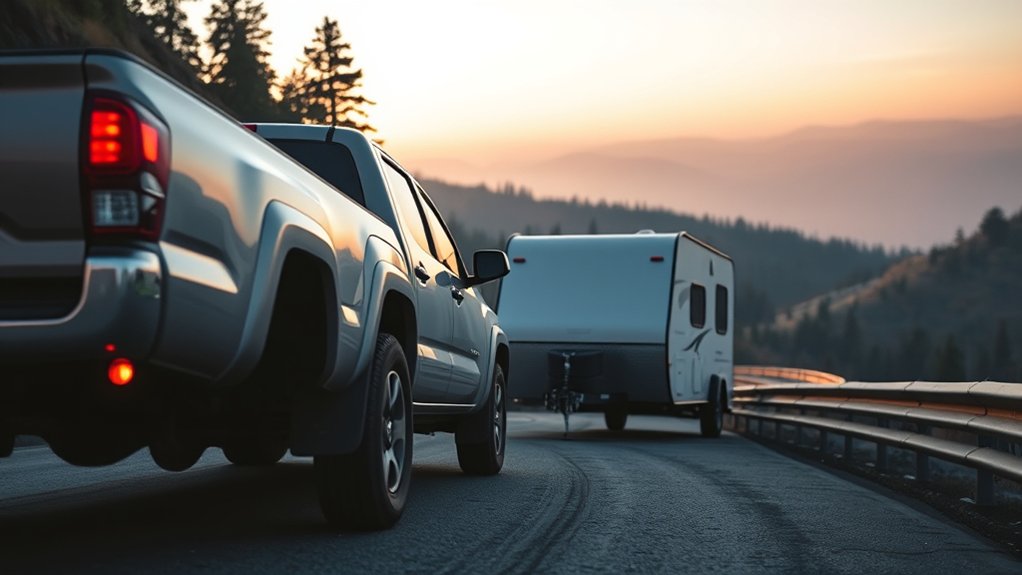
Toyota Tacoma engine braking while towing works best when you slow before the downhill grade, select a lower transmission range before speed builds, and use the truck and trailer brakes only as much as needed to hold a controlled speed. Do not treat Tow/Haul, S mode, or engine braking as a replacement for service brakes. The exact controls and limits vary by Tacoma generation, transmission, powertrain, and trailer setup.
Last updated: September 19, 2026 — checked against current Toyota Tacoma towing information, Toyota owner documentation, and published towing tests.
Verification note: This guide synthesizes manufacturer instructions and published road-test observations. It does not claim that every Tacoma, trailer, grade, or brake-controller combination was independently road-tested.
Quick Answer
Before a steep descent, slow your Tacoma while the truck and trailer are straight, then select a lower transmission range that adds engine braking without forcing excessive RPM. On 2024-and-newer Tacomas, Toyota’s quick-reference guidance confirms that downshifting increases engine braking downhill, while Tow/Haul changes powertrain behavior for towing when equipped. Use the service brakes and properly adjusted trailer brakes as needed, and follow the owner’s manual for your exact truck.
Key Takeaways
- Choose a safe speed and lower transmission range before the downhill grade begins.
- Use Tow/Haul only when equipped; older Tacomas may use different controls such as S mode and ECT PWR.
- Engine braking reduces continuous demand on the friction brakes, but it does not replace them.
- Confirm that the trailer brakes and brake controller work before entering mountain terrain.
- Never force a downshift that causes abrupt wheel deceleration or pushes the engine beyond its safe operating range.
At a Glance
| Time Required | About 10–15 minutes for a pre-descent inspection, plus continuous attention while driving |
| Difficulty | Moderate; mountain towing requires planning and experience |
| Tools Needed | Model-specific owner’s manual, tire-pressure gauge, wheel chocks, torque wrench, and trailer-brake controller when required |
| Cost | No added cost for the driving technique; inspection, repair, or brake-controller costs vary |
Warning: Mountain towing can cause brake fade, engine over-revving, trailer sway, or loss of control. Never exceed the lowest rated limit among the truck, hitch, ball mount, coupler, tires, trailer, and related equipment. Stop in a safe location if you smell overheated brakes, lose braking force, see a warning light, or cannot hold a controlled speed.
Understanding Engine Braking in the Toyota Tacoma
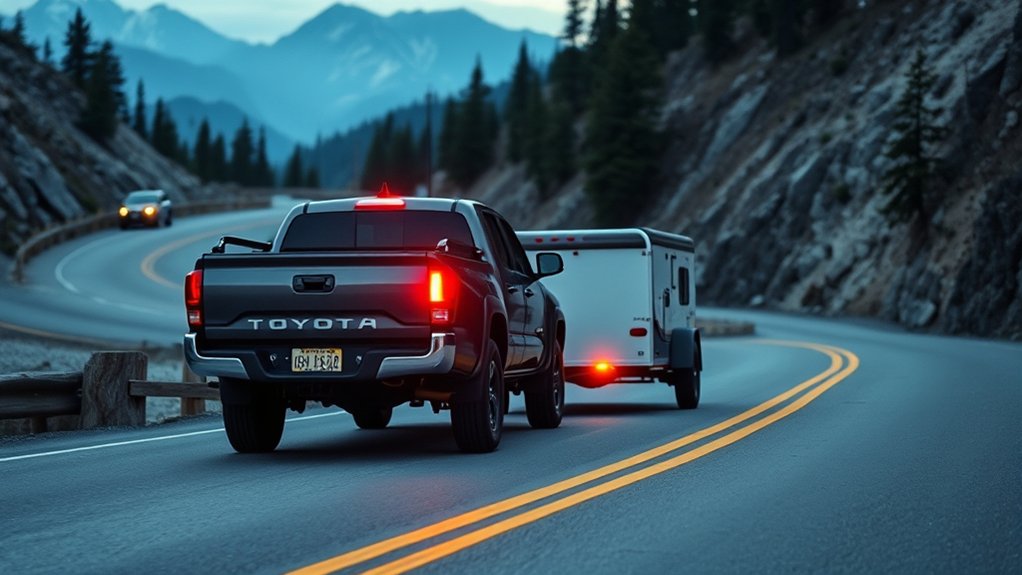
Engine braking occurs when you release the accelerator while the drivetrain remains engaged. The engine and transmission resist the vehicle’s motion, helping slow the truck without converting all of its downhill energy into heat at the wheel brakes.
In a gasoline Tacoma, the closed or partly closed throttle and internal engine resistance create much of this braking effect. The engine-control system may also reduce fuel delivery during deceleration when operating conditions allow. A locked torque converter can help transfer the engine’s resistance through an automatic transmission, but the torque converter does not control the fuel injectors.
A lower transmission range usually produces stronger engine braking because the engine turns faster for a given road speed. Higher engine speed during a controlled descent can be normal, provided the tachometer stays below the red zone and the transmission accepts the selected range without a harsh shift.
On Tacoma i-FORCE MAX hybrid models, braking can include regenerative braking from the motor-generator in addition to the service brakes and powertrain braking. The balance changes with operating conditions, so use the instructions in the Toyota owner’s manual for your exact vehicle.
Note: Increased engine sound or higher RPM during a downhill descent does not automatically mean something is wrong. The important limits are the tachometer’s red zone, warning lights, unusual noises, harsh shifting, and the instructions in your model-specific manual.
Which Tacoma Controls Should You Use by Model Year?
The label on the button matters less than the function it provides. Toyota has changed Tacoma transmissions and towing controls across generations, so do not copy a gear number or mode from a different model year without checking your manual.
| Tacoma setup | Control to start with | What to know |
|---|---|---|
| 2024–2026 automatic or hybrid | S mode/lower range; Tow/Haul when equipped | Toyota states that downshifting adds engine braking downhill and that Tow/Haul changes engine, transmission, and steering behavior for trailer use. Hybrid models can also use regenerative braking. |
| 2016–2023 automatic | S mode/lower range; ECT PWR when equipped | Toyota’s towing guidance for this generation emphasizes slowing and downshifting before long grades. ECT PWR can change shift response, but it is not a substitute for selecting a suitable lower range. See when to use Tacoma ECT PWR mode. |
| Manual-transmission Tacoma | A lower gear selected before the descent | Keep the clutch fully engaged once the gear is selected. Do not coast in neutral or force a downshift that would over-rev the engine. |
What Published Tacoma Towing Tests Show
Real-world tests reinforce why one universal gear recommendation does not work. In a 2023 Tacoma TRD Pro towing test, Cars.com reported little noticeable engine braking until a lower gear was selected manually. In a separate 2024 Tacoma Limited towing test, the publication again found limited engine-braking effect from the turbo powertrain but praised the factory trailer-brake controller’s contribution. By contrast, Edmunds observed its 2024 Tacoma Tow/Haul mode proactively downshifting on long, steep descents. These tests used different trucks and trailers, so treat them as examples of configuration-dependent behavior rather than universal results.
Check Your Tacoma and Trailer Before the Descent
A safe descent begins with a properly matched and maintained towing combination. Do not rely on a lineup maximum alone. Your usable limit may be lower after passengers, cargo, accessories, hitch equipment, and tongue weight consume payload. For the calculations behind those limits, see Toyota Tacoma towing capacity explained and Toyota Tacoma payload rating explained.
For the 2026 Tacoma, Toyota lists maximum towing capacity of up to 6,500 pounds and maximum payload of up to 1,705 pounds, but those figures apply only to qualifying configurations. Toyota also lists available towing technology such as an integrated trailer-brake controller and Trailer Back Up Guide with Straight Path Assist. Review the current Toyota towing information, the certification and loading labels on your truck, and the owner’s manual before towing.
Complete This Pre-Descent Checklist
- Confirm all ratings: Check the truck’s towing capacity, payload capacity, gross axle weight ratings, gross vehicle weight rating, and gross combined weight rating.
- Know the loaded trailer weight: Include water, fuel, batteries, propane, tools, food, cargo, and installed accessories.
- Check tongue weight: Keep it within the limits specified by the truck, hitch, and trailer manufacturers.
- Inspect the hitch: Confirm the coupler is latched, the hitch pin is secured, safety chains are crossed and attached, and the breakaway cable is connected independently.
- Test the lights: Check the brake lights, turn signals, running lights, and hazard lights.
- Test the trailer brakes: Use the controller’s manual control at low speed in a safe area to confirm the trailer brakes respond smoothly.
- Inspect tires: Check pressure when cold and look for damage, uneven wear, exposed cords, cracks, or insufficient tread.
- Check the truck’s brakes and fluids: Do not begin a mountain route with a soft pedal, grinding noise, fluid leak, overdue brake service, or an active warning light.
Use a weight-distribution hitch only when it is approved or required by Toyota, the receiver manufacturer, and the hitch and trailer makers. A universal trailer-weight threshold does not apply to every Tacoma and hitch combination.
How to Use Toyota Tacoma Engine Braking on a Steep Descent
The safest time to establish your speed and transmission range is before gravity begins accelerating the truck and trailer. Waiting until the rig is already moving too fast increases brake heat and may force a harsh downshift.
- Review the grade: Watch for warning signs showing the slope, length, curves, truck speed limits, and runaway-ramp locations.
- Slow before the crest: Enter the descent at a conservative speed that leaves room for curves, traffic, wind, and changing road conditions.
- Select a lower range: Use the sequential range, S mode, manual gear, or other transmission setting described in your owner’s manual.
- Use Tow/Haul if equipped: Activate it according to the manual. Do not assume every Tacoma has the same mode or shift strategy.
- Let the drivetrain hold speed: Release the accelerator and evaluate whether the selected range prevents rapid acceleration.
- Apply the brakes when needed: Reduce speed before it climbs beyond your planned limit, then ease off when safe so the brakes can release heat.
- Reassess continuously: Watch the tachometer, speedometer, mirrors, trailer movement, warning lights, and traffic conditions.
Choose the gear and entry speed before the descent. A lower gear cannot recover the safety margin already lost by entering a grade too fast.
Pro Tip: Note the gear or transmission range your Tacoma needs to climb a mountain grade. A similar or lower range may provide a useful starting point for the descent, but road conditions, curves, load, and model-specific instructions still take priority.
Know When to Downshift While Towing
Downshift before the Tacoma begins gaining speed quickly. Do not wait until you are braking hard in the middle of a curve. Slow the rig first, keep it straight, and request a lower range that the transmission can engage without exceeding safe engine speed.
Automatic Tacoma transmissions may delay or reject a requested range if the road speed is too high. That protection does not make every downshift safe. A sudden reduction in gear range can still upset the truck and trailer, especially on wet, icy, sandy, or gravel-covered pavement.
| Condition | Recommended Action | Reason |
|---|---|---|
| Approaching a steep descent | Slow before the crest and select a lower range | Prevents early speed buildup and excessive brake heat |
| Engine braking is too weak | Brake to a safe speed, then request one lower range if permitted | Adds control without forcing an unsafe high-speed downshift |
| RPM approaches the red zone | Brake to reduce speed or select a higher range as conditions allow | Protects the engine and transmission from excessive speed |
| Wet, icy, or loose surface | Use smaller, smoother speed changes and avoid abrupt downshifts | Reduces the chance of drive-wheel slip or trailer instability |
| Long grade with rising brake heat | Reduce speed, use a lower range, and stop at a safe turnout if needed | Allows the braking system to cool before fade develops |
Automatic Transmission
Use the transmission’s selectable range or manual-shift function exactly as described in the owner’s manual. On modern Tacoma S-mode systems, the selected number limits the upper shift range rather than guaranteeing that the transmission will remain in one fixed gear. Selecting a lower range generally increases engine braking, while the transmission can still protect itself from an unsuitable downshift.
Tow/Haul, when equipped, changes powertrain behavior for trailer use; Toyota’s fourth-generation quick-reference guide also notes steering changes. It does not increase the truck’s tow rating or remove the need to choose a safe entry speed, monitor brake performance, and select a suitable range.
Manual Transmission
Select the lower gear before the descent begins. Release the clutch smoothly and avoid riding the clutch pedal. Do not coast downhill in neutral or hold the clutch disengaged, because doing so removes engine braking and reduces your ability to accelerate away from a hazard.
Do not force a gear that would over-rev the engine. If the required downshift cannot be completed smoothly, reduce road speed first with the brakes.
Combining Engine Braking With Brake Use
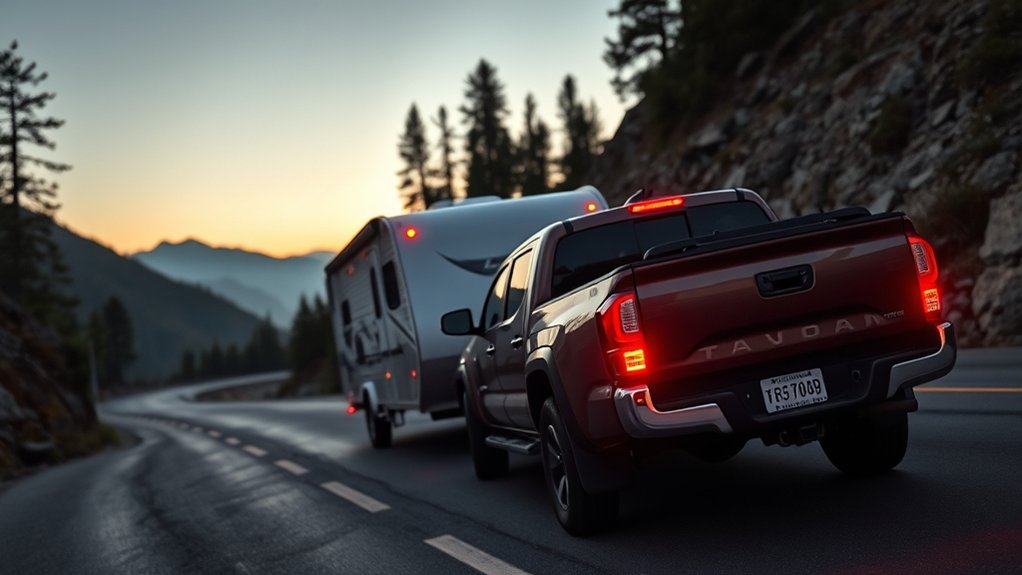
Engine braking and service brakes perform different jobs. Engine braking helps resist continuous acceleration, while the friction brakes provide stronger deceleration and precise speed adjustment. You normally need both on a long or steep descent.
- Establish a conservative target speed: Account for the trailer, grade, curves, visibility, weather, and posted limits.
- Use engine braking continuously: Keep the drivetrain engaged in a suitable lower range.
- Use the service brakes to trim speed: Apply enough pressure to reduce speed before it becomes excessive.
- Avoid riding the brakes: Continuous light pressure can keep adding heat without giving the brakes time to cool.
- Keep the rig straight during stronger braking: Complete most braking before a sharp curve whenever possible.
- Maintain extra following distance: The loaded combination needs more room to slow and stop.
Do not pump an anti-lock braking system during an emergency stop. Press the brake pedal firmly and let the system manage wheel lockup. Normal downhill speed control is different from emergency braking, so your inputs should remain planned and smooth.
Use the Trailer Brakes Correctly
A properly adjusted trailer-brake controller helps the trailer contribute to stopping rather than pushing the Tacoma downhill. Too little trailer braking can overload the truck’s brakes. Too much can lock the trailer wheels or make the trailer unstable.
Test controller response at low speed on level pavement before entering the mountains. Adjust it for the trailer’s current loaded weight and road conditions. Do not use the controller’s manual lever as the main method for controlling a normal descent. Follow the controller and trailer manufacturers’ instructions.
Recognize Brake Fade and Overheating
Brake fade occurs when heat reduces the friction brakes’ ability to slow the vehicle. A heavily loaded truck and trailer can generate heat quickly on a long grade, especially when the driver maintains continuous pedal pressure.
Warning signs may include:
- A hot or burning odor
- Smoke near a wheel
- A pedal that feels different, soft, or unusually firm
- Longer stopping distance
- The need for more pedal pressure
- Pulling, vibration, or grinding
- A brake, ABS, transmission, or temperature warning
Warning: If braking performance decreases, do not continue downhill hoping the brakes will recover. Reduce speed using the available engine braking, activate hazard lights when appropriate, and use a safe turnout or runaway-truck ramp. Never enter opposing traffic or stop in an active travel lane unless no safer option exists.
After stopping safely, keep clear of traffic and allow hot brakes to cool before continuing. Do not touch the wheels, rotors, drums, or calipers to judge temperature. Arrange an inspection if braking changed, smoke appeared, one wheel seems abnormally hot, or a warning remains active.
Towing on Wet, Icy, or Loose Mountain Roads
Engine braking acts through the driven wheels. An aggressive downshift on a slippery surface can reduce traction just as an abrupt brake application can. Use gradual speed changes, increase following distance, and enter curves more slowly than you would on dry pavement.
Avoid abrupt steering, throttle, braking, and gear changes. If the trailer begins to sway, hold the steering wheel steady, ease off the accelerator, and avoid sudden truck braking. Apply the trailer brakes manually only when the controller and trailer manufacturer recommend that response and conditions allow it.
Downhill Assist Control, when equipped, is a low-speed descent aid with model-specific operating limits. It is not a substitute for proper gear selection, trailer brakes, or normal highway towing technique. Review the owner’s manual before using DAC with a trailer or on a steep surface.
Top Mistakes to Avoid When Towing in Mountainous Terrain
- Entering the descent too fast: Slow before the crest instead of trying to recover midway down the grade.
- Waiting too long to downshift: Select the lower range while the truck is slow and stable.
- Forcing first or second gear at high speed: Let the transmission accept an appropriate range without over-revving the engine.
- Riding the brake pedal: Continuous light pressure can build heat throughout the descent.
- Assuming every Tacoma has Tow/Haul: Check your model-specific controls and manual.
- Relying on cruise control during a demanding descent: Driver-assistance rules vary by model year. Take direct control when the grade requires frequent speed or gear changes, and follow the owner’s manual.
- Ignoring trailer-brake setup: Test and adjust the controller before the grade.
- Exceeding payload while staying below trailer capacity: Tongue weight, passengers, cargo, and accessories all consume payload.
- Following a universal hitch rule: Use only equipment approved for the exact truck, receiver, trailer, and load.
- Continuing after warning signs: Stop safely when you notice brake odor, smoke, reduced braking, unusual shifting, or warning lights.
Toyota specifically provides lower transmission ranges for added engine braking, so using them within the owner’s-manual limits is normal operation. The avoidable risks are forcing an unsuitable downshift, exceeding safe engine speed, riding or slipping the clutch, ignoring transmission-temperature warnings, or operating outside the truck’s load limits.
Inspect the Rig After a Long Descent
Use a safe turnout after a demanding grade and walk around the truck and trailer. Look for smoke, leaks, loose cargo, damaged tires, shifted hitch components, dragging safety chains, hot electrical connectors, or an unusual wheel position.
Do not touch a wheel to test its temperature. Compare heat cautiously by standing near each wheel without contacting it. A strong odor or one wheel that radiates far more heat than the others may indicate a dragging brake, failed bearing, or uneven controller adjustment.
Recheck the hitch, coupler, breakaway cable, safety chains, wiring connector, and cargo restraints before continuing.
Frequently Asked Questions
What gear should I use when towing downhill in a Toyota Tacoma?
Use a lower transmission range that helps hold a controlled speed without forcing an abrupt shift or excessive engine RPM. There is no universal “third gear” or “second gear” answer for every Tacoma. Slow before the descent, request the lower range while the rig is stable, and follow the model-year owner’s manual.
Should I use S mode or Tow/Haul when towing downhill?
They do different jobs. S mode lets you limit the transmission’s upper shift range so you can increase engine braking. Tow/Haul, when equipped, changes vehicle control strategy for towing. On a long descent you may still need to select a lower S range even with Tow/Haul active. Follow the instructions for your exact Tacoma.
Is engine braking bad for a Tacoma automatic transmission?
Using the selectable lower ranges for engine braking within Toyota’s operating limits is normal transmission use. Do not force a downshift at excessive road speed, ignore a transmission-temperature warning, or continue if the truck shifts harshly or shows a warning message.
Can I rely only on engine braking during a mountain descent?
No. Engine braking reduces continuous demand on the friction brakes, but the truck’s service brakes and properly adjusted trailer brakes are still needed to control speed, respond to traffic, and slow for curves or emergencies.
Should I use cruise control while towing downhill?
Do not assume one rule applies to every Tacoma generation. Driver-assistance availability and towing restrictions vary by model year and equipment. On a demanding grade that requires frequent speed or gear changes, direct manual control is the safer default; follow the towing and cruise-control instructions in your exact owner’s manual.
What should I do if I smell hot brakes while towing downhill?
Treat a strong hot-brake odor, smoke, changing pedal feel, or reduced braking as a warning. Reduce speed with the available engine braking, move to a safe turnout or escape ramp if necessary, and stop. Let the brakes cool before continuing and arrange an inspection if braking performance changed or a warning remains active.
Conclusion
Safe mountain towing in a Toyota Tacoma depends on preparation, not one button or one universal gear number. Verify the loaded combination, inspect the hitch and brakes, slow before the crest, and select an appropriate lower transmission range. Use engine braking to resist acceleration, then use the truck and trailer brakes as needed to maintain a controlled speed.
Controls, ratings, and braking systems vary across Tacoma generations. Always give the instructions for your exact model year priority over general advice. Stop immediately when you notice brake fade, smoke, warning lights, unusual shifting, or an inability to hold speed.
Sources
- Toyota Manuals and Warranties — model-specific towing, transmission, braking, warning, and control instructions
- Toyota Vehicles for Towing — current 2026 Tacoma towing-capacity and towing-technology information
- Toyota 2024 Tacoma / Tacoma Hybrid Quick Reference Guide — S mode, engine braking, ECT PWR, hybrid braking, and Tow/Haul operation
- Cars.com: Towing With the 2023 Toyota Tacoma TRD Pro — observed downhill braking behavior in a third-generation towing test
- Edmunds 2024 Tacoma Long-Term Road Test — observed Tow/Haul behavior during long, steep towing descents
- NHTSA Recall Lookup — VIN-specific safety recall research

