Last updated: September 11, 2026 — charging-system specifications, warning-light guidance, and test steps rechecked.
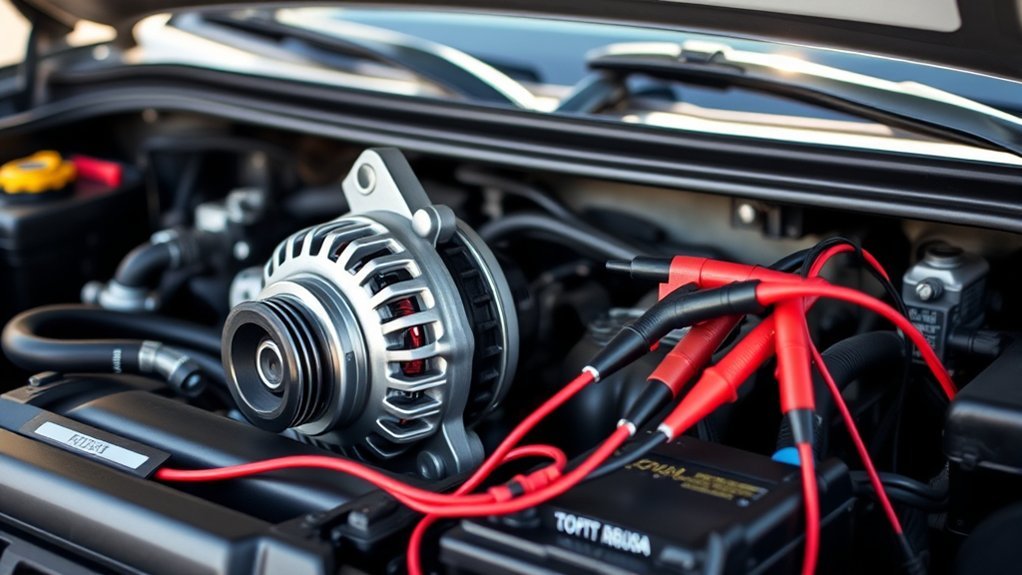
The Toyota Tacoma alternator charging system keeps the 12-volt battery supplied and powers electrical loads while a conventional gasoline Tacoma is running. Do not judge the system by one universal voltage number: Toyota service specifications vary by model year, engine, temperature, load, and charging-control strategy. On many conventional Tacoma systems, Toyota service information specifies about 13.2 to 14.8 volts at 2,000 rpm during a charging-circuit check, but you should verify the exact specification for your truck before condemning the alternator.
If the charging system warning light comes on while driving, treat it as an urgent fault. Toyota’s current owner guidance says to stop in a safe place and contact a Toyota dealer. For basic diagnosis, start with battery condition, terminals, belt condition, wiring, and a model-appropriate voltage test before replacing parts.
Scope: This guide focuses on conventional Tacoma charging systems that use an engine-driven alternator/generator. Tacoma hybrid models use a different electrical architecture, so use the hybrid-specific Toyota manual and service procedure for those trucks.
Understanding the Basics of the Toyota Tacoma Alternator
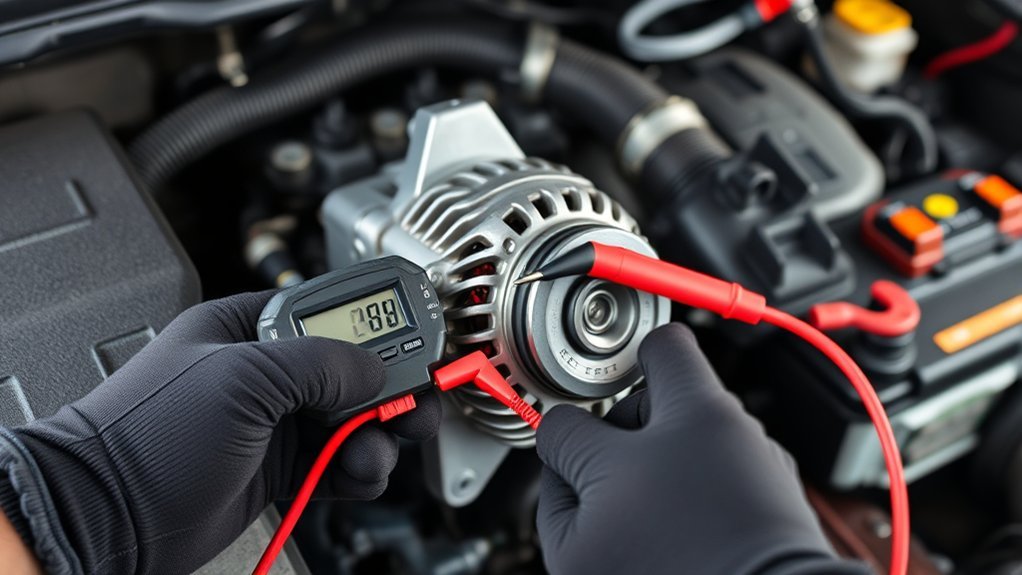
On a conventional gasoline Tacoma, the alternator converts mechanical energy from the engine into electrical energy. The rotor creates a rotating magnetic field, the stator produces alternating current, and rectifier diodes convert that output to direct current for the truck’s 12-volt electrical system and battery.
The regulator and, on some later systems, engine-control communication help control alternator output. That is why a single idle-voltage reading is not enough to diagnose every Tacoma. Battery state of charge, electrical load, engine speed, temperature, wiring resistance, and the truck’s control strategy can all change what you see on a multimeter.
How the Alternator Converts Mechanical Energy to Electrical Energy
The alternator pulley turns the rotor as the engine runs. The rotating magnetic field induces AC voltage in the stator windings. A rectifier bridge changes that AC into DC, which the battery and vehicle electronics can use. The charging-control system then adjusts field current so output matches battery and electrical demand.
For many conventional Tacoma applications, Toyota service procedures check charging voltage at about 2,000 rpm rather than relying only on idle. Service-manual examples for multiple Tacoma generations use a 13.2 to 14.8 volt specification under the stated test conditions. Earlier applications can use slightly different limits, so always confirm the procedure for your exact year and engine.
Essential Components of the Toyota Tacoma Charging System
A charging problem can come from more than the alternator. Check the system as a circuit:
- Alternator/generator assembly: Produces electrical power on conventional gasoline models.
- Rotor, stator, rectifier, and regulator: Create, convert, and control alternator output.
- 12-volt battery: Supplies starting power and stabilizes system voltage.
- Drive belt and tension system: Spins the alternator; a damaged or slipping belt can reduce output.
- Cables, grounds, connectors, fuses, and fusible links: Carry charging current and sensing signals. Corrosion or high resistance can mimic alternator failure.
- Control and communication circuits: Later Tacoma charging systems may use ECM communication, so a wiring or communication fault can affect charging even when the alternator itself is mechanically sound.
Because fuse names, amperage ratings, alternator design, and control logic vary by configuration, use the Toyota manual for your exact truck. For a separate explanation of Tacoma fuse locations and identification, see the Toyota Tacoma fuse box guide.
Recognizing Symptoms of Alternator Failure
Possible charging-system symptoms include a charging warning light, repeated low-battery events, slow cranking after the battery has been charged, electrical accessories acting abnormally, or unusual alternator/belt noise. These symptoms do not prove the alternator is bad. A weak battery, loose terminal, corroded ground, belt problem, blown fuse or fusible link, damaged wiring, or key-off parasitic draw can produce similar complaints.
If the charging system warning light appears while the engine is running, do not keep driving just to see whether the battery lasts. Toyota’s owner guidance treats this as a stop-and-inspect condition because the charging system may no longer support the vehicle.
How to Test Your Alternator Like a Pro?
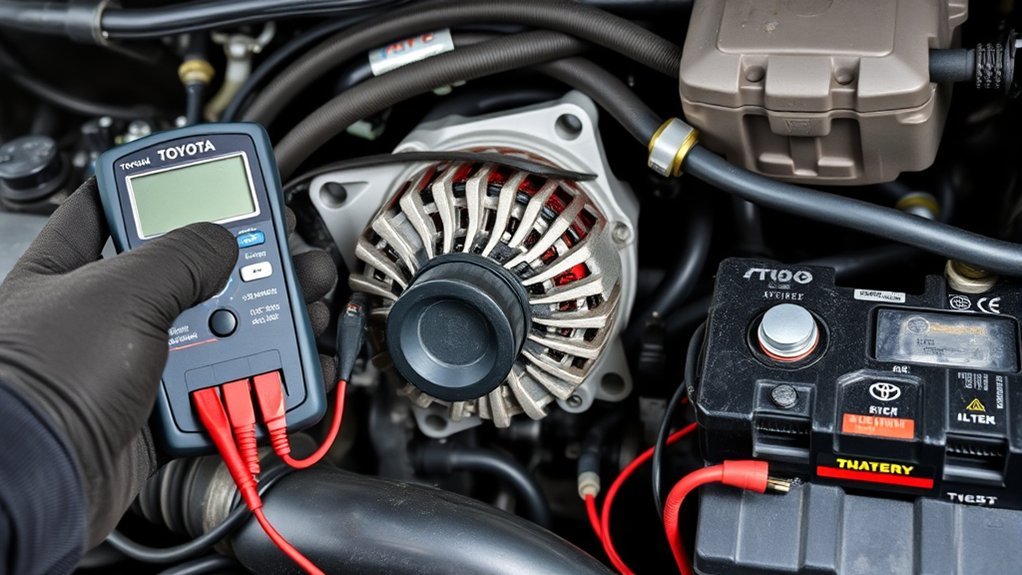
A useful Tacoma charging-system test separates battery condition from charging output. Use a digital multimeter across the battery posts for the basic checks, and verify your model-year procedure before interpreting the result.
- Check the battery first: With the engine off and the battery rested, a fully charged 12-volt lead-acid battery is typically around 12.6 volts. A discharged battery should be charged before alternator testing so it does not distort the result.
- Inspect the mechanical and electrical basics: Check battery terminals, grounds, alternator wiring, the drive belt, and relevant fuses/fusible links before replacing the alternator.
- Measure running voltage: Start the engine and compare the reading with the correct Toyota specification. On many conventional Tacoma service procedures, the charging check is performed around 2,000 rpm and uses a 13.2 to 14.8 volt range.
- Add electrical load: Follow the model-specific procedure. Toyota service examples commonly use high beams and the blower on high at about 2,000 rpm to verify the system under load.
- Check voltage drop if readings are low: Excess resistance in the positive cable or ground path can reduce voltage at the battery even when the alternator can produce power.
- Scan for charging-system faults when applicable: Later systems can involve ECM or communication faults that a simple voltage test will not identify.
Safety: Never use the old “disconnect the battery cable while the engine is running” test. Toyota service information warns against disconnecting the battery while the engine is running. Also avoid working around an exposed alternator B+ terminal unless you understand short-circuit and arc risks.
Measuring Voltage: What to Expect
Voltage is useful only when you know the test condition. Use the table below as a diagnostic framework, then confirm the exact limit in the Toyota service information for your year, engine, and powertrain.
| Test condition | What the reading can tell you | How to interpret it |
|---|---|---|
| Engine off, battery rested | Approximate battery state of charge | Around 12.6 V is typical for a fully charged 12 V lead-acid battery, but voltage alone does not prove battery capacity. |
| Engine running, conventional Tacoma | Whether charging voltage rises above resting battery voltage | Do not use one universal idle number. Compare with the Toyota procedure for the truck. |
| About 2,000 rpm, specified charging check | Regulated charging output | Many conventional Tacoma service procedures specify 13.2–14.8 V; exact limits and conditions vary by application. |
| Electrical load applied | Whether the system can support demand | A falling reading that approaches battery-only voltage requires further diagnosis of the alternator, belt, cables, grounds, fuses, and control circuit. |
| Battery carbon-pile load test | Battery cranking capacity, not alternator output | A common battery test applies one-half the battery’s CCA for 15 seconds and uses a temperature-adjusted minimum voltage; at about 70°F, 9.6 V is a common pass threshold. |
The important distinction is that a battery load test is not an alternator load test. Applying half the battery’s CCA for 15 seconds evaluates the battery’s ability to maintain voltage under heavy load. Alternator capacity is checked with the engine running and the charging system loaded according to the vehicle-specific service procedure.
Common Issues Affecting Charging System Performance

The fastest way to avoid an unnecessary alternator replacement is to separate battery, connection, belt, and control problems from a true generator failure. A charging fault can be caused by one problem or several small voltage losses added together.
Battery Health and Maintenance
A weak or discharged battery can pull charging voltage down and make an otherwise functional alternator look bad. Check battery state of charge before running charging-system tests. Clean and tighten terminals, inspect the case and cables, and test battery capacity if the truck has repeated starting problems.
For a traditional carbon-pile battery load test, the load is commonly set to one-half of the battery’s CCA rating for 15 seconds. At about 70°F, the battery should generally remain at or above 9.6 volts; colder temperatures require an adjusted threshold. This test evaluates the battery, not the alternator.
Voltage Regulation Failures
Charging voltage that is persistently outside the correct specification can point toward the alternator/regulator, sensing circuit, wiring, ground path, or charging-control communication. On later Tacoma systems, do not assume the internal regulator is the only control element. Toyota service information for some applications includes ECM-to-generator communication checks.
Also avoid diagnosing a rectifier from a single AC-voltage number unless the meter and service procedure support that test. If you suspect failed diodes because of abnormal noise, unstable charging, or excessive ripple, confirm with the correct service procedure or an oscilloscope before replacing the alternator.
Maintaining Your Alternator and Battery: What You Need to Know
Charging-system maintenance is mostly inspection and early diagnosis rather than routine alternator replacement. Use these checks:
- Keep battery terminals and primary grounds clean, tight, and free of corrosion.
- Inspect the drive belt and tension system for cracking, glazing, contamination, looseness, or abnormal noise.
- Check charging voltage when you notice slow cranking, repeated battery discharge, or a charging-system warning.
- Test the battery separately before blaming the alternator.
- Inspect charging cables, connectors, fuses, and fusible links if voltage is low or intermittent.
- Use the exact Toyota manual for model-specific voltage, amperage, fuse, and diagnostic-code information.
How to Troubleshoot Common Alternator Issues?
Use this order so each test rules out a common cause before you replace the alternator:
- Confirm the complaint. Note whether the charging warning light is on, the battery repeatedly goes flat, cranking is slow, or accessories behave abnormally.
- Identify the powertrain. Confirm whether the Tacoma uses the conventional charging system covered by this guide or a hybrid system that requires a different procedure.
- Check battery state of charge. Recharge a low battery before drawing conclusions from running voltage.
- Inspect terminals, grounds, belt, wiring, fuses, and fusible links. Repair obvious connection or drive problems first.
- Measure charging voltage under the Toyota-specified conditions. For many conventional Tacoma applications, that includes about 2,000 rpm and a specified electrical load.
- Perform voltage-drop testing if output is low at the battery. This can reveal resistance in the charge cable or ground path.
- Scan for trouble codes or communication faults when applicable. Later charging systems can require scan-tool diagnosis.
- Replace the alternator only after the fault is isolated. If testing confirms the generator assembly is faulty, see the Toyota Tacoma alternator replacement overview for the next step.
When to Seek Professional Help for Alternator Problems?
Seek professional help when the warning light stays on while driving, the belt is damaged, you smell burning, charging voltage is clearly outside the correct specification after the battery is charged, or you need high-current alternator output tests. Hybrid-system warnings and high-voltage components also require hybrid-specific procedures and training.
Signs Of Alternator Failure
Evidence that points more strongly toward alternator or charging-circuit failure includes charging voltage that does not meet the correct model-specific test specification, output that collapses under electrical load, abnormal generator noise, a confirmed rectifier fault, or charging-system diagnostic codes. Even then, inspect the belt, cables, grounds, fuses, and battery before replacing the unit.
Complex Electrical Diagnosis Required
Professional diagnosis becomes valuable when the problem is intermittent or when basic voltage tests are inconclusive. A technician can use a current clamp, voltage-drop tests, a scan tool, and an oscilloscope to separate alternator output problems from cable resistance, battery faults, parasitic drain, regulator control, or communication faults.
If the charging system warning light comes on while the engine is running, Toyota’s current guidance is to stop the vehicle in a safe place and contact a Toyota dealer rather than continue driving on battery power alone.
Warranty And Repair Options
Before paying for a replacement, check the warranty status and service information for your exact VIN and model year. Toyota’s Manuals and Warranties portal provides model-specific owner information. Warranty coverage and repair eligibility depend on the vehicle, in-service date, mileage, part, and applicable terms, so verify coverage rather than assuming the alternator is included.
Sources and Service References
- Toyota Manuals and Warranties — owner-manual and warning-light guidance by model year.
- Toyota Technical Information System (TIS) — official repair procedures and model-specific service specifications.
- DENSO battery, starter, and alternator testing guidance — battery condition and load-test procedure.
Frequently Asked Questions
How to Test if an Alternator Is Charging Properly?
Charge and test the battery first, then measure DC voltage across the battery posts with the engine running under the conditions specified for your Tacoma. Many conventional Tacoma service procedures use about 2,000 rpm and a 13.2–14.8 V specification, but the exact limit depends on the year, engine, and charging strategy. Add the specified electrical load and inspect the belt, wiring, grounds, fuses, and voltage drop if the reading is low.
How Do I Know if My Toyota Alternator Rectifier Is Failing?
A failed rectifier diode can cause unstable charging, abnormal alternator noise, or excessive AC ripple, but symptoms alone are not conclusive. Use the model-appropriate service test or an oscilloscope to confirm a rectifier fault. Do not replace the alternator solely because one generic AC-voltage threshold was exceeded on an unknown meter.
What Does “Check Charging System” Mean in a Toyota Tacoma?
It means the vehicle has detected a charging-system malfunction. Toyota’s owner guidance says that if the charging-system warning appears while the vehicle is running, stop in a safe place and contact a Toyota dealer. The cause can involve the alternator/generator, battery, belt, wiring, grounds, fuses, or charging-control circuit.
How Many Volts Should a Toyota Alternator Put Out?
There is no single voltage that applies to every Tacoma under every condition. Many conventional Tacoma service procedures specify about 13.2–14.8 V at 2,000 rpm during the stated charging-circuit test. Use the Toyota service information for your exact model year, engine, and powertrain before calling a reading normal or faulty.
Conclusion
A Toyota Tacoma charging problem is not automatically a bad alternator. Start with the battery, terminals, grounds, belt, wiring, fuses, and the correct model-year charging specification. On many conventional Tacoma systems, Toyota’s service check uses roughly 13.2–14.8 volts at about 2,000 rpm, but the exact procedure varies by truck. If the charging-system warning appears while driving, stop safely and follow Toyota’s guidance instead of continuing until the battery is depleted.
