
Engine braking helps you control a Toyota Tacoma and trailer on long or steep descents without relying continuously on the service brakes. The safe method depends on your Tacoma’s model year, engine, transmission, load, and road conditions. Slow before the grade, choose a suitable lower range, and keep fully functioning truck and trailer brakes available.
Quick Answer
Use engine braking by slowing before the grade and selecting a lower transmission range that holds a safe downhill speed without pushing the tachometer near redline. Let the engine share the work, then use the service brakes in controlled applications when speed rises. Follow the owner’s manual for your Tacoma’s year, engine, and transmission.
Key Takeaways
- Reduce your speed and select a lower range before starting down a long or steep grade.
- Do not target one universal gear or RPM range. Tacoma transmissions and controls vary by model year.
- Engine braking supplements the service brakes and trailer brakes. It never replaces them.
- Avoid riding the brake pedal. Use controlled applications to reduce speed, then release the pedal when conditions allow.
- Stop safely if you notice a soft pedal, strong burning smell, smoke, reduced braking, or an engine or transmission temperature warning.
At a Glance
| Time Required | About 2–5 minutes to inspect and set up before the descent, followed by continuous speed monitoring |
| Difficulty | Moderate; practice with a light or unloaded trailer before attempting a long mountain descent |
| Tools Needed | Correct Tacoma owner’s manual, working truck and trailer brakes, and a properly adjusted brake controller when equipped |
| Cost | $0 when the towing and braking systems are already correctly equipped and maintained |
Warning: Engine braking cannot compensate for an overloaded truck, an unsuitable trailer, worn brakes, an improperly adjusted brake controller, excessive speed, or poor traction. Do not begin a steep descent when the truck or trailer brakes are not working correctly. Pull over safely if braking performance changes or a temperature warning appears.
What Is Engine Braking and How Does It Work?
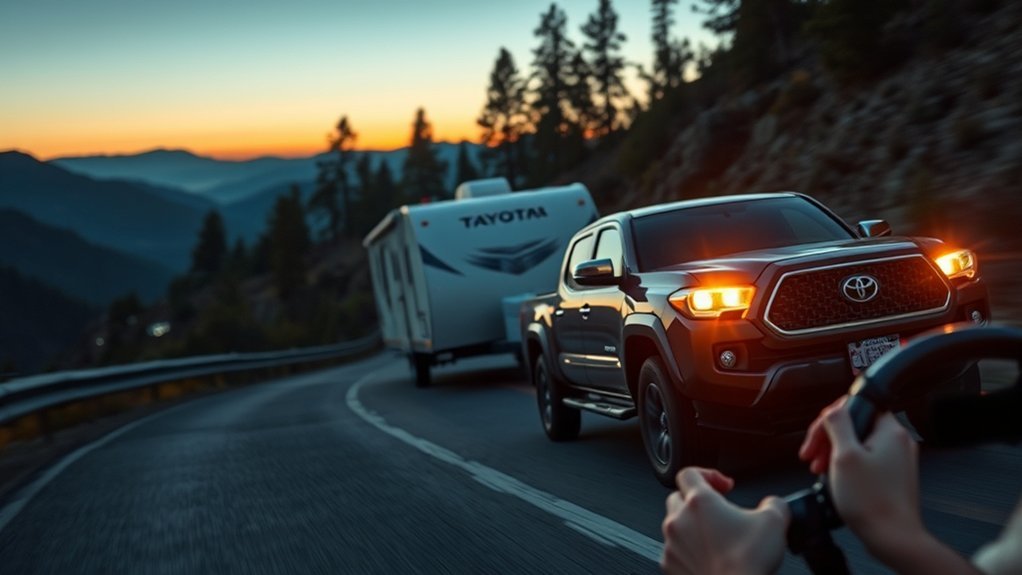
Engine braking uses resistance from the engine and drivetrain to help slow the Tacoma after you release the accelerator. Selecting a lower transmission range increases that resistance, which can help keep the truck and trailer from gaining speed on a descent.
The effect is different from simply pressing the brake pedal. Your service brakes convert motion into heat at the brake pads, rotors, drums, or trailer brakes. Engine braking shares part of the speed-control work with the powertrain, leaving more service-brake capacity available when you need to slow sharply or stop.
Automatic Tacoma models may provide an S, manual-selection, or lower-range function, depending on the year and transmission. Manual models require an appropriate lower gear. Some newer manual Tacomas include automatic rev matching, but older configurations may not. Use the controls and procedures listed in the Toyota owner’s manual for your exact model year.
Note: Engine braking is not the same as a diesel exhaust brake or compression-release brake. A gasoline Tacoma normally creates downhill resistance through its engine, throttle operation, transmission, and selected gear range.
The Benefits of Engine Braking for Towing Safety
Enhanced Control on Descents
A suitable lower gear can reduce how quickly gravity accelerates the truck and trailer. This gives you more time to assess curves, traffic, changing speed limits, and road conditions instead of reacting after the combination has already gained too much speed.
Select the range before the steepest part of the descent. Waiting until the Tacoma is moving too fast can force a harsh downshift, excessive engine speed, or heavy brake application.
Reduced Brake Heat and Wear
Long, continuous brake applications can create excessive heat. As brake temperatures rise, stopping performance may decrease. Engine braking reduces the amount of continuous work demanded from the service brakes, although it does not eliminate normal brake use.
| Engine Braking Can Help | Engine Braking Cannot Do |
|---|---|
| Limit downhill acceleration | Replace the service brakes |
| Reduce continuous brake heat | Correct worn or overheated brakes |
| Support steadier speed control | Correct an overloaded or unstable trailer |
| Leave more braking capacity for stopping | Replace required trailer brakes or a brake controller |
Improved Towing Stability
A steady, appropriate downhill speed can make the truck-and-trailer combination easier to manage. However, engine braking does not prevent sway by itself. Trailer stability also depends on speed, loading, tongue weight, tire condition, hitch setup, suspension condition, crosswinds, and trailer-brake adjustment.
If the trailer begins to sway, avoid abrupt steering or acceleration. Reduce speed smoothly and follow the instructions supplied with the trailer and brake controller. Pull over when safe and correct the cause before continuing.
Choose the speed and gear before gravity chooses them for you.
When Should You Use Engine Braking While Towing?
Engine braking is most useful when gravity would otherwise make the Tacoma accelerate, including:
- Long mountain descents
- Steep highway grades
- Repeated rolling hills with a heavy trailer
- Approaches to downhill curves or reduced-speed zones
- Situations where continuous brake use could build excessive heat
You usually do not need to hold an unusually low gear on level ground or while climbing when speed is stable. Use the normal drive range, Tow/Haul mode, or other transmission setting recommended by the owner’s manual. A lower range may still be useful when the transmission repeatedly shifts between gears, but it should not force the engine near redline.
Use extra caution on wet, snowy, icy, gravel, or otherwise slippery roads. Abrupt downshifts can change drive-wheel traction. Reduce speed earlier, make gentle control inputs, and avoid forcing a strong engine-braking effect when traction is limited.
Before You Descend: Towing Safety Checklist
- Confirm the ratings. Verify the Tacoma’s towing capacity, payload limit, gross axle ratings, gross combination rating, hitch rating, and the trailer’s loaded weight. Use the exact configuration, not a general maximum quoted for another trim.
- Count the full load. Include passengers, cargo, accessories, hitch equipment, and trailer tongue weight when checking available payload.
- Inspect the brakes. Confirm that the truck brakes, trailer brakes, breakaway system, and brake controller operate correctly.
- Check tires and connections. Inspect inflation, tread, lug nuts, coupler engagement, safety chains, electrical plug, lights, and breakaway cable.
- Identify the grade early. Read warning signs, observe traffic, and choose a safe entry speed before the road drops.
- Increase following distance. A loaded combination needs more room to slow and stop.
- Select the driving mode. Engage Tow/Haul or another towing mode when the owner’s manual recommends it, then choose a suitable lower range before speed builds.
Towing ratings differ by configuration. For example, Toyota lists a maximum towing capacity of 6,500 pounds for specific 2024 Tacoma grades, not every 2024 Tacoma and not every model year. Toyota also lists an available integrated trailer brake controller on certain configurations. Review the official Toyota Tacoma specifications and the manual for your truck.
How to Properly Downshift for Engine Braking

Automatic-Transmission Tacoma
- Release the accelerator early. Begin reducing speed while the truck and trailer are straight and stable.
- Use the service brakes to reach a safe entry speed. Do this before the steepest part of the descent.
- Engage the recommended towing mode. Use Tow/Haul or another applicable setting only as described in the owner’s manual.
- Select one lower range. Use the S, manual-selection, or lower-range control available on your Tacoma.
- Observe the result. The correct range should help hold speed without sending the tachometer near the red zone.
- Reduce road speed before shifting lower again. If the truck still accelerates, use the brakes to slow first, then select another lower range if the manual permits it.
- Return to a higher range when the grade eases. Avoid holding a low gear when it is no longer needed.
Do not assume S4, S5, or another numbered range is correct for every Tacoma. Gear counts and controls differ across generations. Fourth-generation models can use an eight-speed automatic, while earlier trucks may use different transmissions.
Manual-Transmission Tacoma
- Slow before the descent. Choose a gear that lets the engine resist acceleration without exceeding its safe RPM range.
- Press the clutch fully and shift smoothly. Avoid forcing the shifter or skipping into a gear that is too low for the road speed.
- Match engine and road speed. Some newer manual Tacomas can assist with automatic rev matching. Other models require the driver to make a smooth shift.
- Release the clutch progressively. A sudden clutch release can create a sharp driveline load or disturb traction.
- Keep the clutch engaged while descending. Do not coast in neutral or hold the clutch pedal down, because doing so removes the engine-braking effect.
Combine Engine Braking With the Service Brakes
Engine braking should hold or slow the combination enough to reduce continuous brake use. When speed rises above your safe target, apply the brakes firmly and smoothly enough to create a definite slowdown. After returning to a lower safe speed, release the pedal when road and traffic conditions allow.
Avoid resting your foot on the pedal or using light, continuous pressure throughout a long descent. Continuous contact can build heat without reducing speed enough. Always keep enough braking capacity available to respond to traffic, curves, hazards, or a required stop.
Pro Tip: Practice selecting the lower ranges on a familiar road without a trailer, then repeat with a lightly loaded trailer in safe conditions. Learn how quickly each range changes speed and RPM before attempting a mountain route.
What RPM Is Safe for Tacoma Engine Braking?
No single RPM target, including 2,300–2,800 RPM, works for every Tacoma. The safe limit depends on the engine, transmission, selected range, vehicle speed, and model year.
Use the tachometer and the owner’s manual together. A higher-than-normal RPM can be expected in a lower gear, but the needle should remain safely below the red zone. If RPM rises too close to the limit:
- Do not downshift again.
- Use the service brakes to reduce road speed.
- Select a higher range if the engine is turning too fast.
- Choose a lower overall travel speed.
If an engine-coolant or transmission-temperature warning appears, reduce the load on the vehicle and pull over at a safe location. Follow the warning procedure in the owner’s manual. Do not continue a demanding descent merely because the truck still moves normally.
Trailer Brakes and the Brake Controller
Engine braking acts through the Tacoma’s drivetrain. It does not directly command the trailer’s electric brakes. This means the truck may experience a stronger slowing effect than the trailer when you release the accelerator.
A correctly installed and adjusted brake controller coordinates the trailer brakes with the truck’s service brakes. Test the system at low speed before entering traffic or approaching a steep grade. The trailer should contribute smoothly without grabbing, locking its wheels, or pushing heavily against the truck.
Do not use the controller’s manual lever as a substitute for normal downhill speed management. Use it only as instructed by the controller or trailer manufacturer, including any approved response to trailer sway. Trailer-brake requirements vary by jurisdiction, trailer type, and weight, so check the laws for every state or province on your route.
Top 5 Mistakes to Avoid When Using Engine Braking
- Relying on engine braking alone: You still need working service brakes and properly equipped trailer brakes to slow or stop safely.
- Choosing too low a gear at excessive speed: A severe downshift can create a sharp RPM increase, driveline shock, or loss of traction.
- Waiting until the combination is already moving too fast: Slow and choose the range before entering the steepest part of the descent.
- Coasting in neutral or with the clutch disengaged: Coasting removes the engine-braking effect and can reduce your control.
- Ignoring the complete towing setup: Engine braking cannot correct overloading, poor weight distribution, underinflated tires, a weak hitch, or an improperly adjusted brake controller.
Using a low range unnecessarily on flat or uphill stretches may create extra noise and high RPM without providing a useful speed-control benefit. Shift normally when gravity is no longer increasing your speed, unless the owner’s manual recommends holding a range to prevent repeated shifting.
Troubleshooting Engine Braking While Towing
| Symptom | Likely Issue | Safe Response |
|---|---|---|
| Speed continues to rise | Gear is too high, entry speed is excessive, or the grade is too demanding | Brake smoothly to a lower speed, then select one lower range if RPM permits |
| RPM approaches the red zone | Selected gear is too low for the current road speed | Do not downshift further; slow with the brakes and select a suitable higher range |
| Strong burning smell or smoke | Possible overheated truck or trailer brakes | Pull over safely, stop, and allow the system to cool; inspect before continuing |
| Brake pedal feels soft or stopping power drops | Possible brake fade or brake-system problem | Use the safest available escape or stopping area and do not continue until the system is checked |
| Transmission or coolant warning appears | Powertrain temperature may be excessive | Reduce demand, stop safely, and follow the owner’s-manual warning procedure |
| Trailer begins to sway | Speed, wind, loading, hitch setup, tires, or brake adjustment may be unsuitable | Avoid abrupt steering, reduce speed smoothly, follow controller instructions, and correct the cause before continuing |
| Drive wheels slip after a downshift | Downshift was too abrupt or traction is limited | Make gentle inputs, reduce speed, and use a less aggressive range |
Tacoma Owners’ Tips for Effective Engine Braking
- Read the towing and transmission sections of the manual for your exact year and configuration.
- Practice the truck’s lower-range controls before towing on a mountain route.
- Enter the descent more slowly than you think will be necessary.
- Select the lower range before speed builds.
- Use Tow/Haul mode when your manual recommends it, but do not treat it as an automatic substitute for driver control.
- Watch the tachometer and warning indicators rather than targeting a universal RPM band.
- Increase following distance and leave room for a controlled slowdown.
- Check the brake controller at low speed at the start of each towing day.
- Disengage cruise control when the grade, traffic, or weather requires active speed management.
- Stop and investigate new smells, smoke, unusual pedal feel, warning lights, or reduced braking.
Frequently Asked Questions
What should you not tow with a Tacoma?
Do not tow a trailer that causes the truck to exceed any applicable towing, payload, axle, combination, tire, hitch, or tongue-weight limit. The maximum advertised rating does not apply to every Tacoma. Check the exact model-year manual, door labels, hitch rating, passenger and cargo weight, and the trailer’s loaded weight.
What year was the worst year for the Toyota Tacoma?
No single Tacoma year is objectively the worst for every buyer. Condition, maintenance, corrosion exposure, modifications, accident history, recalls, and individual configuration matter more than a simple label. Check the VIN through the NHTSA recall database and obtain an independent inspection before buying a used truck.
Is engine braking bad for a Toyota automatic transmission?
Normal engine braking is not inherently harmful when you use the transmission controls as Toyota directs and keep engine speed within the permitted range. Problems can occur if you force an unsuitable low gear at excessive speed, ignore warning lights, exceed towing limits, or continue after the transmission overheats.
What is the most common problem with the Toyota Tacoma?
Problems vary by generation, region, powertrain, use, and maintenance history. Corrosion deserves careful inspection on trucks exposed to road salt, but it is not accurate to call one issue universal across every Tacoma. Review VIN-specific recalls, service records, underbody condition, transmission operation, brakes, tires, and towing modifications.
What gear should I use when towing downhill with a Tacoma?
Use the highest lower range that holds a safe speed without allowing continuous acceleration or pushing the engine near redline. No universal gear number works for every Tacoma. Slow first, select one lower range, observe the result, and shift lower only after reducing road speed enough for a smooth change.
Should I use Tow/Haul mode and engine braking together?
Use Tow/Haul mode when the owner’s manual recommends it. The mode may change shift behavior and reduce unnecessary gear hunting, but you must still choose a safe speed, select a suitable lower range when needed, and operate the service brakes correctly.
Can engine braking replace trailer brakes?
No. Engine braking acts through the Tacoma’s drivetrain and does not directly apply a trailer’s electric brakes. Use the trailer brakes and controller required for the trailer, load, and jurisdiction. Test and adjust the system before entering a steep route.
Conclusion
Engine braking can make downhill towing safer and more controlled when you use it within your Tacoma’s limits. Slow before the grade, select a suitable lower range, monitor speed and RPM, and use the service brakes in controlled applications when necessary.
Do not rely on a universal gear, a fixed RPM target, or the truck’s advertised maximum towing figure. Match every decision to your exact model, loaded combination, road, weather, and owner’s manual. Fully functioning truck and trailer brakes must remain your primary means of slowing and stopping.
Sources
- Toyota Manuals and Warranties — model-year-specific operating instructions, warnings, ratings, and transmission controls
- Toyota USA Newsroom: 2024 Tacoma — transmission options, configuration-specific towing capacity, trailer brake controller, and towing features
- California DMV Recreational Vehicles and Trailers Handbook — mountain-grade speed control, lower-gear use, brake-fade prevention, loading, and trailer-brake principles
- NHTSA Recall Search — VIN- and model-based recalls, investigations, complaints, and manufacturer communications
