Toyota Tacoma ECT PWR mode is a transmission-response setting for automatic-equipped trucks. Use it when you want stronger response while towing, climbing a grade, merging with a load, or passing. It changes shift behavior so the engine can stay in a more useful RPM range; it does not add horsepower, increase towing capacity, or replace selecting a lower range for a long descent. Feature availability and related controls vary by model year and configuration.
Last updated: September 11, 2026 — verified against Toyota Tacoma owner documentation, including fourth-generation ECT PWR and TOW HAUL controls.
Quick Answer
Use ECT PWR when your automatic Tacoma needs more responsive shifting for towing, hills, merging, or passing. Toyota describes the mode as useful when high response is desirable, including mountainous driving and pulling a trailer. It does not raise engine output or towing limits. On long descents, use the transmission range and braking guidance in your exact owner’s manual rather than relying on ECT PWR alone.
Key Takeaways
- ECT PWR changes automatic-transmission response and shift timing rather than increasing the engine’s rated output.
- It can help when towing, climbing, merging, passing, or carrying a heavy legal load.
- For a long descent, select an appropriate lower range instead of relying on ECT PWR alone.
- The mode may increase fuel use when it keeps the engine at higher RPM or encourages stronger acceleration.
- For 2024, Toyota lists ECT PWR on some non-hybrid Tacoma configurations and TOW HAUL as a separate if-equipped control; check the exact controls in your model-year manual.
At a Glance
| Towing or climbing under load | ECT PWR when you want quicker automatic-transmission response |
| Long or steep descent | Select an appropriate lower S range or gear range; use brakes as directed by the manual |
| Flat road, light load | Normal mode is usually smoother and more economical |
| 2024 fourth-generation Tacoma | On some non-hybrid trucks, ECT PWR is listed separately from TOW HAUL; use the controls specified for your configuration |
Warning: ECT PWR does not make an overloaded truck or trailer safe. Stay within the ratings for your exact Tacoma, hitch, tires, axle, payload, tongue weight, and trailer brakes. If you see a transmission-temperature warning, follow the vehicle message and model-year manual; this Tacoma transmission-temperature warning guide explains the general response. Stop safely for a brake warning, burning smell, loss of braking, or unusual shifting.
Understanding the ECT PWR Button on Your Tacoma
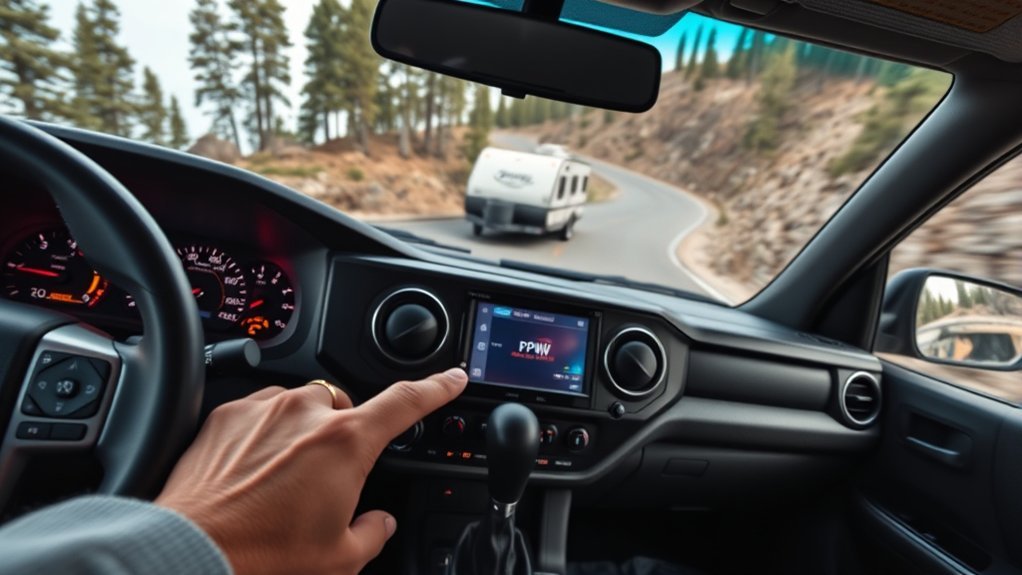
ECT refers to Toyota’s electronically controlled transmission, while ECT PWR selects the transmission’s power mode on equipped Tacomas. Toyota’s manuals describe power mode as a setting for situations where higher response is desirable, including mountainous driving and pulling a trailer. In use, that means the automatic transmission can favor a more responsive shift pattern than Normal driving.
Keeping a lower gear can place the engine in a stronger part of its operating range. You may therefore feel quicker acceleration or less hesitation, but the mode does not change the engine’s rated horsepower or torque.
On equipped trucks, press the ECT PWR control to select power mode and confirm that the ECT PWR indicator appears. Press the control again to cancel the mode. Control location and availability vary by model year and configuration.
Note: Not every Tacoma has an ECT PWR button. Check the Toyota manual page for your model year before following instructions written for another generation, trim, engine, or transmission.
What ECT PWR Does Not Do
- It does not add horsepower or increase rated engine torque.
- It does not increase payload, tongue-weight, or towing limits.
- It does not activate four-wheel drive or lock a differential.
- It does not replace a trailer brake controller or properly adjusted trailer brakes.
- It does not guarantee lower transmission or brake temperatures.
- It does not replace selecting a suitable lower range on a long descent.
How ECT PWR Mode Enhances Performance on Steep Hills
Hills often cause an automatic transmission to shift repeatedly as vehicle speed and engine load change. ECT PWR can make the response feel more decisive by favoring lower gears and delaying some upshifts.
Why ECT PWR Feels More Responsive on Hills
On an incline, power mode can keep the transmission in a response-focused shift strategy instead of prioritizing early upshifts. That can help the engine stay in a more useful RPM range when load increases.
This behavior can help when you need to merge, pass, climb a hill, or accelerate with a properly loaded trailer. Use smooth accelerator input instead of flooring the pedal whenever possible, especially on wet or loose surfaces.
Enhanced Engine Braking
ECT PWR can sometimes increase engine braking indirectly because the transmission may remain in a lower gear. However, you should not assume the mode will always select or hold the gear needed for a long or steep descent.
Before descending, reduce your speed and select an appropriate lower transmission range if your Tacoma provides S mode or selectable ranges. Toyota notes that downshifting can provide engine braking downhill. Use the service brakes as needed and follow the towing and downhill-driving instructions in your exact owner’s manual.
ECT PWR may support engine braking, but the selected gear controls how much engine braking you actually receive.
How to Effectively Use ECT PWR for Towing
Use ECT PWR when you want added transmission response before or during demanding conditions such as a climb, merge, or pass while towing. Confirm the ECT PWR indicator after selecting the mode, and follow any model-specific operating notes in your owner’s manual.
- Verify your load first. Confirm the trailer, cargo, passengers, hitch load, and accessories remain within every applicable rating.
- Accelerate smoothly. Press the accelerator progressively and allow the transmission to choose a suitable gear.
- Activate ECT PWR when added response is useful. Watch for the dashboard indicator.
- Listen and watch. Higher RPM can be normal, but harsh shifting, warning messages, unusual noises, or a burning smell are not.
- Turn it off when conditions ease. Normal mode is usually smoother and more economical on flat roads with light loads.
Optimal Gear Selection
ECT PWR changes the automatic shift program, while S mode or another selectable range limits the highest gear the transmission can use. These controls are related but not identical. If you are comparing transmission choices more broadly, see this Toyota Tacoma automatic vs. manual transmission guide.
- Use ECT PWR when you want quicker automatic response.
- Use a lower selectable range when you need the transmission to remain below a particular upper gear.
- Use both only when appropriate and permitted by your model-year manual.
- Return to a higher range when the grade ends and the engine no longer needs the lower gear.
- Never shift to Neutral on a descent because you will lose useful engine braking.
Engine Braking Benefits
Engine braking reduces some of the work required from the wheel brakes. It can be especially useful when you are descending with a trailer, but it must be combined with a safe starting speed, a suitable gear, properly maintained truck brakes, and correctly adjusted trailer brakes.
| Control or Action | Main Purpose |
|---|---|
| ECT PWR | Uses a more responsive automatic shift program |
| Lower S range or selectable gear range | Restricts higher gears and can increase engine braking |
| Truck service brakes | Provide primary controlled braking |
| Trailer brakes | Help slow the trailer instead of forcing the truck to do all the work |
| Reduced starting speed | Lowers the braking demand before the descent begins |
Top Benefits of ECT PWR While Towing
ECT PWR is most useful when Normal mode shifts too early or feels slow to respond under load. Its practical benefits may include:
- Quicker downshift response: The transmission may select a lower gear sooner when you ask for acceleration.
- Longer gear holding: Fewer early upshifts can reduce gear hunting on rolling terrain.
- Stronger hill response: The engine can remain in a more useful RPM range during a climb.
- More predictable passing: Throttle input may produce a quicker transmission reaction.
- Possible added engine braking: Lower-gear operation may help slow the truck when you release the accelerator.
These benefits do not change the truck’s mechanical limits. Always use the tow rating for your exact cab, bed, engine, drivetrain, axle, hitch, and equipment combination.
ECT PWR vs. Normal Driving Mode: Key Differences
| Characteristic | Normal Mode | ECT PWR Mode |
|---|---|---|
| Shift priority | Smoothness and everyday efficiency | Faster response and lower-gear use |
| Typical RPM | Often lower during light acceleration | May remain higher before an upshift |
| Best use | Unloaded or lightly loaded everyday driving | Towing, grades, merging, passing, and heavier legal loads |
| Fuel use | Usually lower under gentle conditions | May rise with higher RPM or stronger acceleration |
| Tow rating | Unchanged | Unchanged |
Effective Tips for Using ECT PWR When Towing
Do Not Chase One Exact RPM
No single RPM value tells you when every Tacoma should shift. Automatic shift timing changes with accelerator position, road speed, grade, load, temperature, engine, transmission, and model year.
A higher engine sound is often normal when ECT PWR holds a lower gear. However, reduce the load and stop safely if you see a temperature warning, smell overheated components, experience repeated harsh shifts, or notice a sudden loss of power.
Use Lower Ranges for Long Descents
Before a steep descent, slow down while the truck and trailer are straight. Select a lower range before speed begins to build. ECT PWR may support lower-gear operation, but the selectable range gives you more direct control over the highest gear available.
Do not wait until the truck is moving too fast before downshifting. Avoid abrupt gear changes that could cause excessive RPM or disturb traction.
Pro Tip: If the transmission repeatedly shifts up and down on rolling terrain, ease the demand within safe traffic conditions and let the transmission settle into a suitable range. Persistent harsh or abnormal shifting deserves diagnosis rather than more throttle.
Match the Mode to the Load and Terrain
- Heavy trailer or cargo: ECT PWR may provide more useful response, but only within the truck’s ratings.
- Steep uphill grade: Activate it before the truck begins losing speed.
- Long downhill grade: Select a lower range and use ECT PWR only as a supporting control.
- Flat highway: Turn it off if the truck holds unnecessary RPM or feels too aggressive.
- Rain, snow, gravel, or mud: Use smooth accelerator inputs. ECT PWR does not create traction, and the correct 2WD/4WD or terrain setting is a separate decision.
- Light city driving: Normal mode is usually smoother and more economical.
Common Misconceptions About ECT PWR Usage
“ECT PWR Adds More Horsepower”
It does not increase the engine’s rated output. It changes how the transmission responds so the available output may feel easier to access.
“ECT PWR Increases Towing Capacity”
The button does not change any published weight rating. Your configuration-specific limits remain the same with the mode on or off.
“ECT PWR Is the Same as Selecting a Lower Gear”
ECT PWR changes automatic shift logic. A selectable S range or lower range restricts the gears the transmission may use. You may use either control for a different reason.
“ECT PWR Prevents Overheating”
No drive mode guarantees safe brake, engine, or transmission temperatures. Excessive weight, high speed, hot weather, steep grades, frequent shifting, or mechanical problems can still cause overheating.
“ECT PWR Must Stay On Whenever a Trailer Is Attached”
You can turn it off when you no longer need the added response. A light trailer on a flat road may not require it.
Best Situations to Use ECT PWR for Optimal Performance
- Towing on rolling or hilly roads: Helps reduce early upshifts and slow responses.
- Climbing a steep grade: Helps the transmission remain in a more useful gear.
- Merging with cargo or a trailer: Provides quicker response when entering traffic.
- Passing: Can reduce the delay before the transmission selects a lower gear.
- Carrying a heavy legal payload: May improve response when the truck feels sluggish.
- Descending moderate grades: May support lower-gear operation, although a selected lower range remains more dependable for long descents.
Leave it off when the truck is lightly loaded, the road is flat, traction is limited, or you prefer smoother and more economical shifting.
What You May Notice When ECT PWR Is Active
The effects you notice will depend on the Tacoma’s year, engine, transmission, trailer weight, road, elevation, temperature, and driving style. The table below describes expected effects of a more responsive shift strategy; it is not presented as a survey or instrumented road test.
| What You May Notice | What It Usually Means |
|---|---|
| The engine sounds louder | The transmission is holding a lower gear and higher RPM |
| The truck responds sooner to the accelerator | The transmission is using a more responsive shift program |
| Upshifts happen later | ECT PWR is keeping the engine in a stronger operating range |
| The truck still gains speed downhill | You need a lower selected range, a lower starting speed, or additional controlled braking |
| Fuel economy decreases | Higher RPM, greater load, terrain, wind, and acceleration are increasing fuel use |
Does the 2024 Tacoma Still Have ECT PWR?
Yes, Toyota lists ECT PWR on some non-hybrid 2024 fourth-generation Tacoma configurations. The 2024 Tacoma Quick Reference Guide shows ECT PWR as an if-equipped control for Tacoma and lists TOW HAUL separately. The Tacoma Hybrid control overview does not show ECT PWR. That means TOW HAUL did not simply replace ECT PWR across every fourth-generation truck; the available controls depend on configuration.
| 2024 Control | Toyota’s Stated Purpose |
|---|---|
| ECT PWR (if equipped) | Power mode for situations where high response is desirable, including mountainous driving or pulling a trailer |
| TOW HAUL (if equipped) | Changes engine, transmission, and steering operation to better suit trailer pulling or hauling a heavy load |
| S mode | Lets the driver select shift ranges; downshifting increases uphill power response or provides engine braking downhill |
The fourth-generation Tacoma also uses an eight-speed automatic on applicable configurations and adds model-dependent towing, terrain, camera, braking, and drive-control technologies. Use the control named in your exact manual rather than assuming ECT PWR, TOW HAUL, S mode, Drive Mode Select, Multi-Terrain Select, and Downhill Assist Control perform the same job.
See Toyota’s 2024 Tacoma Quick Reference Guide for the ECT PWR, S mode, and TOW HAUL descriptions, and Toyota’s 2024 Tacoma i-FORCE MAX overview for the fourth-generation powertrain and eight-speed automatic details.
Frequently Asked Questions
Should I use ECT PWR when towing?
Use it when your automatic Tacoma needs quicker transmission response, such as during acceleration, merging, passing, or hill climbing. You do not need to leave it on during every mile of every towing trip.
Should I drive with ECT PWR on all the time?
You can use it when needed, but Normal mode is usually smoother and more efficient for unloaded driving on flat roads. Turn ECT PWR off when the extra response no longer helps.
What does ECT PWR do in a Toyota Tacoma?
It selects a more responsive automatic-transmission program. The transmission may hold a lower gear longer, delay some upshifts, or downshift sooner when you request acceleration.
Does ECT PWR increase horsepower or towing capacity?
No. It does not change engine output or any payload, axle, hitch, tongue-weight, or trailer-weight rating. It only changes transmission behavior.
Is ECT PWR bad for gas mileage?
It can increase fuel use when the transmission holds higher RPM or when you accelerate more aggressively. The actual difference depends on speed, load, hills, wind, traffic, and driving style.
Is ECT PWR the same as S mode or Tow/Haul?
No. ECT PWR changes automatic shift response. S mode or selectable ranges restrict available upper gears. Tow/Haul and other drive modes can use different programming and may control additional systems, depending on the truck.
Why does my Tacoma not have an ECT PWR button?
The feature is not installed on every model year, transmission, trim, or powertrain. Your truck may use other controls, or it may not include a separate performance-mode button. Check the controls section of your exact owner’s manual.
Does the 2024 Toyota Tacoma have ECT PWR?
Toyota’s 2024 Tacoma Quick Reference Guide lists ECT PWR as an if-equipped control for Tacoma and lists TOW HAUL separately. The Tacoma Hybrid control overview does not show ECT PWR. Availability depends on configuration, so use the controls shown in your exact owner’s manual.
Conclusion
ECT PWR can make an automatic Toyota Tacoma respond more confidently when you’re towing, climbing, merging, passing, or carrying a heavy legal load. It works by changing transmission behavior, not by adding engine power or increasing the truck’s ratings.
Use the mode as one part of a safe towing plan. For climbs or towing, choose ECT PWR when you want quicker transmission response. For long descents, start slowly and select the appropriate lower range. On a 2024 Tacoma, remember that ECT PWR and TOW HAUL can be separate controls. Follow the instructions and weight limits in your exact model-year owner’s manual.
Sources
- Toyota 2024 Tacoma Quick Reference Guide — official ECT PWR, S mode, TOW HAUL, and control-availability guidance.
- Toyota 2023 Tacoma Manuals and Warranties — model-year-specific operating instructions and feature information.
- Toyota 2024 Tacoma Manuals and Warranties — fourth-generation controls, warnings, and operating guidance.
- Toyota USA Newsroom: All-New 2024 Tacoma Is Adventure Ready Out of the Box — fourth-generation i-FORCE powertrain and eight-speed automatic details.
- Toyota USA Newsroom: 2024 Tacoma with i-FORCE MAX — hybrid powertrain, transmission, drive-mode, and towing-system context.