
Hard shifting in a Toyota Tacoma can feel like a jolt, delayed engagement, gear flare, grinding, or a stiff shifter. The cause may be simple, such as a leak or an overdue model-specific service, or it may involve software, the valve body, clutch operation, driveline play, or internal transmission wear. The safest approach is to diagnose the symptom in a fixed order instead of replacing parts at random.
Quick Answer
Hard shifting in a Toyota Tacoma is not one diagnosis. Start by identifying the model year and transmission, scanning for transmission-capable trouble codes, checking for leaks, and reviewing the correct maintenance schedule. Avoid an automatic “flush” or computer reset until a qualified technician confirms the cause and the year-specific Toyota procedure.
Key Takeaways
- Separate automatic-transmission symptoms from manual clutch or shifter problems before diagnosing the truck.
- A low level in a sealed automatic transmission usually points to a leak and requires the correct temperature-based service procedure.
- Use a scanner that can read transmission codes, but remember that a code identifies a circuit or condition, not always the failed part.
- Fluid replacement intervals vary by model year and operating conditions, so follow the exact Toyota guide for your Tacoma.
- Stop driving and arrange professional help if the truck slips badly, will not engage a gear, leaks heavily, smells burned, or makes grinding noises.
At a Glance
| Time Required | 15–30 minutes for initial checks; longer for professional testing |
| Difficulty | Beginner for observation and leak checks; advanced for fluid-level, software, hydraulic, or internal work |
| Tools Needed | Owner’s manual, flashlight, gloves, clean cardboard, and a transmission-capable scan tool |
| Cost | Low for basic checks; variable for software, valve-body, clutch, or internal transmission repairs |
What to Do About Hard Shifting in Your Toyota Tacoma

Start by identifying whether your Tacoma has an automatic or manual transmission. A harsh automatic shift, a delayed move into Drive, and a stiff manual gear lever require different checks. Also record the model year, mileage, recent repairs, towing use, modifications, warning lights, and the exact gear change that causes the problem.
Notice whether the symptom happens only when cold, after the truck warms up, during a sudden stop, under light throttle, while climbing, or when shifting into Drive or Reverse. Repeatable details help a technician separate a control issue from a fluid, hydraulic, driveline, clutch, or internal mechanical problem.
Note: Tacoma transmissions and service procedures changed across generations. Use the Toyota manual for your exact year, not a procedure written for a different Tacoma.
If the truck has an aftermarket engine or transmission tune, return it to the approved stock calibration when practical before diagnosis. Changes to torque management or shift scheduling can alter how an automatic transmission behaves and can make the original cause harder to isolate.
Common Symptoms of Hard Shifting
Hard shifting may appear as one or more of these symptoms:
- Jolt or clunk between gears: You feel a sharp bump during an upshift or downshift.
- Delayed engagement: The truck pauses before moving after you select Drive or Reverse.
- Shift flare: Engine speed rises between gears before the next gear engages.
- Slipping: Engine speed increases without a matching increase in road speed.
- Grinding or scraping: A manual transmission grinds during a shift, or an automatic makes an abnormal mechanical noise.
- Stiff manual shifter: The lever is difficult to move, especially when selecting first gear or reverse.
- Cold-only concern: The shift is much harsher before the powertrain reaches normal operating temperature.
- Warning light or message: The check-engine, master-warning, or transmission-related alert appears with the symptom.
A driveline clunk can feel like a transmission shift. Worn engine or transmission mounts, excessive driveshaft or universal-joint play, and differential backlash should remain on the diagnostic list.
What Causes Hard Shifting and How to Fix It?
The likely cause depends on the transmission type, model year, driving conditions, and exact symptom. Do not treat every hard shift as a failed transmission.
Common Causes Explained
| Symptom or Finding | Possible Areas to Check | Best Next Step |
|---|---|---|
| Harsh automatic upshift or downshift | Fluid level or condition, calibration, adaptive values, valve body, solenoids, mounts, or driveline play | Scan all powertrain modules and compare the symptom with Toyota service information |
| Delay into Drive or Reverse | Leak, low hydraulic pressure, valve-body fault, torque-converter issue, or internal clutch wear | Avoid repeated revving; arrange pressure and leak testing |
| Engine revs rise between shifts | Low pressure, solenoid or valve-body problem, or internal clutch slippage | Limit driving and get a professional diagnosis promptly |
| Stiff or grinding manual shift | Clutch drag, hydraulic fault, linkage or bushing wear, incorrect oil, or synchronizer wear | Check clutch operation and external linkage before condemning the gearbox |
| Clunk after throttle changes | Mounts, driveshaft slip joint, universal joints, differential play, or abrupt shift control | Inspect the complete driveline, not only the transmission |
Low automatic-transmission fluid can cause pressure and engagement problems, but fluid does not normally disappear from a sealed system. A low level usually means a leak. Dirty-looking fluid alone does not prove that a transmission needs a flush, and opening the wrong plug can drain fluid or cause an incorrect level.
Automatic clutch packs and shift solenoids are real failure points, but they are not casual DIY inspection items. Solenoid operation may require bidirectional scan-tool tests and electrical checks. Internal clutch packs require hydraulic testing or disassembly.
Effective Fixes Available
The correct fix may be a leak repair and proper fluid-level adjustment, the specified fluid service, a software update, an adaptive relearn after a verified repair, a valve-body or solenoid repair, mount or driveline service, clutch-hydraulic work, linkage repair, or internal transmission rebuilding.
Do not clear transmission adaptive values simply to hide a symptom. A reset can change shift feel for a short time, but it does not repair low pressure, worn components, a leak, or an electrical fault. Perform a relearn only when the year-specific Toyota procedure calls for it.
Ask a Toyota dealer or qualified transmission specialist to check for Technical Service Bulletins that match the exact year, engine, transmission, build range, calibration, and symptom. Toyota’s Technical Information System contains service information, while campaigns and recalls should be checked by VIN.
Key Maintenance Tips to Prevent Transmission Issues
Use the maintenance guide for your exact model year and operating conditions. Avoid a universal “change it every 30,000 to 60,000 miles” rule because Toyota’s schedule varies by generation and duty cycle.
For example, the 2026 Tacoma Warranty and Maintenance Guide lists automatic-transmission fluid replacement at 60,000 miles for specified special operating conditions, including towing or heavy loading and extensive idling or low-speed use. It lists another replacement at 120,000 miles under those conditions. The 2018 Tacoma guide also places transmission-fluid replacement at 60,000 miles under listed special conditions.
- Inspect the transmission and cooler lines for leaks at the intervals listed in your guide.
- Use only the fluid specification stated for your exact transmission.
- Do not mix fluid types or rely on bottle claims without confirming compatibility.
- Address cooling-system, engine-performance, battery-voltage, and wiring faults that can affect shift control.
- Keep records of fluid service, software updates, towing, and repairs.
- After off-road use, inspect the underbody, wiring, connectors, and driveline for impact or water damage.
Pro Tip: Before a service visit, record a short video of the tachometer and describe the speed, throttle position, temperature, and gear change. A repeatable symptom gives the technician a much better starting point.
Effective Strategies for Diagnosing Transmission Problems
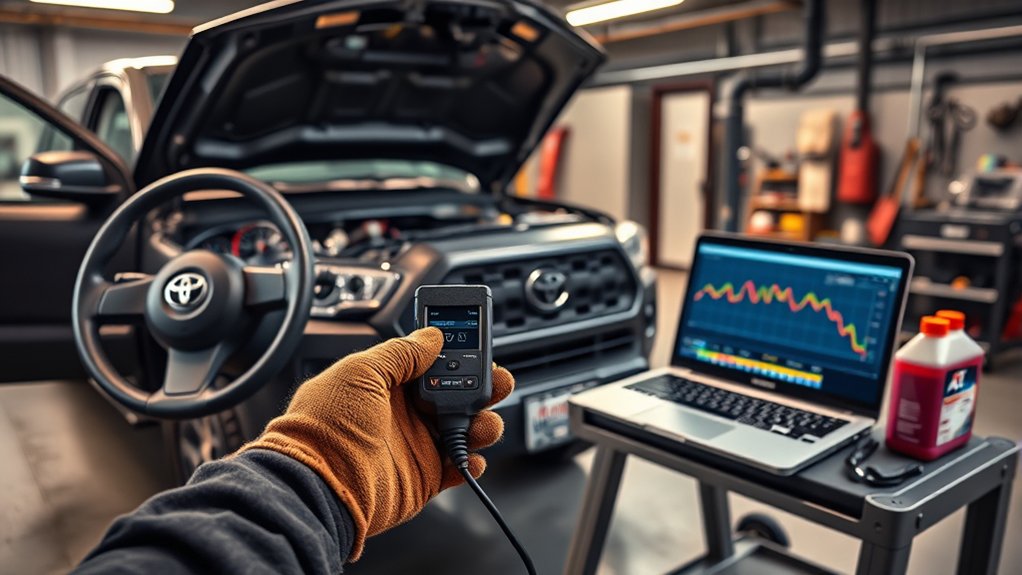
- Confirm the complaint. Write down the exact shift, speed, temperature, load, and whether the event occurs during acceleration, deceleration, or gear selection.
- Check warning lights before clearing anything. Use a scan tool that can access transmission and manufacturer-specific powertrain codes. Save freeze-frame and live data.
- Inspect for leaks. Look under the truck and around the transmission, cooler lines, radiator or cooler connections, and transfer-case area. Clean cardboard under the parked truck can help reveal fresh drips.
- Review service history. Confirm the correct fluid, the last service method, recent battery work, software updates, repairs, towing, water exposure, and modifications.
- Inspect related systems. Check mounts, driveshaft joints, differential play, engine operation, wiring, grounds, charging voltage, and clutch operation where applicable.
- Perform a controlled test drive. Use a safe route and avoid aggressive driving. A technician can compare commanded gear, input and output speeds, slip values, temperature, and solenoid commands.
- Check VIN-specific information. Search Toyota’s recall and service-campaign lookup and the NHTSA recall database. Ask the dealer to check applicable TSBs.
- Escalate to hydraulic or mechanical testing. If basic checks do not explain the problem, a qualified shop may need pressure tests, electrical measurements, fluid-pan inspection, valve-body tests, or internal inspection.
A diagnostic trouble code is a clue to the affected system. It is not automatic proof that the named sensor, solenoid, or transmission must be replaced.
DIY Solutions for Minor Transmission Issues
You can complete a few low-risk checks without opening the transmission:
- Confirm that the floor mat or stored items do not interfere with pedal movement.
- Inspect the ground for fresh fluid and note the color, location, and amount without touching a hot exhaust or drivetrain component.
- Check battery terminals for looseness or corrosion because unstable voltage can create control problems.
- Scan and record codes before disconnecting the battery or clearing data.
- Inspect accessible manual-shifter linkage or bushings for obvious looseness or damage.
- Verify that the installed tires are correctly sized and evenly inflated, especially after drivetrain or tuning changes.
- Compare the maintenance history with the exact Toyota schedule.
Do not crawl under a truck supported only by a jack. Do not remove a fill, drain, or level plug unless you have the correct service procedure, lifting equipment, fluid, temperature data, and torque specifications.
Warning: Stop driving and arrange towing if the Tacoma will not engage a gear, slips severely, loses drive, leaks heavily, produces a strong burned odor or smoke, makes grinding noises, or shows a warning light with unsafe shifting. Continued driving can increase damage and create a traffic hazard.
When to Seek Professional Help for Transmission Repairs
Professional diagnosis is the right next step when the hard shift is repeatable, worsening, or paired with delayed engagement, slipping, grinding, a fluid leak, a warning light, or stored transmission codes. It is also appropriate when the truck is still within applicable warranty coverage or may qualify for a recall or service campaign.
Ask the shop to document the codes, fluid condition, leak source, software level, test-drive findings, and the tests that support its repair recommendation. For an expensive repair, request the diagnosis in writing and consider a second opinion from a Toyota specialist or reputable transmission shop.
A proper diagnosis may involve tests that a basic code reader cannot perform, including manufacturer-specific live data, active solenoid commands, line-pressure testing, clutch or converter slip analysis, and inspection of debris in the fluid pan.
Related Guides
Frequently Asked Questions
What does it mean if my gear shifter is stiff on a Toyota Tacoma?
On a manual Tacoma, a stiff shifter may point to clutch drag, a clutch-hydraulic problem, linkage or bushing wear, incorrect or cold gear oil, or synchronizer wear. If the engine is off and the shifter moves normally but becomes difficult with the engine running, have the clutch release system checked.
What would cause an automatic transmission to shift hard?
Possible causes include an incorrect fluid level, a leak, wrong fluid, software or adaptive-control issues, wiring faults, valve-body wear, sticking solenoids, low hydraulic pressure, worn mounts, driveline play, or internal clutch wear. The symptom and scan data determine which path to test first.
How do you rectify hard gear shifting?
Begin with a code scan, leak inspection, symptom log, and maintenance-history review. Then follow the year-specific Toyota diagnostic procedure. The repair may involve correcting the fluid level, repairing a leak, updating software, completing a relearn, servicing linkage or clutch components, repairing the valve body, or addressing internal wear.
How can you tell if a Tacoma transmission is failing?
Warning signs include repeated slipping, delayed engagement, loss of drive, shift flare, grinding, burned-smelling fluid, metal debris, a significant leak, abnormal noises, or transmission-related trouble codes. One hard shift does not prove failure, but several of these signs justify prompt professional testing.
Should you flush a Tacoma transmission that shifts hard?
Do not choose a flush before diagnosis. First confirm the model-year procedure, fluid specification, service history, leak status, and internal condition. Depending on the findings, Toyota information may call for inspection, a specified fluid replacement procedure, a repair, or no fluid service at that time.
Can you keep driving a Tacoma that shifts hard?
A mild, isolated shift should still be checked, but severe slipping, delayed engagement, loss of drive, grinding, a heavy leak, smoke, a burned odor, or unsafe jolting means you should stop driving and arrange towing. Continuing can increase damage and leave the truck unable to move safely.
Conclusion
Hard shifting in a Toyota Tacoma deserves a structured diagnosis, not a guess. Identify the transmission and model year, document the conditions, scan the correct modules, check for leaks, review the exact Toyota maintenance schedule, and inspect related driveline or clutch components. Avoid automatic flushes, random parts replacement, and unsupported computer resets.
Basic observations can narrow the problem, but persistent jolting, slipping, delayed engagement, grinding, warning lights, or fluid loss calls for professional testing. Prompt diagnosis gives you the best chance of fixing a smaller problem before it becomes a larger repair.
Sources
- Toyota 2026 Tacoma Warranty and Maintenance Guide — current scheduled maintenance and special-operating-condition fluid guidance.
- Toyota 2018 Tacoma Warranty and Maintenance Guide — third-generation maintenance intervals and sealed-component inspection guidance.
- Toyota Manuals and Warranties — model-year-specific owner manuals and warranty guides.
- Toyota Safety Recall and Service Campaign Lookup — VIN-based Toyota campaign information.
- National Highway Traffic Safety Administration Recall Lookup — federal VIN-based recall information.

