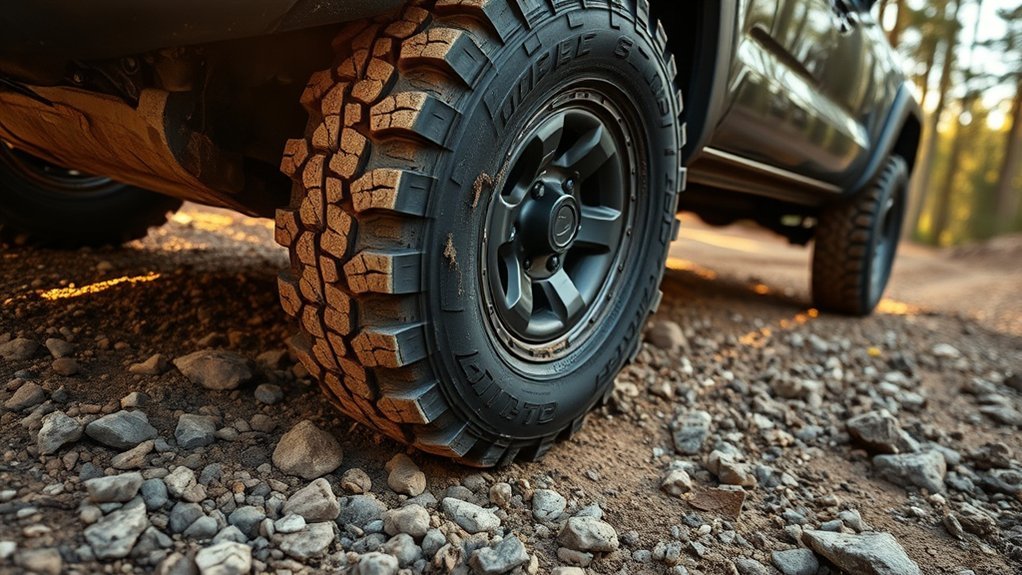
Getting more off-road traction from your Toyota Tacoma requires more than lowering tire pressure or pressing a terrain-mode button. Your tires, 4WD range, differential, electronic controls, speed, and driving technique must work together. Because Tacoma equipment changes by model year and trim, identify your truck’s systems before using them on a trail.
Quick Answer
To improve off-road traction in a Tacoma, choose the correct 4WD range, use the terrain mode your truck offers, apply smooth throttle, and adjust tire pressure conservatively. Never treat 15–20 PSI as a universal target. Reinflate to the door-jamb pressure before pavement, and use Crawl Control or the rear locker only where your owner’s manual permits.
Key Takeaways
- No single off-road tire pressure is safe for every Tacoma, tire, wheel, load, and terrain.
- Use 4H for loose or slippery surfaces and 4L for slow, steep, or technical terrain when your manual allows.
- Keep traction and stability systems enabled unless a specific low-speed situation requires temporary intervention.
- Multi-Terrain Select, Crawl Control, Downhill Assist Control, and rear lockers vary by model year and trim.
- Smooth throttle, careful line choice, and early recovery decisions often improve traction more than added wheelspin.
At a Glance
| Time Required | About 15–30 minutes for inspection, pressure adjustment, and control setup before entering the trail |
| Difficulty | Beginner to intermediate; technical terrain may require an experienced spotter |
| Tools Needed | Accurate pressure gauge, portable compressor, valve deflator, tire-repair kit, shovel, traction boards, rated recovery gear, and the correct owner’s manual |
| Cost | No added cost if you already carry the required tire and recovery equipment; equipment costs vary |
Note: Tacoma controls and activation procedures vary by model year, drivetrain, trim, transmission, and installed package. Confirm your truck’s equipment through the Toyota manuals portal before following any button sequence or speed limit.
Check Your Tacoma’s Off-Road Equipment First
Before changing settings, confirm which traction features your Tacoma actually has. A switch, dashboard menu, or build sheet can help, but your model-specific manual provides the final instructions.
- Drivetrain: Identify whether your truck is 2WD, part-time 4WD, or a configuration with a different full-time system.
- Transfer case: Check whether you have 2H, 4H, and 4L selections.
- Rear differential: Look for an electronic rear-locker switch or indicator.
- Terrain systems: Check for Multi-Terrain Select, Crawl Control, Downhill Assist Control, or a Multi-Terrain Monitor.
- Tires: Record the tire size, load range, construction, tread condition, and recommended cold road pressure.
- Recovery points: Identify the manufacturer-approved recovery locations before you need them.
Toyota lists Crawl Control, trail cameras, stabilizer-disconnect hardware, and other off-road technology as available features on current Tacoma models rather than universal equipment. Review your trim instead of assuming another Tacoma’s controls match yours.
The Importance of Tire Pressure in Off-Roading

Reducing pressure can help a tire flex around rocks and spread its footprint across sand or other loose surfaces. However, lower pressure also increases sidewall movement, heat, impact risk, steering delay, and the chance of losing the tire bead.
No universal PSI works for every Tacoma. Safe pressure depends on tire construction, wheel width, vehicle weight, cargo, trail speed, temperature, and terrain. A heavy truck on factory passenger tires may need a different setting than a lightly loaded Tacoma on reinforced light-truck tires.
Use a Safer Airing-Down Process
- Record the cold road pressure. Use the Tire and Loading Information label on the driver-side doorjamb, not the maximum pressure printed on the tire sidewall.
- Inspect each tire. Do not air down a tire with a cut, bulge, exposed cord, leaking valve, damaged bead, or severe uneven wear.
- Reduce pressure gradually. Make small, equal adjustments instead of jumping immediately to a low target.
- Test at low speed. Check steering response, sidewall folding, rim contact, and tire movement before entering harder terrain.
- Recheck during the trip. Heat, elevation, and changing terrain can alter the reading.
- Reinflate before pavement. Restore the manufacturer’s cold road pressure before sustained speed or normal highway travel.
Warning: Excessively low pressure can unseat a tire bead, damage the sidewall, bend a wheel, or create unstable handling. Do not drive at normal road speeds with trail pressure. Stop if the sidewall folds sharply or the tire contacts the wheel.
Pro Tip: Write down the pressure that works for each surface, along with your cargo load. Carry an accurate gauge and a compressor capable of reinflating all four tires.
Match the Pressure Strategy to the Terrain
| Terrain | Pressure Approach | Main Risk |
|---|---|---|
| Firm dirt or gravel | Begin near normal road pressure and reduce only if the ride or grip requires it | Sharp stones, heat, and excessive speed |
| Sand | Use a gradual reduction to improve flotation while maintaining bead security | Digging in through wheelspin or turning too sharply |
| Mud | Adjust conservatively and let the tread clear itself without excessive spin | Sidewall damage, buried obstacles, and loss of steering |
| Rocks | Use enough flex to conform to obstacles without allowing rim strikes | Pinch damage, bead loss, and wheel contact |
| Snow or ice | Avoid assuming that lower always means better; tire type and surface depth matter more | Reduced lateral control and braking grip |
NHTSA recorded 511 traffic fatalities in tire-related crashes during 2024. Tire pressure and tire condition affect safety, not only off-road comfort and traction.
Follow the NHTSA TireWise guidance for road-pressure checks, tread inspection, tire damage, and TPMS limitations.
Choose 2H, 4H, or 4L Before Adjusting Electronics
The transfer-case setting usually makes a larger difference than changing a terrain preset. Select the range before you enter an obstacle, not after the tires begin spinning.
| Setting | Best Use | Traction Benefit |
|---|---|---|
| 2H | Dry pavement and easy, firm surfaces | Normal steering behavior and reduced driveline load |
| 4H | Loose dirt, gravel, mud, sand, or other slippery surfaces | Sends drive to both axles while allowing more travel speed than low range |
| 4L | Steep climbs, descents, rocks, deep ruts, or slow recovery work | Provides low-speed control and torque multiplication with less throttle |
Follow your manual’s shifting procedure, speed limit, and transmission requirements. Part-time 4WD can bind on dry, high-traction pavement because the front and rear axles cannot relieve their speed difference normally. Return to the appropriate road setting once the loose surface ends.
Mastering Tacoma’s Traction Control Features for Enhanced Off-Road Performance
Tacoma traction and stability systems monitor wheel speed and may reduce engine output or apply brake pressure when they detect excessive slip. Depending on the model, Toyota may identify these systems as TRAC, A-TRAC, VSC, or part of Multi-Terrain Select.
Leave the systems enabled during most driving. They can reduce uncontrolled wheelspin and help the truck maintain its intended path. Pressing or holding a button does not produce the same result on every Tacoma, so avoid following a timing instruction written for another model year.
When Temporary Reduction May Help
A temporary reduction may help when the truck is already stuck in deep sand, loose snow, or mud and the system repeatedly cuts power before the tires can clear material. Use this option only when your owner’s manual permits it.
- Stop or slow the truck as required before changing the setting.
- Keep the wheels nearly straight.
- Use gentle throttle instead of a sudden full-power attempt.
- Stop if the tires dig deeper or the truck moves sideways.
- Reactivate the normal traction and stability setting after clearing the obstacle.
Warning: Disabling a traction or stability feature does not create more tire grip. It only changes how much wheelspin the truck permits. Excessive wheelspin can damage tires, dig the truck deeper, and cause sudden movement when traction returns.
Use the Rear Differential Lock Carefully
An electronic rear locker, when equipped, forces both rear wheels to turn together. It can help when one rear tire has grip and the other is suspended, unloaded, or on a slippery surface.
Engage it before a low-speed obstacle, follow the dashboard indicator, and maintain a steady steering angle. Disengage it after clearing the obstacle. A locked differential can resist turning and increase tire scrub on firm ground.
Choosing the Right Terrain Select Mode for Your Drive
Multi-Terrain Select changes throttle and brake intervention to manage wheelspin for a selected surface. The available labels and permitted 4WD ranges differ between Tacoma generations.
Earlier Tacoma systems may show modes such as Mud and Sand, Loose Rock, Mogul, or Rock. Toyota states that the redesigned 2024 Tacoma’s available system operates in both 4WD High and 4WD Low and includes settings for terrain such as Mud, Dirt, and Sand.
Choose the label displayed in your truck rather than assuming a mode from another Tacoma will be present.
| Surface | Mode Approach | Driver Technique |
|---|---|---|
| Sand | Select Sand or Mud and Sand if your display provides it | Maintain smooth momentum and avoid sharp steering |
| Mud | Choose the available Mud setting | Use measured throttle and avoid digging through repeated spin |
| Loose dirt or gravel | Use Dirt or the closest loose-surface setting | Brake early and keep steering inputs small |
| Rocks | Use Rock or the nearest technical-terrain setting, usually with low range when required | Crawl slowly and place the tires on stable high points |
| Moguls or cross-axle ruts | Choose Mogul if available or follow the manual’s nearest equivalent | Approach diagonally only when safe and use a spotter for wheel placement |
| Snow or ice | Do not assume Multi-Terrain Select provides a dedicated snow mode | Use suitable tires, reduce speed, and preserve braking distance |
Toyota’s fourth-generation Tacoma overview explains the redesigned Multi-Terrain Select, Crawl Control, rear locker, and Downhill Assist features.
Using Downhill Assist and Off-Road Cruise
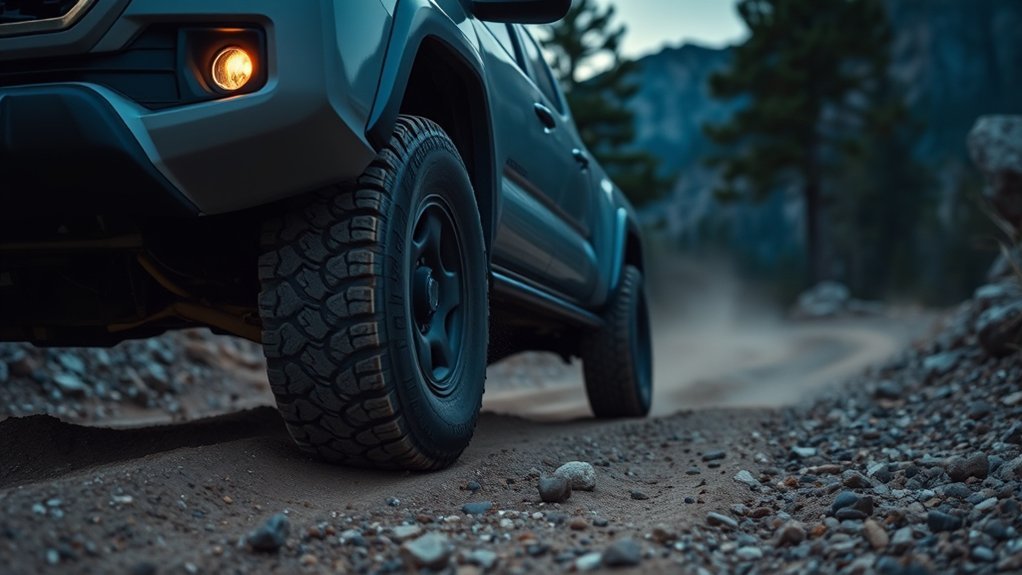
Downhill Assist Control and Crawl Control reduce the number of throttle and brake adjustments you must make on technical terrain. They support the driver, but they do not choose a safe line or detect every obstacle.
Using Crawl Control
Toyota describes Crawl Control as a low-speed off-road cruise system. On the redesigned Tacoma, it can manage throttle and braking at one of five selectable speeds while you concentrate on steering.
- Stop or slow the truck as required by the manual.
- Select the required transfer-case range and terrain setting.
- Choose a low Crawl Control speed before entering the obstacle.
- Keep both hands on the wheel and watch tire placement.
- Cancel the system if the line changes, the truck slides, or conditions exceed its limits.
Mechanical noises, pulsing, and brake operation may occur while the system controls individual wheels. Check your manual for normal system behavior and activation requirements.
Using Downhill Assist Control
Downhill Assist Control, when equipped, helps limit speed on a descent. It does not guarantee that the truck will avoid sliding sideways on loose gravel, mud, snow, or a steep side slope.
- Select the correct 4WD range before starting down.
- Use a low gear and let engine braking support the system.
- Point the wheels along the intended path before the steep section.
- Avoid sudden steering or throttle inputs.
- Stop in a safe location if you smell overheated brakes or notice reduced braking response.
Note: Crawl Control and Downhill Assist Control operate only when required vehicle conditions are met. A rejected activation often means the transfer-case range, transmission position, speed, door status, or another prerequisite is incorrect.
Use Driving Technique to Preserve Traction
Electronic controls cannot replace smooth inputs and a safe line. Most traction losses begin when the driver asks the tires to accelerate, turn, and climb at the same time.
Apply Smooth Throttle
Increase throttle gradually until the truck moves. If a tire starts spinning quickly, ease off instead of adding more power. A spinning tire often has less usable grip and can polish mud, dig sand, or throw rocks.
Straighten Before Applying More Power
A tire has limited grip to divide between turning and driving. Straightening the steering wheel can free more traction for forward motion, especially in sand, mud, or snow.
Choose a Stable Line
- Place tires on firm, high points rather than deep holes when possible.
- Cross ledges and ruts at an angle that preserves clearance without creating an unsafe side slope.
- Avoid placing the differential, control arms, or steps directly over exposed rocks.
- Walk an unfamiliar obstacle before driving it.
- Use a spotter where the hood or terrain blocks your view.
Use Momentum Without Excessive Speed
Soft surfaces may require steady momentum, but speed reduces your time to react and increases impact loads. Enter with enough movement to continue, not enough speed to bounce or lose steering control.
Traction improves when you reduce the number of demands placed on the tires. Brake before the obstacle, straighten the wheels, and apply power smoothly.
Terrain-Specific Traction Checklist
| Terrain | Recommended Setup | Avoid |
|---|---|---|
| Sand | Appropriate 4WD setting, gradual pressure reduction, smooth momentum, wide turns | Stopping on an uphill section or spinning until the axles bury |
| Mud | Read the depth first, use steady throttle, and preserve a recovery route | Blind entry, repeated high-speed attempts, or standing near spinning tires |
| Rocks | 4L where required, slow tire placement, spotter guidance, rear locker when appropriate | Throttle surges, wheel hopping, or dropping from ledges |
| Loose climbs | Select the range before climbing, keep a steady line, and preserve momentum | Gear changes mid-climb or turning across the slope after losing momentum |
| Snow and ice | Suitable tires, slower speed, gentle steering, long braking distance | Cruise control, sudden braking, or assuming 4WD improves stopping grip |
Maintaining Your Tacoma for Maximum Off-Road Capability
Traction depends on tire condition, suspension movement, brakes, steering, and drivetrain health. A control system cannot compensate for a damaged tire, worn component, or overloaded truck.
Before the Trail
- Check all tire pressures with an accurate gauge, including the spare.
- Inspect tread, sidewalls, valve stems, beads, and wheels for damage.
- Confirm that each tire has enough load capacity for the truck and cargo.
- Check lug nuts, steering components, shocks, springs, and visible brake parts.
- Look for fluid leaks and confirm engine oil, coolant, and brake-fluid levels.
- Secure cargo so it cannot shift during a climb, descent, or side angle.
- Pack a compressor, repair kit, shovel, traction boards, first-aid kit, water, communication device, and rated recovery equipment.
Do not rely on TPMS as your pressure gauge. NHTSA explains that the warning may appear only after a tire becomes significantly underinflated.
After the Trail
- Reinflate the tires before sustained pavement driving.
- Check for cuts, bulges, punctures, missing tread blocks, and bead damage.
- Remove packed mud from wheels, brakes, cooling openings, and suspension parts.
- Inspect skid plates, recovery points, steps, exhaust parts, and differentials for impacts.
- Check underneath the truck for fresh oil, coolant, fuel, or gear-fluid leaks.
- Investigate new vibration, pulling, noise, warning lights, or pressure loss before the next trip.
What to Do When the Tacoma Stops Moving
Stop repeated wheelspin early. Each failed high-throttle attempt can dig the tires deeper, overheat components, and reduce the quality of the recovery path.
If the Wheels Spin but the Truck Does Not Move
- Release the throttle and let the tires stop.
- Straighten the steering wheel.
- Check whether the correct 4WD range and terrain setting are active.
- Back up gently into the existing tracks if the path remains safe.
- Clear material from the tires, axles, and underbody with a shovel.
- Place traction boards where the driven tires can climb onto them.
- Use the rear locker only when equipped, permitted, and appropriate for the obstacle.
If the Truck Is High-Centered
More throttle will not help when the frame, skid plate, axle, or differential supports the truck’s weight. Remove material, build a ramp, use a suitable jack where safe, or perform a controlled recovery from approved points.
If Crawl Control, the Locker, or a Terrain Mode Will Not Activate
- Check the required transmission position.
- Confirm the correct 4WD range.
- Reduce speed or stop if the manual requires it.
- Check whether the steering angle, parking brake, open door, or other condition prevents operation.
- Wait for the dashboard indicator to confirm engagement before entering the obstacle.
If the TPMS Light Comes On After Airing Down
A low-pressure warning may be expected after a deliberate trail adjustment. Verify every tire with a gauge and inspect for damage. Do not ignore rapid pressure loss, a visibly deformed tire, or a warning that remains after correct reinflation.
If a Traction or 4WD Warning Stays On
Stop in a safe location and check the manual. A flashing engagement light may indicate that the shift has not completed. A persistent malfunction warning can mean the system needs inspection. Do not enter difficult terrain while an essential drivetrain system is unavailable.
Related Guides
Frequently Asked Questions
What is the traction system on a Toyota Tacoma?
A Tacoma may combine traction control, stability control, 4WD, Multi-Terrain Select, Crawl Control, and an electronic rear locker. The exact combination depends on the model year, trim, drivetrain, transmission, and installed packages. Check the switches and the model-specific owner’s manual before assuming a feature is present.
When should you turn off traction control in a Tacoma?
Leave it enabled for most driving. Temporary reduction may help a stuck truck in deep sand, mud, or loose snow when the system repeatedly cuts power. Use the model-specific procedure, remain at low speed, avoid aggressive wheelspin, and restore the normal setting after clearing the obstacle.
How does a Toyota Tacoma 4×4 system work?
A part-time Tacoma 4×4 uses a transfer case to send drive to the front and rear axles. Use 4H on loose or slippery surfaces and 4L for slow, steep, or technical terrain when the manual permits. Avoid part-time 4WD on dry, high-grip pavement because driveline binding can occur.
How does Toyota traction control work?
The system compares wheel-speed information and responds when a driven tire slips excessively. Depending on the Tacoma, it may reduce engine output, apply brake pressure to a spinning wheel, or coordinate with a selected terrain mode. It cannot create grip when the tires lack contact with a usable surface.
What is the best off-road tire pressure for a Toyota Tacoma?
No single PSI fits every Tacoma. Start with the cold pressure on the door-jamb label, then reduce it gradually for low-speed trail use while monitoring sidewall shape, steering, load, and terrain. Stop before the tire folds or contacts the wheel, and reinflate before returning to normal pavement speeds.
Does every Toyota Tacoma have Crawl Control and Multi-Terrain Select?
No. Availability changes by model year, trim, transmission, drivetrain, and package. Some Tacoma models have conventional traction control without Crawl Control or Multi-Terrain Select. Confirm the equipment through your controls, build information, and Toyota owner’s manual.
Sources
- Toyota: Current Tacoma Features and Specifications — current trim lineup and available off-road technology
- Toyota USA Newsroom: All-New 2024 Tacoma — Multi-Terrain Select, Crawl Control, Downhill Assist Control, rear-locker, and fourth-generation changes
- Toyota Manuals and Warranties — model-year-specific operating procedures and limitations
- NHTSA TireWise — tire pressure, TPMS, tread, inspection, and road-safety guidance
Conclusion
Maximizing Toyota Tacoma off-road traction starts with the right tires, safe pressure, and the correct 4WD range. Terrain modes, Crawl Control, Downhill Assist Control, and a rear locker can support those basics when your truck has them.
Use smooth throttle, straighten the wheels before demanding more power, and stop repeated wheelspin early. Check the manual for your exact Tacoma, carry a compressor and recovery equipment, and restore the tires and drivetrain settings before returning to paved roads.