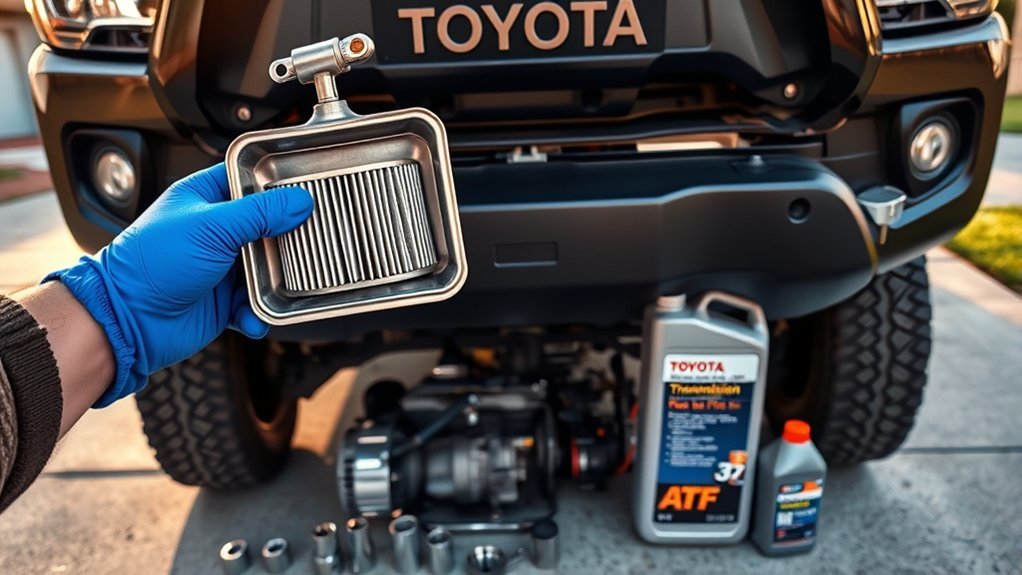
Your Toyota Tacoma’s transmission does not have one guaranteed lifespan or one fluid-change interval that applies to every truck. Model year, transmission type, maintenance history, towing, payload, heat, and driving conditions all matter. The safest approach is to follow the Toyota maintenance guide for your exact Tacoma, watch for changes in operation, and investigate symptoms before they become severe.
Quick Answer
A Toyota Tacoma transmission may provide long service when it receives the correct model-specific maintenance, but no mileage is guaranteed. Check your exact Toyota schedule, use only the specified fluid, reduce heat and overload, and arrange diagnosis if you notice slipping, delayed engagement, shuddering, warning lights, unusual noises, or leakage.
Key Takeaways
- Do not apply a universal 30,000-mile or 60,000-mile fluid rule to every Tacoma.
- Toyota’s maintenance schedule can change according to model year and operating conditions.
- Towing, heavy loading, extensive idling, and prolonged low-speed use may require additional transmission service.
- Shuddering, slipping, or harsh shifts require diagnosis because engine and driveline faults can produce similar symptoms.
- Sealed-transmission fluid service may require a level vehicle, a specified fluid temperature, proper equipment, and Toyota’s exact procedure.
At a Glance
| Time Required | 10–15 minutes for a maintenance-record and visual leak check; diagnosis or fluid service takes longer. |
| Difficulty | Easy for record review and visual checks; advanced for sealed-transmission fluid service. |
| Tools Needed | Owner’s manual, maintenance guide, flashlight, gloves, clean cardboard, and an appropriate scan tool if diagnostic data is needed. |
| Cost | A visual check requires no parts. Diagnostic and fluid-service costs vary by model, fluid quantity, procedure, and local labor. |
The Importance of Transmission Maintenance and Recommended Fluid Change Intervals
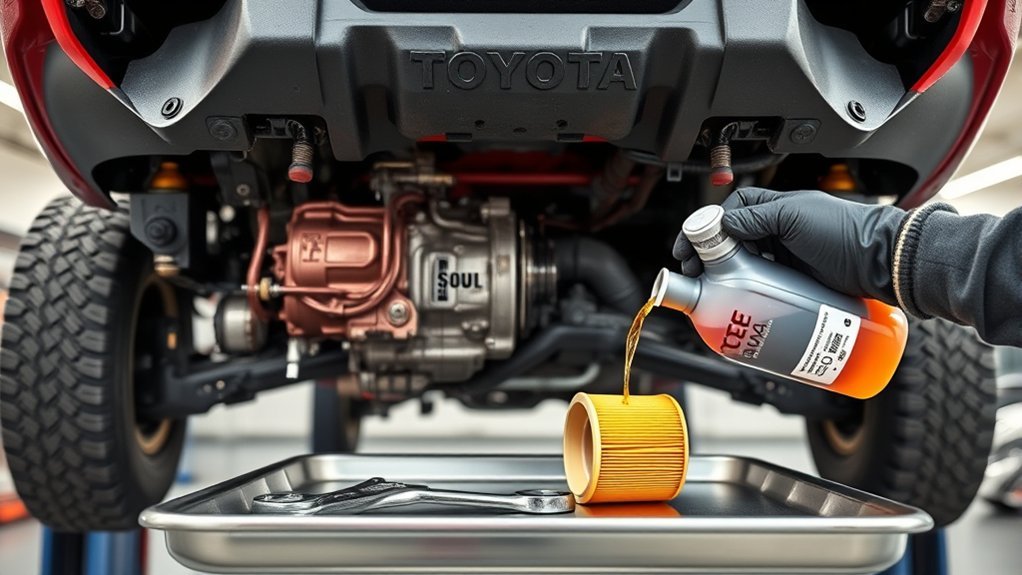
Transmission fluid lubricates internal parts, supports hydraulic operation, carries heat, and helps the transmission shift correctly. As fluid ages, heat and contamination can reduce its ability to perform these jobs. However, that does not mean every Tacoma needs fluid replacement at the same mileage.
Start by identifying your truck’s model year, engine, drivetrain, and transmission. Then retrieve the matching owner’s manual and warranty and maintenance guide. Do not rely on an interval copied from a different generation, transmission, or driving pattern.
For example, the official 2026 Toyota Tacoma Warranty & Maintenance Guide lists automatic-transmission-fluid inspections at specified points under the normal schedule. Its special-operating-condition chart calls for fluid replacement at 60,000 and 120,000 miles when the truck is used primarily under qualifying conditions. Those conditions include towing or heavy loading and extensive idling or low-speed driving for long distances.
Note: The 2026 schedule is an example, not a rule for every Tacoma. Older and newer model years may use different transmissions, fluids, inspections, and service requirements.
Toyota’s schedule uses separate terms for inspection and replacement. An inspection may involve checking for leakage, cooler-line condition, fluid-related symptoms, or other specified items. Replacement means servicing the fluid according to the approved procedure. It does not automatically mean connecting the transmission to a powered flushing machine.
Recognizing Signs Your Tacoma’s Transmission Needs Attention
A change in shifting does not always confirm internal transmission damage, but it should not be ignored. Record when the symptom occurs, whether the truck is hot or cold, its speed, throttle position, load, selected gear, and any dashboard message.
- Slipping or engine-speed flare: Engine rpm rises without a matching increase in road speed.
- Delayed engagement: The truck hesitates before moving after you select Drive or Reverse.
- Harsh or irregular shifts: Gear changes feel unusually abrupt, inconsistent, or poorly timed.
- Shuddering: A vibration appears during acceleration, light-throttle cruising, or a gear change.
- Warning lights or messages: The check-engine light or another powertrain warning appears.
- Unusual sounds: Whining, grinding, clunking, or repeated clicking occurs with vehicle movement or shifting.
- Burning odor or smoke: Heat, leaking fluid, or another mechanical problem may be present.
- Visible leakage: Fresh fluid appears beneath the truck or around a transmission, cooler hose, fitting, or seal.
Fluid color alone does not identify a leak reliably. Engine oil, coolant, transfer-case oil, differential oil, power-steering fluid on equipped models, and transmission fluid can spread across underbody components before reaching the ground. Have the source identified before adding fluid.
Warning: Stop driving and seek assistance if the truck loses drive, produces smoke, develops a major leak, displays an overheating warning, or makes severe grinding noises. Continuing to drive may increase damage or create a traffic hazard.
Effective DIY Techniques for Maintaining Your Tacoma’s Transmission
You can complete several useful checks without opening the transmission or disturbing its fluid level:
- Confirm the vehicle details. Record the model year, VIN, engine, drivetrain, mileage, and transmission type.
- Review the official schedule. Compare the normal schedule with any special-use schedule that applies to your driving.
- Check service records. Look for the date, mileage, fluid specification, quantity, and procedure used during previous work.
- Inspect the parking area. Place clean cardboard beneath the truck overnight to make fresh drips easier to locate.
- Look for visible leakage. Use a flashlight from a safe position. Check accessible areas around the transmission, cooler lines, connections, and nearby components.
- Record symptoms before clearing codes. Photograph warning messages and save diagnostic trouble codes and freeze-frame data when possible.
- Check recall status. Enter the VIN at the NHTSA recall lookup before authorizing a major repair.
Some Tacomas use sealed-transmission level procedures rather than a conventional engine-bay dipstick. Fluid service may require the vehicle to remain level while raised, the fluid to be within a specified temperature window, and a particular sequence of filling, checking, and closing the level plug.
Warning: Never work beneath a vehicle supported only by a jack. Transmission fluid and exhaust components can cause serious burns. Do not open a fill, drain, or overflow plug unless you have the correct service procedure, lifting equipment, fluid, and protective gear.
Use only the fluid specification stated for your exact transmission. A fluid that works in one Tacoma generation may not meet the friction, viscosity, or compatibility requirements of another. Do not mix products based only on color or a broad “universal” label.
How Driving Habits Impact Transmission Longevity

Heat and load strongly affect transmission operation. Repeated heavy acceleration, overloaded towing, deep-sand driving, prolonged low-speed work, and stop-and-go operation can increase heat and place greater demand on the fluid, clutch packs, torque converter, cooler, and seals.
Use the towing and payload limits in your exact owner’s manual. Include passengers, cargo, accessories, trailer tongue weight, and items carried in the bed when calculating load. A truck can exceed payload before reaching its advertised trailer limit.
Allow the truck to stop fully before moving between Reverse and Drive. Use smooth throttle inputs, avoid repeatedly rocking a stuck truck between gears, and use the transmission or towing controls described in the owner’s manual. If the truck displays a temperature warning while towing, reduce the load on the powertrain and follow the manual’s warning instructions.
Pro Tip: Keep a simple maintenance log that records mileage, towing frequency, payload use, warning messages, fluid service, and shift symptoms. This history helps a technician reproduce intermittent problems and choose the correct maintenance schedule.
What Transmission Issues to Watch Out For in Your Tacoma?
Tacoma transmission symptoms can come from hydraulic, electrical, software, cooling, engine, driveline, or mounting problems. Avoid replacing parts until the vehicle has been tested under the conditions that produce the complaint.
- Low fluid caused by leakage: A cooler line, fitting, seal, pan area, or another component may be leaking.
- Incorrect fluid level or specification: Overfilling, underfilling, or using an unsuitable fluid can affect shifting.
- Torque-converter or clutch concerns: These may create shuddering, slipping, or abnormal engagement.
- Control-system faults: Sensors, wiring, solenoids, modules, or calibration issues can affect shift timing.
- Cooling problems: Restricted airflow, cooler damage, or demanding use can contribute to excessive heat.
- Mechanical wear: Internal bearings, clutches, gears, valves, or other components may deteriorate.
- Non-transmission problems: Engine misfires, worn mounts, driveshaft joints, wheel or tire faults, and differential problems can feel similar to transmission shudder.
Do not assume a vibration at one speed proves torque-converter failure. A complete diagnosis may include a road test, code scan, fluid-leak inspection, engine misfire data, tire and wheel checks, driveline inspection, and verification of software or service information applicable to the VIN.
How to Fix Common Transmission Problems?
The correct repair depends on the cause. A fluid service may help when the maintenance schedule calls for it or when testing identifies a fluid-related problem, but fluid replacement cannot repair every worn or broken component.
Regular Fluid Changes
Use the following decision guide instead of applying one interval to every Tacoma:
| Situation | Recommended Action |
|---|---|
| Model year or transmission is unknown | Identify the truck by VIN and retrieve the correct Toyota guide before choosing an interval or fluid. |
| Normal driving with complete records | Follow the inspections and replacements listed in the exact model-year schedule. |
| Frequent towing, heavy loading, prolonged idling, or low-speed commercial use | Review the special-operating-condition chart. Service may be required earlier or more often than under normal use. |
| High mileage with unknown service history | Have the transmission inspected and discuss the safest service method before authorizing an aggressive exchange. |
| Wrong fluid, contamination, debris, or a major leak is suspected | Stop guessing and obtain a professional diagnosis. Internal inspection or repair may be necessary. |
A drain-and-fill removes part of the fluid and replaces it with the correct product. Other procedures may replace more fluid. A powered flush should not be treated as a default maintenance step. Ask the shop which Toyota procedure it will follow, which fluid it will use, how it will verify the final level, and why the recommended method fits your truck.
Monitor Transmission Temperature
A compatible scan tool may display transmission-related temperature data, but the reading must be interpreted using the correct service information. Sensor location, transmission design, ambient temperature, vehicle speed, towing load, and operating mode can all affect the number.
Do not use a universal “safe” range copied from another vehicle. Watch for dashboard warnings, unusual shifting, a burning odor, reduced performance, or temperature behavior that differs sharply from the truck’s normal pattern under similar conditions.
If a warning appears, reduce throttle and load, move to a safe location, and follow the owner’s manual. Do not remove a hot transmission plug or assume that adding fluid will solve the problem. Low fluid is only one possible cause of excessive heat.
Address Shuddering Immediately
Shuddering deserves timely diagnosis, but it does not automatically mean the transmission needs a flush or replacement.
| Possible Source | Useful Next Step |
|---|---|
| Fluid level, leakage, or fluid condition | Inspect for leaks and verify level and condition using the correct Toyota procedure. |
| Torque converter or transmission control | Road-test while monitoring commanded gear, converter operation, codes, and relevant live data. |
| Engine misfire or poor combustion | Check misfire counters, ignition, fuel delivery, and engine codes. |
| Tires, wheels, or driveline | Inspect tire condition, balance, driveshaft joints, differential components, and operating-speed patterns. |
| Engine or transmission mounts | Inspect for damaged rubber, excess movement, or contact between components. |
Preserve diagnostic trouble codes before disconnecting the battery or clearing the warning light. Erasing data can make an intermittent fault harder to reproduce.
Community Insights: What Tacoma Owners Are Saying
Owner communities can help you recognize symptom patterns, find photographs of leak locations, and prepare questions for a repair shop. They should not replace the maintenance guide or a diagnosis performed on your truck.
Posts that describe high-mileage Tacomas show what may be possible, but they do not prove that every transmission will reach the same mileage. Owners may use their trucks differently, follow different service schedules, omit past repairs, or have different engines and transmissions.
Maintenance Practices Shared
The most useful community practices are those that support verifiable maintenance:
- Recording the exact fluid brand and specification used.
- Saving invoices and noting the mileage of each service.
- Checking for leaks before and after towing trips.
- Comparing recommendations with the correct Toyota guide.
- Photographing warning messages and saving scan data.
- Seeking a second diagnosis before authorizing a complete transmission replacement.
Recommendations based only on “what everyone does” should be treated cautiously. A schedule suitable for a heavily loaded work truck may not match a lightly used personal truck, and advice for one generation may be wrong for another.
Transmission Issues Discussed
| Common Online Claim | Better Response |
|---|---|
| “Lifetime fluid means it must never be serviced.” | Read the exact Toyota maintenance chart, including its special-operating-condition section. |
| “Every shudder needs a transmission flush.” | Diagnose transmission, engine, tire, wheel, mount, and driveline causes before selecting a repair. |
| “Any reddish spot proves the transmission is leaking.” | Trace the fluid to its source. Color can change with age and contamination. |
| “One mileage interval works for every Tacoma.” | Match the interval to the model year, transmission, maintenance guide, and operating conditions. |
| “An online complaint proves every truck has the same defect.” | Check the VIN for recalls and have the individual vehicle tested before drawing conclusions. |
When to Seek Professional Help for Transmission Issues?
Arrange professional diagnosis when slipping, delayed engagement, shuddering, harsh shifts, unusual noises, leakage, or warning lights persist. Immediate assistance is appropriate if the truck will not move normally, loses a gear, overheats, leaks heavily, or produces smoke or a strong burning odor.
Professional help is also sensible when the transmission has no conventional dipstick, its service history is unknown, the wrong fluid may have been added, or the repair requires the truck to be raised and kept level. A qualified shop should be able to explain the applicable fluid specification, level-check procedure, scan results, leak source, and evidence supporting the recommended repair.
Before approving major work, ask for:
- The stored, pending, and history diagnostic codes.
- The results of the road test and leak inspection.
- The confirmed fluid specification and service method.
- An explanation of other causes that were ruled out.
- A written estimate separating parts, labor, fluids, taxes, and diagnostic charges.
- Warranty terms for the repair or replacement unit.
- Confirmation that recalls and applicable service information were checked by VIN.
A second opinion can be valuable when the first recommendation is a complete replacement without documented testing.
Frequently Asked Questions
How long should a Toyota Tacoma transmission last?
Toyota does not publish one guaranteed lifespan for every Tacoma transmission. Service life varies with model, maintenance history, fluid condition, towing, load, heat, driving pattern, defects, and repair quality. Following the exact maintenance guide and diagnosing symptoms early gives the transmission its best chance of long service.
Should I change Toyota “lifetime” transmission fluid?
Do not decide from the word “lifetime” alone. Read the maintenance guide for your model year and check its special-operating-condition chart. Some schedules call for inspection during normal use and replacement at specified intervals when the truck is used for towing, heavy loading, extensive idling, or prolonged low-speed driving.
How many years does transmission fluid last in a Toyota Tacoma?
No single number of years applies to every Tacoma. Fluid requirements depend on the model-year schedule, mileage, use, fluid specification, transmission design, and condition. Follow the official guide and documented inspection results rather than a universal two-year or four-year rule.
How much does it cost to replace a Tacoma transmission?
The total depends on the model year, transmission, damage, parts availability, new or remanufactured unit, labor rate, programming, fluids, taxes, and warranty. Obtain a confirmed diagnosis and itemized written estimates instead of relying on one national price range.
Is a transmission flush the same as a drain-and-fill?
No. A drain-and-fill removes fluid through the drain opening and replaces a measured amount. Other exchange methods may replace more fluid. Do not assume a powered flush is required. The shop should follow a procedure suitable for your transmission, fluid condition, and service history.
What transmission fluid should I use in my Tacoma?
Use only the specification listed for your exact model year and transmission in Toyota’s documentation or service information. Do not choose fluid by color or assume one product is correct for every Tacoma generation.
Conclusion
Your Tacoma’s transmission life depends on more than mileage. The most useful steps are to identify the exact transmission, follow the correct Toyota maintenance chart, account for towing and other demanding use, use the specified fluid, and investigate new symptoms promptly.
A fluid replacement can be valuable when the schedule or diagnosis calls for it, but it is not a universal cure for shuddering, slipping, or harsh shifts. Safe inspection, accurate testing, complete service records, and a qualified second opinion can help you avoid both neglected maintenance and unnecessary repairs.
Sources
- Toyota 2026 Tacoma Warranty & Maintenance Guide — normal and special-operating-condition maintenance charts, sealed-component inspections, and automatic-transmission-fluid service entries.
- Toyota 2023 Tacoma Warranty & Maintenance Guide — model-year-specific maintenance requirements for an earlier Tacoma generation.
- Toyota Owner’s Manuals and Warranty Information — official model and year selection for owner documentation.
- National Highway Traffic Safety Administration Recall Lookup — VIN-based safety-recall checks and recall information.
