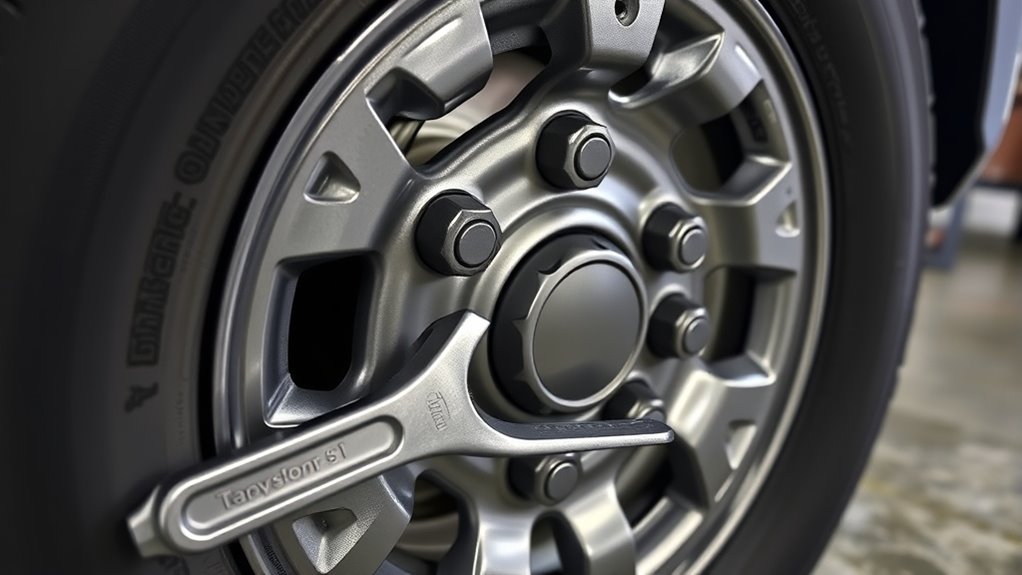
The correct 2025 Tacoma TRD Sport lug nut torque depends on the wheel material, not just the truck’s trim. Factory alloy wheels have a different tightening requirement from steel wheels, and the fourth-generation Tacoma uses different lug hardware from older models. Here’s how to identify the right specifications and install the nuts safely.
Quick Answer
The 2025 Toyota Tacoma TRD Sport requires 97 ft-lb (131 N·m) of lug nut torque for its factory 18-inch alloy wheels. Compatible factory-style lug nuts use M14×1.5 threads and a washer-style seat. A properly fitting socket and calibrated torque wrench are essential. Steel wheels require a different torque specification.
Key Takeaways
- Toyota specifies 154 ft-lb (209 N·m) for steel wheels, including a compatible steel spare, rather than the alloy-wheel setting.
- The fourth-generation Tacoma uses M14×1.5 wheel-stud threads. Older Tacoma lug nuts may not fit.
- A 21 mm (13/16-inch) socket fits many compatible lug nuts, but the actual hex size should be confirmed.
- Factory alloy wheels require compatible washer-seat lug nuts. Aftermarket wheels may need a different seat design.
- Toyota instructs owners to retighten the wheel nuts within 100 miles (160 km) after wheel installation.
- Damaged, rounded, or swollen lug nuts should be replaced rather than forced into place.
2025 Tacoma TRD Sport Lug Torque
)
The 2025 Tacoma TRD Sport uses 97 ft-lb (131 N·m) of wheel lug torque with its factory aluminum alloy wheels. Toyota lists this value in the wheel installation instructions of its 2025 Tacoma owner’s manual.
This measurement is the rotational force applied to each wheel nut with a torque wrench. It helps produce the clamping force that holds the wheel firmly against the hub.
The correct specification is important because excessive or insufficient torque can damage components or allow a wheel to loosen.
Alloy Wheel vs. Steel Wheel Torque
Toyota provides separate tightening specifications for aluminum and steel wheels. This matters when installing a spare tire or changing to a different wheel material.
| Wheel Type | Torque (ft-lb) | Torque (N·m) |
|---|---|---|
| Factory aluminum alloy wheel | 97 | 131 |
| Steel wheel or compatible steel spare | 154 | 209 |
These values apply to the wheel types specified by Toyota. If your truck has nonfactory wheels, confirm that the wheels, nuts, and mounting hardware are suitable for the vehicle before tightening them.
Use the torque specified for the wheel material and matching hardware, not a value copied from an older Tacoma generation.
Why Correct Torque Matters
Wheel nuts secure the wheel by stretching the studs slightly as they are tightened. This creates clamping force between the wheel and hub.
If torque is too low, the wheel may move against the hub. That movement can cause vibration, fastener loosening, and damage around the mounting holes.
Overtightening can stretch studs beyond their intended range, damage threads, or make future removal difficult. It can also affect how securely the wheel remains clamped.
A calibrated torque wrench provides a more reliable final measurement than tightening by feel or using an impact wrench alone.
Tacoma TRD Sport Lug Nut Size, Thread Pitch, and Socket
The 2025 Toyota Tacoma TRD Sport uses M14×1.5 lug nut threads. This is different from the M12×1.5 specification commonly associated with previous Tacoma generations.
The M14 measurement identifies a nominal thread diameter of 14 mm. The 1.5 measurement describes the distance, in millimeters, between adjacent thread peaks.
A lug-nut manufacturer’s fitment specifications confirm M14×1.5 compatibility with the 2024–2026 Tacoma and list a 21 mm (13/16-inch) hex for its replacement nuts.
What Socket Size Fits Tacoma Lug Nuts?
A 21 mm socket is suitable for many compatible Tacoma lug nuts. However, the socket must fit the actual nut installed on the wheel.
Some replacement lug nuts, wheel locks, and special fasteners use different external dimensions even when their threads match.
Before removing a wheel:
- Check that the socket fits fully over the nut without rocking.
- Use a six-point socket for secure contact with standard hex nuts.
- Avoid forcing an undersized socket onto a swollen or damaged nut.
- Use the proper wheel-lock key if locking nuts are installed.
- Make sure the socket provides enough clearance to avoid scratching the wheel.
The socket size describes the outside hex of the lug nut. It does not identify the stud’s thread diameter.
Flat-Seat Washer Design
Factory-style Tacoma alloy wheel nuts use a washer-style seating arrangement. The washer contacts the wheel’s flat mounting surface and helps distribute the clamping force.
Toyota identifies genuine replacement part 90942-A1008 as a hub nut with washer.
Not every Toyota wheel uses the same nut. Depending on wheel design, other genuine part numbers may apply.
Standard tapered or conical lug nuts should not be substituted for washer-seat nuts on wheels designed for flat seating.
Likewise, washer-seat nuts should not be installed on aftermarket wheels that require a tapered or another specialized seat.
Why Tacoma Lug Nuts Swell
Lug nut swelling can occur when corrosion develops beneath the outer shell of a two-piece capped nut. Moisture, road salt, and temperature changes can make the shell expand or deform.
Not every Tacoma lug nut uses the same construction, so swelling should be diagnosed by inspecting the installed hardware rather than assuming all factory nuts have this problem.
Swelling usually becomes noticeable when a correctly sized socket no longer slides over the nut or cannot grip it securely.
| Condition | Effect |
|---|---|
| Moisture ingress | Corrosion can develop beneath a cap |
| Road salt | Accelerates rust and surface deterioration |
| Two-piece capped design | May trap moisture between metal layers |
| Swelling or rounded hex | Makes socket engagement and removal difficult |
| Damaged threads or seating surface | Can prevent proper installation and clamping |
Signs a Lug Nut Needs Replacement
Inspect lug nuts whenever you remove a wheel, especially if the truck regularly encounters rain, mud, or salted winter roads.
Common warning signs include:
- A socket that previously fit no longer slides over the hex.
- Visible rust, cracking, or separation around an outer cap.
- Rounded corners that allow the socket to slip.
- Threads that bind or do not turn smoothly by hand.
- Damaged washers or seating surfaces.
- A loose or missing protective cap on a capped nut.
These problems are among the replacement indicators explained in Discount Tire’s lug nut replacement guidance.
Do not reuse a lug nut with damaged threads, a cracked body, or a deformed seating surface.
If a nut is stuck because of swelling or corrosion, avoid repeated force that might damage the wheel stud. A tire professional can select suitable extraction tools and inspect the remaining hardware.
How to Torque Tacoma Wheels Correctly
To torque the factory alloy wheels on a 2025 Toyota Tacoma TRD Sport, use a calibrated torque wrench set to 97 ft-lb (131 N·m). Tighten the nuts evenly in a star or cross pattern after confirming the correct wheel and lug nut fitment.
You will need a suitable socket, a torque wrench with the necessary range, and the equipment required to lift and secure the vehicle if a wheel is being removed.
Warning: Never apply oil or grease to Tacoma wheel studs or lug nut threads before tightening. Toyota warns that lubrication can cause excessive tightening and damage. Never work under a vehicle supported only by a jack. Use the proper lifting points and approved support equipment.
Step-by-Step Wheel Lug Nut Tightening
- Park on level ground. Apply the parking brake and secure the vehicle against movement with wheel chocks. Keep the transmission in Park or the appropriate gear for a manual transmission.
- Loosen the nuts before lifting. If removing a wheel, loosen the nuts slightly while the tire is still on the ground. Follow Toyota’s approved jack-point and lifting instructions.
- Inspect the mounting surfaces. Remove dirt and loose corrosion from the hub and wheel contact surfaces. Check the studs, nuts, and mounting holes for damage.
- Start the nuts by hand. Position the wheel securely and thread each compatible lug nut by hand. Do not use an impact wrench to start a nut that may be cross-threaded.
- Snug the nuts in a star pattern. Alternate across the wheel rather than tightening neighboring nuts in sequence. This helps the wheel seat evenly against the hub.
- Lower the vehicle for final tightening. With the wheel resting securely against the ground and unable to rotate, use the calibrated torque wrench. For the factory alloy wheels, tighten to 97 ft-lb (131 N·m).
- Confirm the final torque. Make another pass around the wheel in the same cross pattern to confirm that every nut has reached the specified setting.
For a six-lug wheel, alternate between nuts on opposite sides of the hub rather than moving around the circle in order.
When Should You Recheck Lug Nut Torque?
Toyota instructs owners to retighten wheel nuts within 100 miles (160 km) after wheel installation.
This applies after work such as changing a tire or removing and reinstalling a wheel during maintenance.
Rechecking confirms that the hardware remains properly tightened after the wheel has seated during initial use.
Use the appropriate torque value for the installed wheel. Do not assume that the alloy-wheel setting applies to a steel spare.
Common Lug Nut Installation Mistakes
The most common errors involve incorrect hardware, uneven tightening, and using the wrong tools.
- Using M12 instead of M14: An older Tacoma lug nut will not correctly fit the fourth-generation truck’s M14 studs.
- Mixing seat designs: A nut with the wrong seat may not clamp the wheel correctly.
- Using an impact wrench for final torque: Impact tools can apply inconsistent or excessive force.
- Skipping the cross pattern: Uneven tightening can prevent the wheel from seating properly.
- Ignoring damaged threads: A nut that binds or cross-threads can damage the stud.
- Applying the alloy torque to a steel wheel: Toyota specifies a separate tightening value for steel wheels.
If a nut cannot be tightened smoothly, stop and inspect the threads and seating surface before continuing.
Which Lug Nuts Fit Tacoma TRD Sport Wheels
The correct lug nuts for factory 2025 Tacoma TRD Sport alloy wheels must match the truck’s M14×1.5 wheel studs and the wheel’s washer-style seating design.
Thread compatibility alone does not guarantee safe fitment. The nut’s seat, shank dimensions, thread engagement, and wheel design must also be compatible.
Factory Wheel Specifications
The 2025 Tacoma TRD Sport comes with 18-inch alloy wheels and 265/65R18 tires in its standard factory configuration.
These dimensions are confirmed by Toyota Canada’s 2025 Tacoma product specifications.
The TRD Sport’s standard wheel size should not be confused with the 17-inch alloy wheels used on some other Tacoma trims.
OEM vs. Aftermarket Lug Nuts
Genuine Toyota wheel nuts are designed for specific factory wheel applications. They offer a straightforward replacement option when the correct part number is matched to the truck and wheel.
Aftermarket nuts can also work, but they must meet the same fitment requirements.
Before selecting replacement lug nuts, confirm:
- M14×1.5 thread size and pitch.
- Correct flat washer or other required seat design.
- Proper shank length and thread engagement.
- Suitable fastener strength and construction.
- Compatible socket or wheel-lock key.
- A corrosion-resistant finish appropriate for regular road conditions.
Black lug nuts can complement the TRD Sport’s wheel appearance, but the finish is secondary to mechanical compatibility.
For aftermarket wheels, use the wheel manufacturer’s specified seat type and fastening hardware rather than assuming the original Toyota nuts will fit.
Can You Use Tapered Lug Nuts on Factory Wheels?
Ordinary conical-seat lug nuts are not direct substitutes for the washer-seat nuts used with factory Tacoma alloy wheels.
The seating surface must match the wheel. Otherwise, the nut may contact the wheel incorrectly and fail to produce reliable clamping force.
When installing a compatible steel spare, follow Toyota’s specific instructions for how the tapered portion of the supplied nut contacts the steel wheel.
If wheel fitment is uncertain, a Toyota dealer or qualified tire specialist can identify the correct hardware using the vehicle identification number and wheel part number.
Frequently Asked Questions
What Is the Torque of a 2025 Toyota Tacoma?
The 2025 Toyota Tacoma requires 97 ft-lb (131 N·m) of wheel lug nut torque for factory aluminum wheels. Toyota specifies 154 ft-lb (209 N·m) for steel wheels. Always use the specification for the installed wheel material and compatible fastening hardware.
What Is the Torque Spec for Toyota Tacoma Wheels?
Toyota Tacoma wheel torque varies by model year and wheel material. For the 2025 TRD Sport, the factory alloy-wheel specification is 97 ft-lb (131 N·m). Older Tacoma models can use different settings, so their torque values should not be applied to this truck.
What Type of Lug Nuts Are Compatible With a 2025 Toyota Tacoma?
The 2025 Toyota Tacoma uses M14×1.5 lug nut threads. Factory alloy wheels require compatible washer-style seating hardware, while some aftermarket wheels use different seat designs. Match the thread size, seat type, shank dimensions, and wheel specifications before installation.
What Size Wheels Are Standard on a 2025 TRD Sport Tacoma?
The 2025 Toyota Tacoma TRD Sport comes standard with 18-inch alloy wheels and 265/65R18 tires. Other Tacoma trims may use different factory wheel sizes. If aftermarket wheels are installed, confirm their mounting and lug nut specifications separately.
Conclusion
For the 2025 Tacoma TRD Sport, 97 ft-lb (131 N·m) is the correct lug nut torque for factory alloy wheels. Use M14×1.5 hardware with the proper washer-style seat, tighten evenly with a calibrated torque wrench, and follow Toyota’s retorque guidance.
Before installing replacement wheels or lug nuts, confirm that every fastening component matches the wheel and vehicle. Correct fitment matters just as much as the torque setting.
Sources
- Toyota Motor Sales, 2025 Tacoma Owner’s Manual, OM04011U: Official wheel nut torque specifications, wheel installation procedure, steel-wheel exception, and 100-mile retorque requirement.
- Toyota Canada, 2025 Tacoma Product Information: Factory TRD Sport wheel diameter and tire size.
- Toyota Genuine Parts, Hub Nut with Washer, Part 90942-A1008: Factory-style washer-seat lug nut identification.
- KSP Performance, M14×1.5 OEM Lug Nut Specifications: Fourth-generation Tacoma thread compatibility and replacement nut hex dimensions.
- Discount Tire, How to Replace OE and Aftermarket Lug Nuts: Lug nut swelling, damage inspection, seat compatibility, and replacement guidance.