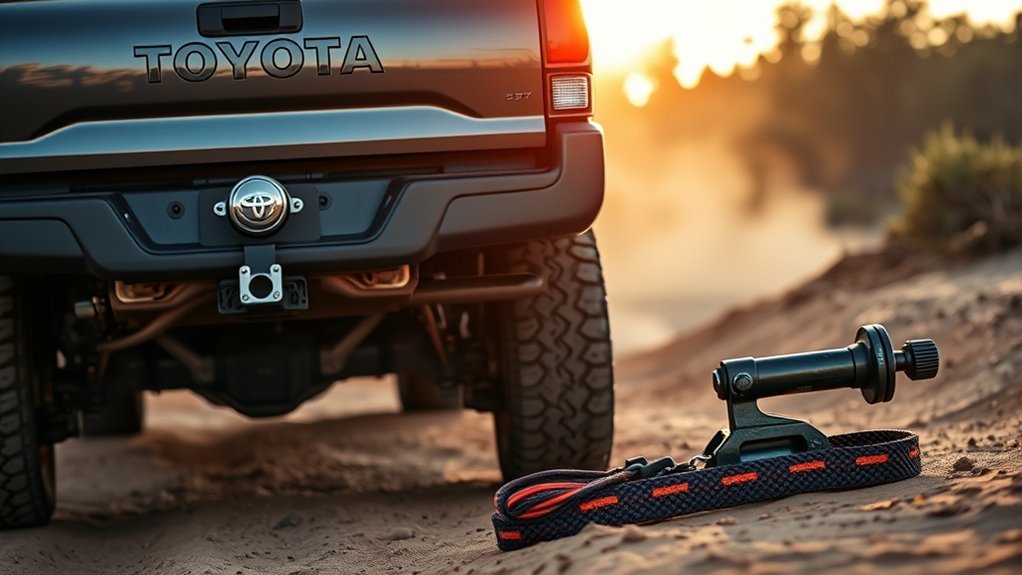
Your Tacoma’s trailer hitch and recovery points may both connect to the truck’s structure, but they are not automatically interchangeable. A hitch is designed primarily for controlled trailer loads. A recovery point is intended for attaching suitable equipment while freeing a stuck vehicle. The safe choice depends on your Tacoma’s model year, trim, hardware, published ratings, permitted pull direction, and recovery method.
Quick Answer
A Tacoma tow hitch is designed for trailer loads, while a recovery point is intended for pulling a stuck vehicle. Never attach a recovery rope to a hitch ball, ordinary ball mount, or unidentified loop. Use only Toyota-approved points or vehicle-specific rated hardware, following the lowest rating in the complete recovery system.
Key Takeaways
- Do not judge an attachment by its appearance or by the words “hook” or “tow point.” Verify its intended use in the exact vehicle or product instructions.
- Some current Tacoma models have factory recovery hooks or recovery points, while other loops may serve a different purpose.
- A trailer ball and ordinary ball mount are not suitable recovery attachments.
- Choose vehicle-specific hardware with published ratings, approved pull directions, correct mounting hardware, and clear installation instructions.
- Clear the recovery area, inspect every component, use one person to direct the operation, and stop if anything shifts, bends, cracks, or loosens.
Understanding the Difference: Tow Hitch vs. Recovery Point
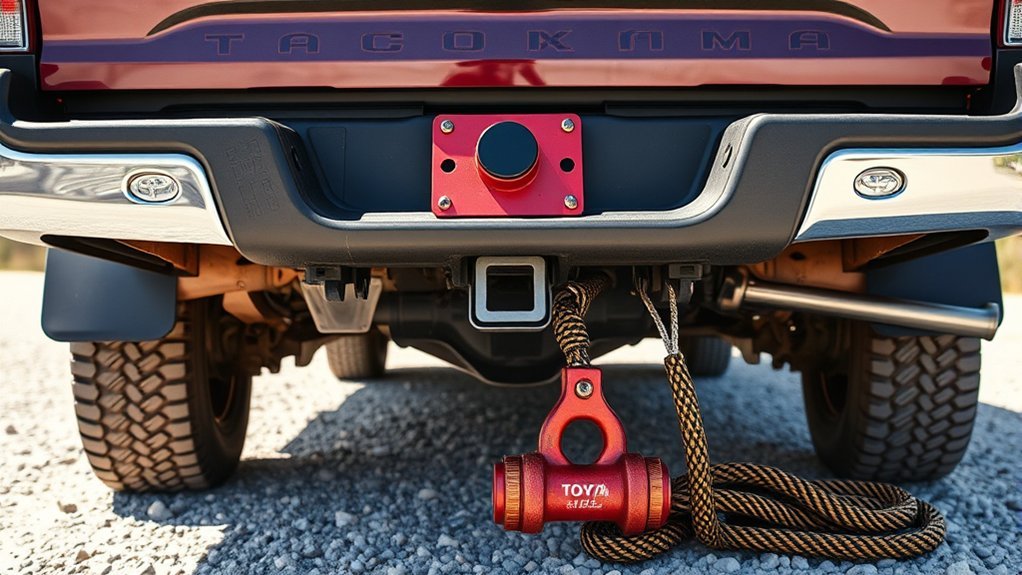
A tow hitch is built primarily for pulling a trailer within the limits assigned to the truck, hitch, ball mount, ball, and trailer equipment. Those loads normally include trailer weight, tongue weight, braking forces, and movement encountered during ordinary road towing.
A recovery point provides an attachment for equipment used to free a stuck or disabled vehicle. Recovery can place sudden or changing loads on the attachment, especially when a vehicle has sunk into mud, become high-centered, or is pulled at an angle.
| Feature | Tow Hitch | Recovery Point |
|---|---|---|
| Primary purpose | Towing a compatible trailer | Attaching approved vehicle-recovery equipment |
| Typical loading | Controlled trailer and tongue loads | Static, winching, or dynamic loads allowed by the manufacturer |
| Safe attachment | Correct towing ball mount and ball for trailer use | Approved recovery hook, point, or rated receiver recovery insert |
| How to verify | Truck, hitch, and towing-equipment labels and manuals | Vehicle manual and recovery-point or accessory instructions |
A rear receiver hitch may be part of a recovery setup only when it is structurally suitable and used with a purpose-built, rated receiver recovery insert approved for that application. The receiver opening alone does not prove that every recovery method or direction is permitted.
Warning: Never loop a kinetic rope, winch line, or recovery strap over a trailer ball or ordinary ball mount. Do not attach recovery gear to suspension parts, axles, bumpers, safety-chain loops, or unidentified transport tie-downs unless the vehicle manufacturer expressly approves that use.
Are Factory Tacoma Tow Points Safe for Recovery?
You cannot answer this question for every Tacoma with a simple yes or no. Toyota has used different hooks, loops, bumpers, and mounting arrangements across generations, trims, markets, and equipment packages.
Toyota states that the current-generation Tacoma offers standard front and optional rear recovery hooks. Toyota also identifies robust rear recovery points as part of the factory-developed Trailhunter equipment. Those components should not be grouped with unidentified transport tie-down loops.
However, the presence of a hook does not establish every permitted recovery method. A factory component may have limits covering its direction of pull, compatible connector, number of points used, or approved recovery method. A component on one Tacoma generation or trim may also differ from a similar-looking component on another.
- Identify the part: Confirm whether Toyota calls it a recovery hook, towing eye, tie-down, or another type of attachment.
- Check the exact manual: Use the manual for your Tacoma’s model year and market, not instructions written for a different generation.
- Inspect its condition: Do not use a bent, cracked, loose, heavily corroded, or collision-damaged attachment.
- Follow stated restrictions: Observe any limits on pull direction, connectors, bridles, or dynamic recovery.
Note: Toyota provides model-year-specific information through its Tacoma manuals and warranty portal. If the manual does not clearly approve a component for your planned recovery method, do not assume that its appearance makes it suitable.
Why Are Vehicle-Specific Aftermarket Recovery Points Better?
A well-designed aftermarket recovery point can add a clearly identified attachment where suitable factory equipment is absent or inaccessible. The benefit comes from engineering, testing, fitment, mounting, and published instructions rather than from the aftermarket label alone.
Aftermarket products vary widely. Choose a reputable manufacturer that identifies the exact Tacoma applications, intended recovery methods, installation hardware, load direction, and inspection requirements.
Enhanced Safety Features
A purpose-built point gives you a defined location for connecting compatible recovery equipment. Companies such as ARB describe their recovery points as rated, tested, and engineered for vehicle-specific fitment and load distribution.
That does not make every product suitable for every pull. The product instructions must still approve the connector, direction, method, and vehicle configuration you intend to use.
Published Load Ratings
A useful recovery point should have a published rating or other clearly stated operating limit from its manufacturer. Do not rely on an unsourced marketplace description, paint color, plate thickness, or the apparent size of a hook.
Check the rating and instructions for every load-bearing part in the system, including:
- The truck’s recovery point or approved receiver insert
- The shackle or connector
- The strap, rope, or winch line
- Any bridle, pulley, extension, or tree-protection strap
- The recovery vehicle’s attachment point
The weakest or most restricted compatible component controls the setup. A highly rated rope does not make an unidentified hook safe.
Engineered for Durability
Material thickness can contribute to strength, but thickness alone does not establish a safe recovery point. Shape, material grade, weld quality, bolt size, bracket design, frame load distribution, corrosion protection, testing, and installation all matter.
Choose a product with complete instructions and supplied or specified hardware. Avoid homemade plates, unknown hooks, copied brackets, or products that advertise a large capacity without explaining how the capacity was established.
Essential Features to Look for in Tacoma Recovery Points
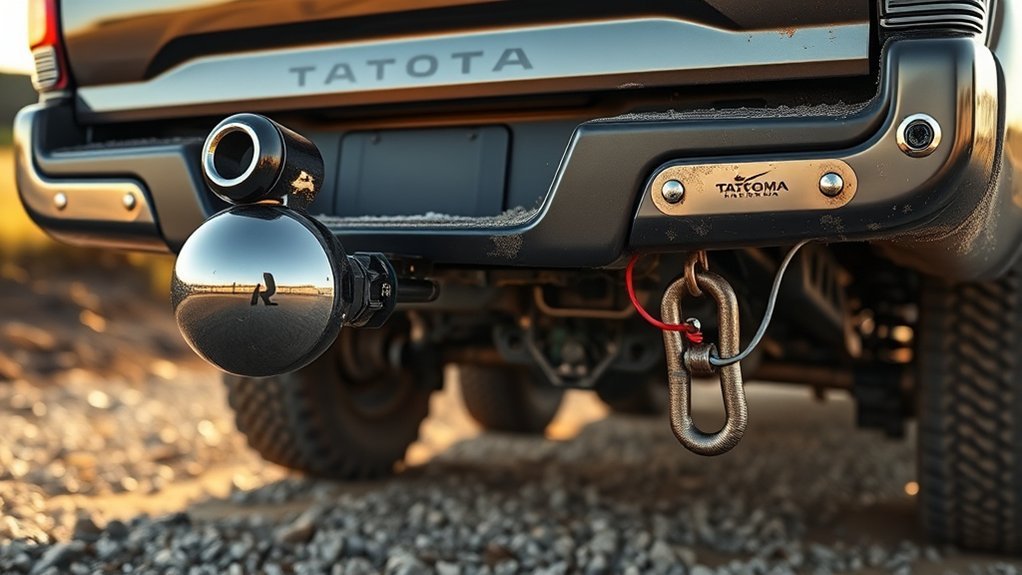
Use the following checklist when comparing recovery points for your Tacoma:
- Exact fitment: The manufacturer should list your model year, trim, drivetrain, cab or frame configuration, and mounting position.
- Published operating information: Look for a stated rating, compatible connectors, and approved recovery methods.
- Permitted pull direction: Confirm whether the point allows straight pulls, angled pulls, vertical loading, a bridle, or only specific directions.
- Vehicle-specific mounting: The brackets and fasteners should distribute the load through approved chassis locations.
- Complete hardware: Use the specified bolts, nuts, washers, spacers, and reinforcement plates.
- Modification compatibility: Verify clearance with the bumper, skid plates, winch, suspension, sensors, and other accessories.
- Accessible attachment opening: You should be able to connect the approved shackle without forcing it against a sharp edge.
- Installation instructions: The manufacturer should provide tightening specifications, sequence, inspection steps, and any retorque requirement.
- Replacement guidance: Instructions should explain what damage, deformation, corrosion, or hardware condition requires replacement.
Do not select a recovery point only because it is thicker, heavier, or advertised with a large number. A lighter engineered assembly with documented fitment and testing may be more suitable than a heavier unidentified plate.
How to Choose the Right Recovery Point for Your Tacoma
Start with the truck, then choose the equipment. Buying a point first and trying to adapt it later can create alignment, clearance, and load-distribution problems.
Assess Vehicle Requirements
Record the following details before shopping:
- Your Tacoma’s model year and market
- Trim and drivetrain
- Front or rear mounting position
- Factory or aftermarket bumper
- Skid plates, winch, receiver hitch, lift, and other modifications
- Visible frame damage, corrosion, or previous collision repairs
- The recovery methods you expect to use
A point designed for a stock bumper may not fit an aftermarket bumper. Likewise, a bracket for one Tacoma generation may align with neither the frame nor the hardware on another generation.
Compare Recovery Point Ratings
Compare products using their official instructions rather than one headline capacity. Check:
- How the rating is defined
- Whether it applies to one point or a pair
- Which pull directions are approved
- Whether kinetic recovery is permitted
- Which shackles or connectors fit the opening
- Whether a bridle is required, optional, or prohibited
- Whether modifications change the product’s approval
Do not combine incompatible rating systems or assume that two points automatically double the permitted load. A bridle changes the direction and distribution of force, and it should be used only when the point and vehicle manufacturers approve that arrangement.
Evaluate Installation Compatibility
Examine the mounting area before installation. The recovery-point bracket should sit correctly against the intended chassis surfaces without improvised gaps, stacked washers, elongated holes, or forced alignment.
Use only the specified hardware and tightening procedure. If installation requires drilling, cutting, welding, removing structural parts, or altering airbag-related components, use a qualified installer who understands the product and your Tacoma’s structure.
Pro Tip: Save the installation instructions and photograph the finished mounting points. This gives you a reference for later inspections and helps another driver identify the approved attachment during a recovery.
Why Proper Fitting Matters for Recovery Points
A recovery point must transfer force into the vehicle through the locations intended by its designer. Incorrect spacers, missing hardware, loose bolts, misaligned brackets, or damaged mounting surfaces can concentrate load where the product was not designed to carry it.
Before first use:
- Confirm that all supplied components were installed.
- Check the required tightening specifications and sequence.
- Verify that the point does not contact a hose, wire, sensor, body panel, or moving component.
- Make sure the approved shackle can move as intended without bearing on a sharp or unsupported edge.
- Inspect the surrounding frame for cracks, distortion, severe corrosion, or previous repair damage.
Reinspect the mounting hardware after installation according to the product instructions. Also inspect it after a demanding recovery or any event that may have shock-loaded the attachment.
Recommended Gear for Tacoma Recovery Points

A recovery point is only one part of the system. Build a kit around the terrain, vehicle weight, planned recovery method, and instructions for each component. Manufacturers such as ARB offer recovery equipment tested for strength and safety, but every item still needs to be compatible with the rest of your setup.
- Approved recovery attachments: Confirm suitable points on both vehicles before a trip.
- Compatible shackles: Use a rated soft shackle only on a smooth, compatible attachment. Use a suitable rated metal shackle where the point or equipment instructions require one.
- Recovery rope or strap: Select the type and operating range specified for the recovery method. Do not confuse a kinetic rope with a static tow strap or winch extension strap.
- Winch equipment: Carry the accessories required by the winch manufacturer, which may include gloves, a tree-protection strap, pulley equipment, and a line damper.
- Traction tools: A shovel and traction boards can reduce resistance before you apply pulling force.
- Tire equipment: Carry an accurate gauge and compressor if you adjust tire pressure for terrain. Stay within the tire, wheel, and vehicle limits.
- Communication and safety gear: Include gloves, eye protection, a first-aid kit, lighting, and reliable communication.
- Inspection supplies: A flashlight and cleaning cloth help you check attachment points, stitching, rope fibers, and hardware.
Replace any component that has damage beyond the manufacturer’s permitted condition. Do not hide knots, cuts, melted fibers, bent pins, cracks, or deformation and continue using the item.
How to Stay Safe When Using Recovery Points
Use a controlled process rather than connecting a rope and accelerating immediately.
- Assess the situation: Identify why the Tacoma is stuck, the direction it should move, nearby hazards, and the safest low-force solution.
- Reduce resistance: Dig around the tires, remove packed material, build a gradual path, or use traction boards when appropriate.
- Inspect the complete system: Check both vehicles’ attachments, connectors, ropes, straps, winch equipment, and mounting hardware.
- Choose one recovery leader: Agree on hand signals or radio commands. Only the designated person should direct vehicle movement.
- Clear the area: Keep bystanders away from vehicles, ropes, straps, shackles, and the potential recoil path.
- Connect approved components: Prevent twisting, side-loading, sharp-edge contact, and incompatible connectors.
- Load the system smoothly: Follow the equipment instructions. Avoid unnecessary shock loading or wheelspin.
- Stop at the first warning sign: Stop if a point moves, a bolt loosens, a connector binds, a rope contacts a sharp edge, or the vehicle behaves unexpectedly.
- Inspect after recovery: Clean and examine the points, connectors, rope, strap, and surrounding structure before packing the equipment away.
The safest recovery usually begins by reducing the resistance holding the truck, not by applying the greatest possible pulling force.
Effective Recovery Techniques for Typical Tacoma Off-Road Scenarios
Sand or Snow
Stop before the tires dig deeper. Clear material from in front of the tires, straighten the wheels when practical, and create a gradual exit path. Traction boards or a controlled winch pull may free the truck with less force than a dynamic pull.
If you reduce tire pressure, follow the limits for your tires, wheels, load, and terrain. Reinflate before returning to normal road speeds.
Mud
Determine whether the tires, axles, frame, or underbody are creating resistance. Digging and building a firmer path may be necessary before pulling.
A straight, controlled pull is generally easier on the attachments than an unnecessary side pull. Use kinetic equipment only when the vehicles, attachment points, connectors, and rope are approved for that method and the operators understand the procedure.
High-Centered Truck
If the frame, skid plate, or axle is resting on an obstacle, pulling harder may damage the truck without restoring traction. Stabilize the vehicle, remove material where practical, and build support beneath the tires.
Never place yourself beneath an inadequately supported vehicle. Severe high-centering may require specialized lifting, winching, or professional recovery equipment.
Angled Recovery
Do not assume a point can accept a side load. Reposition the recovery vehicle, change the winch direction with approved equipment, or use another method that keeps the load within the attachment’s permitted direction.
Use a two-point bridle only when both points and the bridle are approved for that arrangement. The bridle angle affects the force applied to each point, so a wider angle is not automatically safer.
Disabled, Unstable, or Severely Stuck Vehicle
Call a professional when the Tacoma is near a rollover, in moving water, blocking traffic, down a steep slope, heavily damaged, or stuck where attachment points cannot be inspected. Professional recovery is also appropriate when available equipment lacks clear ratings or compatibility.
Tips for New Off-Road Enthusiasts to Prevent Vehicle Damage
- Locate the approved points before the trip: Recovery is not the best time to discover that a bumper blocks the attachment.
- Practice without loading the system: Learn how the shackles, receiver insert, winch controls, and traction boards fit before you need them.
- Travel with another prepared vehicle: Confirm that both vehicles have suitable attachment points and compatible equipment.
- Avoid unnecessary wheelspin: Spinning can dig the truck deeper and increase resistance.
- Use the lowest-energy method first: Shoveling, traction boards, or a slow winch pull may be safer than a dynamic recovery.
- Protect recovery equipment: Keep ropes and straps away from oil, chemicals, heat, sharp edges, and abrasive dirt.
- Inspect modifications: Bumpers, skid plates, lifts, and winches can affect access or compatibility.
- Take practical training: Hands-on instruction can teach communication, equipment inspection, winching, and controlled vehicle movement.
Good terrain judgment prevents many recoveries. Walk an uncertain obstacle, watch another vehicle’s line, and turn around when the available equipment or experience does not match the risk.
Related Guides
Frequently Asked Questions
Can a Tacoma tow hitch be used as a recovery point?
Do not use a trailer ball or ordinary ball mount for recovery. A frame-mounted receiver may be usable with a purpose-built, rated receiver recovery insert only when the vehicle, hitch, and accessory instructions approve the setup and recovery method.
What is the difference between a tow hook and a recovery hook?
The name alone does not prove the hook’s rating or intended use. A hook may be intended for transport, towing, loading, or vehicle recovery. Identify the component through the Tacoma owner’s manual or the product manufacturer’s instructions before attaching recovery equipment.
Can a tow bar be used as a recovery point?
Not unless its manufacturer expressly approves that use. A tow bar is normally designed to connect a vehicle for towing, not to accept off-road recovery loads. Use an identified recovery point or an approved receiver recovery accessory instead.
What should you not tow with a Tacoma?
Do not tow a trailer that exceeds the limits for your exact Tacoma configuration, hitch, ball mount, ball, axle ratings, payload, or braking equipment. Model-year and configuration limits vary, so use the owner’s manual, certification label, hitch label, and trailer requirements rather than a universal Tacoma number.
Do all Toyota Tacomas have the same recovery points?
No. Recovery hooks, tie-downs, bumpers, frame mounting, and optional equipment vary by generation, model year, trim, market, and modifications. Verify the exact truck before buying or connecting recovery equipment.
Can you connect a bridle to two Tacoma recovery points?
Only when Toyota or the recovery-point manufacturer approves both points for simultaneous use and provides suitable load-direction guidance. Do not assume two points double the rating, and avoid a wide bridle angle that increases the force applied to each attachment.
Conclusion
A Tacoma tow hitch, transport tie-down, factory recovery hook, and aftermarket recovery point can look similar while serving different purposes. Identify each attachment through the exact vehicle or product instructions before using it.
Some current Tacoma models include factory recovery hooks or recovery points, while other trucks may need a vehicle-specific aftermarket solution. Whichever setup you use, match every component, observe approved pull directions, inspect the mounting hardware, clear the recovery area, and apply force gradually. When the vehicle is unstable, badly damaged, or beyond your equipment and experience, use a professional recovery service.
Sources
- Toyota USA Newsroom: 2024 Toyota Tacoma — confirms factory front and optional rear recovery hooks and Trailhunter rear recovery points.
- Toyota Tacoma Manuals and Warranties — provides model-year-specific owner information and vehicle instructions.
- ARB Recovery Points — supports the use of rated, tested, vehicle-specific recovery attachments.
- ARB Recovery Equipment — provides manufacturer information about recovery ropes, straps, winches, shackles, gloves, and related equipment.
