
Toyota does not publish one universal windshield washer reservoir capacity for every Tacoma model year. Toyota’s general washer-fluid guidance says most vehicle reservoirs hold about one gallon, but that is not a published one-gallon specification for every Tacoma. Your actual refill amount depends on how much fluid is already in the tank, so add washer fluid gradually and use the reservoir level or your model-year owner’s manual rather than forcing in a full jug.
Last updated: September 19, 2026
Quick Answer
Do not assume every Toyota Tacoma washer reservoir holds exactly one gallon. Toyota says most vehicle washer reservoirs hold about a gallon, but the Tacoma owner’s instructions do not establish that as one universal capacity for every model year. Add fluid slowly, use any visible reservoir level markings, and check your model-year owner’s manual when you need vehicle-specific instructions.
Key Takeaways
- Do not treat one gallon as a confirmed capacity specification for every Tacoma model year.
- Reservoir capacity and refill amount are different: a partially filled tank needs only enough fluid to restore its level.
- Use automotive washer fluid and follow the product’s freezing-temperature and dilution instructions.
- Toyota warns not to add washer fluid while the engine is hot or operating because washer fluid can contain alcohol.
- If a washer nozzle is blocked, do not insert a pin or needle; Toyota warns that this can damage the nozzle.
At a Glance
| Time Required | 5 to 10 minutes |
| Difficulty | Easy |
| Tools Needed | Funnel and clean cloth |
| Cost | One bottle of washer fluid; price varies by formula and region |
How Much Washer Fluid Does a Toyota Tacoma Hold?

There is no single Tacoma-wide reservoir capacity you should assume for every model year. Toyota’s general washer-fluid guide says most vehicle reservoirs hold about one gallon, but its Tacoma owner instructions should be used for model-specific maintenance guidance.
Capacity and refill amount are not the same thing. Capacity is the total volume of an empty reservoir. Refill amount is only the fluid needed to restore the level in a partially filled reservoir. That is why the size of the bottle you buy does not tell you how much your Tacoma needs today.
For a normal top-off, check any visible level markings on the reservoir and add fluid gradually. If the tank or level is difficult to see, do not force an entire jug into the filler neck. Pause as you fill and check the level again. Use Toyota’s manual portal to select your exact model year when you need vehicle-specific instructions.
What Toyota confirms for the 2024 Tacoma: The owner’s manual says to add washer fluid when a washer does not work or a warning appears. It also says not to add fluid while the engine is hot or operating, not to substitute soapy water or antifreeze, and to follow the fluid bottle’s freezing-temperature instructions when dilution is needed.
A one-gallon bottle is a convenient purchase size, not proof that every Tacoma reservoir has a one-gallon capacity.
How Do You Check a Tacoma’s Washer Fluid Level?
Park on level ground, turn off the engine, let the engine bay cool, and open the hood. Look for the cap marked with a windshield-and-spray symbol. The reservoir is located in the engine compartment, although the exact layout can vary by model year.
- Look for visible level markings on the reservoir.
- If the reservoir is translucent and visible, inspect the fluid level from the side.
- If your Tacoma displays a low washer-fluid warning, treat it as a prompt to inspect and refill the reservoir.
- Check the ground and accessible washer hoses for signs of leakage before adding more fluid.
Note: Some reservoir bodies are partly hidden by surrounding components, so the cap and filler neck may be easier to see than the entire tank. Routine washer-fluid filling does not require removing body panels.
How Do You Top Off a Toyota Tacoma Washer Reservoir?
- Park and let the engine cool. Turn the engine off and wait until the engine compartment is no longer hot.
- Find the washer-fluid cap. Confirm the windshield-and-spray symbol so you do not confuse the reservoir with the coolant or brake-fluid reservoir.
- Clean around the cap. Wipe away loose dirt so debris does not fall into the reservoir.
- Use a funnel. Pour automotive windshield washer fluid slowly, pausing to check the level as you fill.
- Stop before overfilling. Use visible reservoir markings when available and do not force the remainder of a bottle into a tank that appears full.
- Close and test. Secure the cap, close the hood, and operate the washer briefly to confirm that fluid sprays normally.
Warning: Toyota warns not to add washer fluid while the engine is hot or operating because washer fluid can contain alcohol and may ignite if spilled on hot components. Many washer fluids also contain methanol or other alcohols. Keep the product in its original container and away from children and pets. If someone swallows washer fluid in the United States, contact Poison Control at 1-800-222-1222.
Pro Tip: Keep washer fluid sealed in its original container and use a small funnel during refills. Add only what the reservoir needs instead of treating the bottle size as the target fill amount.
Why Is My Tacoma Washer Fluid Not Spraying?
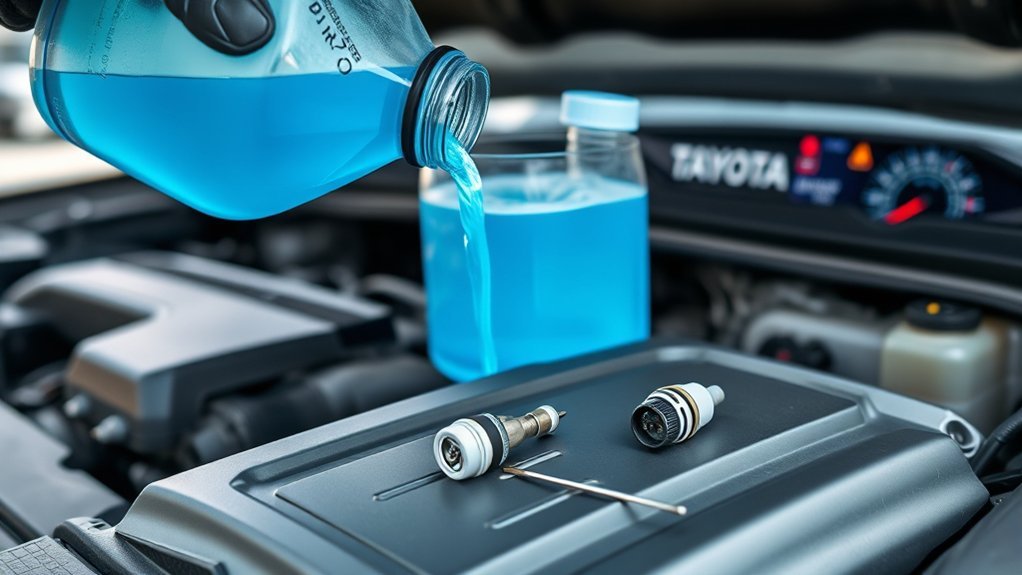
Start with the simplest checks. Confirm that the reservoir contains fluid and that the fluid is suitable for the current temperature. Operate the washer briefly and listen for the pump. Do not hold the washer control continuously when no fluid is coming out, because prolonged operation without spray can damage the pump.
The Pump Is Silent
A silent pump does not automatically mean the pump itself has failed. Possible causes include a fuse, wiring or connector problem, a switch fault, frozen fluid, or a failed pump. Check the fuse information for your exact model year before replacing electrical parts. If electrical diagnosis is outside your experience, have the system inspected.
The Pump Runs, but No Fluid Sprays
Inspect accessible washer hoses for a loose connection, split, pinch, or visible leak. Wipe loose dirt from the outside of the washer nozzles with a soft cloth. If a nozzle itself is blocked, do not insert a pin, needle, or other sharp object. Toyota specifically warns that doing so can damage the nozzle; have a blocked nozzle serviced instead.
The Spray Is Weak or Uneven
Weak or uneven spray can result from low fluid, a restricted nozzle, a damaged hose, a weak pump, or washer fluid beginning to freeze. If freezing is possible, move the truck to a safe warmer location and allow the system to thaw naturally. Do not pour hot water into the reservoir.
The Low-Fluid Warning Stays On
If a low-fluid warning remains after refilling, recheck the fluid level and inspect for obvious leaks. If the reservoir is adequately filled and the warning persists, a level sensor, float, connector, or wiring fault may require diagnosis. Do not continue adding fluid to a reservoir that is already full.
What Washer Fluid Should You Use in a Tacoma?
Use automotive windshield washer fluid. Toyota’s Tacoma instructions warn against substituting soapy water or engine antifreeze because unsuitable fluid can affect painted surfaces and damage the washer pump. If the washer-fluid product requires dilution, follow its label and freezing-temperature instructions.
Choose the Right Temperature Rating
Read the freezing-protection rating on the bottle and select a formula appropriate for the temperatures you expect. Winter products do not all have the same rating. For example, Prestone currently lists its De-Icer Windshield Washer Fluid for protection down to -34°F (-37°C), while other formulas use different limits. Always rely on the label of the product you are actually using.
- Cold winters: Choose washer fluid with a freezing-protection rating below the temperatures you expect.
- Moderate climates: An all-season automotive washer fluid may be suitable.
- Warm, buggy weather: A summer or bug-removing formula can help remove insect residue.
- Concentrates: Dilute them only according to the product instructions.
Local Weather Considerations
Road salt, dust, pollen, insects, and freezing precipitation create different cleaning needs. If you switch from a warm-weather formula to winter fluid, remember that fluid already in the reservoir can change the final mixture’s freeze protection. Do not assume the mixed fluid retains the exact rating printed on a newly added bottle.
How Much Should You Add When the Reservoir Is Hard to See?
If you can see the filler neck but not the entire reservoir, add washer fluid in small amounts rather than guessing at the tank’s total capacity. Pause between pours and recheck the level. The goal is to refill the reservoir without treating a one-gallon bottle as a required quantity.
- Use a clean funnel to control the pour.
- Pause between additions so fluid can settle and you can recheck the level.
- Watch for fluid leaking under the truck, which can indicate a damaged reservoir, hose, connection, or pump seal.
- Do not remove body panels solely to estimate how much fluid remains during a routine top-off.
- Do not estimate remaining reservoir volume by counting washer-spray cycles.
Where Can You Buy Tacoma Washer Fluid and Replacement Parts?
You can buy automotive washer fluid at auto-parts stores, dealerships, service stations, hardware stores, and major retailers. Compare the product’s intended use, dilution instructions, and temperature rating rather than choosing by color alone.
For a replacement reservoir, pump, cap, level sensor, hose, or nozzle, match the part to your Tacoma’s exact model year and configuration. A Toyota dealer or Toyota parts catalog can help confirm OEM fitment. If you use an aftermarket part, verify its listed vehicle application before ordering.
Store unused fluid upright in its original labeled container. Do not dump unwanted chemical products onto the ground or into a storm drain. Follow the product label and your local waste-disposal requirements.
Related Guides
Frequently Asked Questions
How much windshield washer fluid should I add to a Toyota Tacoma?
Add only as much washer fluid as the reservoir currently needs. Toyota’s general guidance says most vehicle washer reservoirs hold about one gallon, but that is not a universal Tacoma capacity specification. Use visible reservoir markings when available and add fluid gradually.
Does every Toyota Tacoma hold one gallon of washer fluid?
Do not assume every Tacoma has an exact one-gallon washer reservoir. Toyota says most vehicle washer reservoirs hold about a gallon, but use the instructions and reservoir level for your specific Tacoma rather than treating one gallon as a universal specification.
Can I use plain water in the washer reservoir?
Use automotive windshield washer fluid rather than substituting plain water, soapy water, coolant, or engine antifreeze. For cold weather, follow the freezing-temperature instructions printed on the washer-fluid product.
Can I mix summer and winter washer fluid?
Mixing different washer fluids changes the final blend, so do not assume the mixture keeps the exact freeze-protection rating printed on the newly added bottle. Before severe cold, follow the product instructions and make sure the fluid in the reservoir and lines is appropriate for the expected temperature.
Can you put too much windshield washer fluid in a Tacoma?
Avoid filling the reservoir to the point that fluid spills from the filler opening. Add fluid gradually, use visible reservoir markings when available, and stop when the reservoir is adequately filled rather than forcing in the remainder of a bottle.
Why does my Tacoma still not spray after I filled the reservoir?
Check for frozen fluid, a blocked nozzle, a loose or damaged hose, an electrical problem, or a failed pump. Do not hold the washer control continuously when no fluid sprays, and do not insert a pin or needle into a blocked nozzle because Toyota warns that this can damage it.
Conclusion
Do not rely on one gallon as an exact washer-fluid capacity for every Toyota Tacoma. Toyota’s general guidance says most vehicle washer reservoirs hold about a gallon, but your Tacoma’s refill amount depends on how much fluid is already in the tank. Add automotive washer fluid gradually, follow the product’s temperature instructions, and keep the engine off and cool while filling. If the washer still does not spray, inspect the fluid level and accessible hoses, avoid prolonged pump operation, and never use a pin or needle to clear a blocked nozzle.
Sources
- Toyota Manuals and Warranties — model-year owner’s manuals and vehicle-specific guidance
- Toyota: Changing Your Windshield Washer Fluid — general reservoir, refill, funnel, and seasonal-fluid guidance
- Toyota 2024 Tacoma Owner’s Manual (OM04041U) — Tacoma-specific washer-fluid maintenance guidance
- CDC/NIOSH Pocket Guide: Methyl Alcohol — methanol flammability, exposure routes, symptoms, and first aid
- Poison Control: Windshield Washer Fluid — ingestion risks, storage, and emergency guidance
- Prestone De-Icer Washer Fluid — example of a product-specific winter temperature rating
- U.S. EPA Household Hazardous Waste — storage and local disposal guidance for potentially hazardous household products
