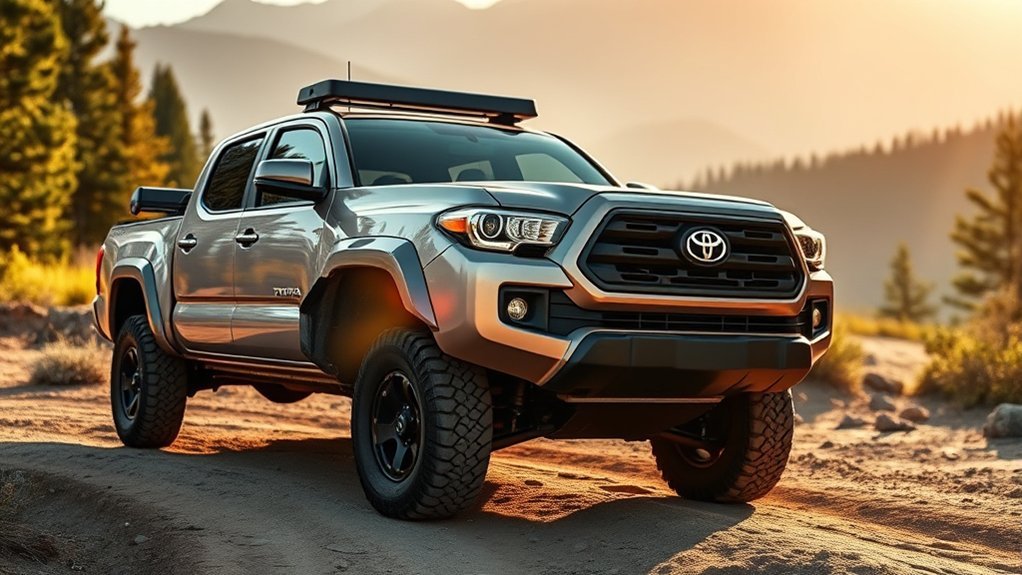
The Toyota Tacoma is a midsize pickup for drivers who value trail capability, useful towing, flexible bed and cab choices, and a durable truck-based design. The 2026 lineup includes gas and hybrid powertrains, eight core trims, rear-wheel-drive and four-wheel-drive configurations, and hardware that ranges from simple work-truck equipment to factory overlanding and high-speed off-road packages.
Last updated: July 14, 2026
Quick Answer
The Toyota Tacoma is a midsize body-on-frame pickup best suited to off-road travel, light-to-moderate towing, outdoor recreation, and everyday truck use. For 2026, it offers up to 326 horsepower, up to 6,500 pounds of towing capacity, and trims ranging from the work-focused SR to the Trailhunter and TRD Pro.
Key Takeaways
- The 2026 Tacoma uses a 2.4-liter turbo engine in gas and i-FORCE MAX hybrid forms.
- Maximum ratings reach 6,500 pounds for towing and 1,705 pounds for payload, but your truck’s configuration may be lower.
- TRD Off-Road, Trailhunter, and TRD Pro target different kinds of trail use, so the most expensive trim is not automatically the best fit.
- The current fourth generation began with the 2024 model year. The third generation ended after 2023.
- Used-truck shoppers should inspect the frame, verify recall completion by VIN, and review maintenance records before buying.
Who the Toyota Tacoma Is Best For
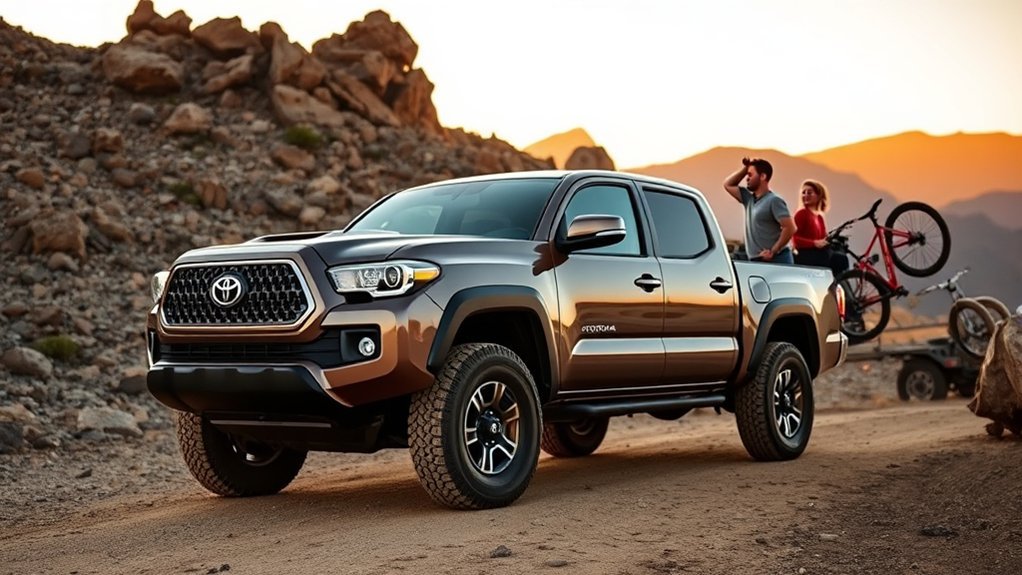
The Tacoma makes the most sense when you want a truck that is easier to place on a trail or in a parking space than a full-size pickup. It suits camping, fishing, hunting, construction support, property maintenance, and towing a small boat, utility trailer, or compact camper within the truck’s rated limits.
You also get meaningful configuration choices. Toyota offers XtraCab and Double Cab layouts, 5-foot and 6-foot beds, gas and hybrid powertrains, and trims aimed at work, road driving, technical trails, overlanding, and faster desert-style travel. Review the exact cab, bed, drivetrain, and axle combination before you buy because those choices affect passenger space, ride quality, payload, and towing.
The Tacoma may be less suitable if you need a wide rear seat, a car-like ride, maximum full-size-truck towing, or the quietest highway cabin. A Honda Ridgeline can feel more car-like, while larger pickups provide more interior room and higher maximum tow ratings.
Quick Take: Tacoma Strengths and Weaknesses
The Tacoma’s main strengths are its broad trim range, strong factory off-road options, compact-for-a-truck dimensions, available manual transmission, and modern towing and camera technology. The i-FORCE MAX hybrid adds strong low-speed torque, while the gas models provide lower-cost entry points and, in some configurations, better highway fuel-economy estimates.
Its tradeoffs are just as important. Rear-seat comfort can feel tight compared with some rivals, aggressive off-road tires can add road noise, and the ride depends heavily on the suspension and cab configuration. Fuel economy also varies by trim rather than settling at one universal figure. Toyota lists 2026 estimates from 18/23 mpg city/highway on the gas TRD Off-Road to 23/24 mpg on the Limited i-FORCE MAX, with some gas trims reaching 26 mpg highway.
The Tacoma’s value comes from choosing the right configuration, not simply choosing the highest trim.
Tacoma Generations: 1995-2026 at a Glance
The Tacoma has four generations. That timeline matters because engine choices, safety equipment, cab layouts, frame concerns, towing ratings, and technology differ sharply between an older used truck and the current model.
First Generation: 1995-2004
The first Tacoma established the model as a smaller North American pickup with four-cylinder and V6 options, two-wheel drive and four-wheel drive, and several cab styles over its production run. Older examples are simple by modern standards, but age, corrosion, previous off-road use, deferred maintenance, and modifications now matter more than trim labels alone.
- Inspect the frame, brake and fuel lines, body mounts, and suspension attachment points.
- Confirm that any applicable corrosion program or safety recall was completed.
- Check timing-belt service history on engines that use one.
- Expect fewer modern airbags and driver-assistance features than newer trucks.
Second, Third, and Fourth Generation Highlights
| Generation | Model Years | Key Changes | Used-Buying Focus |
|---|---|---|---|
| Second | 2005-2015 | Larger body, available 4.0-liter V6, broader cab and bed choices, and higher capability than the first generation. | Frame condition, recall history, suspension wear, and signs of heavy towing or off-road use. |
| Third | 2016-2023 | Updated styling and cabin technology, available 3.5-liter V6, and wider adoption of Toyota Safety Sense during the generation. | Service records, transmission behavior, accident history, modifications, and rust in salted-road regions. |
| Fourth | 2024-present | TNGA-F platform, turbo four-cylinder engines, available hybrid power, four-wheel disc brakes, modern infotainment, and available coil-spring rear suspension. | Choose the configuration carefully and verify current recalls, software campaigns, and warranty coverage by VIN. |
Note: The hybrid Tacoma belongs to the fourth generation. The third generation did not continue through 2026.
Tacoma Engines, Drivetrains, and Performance
The 2026 Tacoma uses a turbocharged 2.4-liter four-cylinder across the lineup. Output changes with the trim and transmission, while the i-FORCE MAX system adds an electric motor for substantially more torque. Toyota also keeps a six-speed intelligent manual transmission on selected gas models.
Engine Options and Output
| Powertrain | Output | Best Fit |
|---|---|---|
| Base i-FORCE with automatic | 228 hp and 243 lb-ft | Basic work and everyday driving |
| Higher-output i-FORCE with automatic | 278 hp and 317 lb-ft | General truck use, towing, and trail driving |
| i-FORCE with six-speed manual | 270 hp and 310 lb-ft | Drivers who prefer direct shift control |
| i-FORCE MAX hybrid | 326 hp and 465 lb-ft | Strong low-speed response, loaded travel, and upper off-road trims |
Toyota’s 2026 Tacoma release confirms the 278-hp gas maximum and 326-hp hybrid output. The earlier fourth-generation technical release also separates the 270-hp manual tune from the 278-hp automatic tune.
Drivetrains and Towing
Depending on configuration, the Tacoma is available with rear-wheel drive, part-time four-wheel drive, or full-time four-wheel drive. The Limited i-FORCE MAX uses a full-time system with a locking center differential, while trail-focused trims add equipment such as an electronic locking rear differential, Multi-Terrain Select, Crawl Control, and camera views.
Maximum towing capacity reaches 6,500 pounds, and maximum payload reaches 1,705 pounds for the 2026 model. Those are lineup maximums, not universal ratings. Your door-jamb certification label, owner’s manual, hitch rating, passenger load, cargo, accessories, and trailer tongue weight determine what your individual truck can safely carry and tow.
| Capability | 2026 Maximum or Availability | What You Must Verify |
|---|---|---|
| Transmission | Eight-speed automatic or available six-speed manual | Trim, cab, bed, and drivetrain compatibility |
| Four-wheel drive | Part-time or full-time, depending on configuration | Transfer-case type and differential equipment |
| Towing | Up to 6,500 lb | Exact tow rating, trailer brakes, hitch, tongue weight, and loaded trailer weight |
| Payload | Up to 1,705 lb | Door-sticker payload minus people, cargo, accessories, and trailer tongue weight |
Warning: Never assume the lineup’s 6,500-pound maximum applies to every Tacoma. Use the exact rating for your VIN and configuration, stay within payload and axle limits, and weigh the loaded truck and trailer when the margin is close.
Tacoma Trim Levels and Special Editions
The 2026 lineup includes eight core trims: SR, SR5, TRD PreRunner, TRD Sport, TRD Off-Road, Limited, Trailhunter, and TRD Pro. Toyota also sells i-FORCE MAX versions of TRD Sport, TRD Off-Road, and Limited, while Trailhunter and TRD Pro use the hybrid powertrain as standard equipment.
| Trim | Main Purpose | Standout Equipment or Layout |
|---|---|---|
| SR | Entry work and utility | Gas power, XtraCab or Double Cab availability, and a standard tow hitch on SR XtraCab for 2026 |
| SR5 | Everyday truck use | Broader cab and bed choices with more convenience equipment |
| TRD PreRunner | Two-wheel-drive trail style and utility | XtraCab, 6-foot bed, raised stance, and electronic locking rear differential |
| TRD Sport | Road-focused response | Sport-tuned suspension, available manual transmission, and available hybrid |
| TRD Off-Road | Technical trail use | Bilstein piggyback-reservoir shocks, locking rear differential, and available stabilizer disconnect |
| Limited | Comfort and premium road use | Adaptive Variable Suspension, premium cabin equipment, and available full-time 4WD on the hybrid |
| Trailhunter | Factory overlanding | Hybrid power, Old Man Emu shocks, high-mount air intake, ARB hardware, and 5- or 6-foot bed choices |
| TRD Pro | High-performance off-road driving | Hybrid power, FOX QS3 shocks, IsoDynamic front seats, and aggressive off-road tires |
PreRunner is a current production trim. S-Runner and X-Runner are legacy sport-truck names, and the later X-Runner revival was shown as a concept rather than a regular 2026 Tacoma trim. Keep those names separate when comparing current inventory.
Off-Road Capability: TRD, Suspension, and Factory Upgrades
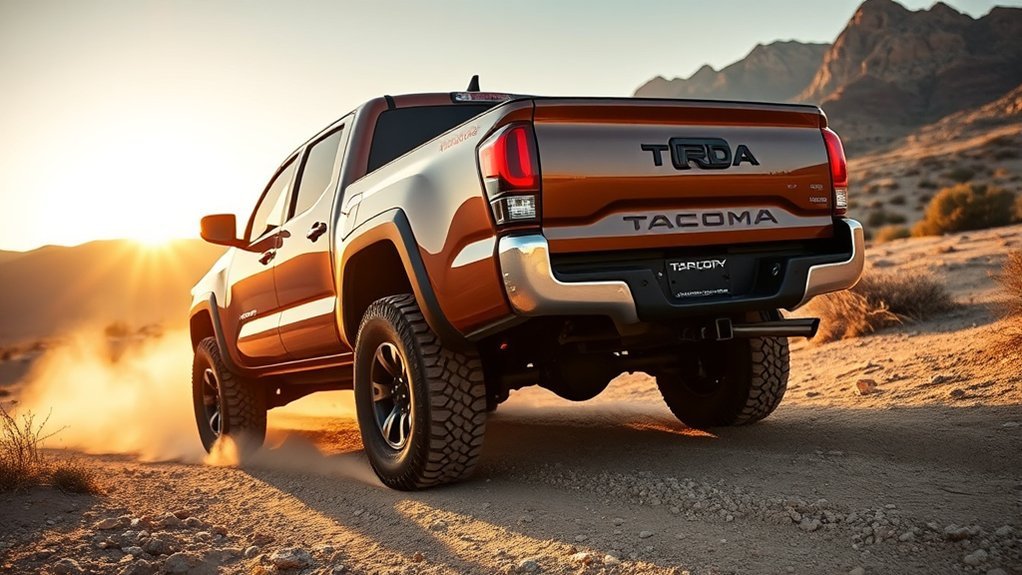
Tacoma off-road capability depends on the trim. TRD Off-Road focuses on slower technical terrain with Bilstein shocks, a locking rear differential, Multi-Terrain Select, Crawl Control, and an available Stabilizer Disconnect Mechanism. Trailhunter targets loaded overland travel with Old Man Emu suspension, recovery equipment, protective hardware, a high-mount air intake, and a choice of 5-foot or 6-foot beds.
TRD Pro takes a different approach. Its FOX QS3 shocks, wider stance, off-road tires, high-clearance hardware, and IsoDynamic front seats target faster rough-road and desert-style use. The TNGA-F chassis supports all of these versions, but the suspension, tires, bumpers, recovery points, and payload needs still vary by trim.
Factory and Toyota-approved accessories can simplify compatibility, but added racks, armor, tents, recovery gear, and larger tires consume payload and can change handling, braking, fuel use, and clearance. Include accessory weight in your load calculation.
Pro Tip: Pick TRD Off-Road for technical trails, Trailhunter for supported overlanding, and TRD Pro for higher-speed rough terrain. Choose based on your normal use instead of the badge hierarchy.
Towing, Payload, Bed Features, and Storage
The 2026 Tacoma’s lineup maximums are 6,500 pounds of towing and 1,705 pounds of payload. Toyota supports towing with available features such as an integrated trailer brake controller, Trailer Backup Guide with Straight Path Assist, a digital rearview mirror, and trailer-aware blind-spot monitoring on compatible setups.
The aluminum-reinforced bed uses a Sheet-Molded Composite surface and comes in 5-foot or 6-foot lengths. Available utility features include an onboard air compressor, bed lighting, power outlets, and a 2,400-watt AC inverter on hybrid models. Cab and bed combinations are trim-dependent, so you cannot pair every cab, bed, engine, and suspension.
XtraCab models seat two and use the space behind the front seats for lockable storage and work-focused utility. Double Cab models add a rear seat and can provide under-seat or fold-down storage depending on configuration. Measure passenger and cargo needs before ordering because the XtraCab is not a conventional extended cab with occasional rear seats.
- Choose a 6-foot bed when load length matters more than maneuverability.
- Choose a Double Cab when you regularly carry rear passengers.
- Choose XtraCab when secure interior storage matters more than rear seating.
- Subtract accessories, occupants, cargo, and tongue weight from the payload shown on the truck’s label.
Safety and Durability: Rust History, Recalls, and Reliability
The current Tacoma includes Toyota Safety Sense 3.0 as standard equipment. The suite includes a pre-collision system with pedestrian detection, lane-departure alert with steering assist, full-speed-range dynamic radar cruise control, lane-tracing assist, road-sign assist, automatic high beams, and proactive driving assist. Blind-spot monitoring and rear cross-traffic alert availability can depend on configuration.
Current crash-test results deserve a balanced reading. The IIHS 2026 Tacoma crew-cab evaluation rates the small-overlap front and updated side tests Good, while the updated moderate-overlap front test is Marginal. IIHS also rates the standard vehicle-to-vehicle and pedestrian front-crash-prevention systems Good.
Older Tacomas have a documented history of frame-corrosion programs, litigation, and model-specific recalls. That history does not mean every Tacoma has a dangerous frame, but it makes inspection essential on used trucks, especially those driven where road salt is common. Check the frame from multiple angles, look for perforation or fresh coating that may hide scaling, and have a qualified technician inspect any questionable area.
Recall status is VIN-specific. Use Toyota’s recall and service-campaign lookup and the NHTSA recall database before purchase and during ownership.
Used Tacoma Buying Checklist
- Run the VIN through Toyota and NHTSA recall tools.
- Inspect the frame, crossmembers, body mounts, hitch area, brake lines, and suspension mounts.
- Check for uneven tire wear, fluid leaks, driveline vibration, and four-wheel-drive engagement.
- Review service records and confirm major engine-specific maintenance.
- Look for poorly installed lifts, oversized tires, wiring changes, skid-plate damage, and evidence of water crossings.
- Confirm that the actual payload and tow rating fit your intended trailer and cargo.
Warranty, Maintenance, and Ownership Considerations
Toyota covers the 2026 Tacoma with a 3-year/36,000-mile basic warranty, a 5-year/60,000-mile powertrain warranty, and 5 years of corrosion-perforation coverage with no mileage limit. Hybrid components receive longer coverage, including 10 years/150,000 miles for the hybrid battery. ToyotaCare includes factory-scheduled maintenance for 2 years or 25,000 miles and roadside assistance for 2 years with unlimited mileage.
Routine ownership still depends on how you use the truck. Frequent towing, dusty trails, water crossings, short trips, heavy loads, and off-road driving can justify more frequent inspections or severe-service maintenance. Tire choice also changes ride, noise, braking, and fuel economy, so aggressive all-terrain tires carry everyday tradeoffs.
For a used Tacoma, condition and documentation usually matter more than reputation alone. A well-maintained, stock truck with a clean frame and complete service history is a safer choice than a neglected example wearing expensive modifications.
Should You Buy a Tacoma? Who Should and Should Not Choose It
Buy a Tacoma when you want a midsize body-on-frame truck with strong factory trail equipment, useful towing, a choice of gas or hybrid power, and enough trim variety to match work, recreation, or overlanding. The current cabin also offers an available 14-inch multimedia display, an available 12.3-inch digital gauge cluster, and an available ten-speaker JBL system with a portable speaker.
- Choose the Tacoma if trail ability, compact truck dimensions, configuration choice, and factory off-road support rank high on your list.
- Choose the Tacoma if you want a manual transmission in selected gas configurations or strong hybrid torque in upper trims.
- Skip or compare carefully if you need a roomy rear seat, a soft car-like ride, or full-size towing capacity.
- Compare another truck if your daily use is almost entirely paved-road commuting and you rarely need low-range four-wheel drive, a locking differential, or a conventional pickup bed.
Before signing, drive the exact trim you plan to buy. Suspension, tires, seat design, cab layout, and drivetrain change the experience enough that a test drive in a different Tacoma may not answer the right questions.
Frequently Asked Questions
What is a Toyota Tacoma classified as?
The Toyota Tacoma is classified as a midsize pickup truck. It uses a body-on-frame platform and offers rear-wheel-drive and four-wheel-drive configurations, which separates it from compact unibody pickups and larger full-size trucks.
What is special about the Toyota Tacoma?
The Tacoma combines manageable midsize dimensions with a wide range of factory off-road equipment. The 2026 lineup also includes a manual transmission on selected gas models, an available 326-hp hybrid, specialized TRD trims, and the factory overlanding-focused Trailhunter.
Is a Toyota Tacoma the same as a Hilux?
No. The Tacoma and Hilux are separate pickup lines developed for different markets, regulations, customer needs, and product strategies. Avoid relying on unsupported parts-overlap percentages because compatibility varies by generation and component.
What does Tacoma mean in Toyota’s truck name?
Toyota’s Tacoma name follows the place-name associated with Tacoma, Washington, and the regional Indigenous names connected with Mount Rainier or Tahoma. Meanings and spellings vary among Indigenous languages, so a single simplified translation can be misleading.
How much can a 2026 Toyota Tacoma tow?
The 2026 Tacoma can tow up to 6,500 pounds in qualifying configurations. Your exact rating may be lower, so confirm the owner’s manual, certification labels, hitch rating, payload, axle limits, trailer brakes, and loaded tongue weight.
Is the Tacoma hybrid mainly for fuel economy?
Not entirely. The i-FORCE MAX system is also a performance powertrain, producing 326 horsepower and 465 lb-ft of torque. It improves low-speed response and supports upper trims, but its fuel-economy advantage depends on the gas trim used for comparison.
Conclusion
The Toyota Tacoma remains a strong choice when you need midsize maneuverability, real pickup utility, and factory-supported off-road capability. Its best feature is not one headline number but the range of configurations, from the simple SR and practical SR5 to the technical TRD Off-Road, overlanding-focused Trailhunter, and high-performance TRD Pro.
Match the cab, bed, drivetrain, suspension, payload, and tow rating to your actual use. For a used truck, verify recall completion, inspect the frame, and favor documented maintenance over reputation or modifications. That approach gives you a more accurate picture of whether a specific Tacoma deserves your money.
Sources
- Toyota: 2026 Tacoma overview and trim information – current trims, MPG estimates, cab choices, technology, and core features.
- Toyota USA Newsroom: The 2026 Toyota Tacoma – engines, towing, payload, off-road equipment, safety systems, and warranty details.
- Toyota USA Newsroom: Fourth-generation Tacoma launch – generation timing, manual output, TNGA-F platform, suspension, and powertrain details.
- Insurance Institute for Highway Safety: 2026 Tacoma ratings – crashworthiness and crash-avoidance evaluations.
- Toyota recall and service-campaign lookup – VIN-specific Toyota recall and campaign status.
- National Highway Traffic Safety Administration recall lookup – federal VIN-based safety recall information.
