
Last updated: September 11, 2026
A Toyota Tundra exhaust system routes hot exhaust from the engine—through turbocharger exhaust hardware where equipped—past emissions sensors and catalytic converters, then through pipes, sound-control components, and the tailpipe. The exact layout is not universal: model year, engine, hybrid or non-hybrid powertrain, cab, bed, wheelbase, drivetrain, and emissions certification can change the parts and routing. Identify your exact truck before diagnosing a fault or ordering components.
Quick Answer
A Toyota Tundra exhaust system normally includes engine-side exhaust hardware, catalytic converters, oxygen or air-fuel ratio sensors, connecting pipes, hangers, mufflers, resonators on some configurations, and one or more tailpipes. These parts route hot gases safely, control noise, support fuel management, and reduce regulated pollutants.
Key Takeaways
- Exhaust layouts and part numbers vary widely across Tundra generations, engines, wheelbases, and emissions certifications.
- Cabin exhaust odor, unusual roaring, ticking, rattling, lost power, or a warning light deserves prompt diagnosis.
- A diagnostic code identifies a monitored problem, but it does not automatically prove that a sensor or catalytic converter has failed.
- Larger pipes, two visible tips, or a louder muffler do not guarantee more horsepower.
- Use your VIN and underhood emissions label when selecting converters, sensors, pipes, or other emissions-related parts.
Understanding the Exhaust System in Your Toyota Tundra

Your Tundra’s exhaust system begins where burned gases leave the engine. The system then routes those gases through emissions-control and sound-control components before releasing them behind or beside the truck.
The exact path depends on the powertrain. Older naturally aspirated Tundras and newer twin-turbo models do not use identical engine-side hardware. Hybrid versions also have powertrain-specific packaging. Pipe length and routing may change with the cab, bed, wheelbase, drivetrain, and market.
A simplified exhaust-flow path looks like this:
- Exhaust leaves the engine through the exhaust manifold or other engine-side passages.
- On turbocharged engines, exhaust energy passes through the turbocharger’s turbine section.
- Upstream oxygen or air-fuel ratio sensors measure exhaust conditions for engine control.
- Catalytic converters reduce regulated pollutants.
- Downstream sensors monitor converter performance.
- Intermediate pipes carry gases toward the sound-control components.
- The muffler and any resonator reduce selected sound frequencies.
- The tailpipe releases exhaust away from the passenger compartment.
A healthy exhaust system should remain sealed, securely supported, and free from sudden changes in sound, odor, or engine response.
Key Components of the Toyota Tundra Exhaust System
Each component has a different job. A problem in one area can sometimes produce symptoms that resemble a failure elsewhere, so diagnosis should come before replacement.
| Component | Main Job | Possible Problem Signs |
|---|---|---|
| Exhaust manifold and engine-side hardware | Collects exhaust from the cylinders and directs it downstream | Cold-start ticking, soot marks, exhaust odor, damaged studs, or a warped sealing surface |
| Turbocharger exhaust section, where equipped | Uses exhaust energy to drive the turbocharger turbine | Boost problems, unusual whistle, oil contamination, leaks, or reduced power |
| Catalytic converter | Converts carbon monoxide, hydrocarbons, and nitrogen oxides into less harmful compounds | Efficiency codes, overheating, sulfur-like odor, rattling substrate, or restricted flow |
| Oxygen or air-fuel ratio sensors | Provide feedback for fuel control and converter monitoring | Warning light, fuel-trim faults, poor economy, rough running, or emissions-test failure |
| Exhaust pipes, joints, flanges, and gaskets | Carry gases while allowing the system to fit the chassis | Roaring, hissing, corrosion, impact damage, soot around a joint, or cabin odor |
| Hangers and heat shields | Support the system and protect nearby components from heat | Rattling, knocking over bumps, sagging pipes, or contact with the body or frame |
| Muffler and resonator | Reduce volume and selected frequencies | Drone, internal rattling, excessive noise, corrosion, or loose baffles |
| Tailpipe and exhaust tip | Release exhaust at a safe location behind or beside the truck | Impact damage, rust, loose tips, blocked outlets, or exhaust staining |
How Tundra Exhaust Layouts Vary by Model Year and Engine
You should not assume that a part listed for one Tundra fits every truck with the same model name. Toyota has used different engines, exhaust routing, sensor arrangements, converter locations, pipe lengths, and emissions calibrations during the Tundra’s production run.
Key model-year breakpoint: Toyota identifies the all-new 2022 Tundra as the third generation. That redesign introduced twin-turbo V6 powertrains, including the i-FORCE MAX hybrid, so 2022-and-newer engine-side exhaust hardware should not be treated as interchangeable with earlier naturally aspirated Tundras. See Toyota’s 2022 Tundra launch details for the powertrain change.
Before buying a part, confirm:
- The model year and production date
- The engine and whether the truck uses a hybrid system
- Two-wheel drive or four-wheel drive
- Cab, bed, and wheelbase configuration
- Federal, California, Canadian, or other market emissions certification
- The VIN and the part number already installed
Note: Toyota provides vehicle-specific manuals and warranty guides through its official manuals portal. Use the guide for your exact model year rather than applying one maintenance schedule to every Tundra.
What Symptoms Point to a Toyota Tundra Exhaust Problem?
Exhaust problems often reveal themselves through sound, smell, warning lights, visible damage, or a change in engine response. Those clues can narrow the search, but they rarely confirm a failed part by themselves.
For a deeper leak-specific workflow—including cold-start listening, soot checks, OBD-II clues, and smoke-test discussion—see Toyota Tundra exhaust leak symptoms, causes, and fix options.
Warning: Stop driving and move into fresh air if exhaust fumes enter the cabin or anyone develops headache, dizziness, weakness, nausea, confusion, or unusual sleepiness. Do not run the truck in an attached garage, even with the door open. The CDC warns that a small exhaust leak can allow carbon monoxide to build inside a vehicle.
| Symptom | Possible Causes | Recommended Response |
|---|---|---|
| Ticking when the engine is cold | Manifold leak, gasket leak, loose fastener, or cracked engine-side component | Arrange a cold-start inspection before the system becomes hot |
| Sudden roaring or hissing | Split pipe, failed gasket, loose flange, damaged flex section, or stolen converter | Limit driving and have the leak located promptly |
| Rattle at idle or over bumps | Loose heat shield, broken hanger, internal muffler damage, or damaged converter substrate | Inspect supports and shields before replacing major components |
| Loss of power under load | Restricted converter, crushed pipe, turbo-related fault, fuel-control problem, or unrelated engine issue | Request scan-data, pressure, temperature, and engine-performance testing |
| Check-engine light | Sensor, heater circuit, fuel trim, misfire, catalyst-efficiency, wiring, or air-leak fault | Read the codes and complete pinpoint testing before ordering parts |
| Sulfur-like odor or excessive heat | Rich running, misfire, contaminated converter, overheating converter, or fuel problem | Stop heavy driving and diagnose the engine fault quickly |
| Exhaust smell inside the cab | Leak, damaged floor or body seal, obstructed outlet, or exhaust recirculation around the rear of the truck | Open the windows, leave the vehicle, and arrange immediate inspection |
Safe Checks You Can Perform
Let the exhaust cool completely before looking underneath the truck. Use a flashlight to check for hanging pipes, missing hardware, impact damage, heavy rust, black soot around joints, and loose heat shields.
Listen from outside the vehicle during a cold start, but keep your hands and clothing away from moving or hot parts. Never crawl beneath a truck supported only by a jack. Use properly rated ramps or jack stands on a stable surface when underbody access is necessary.
Tests a Repair Shop May Use
A technician may combine a visual inspection with scan data, wiring tests, a controlled smoke or low-pressure leak test, exhaust-pressure measurements, temperature comparisons, and fuel-trim analysis. This matters because a catalyst-efficiency or oxygen-sensor code can also result from an exhaust leak, misfire, wiring fault, fuel-control problem, or engine condition.
Pro Tip: Ask the shop what test confirmed the failed component. A code description alone is not proof that the named sensor or catalytic converter needs replacement.
What Do Oxygen Sensors Do in a Toyota Tundra?
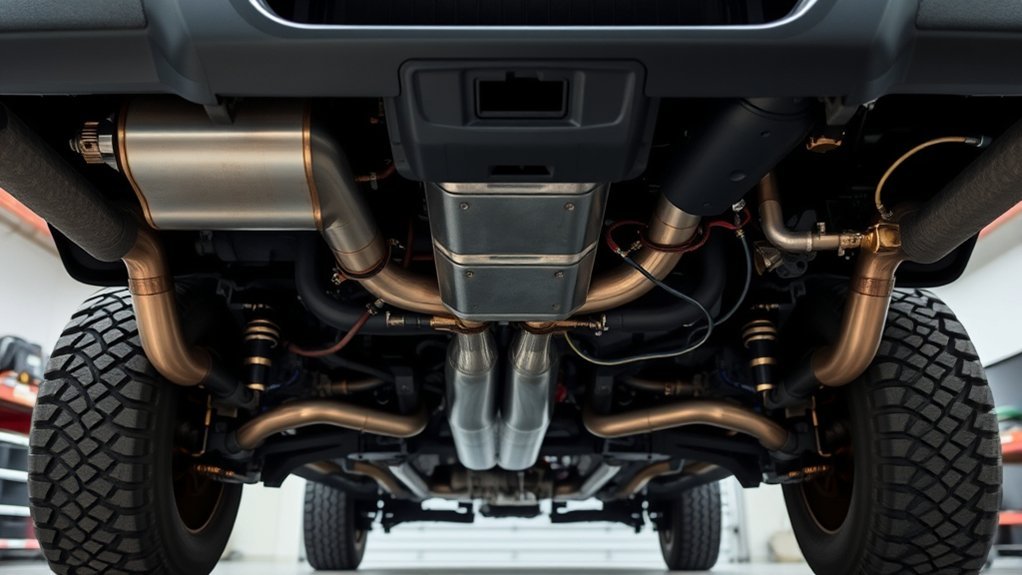
Oxygen sensors and air-fuel ratio sensors provide the engine computer with information about combustion and exhaust conditions. The computer uses upstream sensor data with other inputs to adjust fuel delivery. Downstream sensors help the onboard diagnostic system evaluate catalytic-converter performance.
The sensor type, quantity, connector, thread, wire length, and location vary by engine and model year. “Bank 1,” “Bank 2,” “Sensor 1,” and “Sensor 2” describe engine bank and sensor position, not a universal left-side or right-side part number.
A failing sensor or damaged sensor circuit may contribute to:
- A check-engine light
- Fuel-trim or sensor-response codes
- Higher fuel use when the engine runs too rich
- Rough operation or hesitation
- Increased emissions
- Incorrect converter-monitoring results
Replacing a genuinely failed sensor can restore proper control, but the fuel-economy result depends on the original fault. The current FuelEconomy.gov maintenance guidance recommends diagnosing warning lights promptly because an engine fault may reduce economy, increase emissions, or lead to more expensive repairs.
Do not replace an oxygen sensor solely because a code mentions its circuit. Check the wiring, connector, heater power, exhaust leaks, fuel trims, and related engine conditions first.
How Do Exhaust Pipes Affect Tundra Exhaust Flow?
Exhaust pipes connect the engine-side components, converters, sensors, mufflers, resonators, and tailpipes. They must tolerate heat, vibration, moisture, road salt, chassis movement, and occasional impacts while remaining sealed.
Importance of Exhaust Flow
Exhaust flow affects pumping losses, turbocharger operation where equipped, sound, emissions performance, and engine response. However, the goal is not simply to install the largest possible pipe.
- A pipe that is too small may create unwanted restriction at high flow rates.
- A pipe that is unnecessarily large may alter gas velocity, packaging, noise, and low-speed behavior without delivering a useful gain.
- Bends, merge points, converter design, muffler construction, and pipe length can matter as much as diameter.
- Crushed sections, internal collapse, poor welds, and misaligned joints can restrict flow even when the nominal pipe size appears adequate.
Types of Exhaust Pipes
Common replacement and performance systems use aluminized steel, stainless steel, or a combination of materials. Stainless steel generally offers better corrosion resistance, while material grade, wall thickness, weld quality, and climate also influence service life.
Pipe shapes and manufacturing methods may include:
- Mandrel bends: Maintain a more consistent inside diameter through a bend.
- Compression bends: May narrow more noticeably at tight curves.
- Y-pipes and merge pipes: Combine or divide exhaust paths.
- Flexible sections: Absorb controlled engine and chassis movement where the application requires one.
- Flanged or slip-fit joints: Allow sections to be assembled and serviced.
Correct alignment matters. A system installed under tension may rattle, crack, damage a hanger, or contact the frame, heat shield, spare tire, or body.
What Do Mufflers and Resonators Do?
Mufflers and resonators manage sound in different ways. The muffler reduces overall sound energy, while a resonator is commonly tuned to reduce or reshape selected frequencies that may otherwise create an unpleasant tone or cabin drone.
Muffler Types Overview
- Chambered mufflers: Use internal chambers and reflected sound waves to shape the exhaust note.
- Straight-through mufflers: Usually route gases through a perforated core surrounded by sound-absorbing material.
- Turbo-style mufflers: Route gases through multiple internal passages to reduce noise.
- Application-specific mufflers: Are designed around the truck’s available space, pipe routing, hangers, and sound target.
A muffler’s external size does not predict its sound by itself. Internal design, case volume, packing, inlet and outlet positions, pipe diameter, and the rest of the exhaust system all affect the result.
Resonator Functionality Explained
A resonator targets a narrower frequency range than a typical muffler. Its location, length, internal design, and volume determine which frequencies it affects. Removing one may increase volume or drone, while adding a properly selected resonator can reduce an unwanted highway-frequency boom.
| Component | Primary Function |
|---|---|
| Muffler | Reduces broad exhaust noise and shapes the overall tone |
| Resonator | Targets selected frequencies and may reduce cabin drone |
| Combined system | Balances volume, tone, legal sound limits, packaging, and flow |
Noise Reduction Techniques
Reducing drone may require more than installing a quieter muffler. A complete solution may involve repairing leaks, restoring factory hangers, adding or changing a resonator, selecting a different muffler design, correcting tailpipe position, or eliminating body contact.
Sound should be evaluated during cold starts, acceleration, steady highway cruising, and towing. A system that sounds acceptable at idle may become tiring at a constant engine speed.
What Does the Tundra Tailpipe Do?
Tailpipes direct exhaust away from the body and passenger compartment. Their location, length, angle, and clearance matter more for safety than the appearance of the tip.
A single outlet and a dual-outlet appearance do not, by themselves, reveal how restrictive the upstream system is. Some dual-tip systems divide one exhaust path near the rear, while others use separate paths farther forward. You must inspect the full routing before drawing conclusions about flow or performance.
| Design | What It Usually Changes | What It Does Not Guarantee |
|---|---|---|
| Single outlet | Simple routing, factory-style appearance, and one exit location | Low restriction or quiet operation |
| Dual outlets or tips | Different appearance, routing, and sound characteristics | More horsepower or a true dual system |
Keep the outlet clear of packed snow, mud, debris, and accessories that interfere with exhaust discharge. Replace a loose or damaged tip before it separates from the pipe.
How Does a Tundra Catalytic Converter Fail?
The catalytic converter is an emissions-control device, not a filter that should be removed when it becomes restricted. It uses catalyst materials and high operating temperatures to reduce carbon monoxide, hydrocarbons, and nitrogen oxides.
A converter may fail because of physical impact, corrosion, contamination, overheating, prolonged rich operation, or repeated engine misfires. Replacing the converter without fixing the cause can damage the new unit.
Possible converter problems include:
- A catalyst-efficiency code that returns after proper testing
- An internal rattle from a broken substrate
- Excessive temperature caused by unburned fuel
- Reduced power from a restricted or collapsed internal structure
- Damage to sensor wiring during theft or impact
- A missing converter accompanied by a sudden, extremely loud exhaust
Before replacement, ask the technician to check for misfires, fuel-control faults, oil or coolant consumption, exhaust leaks, sensor problems, and applicable software or service information.
Should You Upgrade Your Toyota Tundra Exhaust System?

An exhaust upgrade can change sound, appearance, corrosion resistance, ground clearance, weight, and serviceability. Performance gains on an otherwise stock truck may be modest, especially when the factory system is not the main restriction.
Choose the modification according to your goal:
- Axle-back system: Changes the muffler, rear piping, or tips while leaving more of the original system intact.
- Cat-back system: Replaces piping and sound-control components after the catalytic converter area.
- Muffler replacement: Primarily changes sound and may alter restriction.
- Resonator change: Targets tone or drone.
- Headers, turbo-side pipes, or converter changes: Affect more complex engine and emissions systems and require greater legal and technical care.
| Your Goal | Best Starting Point | Main Caution |
|---|---|---|
| Fix a leak, rattle, or restriction | Diagnose the failed section first, then repair or replace only what testing supports | Do not mask an engine fault or converter-damaging condition |
| Change sound with minimal system changes | Muffler, resonator, or axle-back change | Check highway drone, towing noise, clearance, and local sound rules |
| Improve corrosion resistance | Application-specific stainless replacement or cat-back system | Verify wheelbase, hanger locations, emissions configuration, and hardware |
| Pursue measurable performance | Confirm an actual restriction, then evaluate the exhaust with intake, calibration, turbocharger, and power goals | Do not attribute a package-level power gain to the exhaust alone |
Toyota’s TRD Performance Package announcement shows why a system-level view matters. Toyota pairs a higher-flowing cat-back exhaust with larger dual intakes, engine-management calibration, and 91-octane fuel. The published power increase applies to that complete package, not to the cat-back exhaust by itself.
Performance Muffler Options
Chambered, straight-through, and turbo-style performance mufflers produce different tones. Select one based on measured sound preferences, cabin-drone tolerance, towing use, pipe size, and available installation space rather than brand reputation alone.
Round and oval cases may fit differently around the frame, spare tire, suspension, heat shields, and bed. A qualified installer should maintain safe clearance and avoid placing the system under stress.
Enhanced Exhaust Flow
Reducing an actual restriction can improve engine response, but every modification should be evaluated as part of the complete system. Pipe diameter, merge geometry, converter design, muffler construction, turbocharger requirements, engine calibration, and intended power level all matter.
Do not assume that a larger pipe will automatically produce more horsepower or torque. An oversized or poorly routed system may add noise and installation problems without a measurable benefit.
Resonator Benefits Explained
A correctly chosen resonator can reduce an objectionable frequency while preserving the overall exhaust tone. This makes it useful when a freer-flowing muffler creates highway drone or when a towing load keeps the engine near a resonant speed for long periods.
Resonator diameter alone does not determine performance. Internal design, length, location, and compatibility with the rest of the system matter more than a simple “larger is better” rule.
Emissions, Sound, and Legal Considerations
Warning: Do not remove, bypass, hollow out, or disable a required catalytic converter, oxygen sensor, or other emissions-control component. The EPA identifies converter removal without an approved replacement as illegal tampering under U.S. federal law.
State, provincial, territorial, and local rules may add converter-approval, inspection, and sound requirements. In California, a replacement must be an OEM converter or a California Air Resources Board-approved aftermarket converter assigned to the exact vehicle application.
A cat-back system that leaves required emissions controls intact presents fewer emissions-compliance concerns than a modification involving converters, sensor locations, turbo-side piping, or engine calibration. However, sound and installation rules still apply.
Where Should You Buy Toyota Tundra Exhaust Parts?
You can purchase exhaust components through a Toyota dealer, an independent repair shop, a specialist exhaust installer, or a reputable parts supplier. The best source depends on whether you need exact factory fitment, an emissions-certified replacement, a repair section, or a sound-focused upgrade.
Toyota’s official online parts store supports searches by keyword, part number, and full VIN. VIN lookup helps reduce fitment mistakes, but you should still compare the listed application with the truck’s emissions label and the original component.
Before ordering, verify:
- Exact model year, engine, drivetrain, cab, bed, and wheelbase
- Federal, California, Canadian, or other emissions certification
- Upstream or downstream sensor position
- Left bank or right bank where applicable
- Pipe diameter, flange pattern, hanger position, and included hardware
- Whether gaskets, fasteners, clamps, shields, and sensors are included
- Converter approval and identification requirements in your jurisdiction
- Warranty terms and return restrictions for installed emissions parts
Do not select a catalytic converter or sensor using price and visual similarity alone. A component may bolt into place yet remain incompatible with the truck’s calibration or emissions certification.
When to Repair a Section and When to Replace It
A local repair may make sense when damage is limited to a flange, gasket, clamp, hanger, heat shield, tip, or accessible pipe section. Replacement becomes more practical when corrosion is widespread, a muffler has failed internally, a converter substrate is damaged, several joints are weak, or the remaining metal cannot support a durable repair.
Ask these questions before approving the work:
- What test confirmed the failed area?
- Did another engine problem cause the damage?
- Can the damaged section be serviced separately?
- Will a repair leave enough sound metal for a lasting joint?
- Does the replacement meet the truck’s emissions application?
- Are related gaskets, hardware, hangers, shields, and sensors included?
- Could emissions-warranty coverage apply?
In the United States, certain major emissions components may have longer federal coverage than the basic vehicle warranty. Coverage varies by model year, mileage, jurisdiction, failure cause, and component, so review the warranty guide for your truck before paying for a major converter or control-system repair.
Tips for Maintaining Your Toyota Tundra Exhaust System
Your exhaust system does not normally need routine internal cleaning. Maintenance focuses on inspection, leak repair, secure mounting, corrosion control, and correction of engine faults that could overheat or contaminate the converter.
Toyota’s 2025 Tundra Warranty & Maintenance Guide is one model-year maintenance reference. Use the warranty and maintenance guide for your own Tundra model year when checking inspection intervals and procedures rather than copying a schedule from a different truck.
- Inspect the system after off-road impacts, deep snow, road debris, or contact with a curb.
- Check hangers and shields when you hear rattling or knocking.
- Wash road salt and packed mud from the underbody without forcing water into electrical connectors.
- Investigate misfires, rich-running conditions, and flashing warning lights promptly to protect the converter.
- Keep the tailpipe clear of snow, mud, and accessories.
- Repair small leaks before heat and vibration enlarge them.
- Use the correct fuel and fluids specified for your model.
- Recheck clearances and fasteners after installing an aftermarket system.
Trucks used for towing, frequent short trips, salted winter roads, off-road travel, or heavy loads may benefit from more frequent visual checks because heat cycles, corrosion, and impact exposure can increase.
Sources
- Toyota 2025 Tundra Warranty & Maintenance Guide — model-year warranty and maintenance reference
- Toyota Manuals and Warranties — model-year-specific manuals and warranty guides
- Toyota Official Parts Store — VIN and part-number fitment searches
- CDC Carbon Monoxide Poisoning Basics — vehicle-exhaust and cabin-safety guidance
- U.S. EPA Transportation and Air Pollution FAQ — catalytic-converter tampering requirements
- California Bureau of Automotive Repair — replacement-converter approval and fitment requirements
- Toyota USA Newsroom: All-New 2022 Tundra — third-generation and twin-turbo V6 powertrain context
- Toyota USA Newsroom: TRD Performance Package — cat-back, intake, calibration, and fuel requirements for Toyota’s package-level performance claim
Frequently Asked Questions
What components are parts of the exhaust system?
A Toyota Tundra exhaust system may include exhaust manifolds, turbocharger-side components on turbo models, catalytic converters, oxygen or air-fuel ratio sensors, pipes, flanges, gaskets, hangers, heat shields, mufflers, resonators, tailpipes, and tips. The exact layout varies by engine and model year.
How do I find the correct Toyota Tundra exhaust system diagram?
Start with the exact model year, engine, VIN, and emissions certification, then confirm cab, bed, wheelbase, and drivetrain where the catalog requires them. Use Toyota’s VIN-aware parts catalog or model-year service information for the truck-specific layout. A generic exhaust diagram is useful for understanding gas flow, but it should not be used as a fitment guide.
What changed in the 2022 and newer Tundra exhaust layout?
Toyota introduced the third-generation Tundra for 2022 with twin-turbo V6 powertrains, including the i-FORCE MAX hybrid. That change altered the engine-side exhaust and turbo packaging compared with earlier naturally aspirated trucks. Exact converters, sensors, pipes, and routing still vary by configuration, so verify the VIN before ordering parts.
How much does it cost to replace the exhaust system on a Toyota Tundra?
There is no single meaningful “full exhaust” price for every Tundra. Cost changes with the model year, engine, emissions certification, failed section, parts source, and local labor rate. A gasket or hanger repair is a different job from replacing a muffler, manifold, converter assembly, or several corroded sections. Ask for an itemized, VIN-specific estimate that separates diagnosis, parts, hardware, and labor.
Can you drive a Toyota Tundra with an exhaust leak?
You should not continue normal driving with a known leak. A leak can expose occupants to carbon monoxide, damage nearby parts, affect sensor readings, increase noise, and worsen over time. Cabin odor, physical symptoms, a large leak, or a hanging component calls for immediate attention.
Does a Tundra exhaust upgrade require an engine tune?
A conventional cat-back or axle-back system often works without recalibration because it leaves engine-side emissions controls and sensor locations unchanged. Changes involving turbo-side piping, headers, converters, sensor positions, or major airflow increases may require professional calibration and emissions-compliance review.
Conclusion
Your Toyota Tundra’s exhaust system combines gas routing, emissions control, engine feedback, noise management, and cabin protection. Understanding each component helps you recognize leaks, rattles, warning lights, corrosion, and flow problems before they become more serious.
Start with the truck’s VIN, emissions label, and model-year documentation before ordering parts. Diagnose engine and sensor faults before replacing a converter, and treat cabin fumes as an urgent safety problem. For an upgrade, choose the change by goal—sound, corrosion resistance, repairability, or measured performance—rather than by pipe size or loudness alone.
