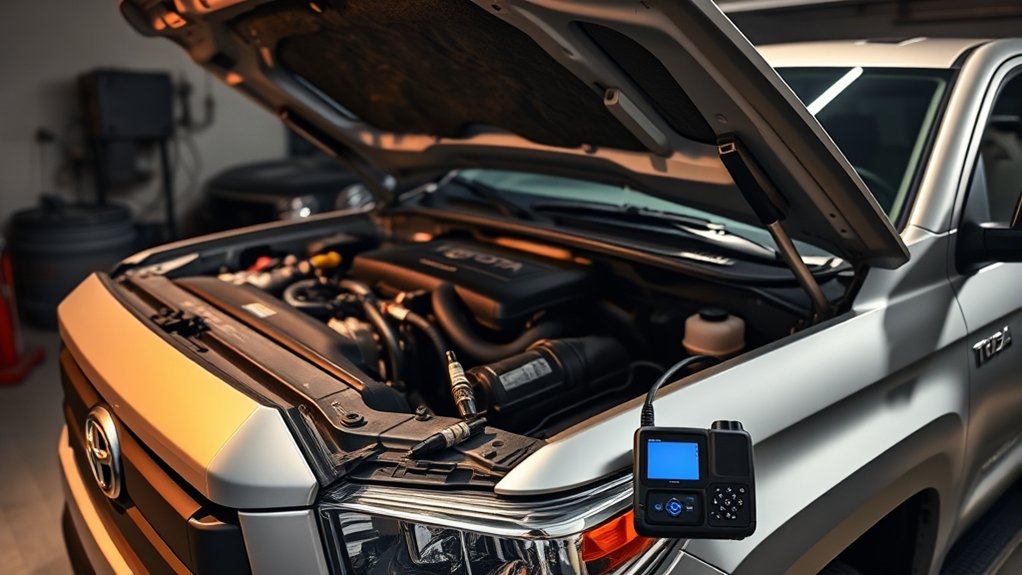
If your Toyota Tundra is misfiring, one or more cylinders are not producing power consistently. You may feel a rough idle, hesitation, shaking, reduced acceleration, or uneven power under load. Start with an OBD-II scan and a careful visual inspection rather than replacing parts based on the code alone.
Quick Answer
A Toyota Tundra misfire can come from a worn spark plug, failed ignition coil, injector or fuel-pressure problem, intake or boost leak, sensor or wiring fault, or low compression. Scan and save the codes plus freeze-frame data first. If the check-engine light flashes or the truck shakes badly, stop driving and arrange service.
Key Takeaways
- A flashing check-engine light or severe shaking requires immediate attention because continued driving may damage the catalytic converter.
- Save confirmed codes, pending codes, freeze-frame information, and misfire data before clearing the engine computer.
- A P0300 code needs a different approach from a code identifying one particular cylinder.
- Do not assume the spark plug or ignition coil is faulty until a swap test, circuit test, or other diagnostic step confirms it.
- Maintenance intervals, compression specifications, plug types, and test procedures depend on the Tundra’s model year and engine.
At a Glance
| Time Required | About 20–60 minutes for scanning and basic inspection; advanced testing may take several hours |
| Difficulty | Beginner for scanning and visual checks; intermediate to advanced for fuel, electrical, compression, and timing tests |
| Tools Needed | OBD-II scan tool, flashlight, basic hand tools, spark-plug socket, torque wrench, and model-specific repair information; advanced tests may require a multimeter, smoke machine, pressure gauge, compression tester, or leak-down tester |
| Cost | Low for basic scanning and inspection; potentially higher if professional testing, internal-engine repair, or catalytic-converter replacement is required |
Last updated: July 11, 2026.
Identifying Symptoms of a Misfire in Your Toyota Tundra
A Tundra misfire may be obvious, or it may appear only under certain temperatures, engine speeds, or loads. Common symptoms include:
- Rough or uneven idle: The engine may shake, stumble, or feel as though it is skipping a beat.
- Hesitation or reduced acceleration: The truck may respond slowly or surge when you press the accelerator.
- Shaking under load: A weak spark, injector problem, boost leak, or mechanical fault may become more noticeable while climbing, towing, or accelerating.
- Hard starting or rough cold starts: The engine may run poorly for several seconds or minutes and then smooth out as it warms.
- Unusual exhaust smell: Unburned fuel may create a strong fuel odor, although other fuel or exhaust faults can cause a similar smell.
- Reduced fuel economy: A misfire can waste fuel, but the amount of change varies with the engine, driving conditions, and severity of the fault.
- Check-engine light: The light may remain steady or flash, and the difference matters.
Warning: A flashing check-engine light can indicate a malfunction that may damage the catalytic converter. Reduce engine load, pull over safely, and shut the engine off if it is shaking severely, losing substantial power, overheating, or producing a strong raw-fuel smell. Arrange professional diagnosis or towing instead of continuing to drive.
A steady check-engine light does not prove that the engine is misfiring. Many emissions, sensor, fuel-system, or electrical faults can illuminate the same light. Scan the truck before deciding which system needs attention.
Possible Causes of Misfire in Tundra Engines
A Toyota Tundra misfire can originate in the ignition, fuel, air, electrical, control, or mechanical system. The fault pattern and scan data should determine which category you test first.
| Cause Group | Possible Problems | Useful Clues |
|---|---|---|
| Ignition | Worn or fouled spark plug, damaged coil boot, failed ignition coil, loose connector, wiring fault, moisture or oil in a plug well | One-cylinder code, misfire that moves during a controlled component swap, or visible plug and boot damage |
| Fuel delivery | Restricted or leaking injector, injector-circuit fault, low or unstable fuel pressure, contaminated fuel, pump or pressure-control problem | Lean or rich data, injector-related codes, cylinder imbalance, abnormal pressure, or a problem that started after refueling |
| Air and induction | Intake leak, PCV-system leak, loose duct, sensor contamination, throttle problem, or charge-air and boost leak on applicable engines | Misfire at idle, positive fuel correction, hissing, loose clamps, or symptoms that appear under boost |
| Mechanical | Low compression, valve leakage, cylinder wear, head-gasket leakage, incorrect cam timing, or valve-timing control problem | Misfire stays on the same cylinder after ignition and fuel checks, uneven compression, leakage during a leak-down test, or coolant and oil symptoms |
| Electrical and control | Damaged wiring, poor ground, sensor bias, cam or crank signal problem, ECM power issue, calibration concern, or an applicable service bulletin | Multiple related codes, intermittent faults, implausible data, communication problems, or no response to normal component tests |
A misfire code identifies the cylinder or pattern the computer detected. It does not identify the failed part.
Fuel contamination can produce rough running, but it should not become the default explanation without supporting evidence. Note whether the problem began immediately after refueling, whether other vehicles using the same fuel had trouble, and whether a fuel sample shows water or debris.
Why the Model Year and Engine Matter
Tundra engines, ignition systems, fuel systems, turbocharging arrangements, maintenance schedules, and mechanical timing systems have changed across generations. A test value or replacement interval for one engine may be wrong for another.
Before ordering parts, identify the model year, engine, VIN, emissions label, and any recent repairs. Use the Toyota manual and maintenance guide for the exact vehicle. For factory diagnostic procedures, wiring diagrams, specifications, calibration information, and service bulletins, use the Toyota Technical Information System or a properly equipped repair facility.
Note: On hybrid-equipped Tundras, do not open, probe, disconnect, or attempt to repair high-voltage components unless you have the required training and protective equipment. Conventional code scanning and visual engine checks do not require opening the high-voltage system.
Key Components to Check for Misfires: Spark Plugs, Fuel Injectors, and More
Check components in an order that confirms the cause instead of replacing several parts at once.
| Component or System | What to Check | How to Confirm the Fault |
|---|---|---|
| Spark plug | Correct part number, wear, deposits, cracked insulator, damaged threads, improper installation, and condition of the plug well | Compare with other cylinders and follow Toyota’s inspection, gap, and torque specifications |
| Ignition coil and boot | Cracks, carbon tracking, moisture, oil, loose terminals, damaged wiring, power, ground, and control signal | Use a controlled swap when appropriate or perform the circuit and waveform tests specified for that engine |
| Fuel injector | Connector condition, command signal, sound, balance, leakage, restriction, and cylinder contribution | Use an injector balance, current-ramp, pressure, or contribution test suitable for the fuel system |
| Intake and boost system | Loose ducts, cracked hoses, intake-gasket leaks, PCV leaks, charge pipes, clamps, and intercooler connections where equipped | Smoke test, pressure test, visual inspection, and comparison of fuel trims under different operating conditions |
| Compression and valve sealing | Cylinder-to-cylinder balance, leakage path, valve sealing, piston condition, and head-gasket symptoms | Compression, relative-compression, cylinder leak-down, borescope, and cooling-system tests as needed |
A dirty or biased airflow sensor can affect the air-fuel calculation, but cleaning it should not be an automatic maintenance step. Inspect the intake for leaks, compare scan data with expected values, and use only an approved sensor-cleaning method when contamination is actually present.
Steps to Diagnose Misfire Issues
Use the following sequence to avoid losing evidence or replacing good parts.
- Decide whether the truck is safe to run. Stop if the check-engine light flashes, the engine shakes heavily, power drops sharply, the engine overheats, or you smell a strong amount of raw fuel.
- Record the complaint. Note whether the misfire happens cold, hot, at idle, during acceleration, while towing, after refueling, in wet weather, or following recent work.
- Scan every relevant module. Save confirmed codes, pending codes, permanent codes, freeze-frame information, readiness status, and available misfire counters before clearing anything.
- Separate the code pattern. P0300 normally describes a random or multiple-cylinder pattern. A P030x code points toward the cylinder represented by the final digit when that cylinder exists on the engine.
- Perform a visual inspection. Look for loose connectors, damaged wiring, unplugged hoses, loose intake clamps, oil or water in plug wells, rodent damage, disconnected grounds, and problems created during recent service.
- Test ignition components. Inspect the plug and coil assembly. When access, component design, and safety allow, move a suspected coil to another cylinder and repeat the test under similar conditions. A code that follows the coil strongly supports coil failure.
- Evaluate fuel and air delivery. Check fuel-trim patterns, injector command, fuel pressure, intake leaks, boost leaks where applicable, and sensor plausibility. Do not condemn an injector or fuel pump from one data value alone.
- Check mechanical condition. If the misfire remains on the same cylinder after ignition and fuel checks, perform relative compression, a standard compression test, or a leak-down test using the exact Toyota procedure and specification.
- Check timing, wiring, calibration, and service information. Persistent or multiple-cylinder faults may require cam and crank correlation testing, valve-timing diagnosis, wiring checks, software verification, or an applicable Toyota service bulletin.
- Verify the repair. Reassemble everything correctly, clear codes only after saving the original data, repeat the conditions that caused the fault, and confirm that misfire counters and fuel corrections remain normal.
Pro Tip: Photograph the scan results and label every coil, plug, and connector before moving parts. Clear records prevent mixed components and make it easier to see whether the misfire followed a part or stayed with the cylinder.
Warning: Do not loosen fuel lines, open a direct-injection system, or perform pressure testing without the exact depressurization procedure and suitable equipment. Gasoline under pressure can cause fire, serious injury, or eye damage.
Common Troubleshooting Techniques for Ignition and Fuel Systems
The most useful test depends on whether the misfire affects one cylinder, several cylinders, one bank, or the whole engine.
Single-Cylinder Misfire Pattern
Begin with the plug, coil, boot, connector, injector, and mechanical condition of the identified cylinder. A controlled coil swap is often more useful than a basic resistance measurement because it tests the component while the engine is operating.
If the code stays with the original cylinder after the coil and plug have been checked, test the injector circuit and cylinder sealing. A damaged valve, injector fault, wiring problem, or localized intake leak may remain tied to one cylinder.
Random or Multiple-Cylinder Misfire Pattern
When several cylinders are involved, look for a cause shared by those cylinders. Possible directions include fuel pressure, contaminated fuel, an intake or boost leak, a sensor bias, incorrect cam timing, a poor electrical connection, or a control-system issue.
Compare both banks when the engine provides bank-specific data. A problem affecting one bank may point toward a bank-specific intake leak, exhaust leak, sensor, wiring circuit, or mechanical timing concern.
Cold-Start, Idle, or Load-Related Misfires
| When It Happens | Possible Direction | Next Checks |
|---|---|---|
| Cold start only | Injector leakage, coolant entry, intake leak, ignition weakness, deposits, sensor bias, or valve-sealing concern | Cold-soak scan data, plug inspection, pressure retention, borescope inspection, and cooling-system testing |
| Idle only | Vacuum leak, PCV leak, injector imbalance, throttle contamination, or low cylinder contribution | Smoke testing, fuel-trim comparison at idle and higher RPM, and cylinder contribution testing |
| Under acceleration or towing | Weak ignition, inadequate fuel supply, boost leak, excessive plug gap, or mechanical fault under load | Misfire counters, fuel-pressure data, ignition waveform testing, charge-air inspection, and controlled road testing |
| After recent repair | Loose connector, incorrect plug, damaged boot, wiring trapped under a component, intake leak, or mechanical timing error | Recheck every disturbed component before replacing additional parts |
Fuel trims are clues, not verdicts. Compare short- and long-term correction by bank at idle, steady higher RPM, and load. A correction that improves as RPM rises may support an intake leak, while a correction that worsens under load may direct attention toward fuel delivery. Confirm the pattern with other tests before replacing a component.
Maintenance Tips to Prevent Future Misfires
You cannot prevent every electrical or mechanical failure, but correct maintenance reduces avoidable ignition, air, and fuel problems.
- Follow the exact Toyota maintenance guide for the model year, engine, and operating conditions.
- Use the specified spark-plug type and install it with the correct procedure and torque.
- Repair oil or coolant leaks that can contaminate plug wells or combustion chambers.
- Keep intake ducts, clamps, connectors, grounds, and vacuum or PCV hoses secure.
- Use the fuel grade specified in the owner’s manual and address symptoms that begin immediately after refueling.
- Investigate warning lights promptly instead of repeatedly clearing codes.
- Check for open recalls and service campaigns by VIN.
Regular Spark Plug Replacement
Do not use one spark-plug interval for every Toyota Tundra. Replacement timing depends on the engine, model year, plug design, maintenance guide, and operating conditions.
Use the exact specified plug rather than choosing only by thread size or appearance. Inspect the removed plug for abnormal deposits, oil, coolant, overheating, cracked insulation, electrode wear, or an installation problem. Compare it with plugs from healthy cylinders because the difference may reveal the cause of the misfire.
Install plugs in a cool engine and use the correct torque procedure. Inspect the coil boot, spring, connector, seal, and plug well before reinstalling the coil. Do not automatically adjust the gap on a new fine-wire plug unless the manufacturer’s instructions require it.
Fuel System Maintenance Practices
| Maintenance Practice | When to Do It | Purpose |
|---|---|---|
| Use the specified fuel grade | At every fill-up | Supports the combustion and engine-control strategy designed for the vehicle |
| Keep the fuel cap and filler area clean and sealed | During refueling and routine inspection | Reduces contamination and evaporative-system problems |
| Service filters and fuel-system components | Only at the vehicle-specific interval or when diagnosis confirms a restriction or failure | Avoids unnecessary replacement while correcting actual flow or pressure problems |
| Test injectors rather than cleaning them automatically | When codes, balance data, pressure results, or symptoms support an injector concern | Prevents unnecessary chemical treatment or parts replacement |
| Document fuel-related symptoms | When a problem begins after refueling | Helps distinguish contamination from an unrelated ignition, air, or mechanical fault |
Common Misfire Diagnostic Mistakes to Avoid
- Clearing codes before recording the data: This can erase freeze-frame information and reset readiness monitors.
- Replacing every ignition coil: One code does not prove that every coil is failing.
- Installing parts without matching the VIN and engine: Similar-looking plugs, coils, injectors, and sensors may have different specifications.
- Assuming a new part is good: New components can be incorrect, damaged, poorly connected, or defective.
- Using fuel additives as the first diagnosis: An additive will not repair damaged wiring, a failed coil, a vacuum leak, low compression, or incorrect timing.
- Ignoring recent work: A connector, hose, ground, plug, coil boot, or timing component disturbed during service may be the real cause.
- Continuing to drive with a flashing light: This may turn a smaller fault into catalytic-converter or engine damage.
When to Call in the Pros for Misfire Issues?
Basic scanning and visual checks are reasonable for many owners. Professional diagnosis becomes important when the fault requires pressurized-fuel testing, oscilloscope analysis, internal-engine testing, programming, hybrid-system work, or repeated road testing under controlled conditions.
Persistent Misfire Despite Repairs
If the misfire remains after the spark plug, coil, connector, and obvious intake problems have been checked, stop replacing parts without confirmation. The underlying problem may involve an injector, fuel pressure, wiring, compression, valve sealing, mechanical timing, or engine-control issue.
A code that remains on the same cylinder after controlled ignition-component swaps is especially important. It directs attention toward that cylinder’s injector circuit, intake path, compression, valve operation, or wiring.
Complicated Diagnostic Requirements
Seek professional help when diagnosis requires:
- Direct-injection or high-pressure fuel-system testing
- Injector balance or current-ramp testing
- Oscilloscope testing of ignition, injector, camshaft, or crankshaft signals
- Compression, relative-compression, leak-down, or borescope inspection
- Cam and crank correlation or variable-valve-timing diagnosis
- ECM calibration, programming, or factory scan-tool functions
- Hybrid high-voltage inspection or repair
- Removal of major intake, timing, cylinder-head, or engine components
Toyota TIS provides factory repair manuals, service bulletins, wiring information, and diagnostic resources for Toyota vehicles.
Safety and Performance Risks
Arrange immediate service when you notice any of the following:
- A flashing check-engine light
- Severe shaking or repeated stalling
- Major loss of power in traffic
- A strong raw-fuel odor or visible fuel leak
- Engine overheating
- Coolant loss, white exhaust smoke, or oil-and-coolant mixing
- Knocking, mechanical noise, or low oil-pressure warning
- Misfiring that becomes worse while towing or accelerating
For model-specific warning-light instructions, consult the Toyota warning-light resource and your exact owner’s manual.
Check Recalls, Service Campaigns, and Bulletins
A misfire does not automatically mean the truck has a recall. However, VIN-specific recalls, service campaigns, warranty extensions, calibration updates, or technical service bulletins can change the correct diagnostic path.
Check the VIN through the Toyota recall and service-campaign lookup and the NHTSA recall and manufacturer-communications database. A Toyota dealer or technician with TIS access can also check for applicable bulletins and software updates.
Frequently Asked Questions
What Are the Three Most Common Causes of a Misfire?
Ignition faults, fuel-delivery problems, and air or mechanical faults are the three broad groups most often investigated. A worn plug or failed coil is possible, but an injector, intake leak, wiring problem, low compression, or timing fault can produce the same code. Test before replacing parts.
What Is the Most Common Problem With Toyota Tundra?
No single problem applies to every Toyota Tundra. Reliability concerns vary by model year, engine, equipment, mileage, use, and maintenance history. Diagnose the actual symptoms and check the VIN for applicable recalls, campaigns, and service bulletins instead of assuming a misfire is a model-wide defect.
How Do You Find Out What Is Causing a Misfire?
Save the codes and freeze-frame data, identify whether the fault affects one or several cylinders, inspect recent work, and then test ignition, fuel, air, wiring, and mechanical condition in that order. Use a controlled swap test only when it is safe and suitable for the component.
What Can Be Mistaken for a Misfire?
Worn engine mounts, driveline vibration, torque-converter shudder, rough transmission operation, exhaust contact, low idle speed, and some sensor or fuel-control faults can feel like a misfire. An OBD scan and cylinder-specific data help separate a combustion fault from a vibration elsewhere in the truck.
Can You Drive a Toyota Tundra With a Misfire?
Avoid driving when the check-engine light flashes, the truck shakes severely, power drops sharply, the engine overheats, or you smell raw fuel. A mild fault with a steady light may still require prompt service, but the owner’s manual and the truck’s actual behavior should guide the safety decision.
What Do P0300 and P030x Codes Mean?
P0300 generally means the engine computer detected a random or multiple-cylinder misfire. A P030x code identifies a particular cylinder through the final digit when that cylinder exists on the engine. The code shows where or how the misfire was detected, not which part failed.
Can Bad Fuel Cause a Tundra Misfire?
Contaminated or incorrect fuel can cause rough running or misfires, especially when symptoms begin immediately after refueling. However, ignition, air, injector, wiring, or mechanical problems are also possible. Confirm fuel contamination with history, pressure testing, scan data, or a properly collected sample.
How Can You Tell Whether the Coil or Spark Plug Is Bad?
Inspect the plug, boot, connector, and plug well first. When appropriate, move the suspected coil to another cylinder while keeping clear records. If the misfire follows the coil, the coil is strongly suspect. If it stays on the original cylinder, continue with plug, injector, wiring, intake, and compression tests.
Conclusion
A Toyota Tundra misfire should be diagnosed from evidence, not guesses. Record the scan data, determine whether the fault affects one cylinder or several, inspect anything recently disturbed, and confirm each suspected part before replacing it. Spark plugs and ignition coils are sensible starting points, but fuel, intake, wiring, compression, cam timing, and control-system faults can produce the same symptoms.
Stop driving if the check-engine light flashes, the engine shakes severely, or the truck loses substantial power. When basic testing does not identify the cause, a technician with Toyota repair information and suitable diagnostic equipment can prevent unnecessary parts replacement and further damage.
Sources
- Toyota Manuals and Warranties — vehicle-specific owner manuals, warranty information, and maintenance guides
- Toyota Technical Information System — factory repair manuals, service bulletins, wiring diagrams, diagnostic information, and calibrations
- Toyota Warning Lights — model-specific warning-light and owner-manual guidance
- California Air Resources Board OBD II Fact Sheet — warning-light behavior, stored diagnostic information, and blinking-light catalyst risk
- Toyota Safety Recalls and Service Campaigns — VIN-specific Toyota recall and campaign lookup
- National Highway Traffic Safety Administration Recall Lookup — recalls, investigations, complaints, and manufacturer communications

