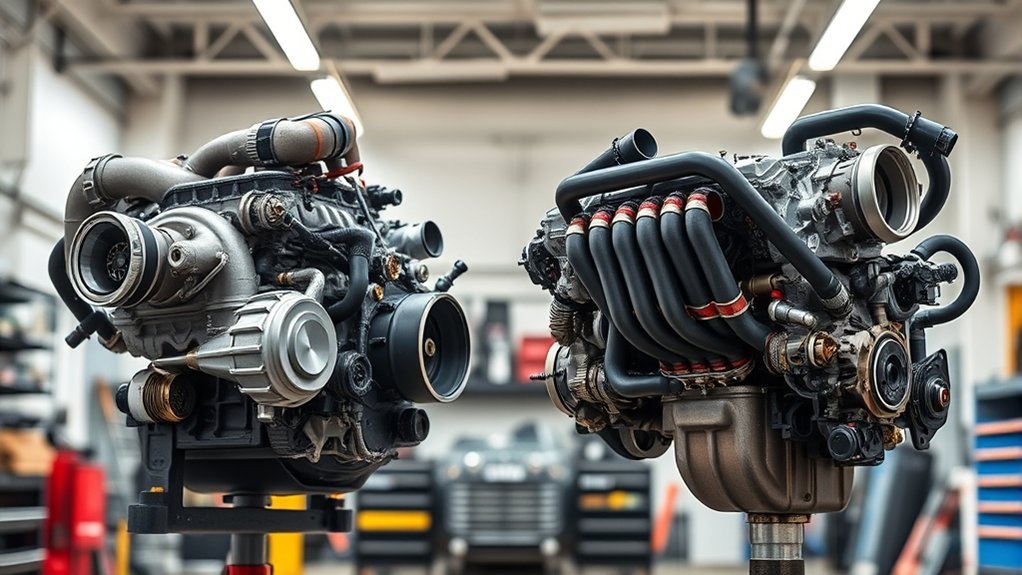
Turbocharged vs. naturally aspirated engines is not a simple winner-or-loser comparison. Turbo engines usually deliver more power and low- to mid-range torque from a smaller displacement, while naturally aspirated engines typically offer more linear response and fewer forced-induction components. The better choice depends on the exact vehicle, fuel requirement, official MPG, towing needs, elevation, maintenance history, and how you prefer the engine to respond.
Quick Answer
Choose a turbocharged engine when you want strong low- and mid-range torque, high power from a smaller displacement, or better performance at elevation. Choose a naturally aspirated engine when you prefer predictable throttle response, fewer boost-system components, and straightforward operation. Compare the exact vehicles because MPG, reliability, fuel requirements, and maintenance vary by model.
Key Takeaways
- A turbocharger uses exhaust energy to compress intake air, allowing an engine to burn more fuel and produce more power when boost is requested.
- A naturally aspirated engine relies on atmospheric pressure and often delivers power more progressively.
- Turbocharging can support better fuel economy when it enables engine downsizing, but it does not guarantee better real-world MPG.
- Naturally aspirated engines have fewer boost-system parts, but that alone does not prove that a particular engine will be more reliable.
- Official fuel-economy ratings, the owner’s manual, towing specifications, and model-specific reliability data matter more than cylinder count or aspiration type by itself.
How Turbocharged and Naturally Aspirated Engines Work
How a Turbocharged Engine Works
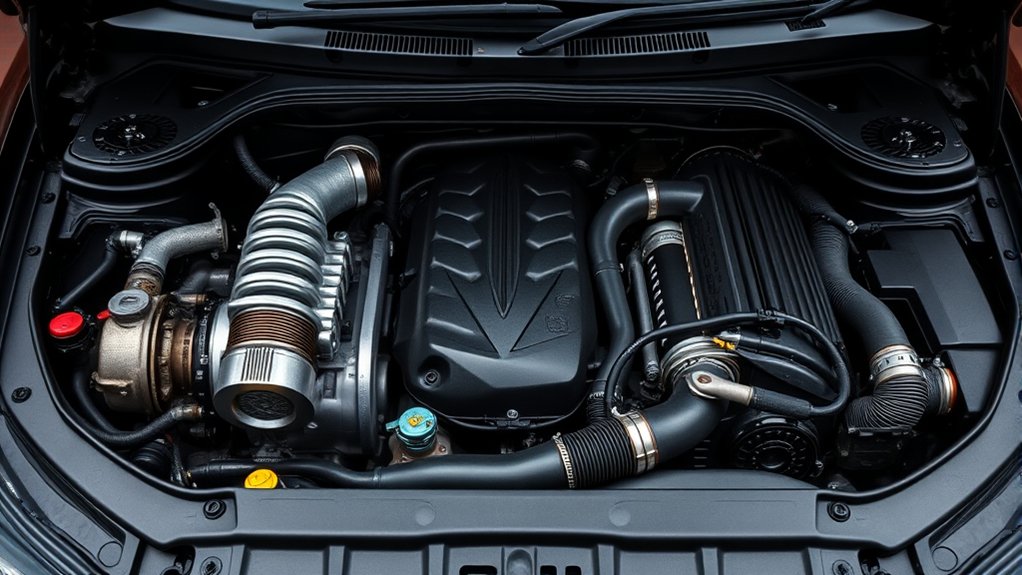
A turbocharger has a turbine on the exhaust side and a compressor on the intake side. Exhaust gas spins the turbine, which is connected by a shaft to the compressor. The compressor pressurizes the incoming air so the cylinders can receive a greater mass of air than they could through atmospheric pressure alone.
The engine control system can then add more fuel while maintaining the required air-fuel ratio. The result is more torque and power from a given displacement. Cummins identifies the turbine wheel, compressor wheel, housings, bearing system, exhaust passages, and compressed-air outlet as core parts of a turbocharger system. You can see a technical overview on the Cummins turbocharger resource.
Compressed air becomes hotter, so many turbocharged engines use an intercooler to reduce intake-air temperature before the air enters the engine. A wastegate or variable-geometry mechanism helps control turbo speed and boost pressure.
How a Naturally Aspirated Engine Works
A naturally aspirated engine has no turbocharger or supercharger. As each piston moves downward during the intake stroke, the pressure difference between the cylinder and the surrounding atmosphere helps draw air through the intake system.
Because the engine does not force additional air into the cylinders, its maximum output is more closely tied to displacement, engine speed, intake efficiency, valve timing, and atmospheric conditions. The absence of a turbocharger also means there is no turbo spool-up delay.
Natural aspiration does not automatically mean that an engine is slow, high-revving, fuel-efficient, or reliable. Those characteristics depend on the complete engine and vehicle design.
Turbocharged vs. Naturally Aspirated Engines at a Glance
| Factor | Turbocharged Engine | Naturally Aspirated Engine |
| Air intake | Compressor forces additional air into the engine. | Relies on atmospheric pressure and piston movement. |
| Power density | Usually produces more power and torque from the same displacement. | Usually needs more displacement or engine speed to match the output. |
| Throttle response | May have a delay before boost builds, although modern systems can make it very small. | Often more immediate and progressive because no turbo must accelerate. |
| Low-rpm torque | Many modern designs provide strong torque across a broad low- and mid-rpm range. | Varies by displacement and design; smaller engines may need more rpm or downshifting. |
| Fuel economy | Can improve rated efficiency when paired with engine downsizing, but heavy boost use consumes more fuel. | Can be efficient, but natural aspiration alone does not guarantee better or worse MPG. |
| Altitude | Can compensate for thinner air within the turbocharger’s operating limits. | Usually loses more maximum output as air density falls. |
| Mechanical complexity | Adds a turbocharger, boost controls, charge plumbing, and often an intercooler. | Has fewer forced-induction components. |
| Best fit | Drivers wanting strong mid-range acceleration, compact power, towing torque, or altitude performance. | Drivers prioritizing linear response, simpler hardware, and predictable power delivery. |
Power Delivery, Turbo Lag, and Throttle Response
What Turbo Lag Actually Means
Turbo lag is the time between requesting more power and receiving the additional output produced after the turbocharger accelerates and creates boost. It is not the same as the boost threshold, which is the engine speed and load range where the turbo can begin producing useful boost.
A delay felt from the driver’s seat may also come from an automatic transmission selecting a lower gear, electronic throttle programming, traction control, or a hybrid system. Not every hesitation in a turbocharged vehicle is caused by the turbocharger itself.
Instrumented testing shows why engine speed matters. In one Car and Driver comparison, a naturally aspirated Chevrolet Camaro V6 reached 0.2 g of acceleration 0.8 second sooner than a turbocharged Ford Mustang from 1,500 rpm; the gap narrowed to 0.2 second at 2,500 rpm, and the two matched at 3,500 rpm. That test is not a universal rule, but it demonstrates how turbo response can improve as exhaust flow and turbo speed rise. See the instrumented throttle-response test.
Smaller turbines, low-friction bearings, short exhaust paths, twin-scroll housings, variable geometry, electric assistance, hybrid torque fill, and well-matched transmissions can improve response. Cummins notes that wastegate designs can use a smaller turbine housing to enhance transient response, while variable-geometry systems optimize exhaust flow across different speeds and loads.
Why Naturally Aspirated Power Often Feels More Linear
A naturally aspirated engine does not need to wait for boost pressure to rise. Pressing the accelerator generally produces a progressive increase in airflow and torque, which can make the relationship between pedal movement and engine response feel more predictable.
That does not mean every naturally aspirated engine has stronger response in every situation. A small naturally aspirated engine may respond immediately but still require a downshift and higher rpm to accelerate as strongly as a turbocharged alternative.
How Torque Delivery Differs
Many modern turbocharged engines are calibrated to produce peak torque across a broad low- and mid-rpm range. This can make passing, climbing hills, and accelerating with passengers or cargo feel effortless.
Naturally aspirated engines often build torque and power more progressively as rpm rises. Performance-oriented examples may reward the driver for using the upper part of the rev range, but high-rpm capability is not guaranteed merely because an engine lacks a turbocharger.
Fuel Economy and Emissions
Turbocharging can improve fuel economy when it lets a manufacturer replace a larger engine with a smaller one while preserving the performance drivers expect. The U.S. Department of Energy and EPA list a potential efficiency improvement of up to 8% for turbocharging with engine downsizing.
Turbocharging is now mainstream, not a niche performance technology. The EPA’s 2025 Automotive Trends Report says gasoline turbocharged engines, including hybrids and plug-in hybrids, accounted for more than 44% of U.S. light-duty vehicle production in model year 2024. That market share reflects how widely manufacturers use turbocharging for power density and engine downsizing, but it does not mean every turbo model is more efficient than a naturally aspirated alternative. See the EPA Automotive Trends Report.
That figure is an engineering potential, not a promise for every vehicle. A turbocharged engine uses more air and fuel when it operates under substantial boost. Frequent hard acceleration, towing, high speeds, steep grades, cold weather, short trips, vehicle weight, and transmission behavior can reduce or erase the expected advantage.
Turbocharging changes an engine’s operating range; it does not guarantee better MPG, reliability, or performance by itself.
Note: Compare the official city, highway, and combined ratings of the exact vehicles. Do not assume that a turbo four-cylinder will use less fuel than a naturally aspirated six-cylinder without checking the complete vehicle specifications.
Official ratings also reflect far more than the engine. Aerodynamics, tires, transmission ratios, hybrid assistance, stop-start operation, vehicle mass, and drivetrain losses all affect consumption. The EPA’s Automotive Trends data provides vehicle and technology information for more meaningful comparisons.
Reliability, Maintenance, and Ownership Costs
Turbocharged Engine Ownership
A turbocharged engine contains additional hardware that a naturally aspirated engine does not need. Depending on the design, this may include the turbocharger assembly, wastegate or variable-geometry controls, intercooler, charge pipes, bypass or recirculation valve, extra oil and coolant lines, and additional sensors.
Those components create more possible leak and repair points, but they do not automatically make the engine unreliable. A well-designed and properly maintained turbo engine can provide a long service life. A poorly designed or neglected naturally aspirated engine can still have serious problems.
Turbochargers operate at high speed and temperature, making correct lubrication especially important. Garrett identifies oil starvation or contamination, hard acceleration before oil circulates fully, and hot shutdown as contributors to turbocharger damage. Use the oil viscosity, performance standard, fuel grade, and change interval specified by the vehicle manufacturer. A generic rule such as “all turbo engines need premium fuel” or “all turbo engines need shorter oil intervals” is not accurate. See Garrett Motion’s turbocharger failure guidance.
Possible turbo-system warning signs include:
- Sudden loss of power or inconsistent boost
- Whistling, siren-like, scraping, or unusual rushing-air noises
- Oil smoke from the exhaust
- Loose, cracked, or oil-soaked charge pipes
- Check-engine or underboost codes
- Unexplained oil consumption
- Coolant loss on a water-cooled turbo system
Naturally Aspirated Engine Ownership

A naturally aspirated engine has fewer forced-induction components. That can simplify packaging, diagnosis, and some repairs. There is no turbocharger, intercooler, boost-control system, or pressurized charge-air plumbing to service.
Mechanical simplicity is an advantage, but it should not be treated as proof of lower total ownership cost. Timing systems, oil consumption, cylinder deactivation, direct injection, cooling systems, transmissions, and model-specific defects may have a greater effect on long-term expense than the absence of a turbocharger.
Pro Tip: When comparing used vehicles, research the exact engine code, model year, service history, recalls, technical service bulletins, and common failure points. “Turbo” or “naturally aspirated” is too broad to predict reliability by itself.
Do Turbo Engines Need to Idle Before Shutdown?
Modern turbo systems may use water cooling and control strategies that manage heat after shutdown. Garrett Motion notes that current vehicle controllers can account for a turbocharger’s high operating temperature and compensate for the cool-down period after the vehicle is switched off. Under normal commuting, follow the owner’s manual rather than applying a universal idle-time rule. See Garrett’s turbocharging facts.
After sustained towing, track driving, a long high-speed climb, or another unusually high-load event, reducing load for the final minutes of the drive may help temperatures stabilize. Follow the instructions for the specific vehicle rather than relying on advice written for older turbo systems.
Altitude, Heat, Towing, and Driving Conditions
High-Altitude Driving
Air becomes less dense as elevation increases. A naturally aspirated engine therefore receives less oxygen on each intake stroke and usually loses maximum output.
A turbocharged engine can command additional compressor work to offset some of that loss, so it commonly preserves performance better at elevation. It cannot compensate without limit. Compressor speed, temperature, cooling capacity, knock control, and programmed boost limits eventually restrict output.
Hot Weather
Hot intake air is less dense and more prone to knock in a gasoline engine. Turbocharged vehicles rely heavily on effective intercooling, engine cooling, and heat management. Under very hot or repeated high-load conditions, the engine computer may reduce boost or ignition advance to protect the powertrain.
Naturally aspirated engines are also affected by high intake and coolant temperatures, but they do not add heat by compressing the intake charge through a turbocharger.
Towing and Carrying Heavy Loads
A broad low-rpm torque curve can make a turbocharged engine well suited to towing and hauling. However, the engine type does not determine the legal or safe towing capacity. Cooling, transmission design, axle ratio, brakes, chassis, hitch equipment, and the manufacturer’s gross-weight ratings are equally important.
Use the vehicle’s official towing specification and follow any severe-service maintenance schedule. Sustained boost while towing can increase fuel consumption and thermal load substantially.
Advantages of Turbocharged Engines
- More output per unit of displacement: A turbo can help a smaller engine produce the power of a larger unboosted engine.
- Strong low- and mid-range torque: Many modern turbo engines provide useful torque without requiring high rpm.
- Potential efficiency benefit: Engine downsizing can reduce pumping and friction losses during lighter-load operation.
- Better altitude compensation: The compressor can offset part of the reduced air density at elevation.
- Flexible calibration: Manufacturers can tune boost, torque delivery, and response for economy, towing, luxury, or performance applications.
Advantages of Naturally Aspirated Engines
- Progressive response: Power delivery often follows accelerator input more directly because there is no turbo spool-up period.
- Fewer boost-system components: There is no turbocharger, intercooler, wastegate, or pressurized charge-air system.
- Straightforward diagnosis: Mechanics do not need to isolate boost leaks or turbo-control faults.
- Consistent character: Drivers may prefer the predictable increase in torque and sound as engine speed rises.
- Potentially lower repair exposure: There is no turbo assembly to replace, although total reliability still depends on the exact engine.
Drawbacks of Each Engine Type
Turbocharged Engine Drawbacks
- Possible lag or non-linear response, depending on turbo sizing and calibration
- More heat and additional intake, exhaust, oil, coolant, and control components
- Potentially higher repair cost if the turbocharger or related hardware fails
- Real-world fuel savings may be small when boost is used frequently
- Some models require higher-octane fuel for rated performance
- Aftermarket tuning can increase thermal and mechanical stress or affect emissions compliance and warranty coverage
Naturally Aspirated Engine Drawbacks
- Lower power density than a comparable boosted engine
- May require more displacement, higher rpm, or more frequent downshifts for similar acceleration
- Usually loses more output at high elevation
- May have less low-rpm torque in smaller-displacement applications
- Can use as much or more fuel than a downsized turbo engine, depending on the vehicle
Turbocharged vs. Naturally Aspirated: Which Is Right for You?
A turbocharged engine may be the better fit when you regularly drive at elevation, carry heavy loads, tow within the vehicle’s rating, or want strong acceleration without a large-displacement engine. It can also be appealing when the turbo model has clearly better official MPG or performance than the naturally aspirated alternative.
A naturally aspirated engine may be preferable when you value progressive response, intend to keep the vehicle for a long time, want fewer boost-system components, or simply prefer the way the particular engine delivers power.
Before choosing, compare the following for the exact vehicles:
- Official city, highway, and combined fuel-economy ratings
- Required and recommended fuel grade
- Horsepower, torque, and the rpm range where torque is available
- Vehicle weight and transmission behavior
- Towing and payload ratings
- Oil specification and service schedule
- Warranty coverage
- Model-specific reliability records and repair costs
- Insurance and purchase price
- Throttle response and noise during an actual test drive
If you want a model-specific comparison, see our naturally aspirated vs. turbo Tacoma engine guide. For a current example of a non-turbo strategy, see our 2026 Toyota RAV4 turbo-engine explainer.
For a used turbocharged vehicle, accelerate under moderate and heavy load, listen for abnormal noises, check for warning lights or smoke, inspect visible intake hoses, and obtain a professional pre-purchase inspection. For either engine type, complete service records are usually more valuable than a broad assumption about the induction system.
Frequently Asked Questions
Which is better, turbocharged or naturally aspirated?
Neither is universally better. Turbocharged engines generally offer greater power density and strong mid-range torque. Naturally aspirated engines often provide more progressive response and fewer boost-system components. Compare the exact vehicles, prices, MPG ratings, fuel requirements, service records, and intended use.
What is the main disadvantage of a turbocharged engine?
The main disadvantage is added complexity and heat. The turbocharger, controls, intercooler, plumbing, and lubrication or cooling connections create additional possible repair points. Some vehicles also have noticeable turbo lag, although modern systems can reduce it considerably.
Are naturally aspirated engines more reliable than turbo engines?
They are mechanically simpler because they lack turbo-specific hardware, but that does not guarantee greater reliability. Engine design, manufacturing quality, cooling, oil control, maintenance, operating conditions, and model-specific defects matter more than aspiration type alone.
Is a four-cylinder turbo better than a V6?
Not automatically. A turbo four may provide more low-rpm torque and better rated fuel economy, while a V6 may offer smoother delivery, a different sound, or stronger performance under sustained load. Compare the exact horsepower, torque curve, MPG, vehicle weight, transmission, towing rating, fuel grade, and reliability history.
Do turbocharged engines always get better fuel economy?
No. Turbocharging can improve rated efficiency when it allows engine downsizing, but substantial boost requires additional fuel. Driving style, vehicle weight, gearing, aerodynamics, temperature, towing, and traffic conditions determine real-world MPG.
Do all turbo engines require premium gasoline?
No. Some require premium, some recommend it for maximum performance, and others are designed for regular fuel. Use the minimum octane specified in the owner’s manual and on the fuel-filler label.
Do turbo engines need more frequent oil changes?
Follow the manufacturer’s interval. Turbochargers depend on clean oil of the correct specification, but the required schedule varies by vehicle and operating conditions. Towing, repeated short trips, extreme temperatures, or other severe use may trigger a shorter schedule in the owner’s manual.
Do turbo engines last as long as naturally aspirated engines?
They can, but aspiration type alone cannot predict engine life. Turbocharged engines add heat, pressure, and turbo-specific hardware, while modern designs are engineered around those loads. Maintenance history, correct oil, cooling-system condition, operating conditions, and model-specific defects are more useful reliability signals than the turbo label by itself.
Are turbo engines better at high altitude?
Usually, for preserving power. A turbocharger can compress thinner intake air and offset part of the density loss that reduces naturally aspirated engine output. The advantage has limits because turbo speed, charge temperature, cooling capacity, fuel quality, and engine calibration can restrict how much boost the system can safely add.
Conclusion
Turbocharged engines are attractive when you want high power from a smaller displacement, broad low- and mid-range torque, and better performance at elevation. Naturally aspirated engines remain appealing for their progressive response and simpler air-intake and exhaust arrangement.
The engine type should be the beginning of the comparison, not the final decision. Review the exact vehicle’s official MPG, fuel requirement, service schedule, towing limits, warranty, reliability record, and test-drive behavior. A well-engineered engine that suits your use and has been properly maintained is a better choice than one selected only because it has—or does not have—a turbocharger.
Sources
- U.S. Department of Energy and EPA — Advanced Engine Technologies — explains turbocharging with engine downsizing and its potential efficiency benefit.
- FuelEconomy.gov — Energy Efficient Technologies — provides government estimates and context for fuel-saving vehicle technologies.
- U.S. EPA — Automotive Trends Report — current official reporting on light-duty vehicle technology and fuel-economy trends.
- Cummins — Turbochargers and Air Handling — describes turbocharger parts, wastegates, variable geometry, and exhaust-flow control.
- U.S. Department of Energy Alternative Fuels Data Center — How Gasoline Cars Work — explains the basic operation and major components of spark-ignition vehicles.
- Garrett Motion — Why Do Turbochargers Fail? — covers oil-related failure contributors and hot-shutdown risks.
- Car and Driver — Turbo vs. Non-Turbo Throttle Response Test — provides instrumented response measurements at different engine speeds.
