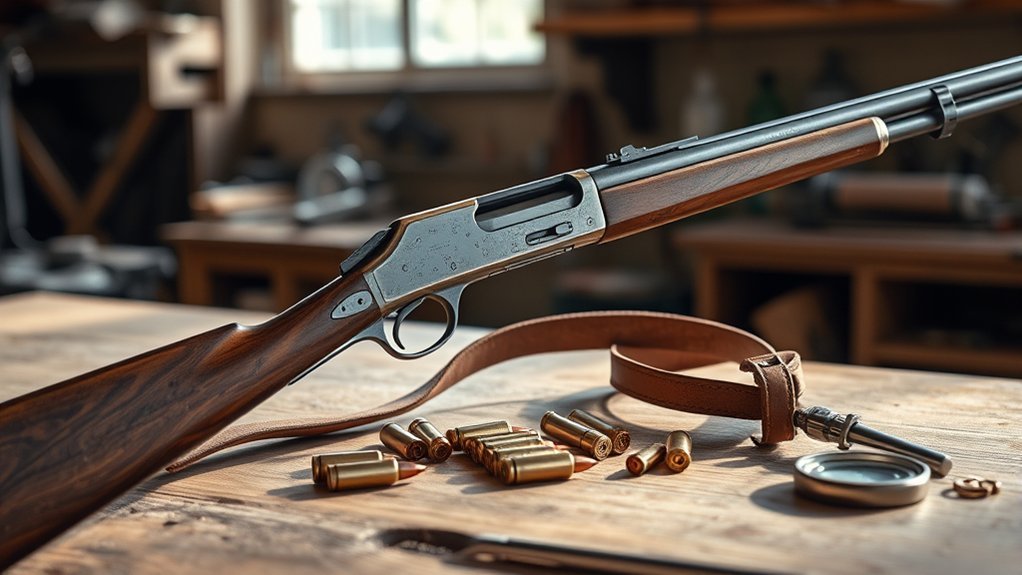
The first recognized bolt-action rifle, the Dreyse Needle Rifle, was developed in 1824 by Johann Nikolaus von Dreyse. This rifle featured a revolutionary rotating bolt mechanism, considerably enhancing loading efficiency and marking a pivotal change in military firearms. It was adopted by the Prussian Army in 1841. Key developments, such as the Mauser 98, further solidified the bolt-action’s importance. Understanding these foundations can inform smarter purchasing decisions for enthusiasts exploring the world of bolt-action rifles.
The Origins of the Bolt Action Rifle
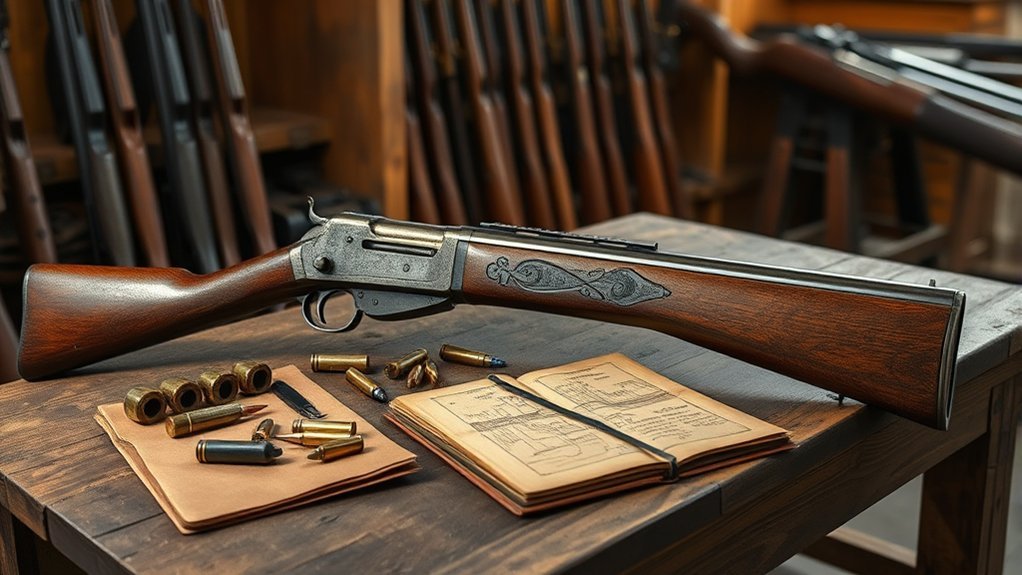
The origins of the bolt-action rifle can be traced back to the innovative design of the Dreyse Needle Rifle, which Johann Nikolaus von Dreyse developed in 1824. This rifle, recognized as the first bolt-action rifle, featured a groundbreaking rotating bolt mechanism that allowed for more efficient loading and firing. Adopted by the Prussian Army in 1841, the Dreyse Rifle utilized a needle fire system, enhancing operational efficiency over previous firearms.
The introduction of bolt actions marked a pivotal evolution in firearms technology, enabling rapid manual cycling and greatly improving battlefield accuracy.
Essential Features of Bolt Action Mechanisms
The essential features of bolt action mechanisms are defined by their key components and operational mechanics, which collectively contribute to their reliability and efficiency.
Central to this design is the rotating bolt system, allowing for rapid chambering and ejection of cartridges, while Controlled Round Feeding (CRF) enhances overall cartridge management.
Moreover, the simplicity of fewer moving parts not only facilitates maintenance but also underscores the enduring appeal of bolt action rifles in various shooting contexts.
Key Components Explained
Bolt-action mechanisms are defined by several key components that contribute to their efficiency and reliability. The primary elements include the bolt body, which houses the locking lugs that engage when the bolt is closed, and the trigger mechanism that releases the firing pin. Most bolt-action rifles utilize a rotating turn-bolt system, enabling a smooth operation for rapid firing. Precision machining of components like the receiver enhances accuracy, essential for long-range shooting. Significantly, the Mauser system exemplifies Controlled Round Feeding (CRF), optimizing cartridge management during feeding and ejection.
| Component | Function | Importance |
|---|---|---|
| Bolt Body | Houses locking lugs | Secures the action |
| Locking Lugs | Engages when bolt is closed | Guarantees firing reliability |
| Trigger Mechanism | Releases firing pin | Initiates shot |
| Receiver | Supports the bolt action | Enhances accuracy |
| Turn-Bolt System | Facilitates smooth operation | Increases firing speed |
Operation Mechanics Overview
Understanding the operation mechanics of bolt-action rifles reveals the intricacies of their design and functionality. Central to this mechanism is the rotating turn-bolt, which, through an upward motion of the handle, releases the bolt, facilitating precise chambering and ejection of cartridges.
Unlike semi-automatic designs, bolt-action rifles incorporate fewer moving parts, enhancing reliability and simplifying maintenance. Key components, including the bolt body, locking lugs, barrel, and trigger mechanism, collaborate to guarantee accuracy and control with each shot.
Additionally, many designs feature internal or detachable magazines, typically accommodating two to ten rounds. The Mauser system, renowned for its Controlled Round Feeding (CRF) feature, exemplifies superior cartridge control during feeding and extraction, highlighting the sophistication of bolt-action operation mechanics.
Key Historical Milestones in Bolt Action Development
The development of bolt-action rifles marks a pivotal evolution in firearm technology, beginning with the introduction of the Dreyse Needle Rifle in 1824.
Subsequent models, including the Ward-Burton Model 1871 and the Mauser 98, played essential roles in military applications, showcasing advancements in reliability and accuracy.
The shift to smokeless powder further enhanced these rifles’ effectiveness, laying the groundwork for modern designs and their enduring legacy in military and civilian contexts.
Early Innovations in Firearms
Although firearms had evolved considerably since their inception, the advent of the bolt-action mechanism marked a pivotal transformation in military technology. The Dreyse Needle Rifle, introduced in 1824, represented the first bolt-action design, enhancing efficiency for the Prussian Army by 1841.
The subsequent introduction of metallic cartridges in the mid-19th century further revolutionized bolt-action rifles, leading to improved reliability and reloading speed. The Mauser 98, developed in 1898, epitomized this advancement with its robust construction and exceptional accuracy, influencing military applications worldwide.
Key Models and Variants
Bolt-action rifles have undergone significant evolution since their inception, with various models and variants reflecting technological advancements and military requirements.
Key historical milestones include:
- Dreyse Needle Rifle (1824): The first bolt-action rifle, adopted by the Prussian Army, revolutionizing firearm mechanics.
- Mauser Model 98 (1898): Set the standard for military bolt-actions, influencing designs across the globe and serving as a benchmark for subsequent semi-automatic rifles.
- Lee–Enfield (1895): Its unique magazine design allowed for rapid cycling, enhancing operational efficiency in combat.
These models illustrate the critical shift from earlier designs, paving the way for future innovations in both bolt-action and semi-automatic rifles, underscoring their enduring legacy in firearm history.
Impact on Modern Rifles
As advancements in firearm technology unfolded throughout the 19th and 20th centuries, the influence of early bolt-action rifles became evident in the design and functionality of modern rifles.
The Dreyse Needle Rifle, introduced in 1824, marked a pivotal shift, later enhanced by the adoption of metallic cartridges, which improved reliability and efficiency.
The Mauser 98 further refined bolt-action design, establishing a controlled round feeding system that remains foundational today.
During World War I, models like the Lee-Enfield and Springfield 1903 showcased exceptional accuracy, traits still sought after in contemporary rifles.
The change to smokeless powder also revolutionized performance, allowing for higher velocities and improved precision, characteristics that continue to define modern bolt-action rifles and their enduring legacy.
Comparing Popular Bolt Action Systems
When examining the evolution of bolt-action systems, it becomes evident that each design reflects distinct engineering philosophies and operational priorities. Various bolt-action mechanisms demonstrate unique characteristics, influencing their effectiveness and user experience.
- Dreyse Needle Rifle: The first bolt-action rifle, it introduced a rotating bolt mechanism, laying foundational technology.
- Mauser System: Known for Controlled Round Feeding (CRF), it enhances reliability during cycling the bolt, particularly in military contexts.
- Lee-Enfield System: Celebrated for its rapid cycling rate, it offers a smooth operation, making it a soldier’s choice in both World Wars.
Other notable systems include the Remington M-700, which features a three-locking lug design for precision, and the Mosin–Nagant, revered for its durability.
Each system’s unique bolt handle configuration contributes considerably to its operational efficiency and user satisfaction, demonstrating the diverse innovations in bolt-action rifle technology.
Advantages of Choosing a Bolt Action Rifle
Although many firearm options exist, choosing a bolt-action rifle offers distinct advantages that cater to specific needs in accuracy and reliability.
Renowned for their unmatched precision, bolt-action rifles are favored by sport shooters for long-range applications and hunting. The simplicity of the bolt body mechanism results in fewer moving parts, enhancing reliability and facilitating maintenance compared to semi-automatic firearms.
Renowned for their precision, bolt-action rifles offer superior reliability and ease of maintenance, making them ideal for long-range sport shooting and hunting.
Many designs, such as the Mauser system, incorporate Controlled Round Feeding (CRF), ensuring improved cartridge control and consistent performance. Additionally, these rifles allow for extensive customization options, empowering enthusiasts to create precision firearms tailored to their shooting preferences.
They excel in handling high-powered magnum calibers, enhancing versatility across various shooting scenarios. This blend of accuracy, reliability, and adaptability makes bolt-action rifles a compelling choice for those seeking a powerful tool for both sport and hunting endeavors.
Buying Tips for Bolt Action Rifles
What factors should one consider when buying a bolt-action rifle? Understanding the essential aspects can greatly enhance the purchasing experience. Here are key buying tips to keep in mind:
- Build Quality: Prioritize a strong, precision-machined receiver, guaranteeing durability and performance.
- Bolt Operation: Test the smoothness of the bolt’s movement; ease of use is vital for reliability during cycling.
- Magazine Capacity: Assess the magazine options available, whether internal or detachable, as this impacts reloading convenience.
Additionally, examine safety features, looking for models with multiple settings to confirm secure handling. Stock materials also play a significant role: synthetic stocks offer weather resistance, while wooden stocks provide traditional aesthetics and rigidity. By focusing on these factors, buyers can make informed choices that align with their needs and preferences.
Common Myths About Bolt Action Firearms
Why do so many misconceptions surround bolt-action firearms? Despite their historical significance, introduced with the Dreyse Needle Rifle in 1824, misconceptions persist.
A prevalent belief is that bolt-action rifles are outdated, yet they maintain popularity due to their unmatched accuracy and reliability, particularly in hunting and long-range shooting.
Additionally, many erroneously associate bolt-actions exclusively with snipers, while they are extensively utilized by hunters and competitive shooters across various disciplines.
The notion that a low rate of fire limits versatility is misleading; bolt-actions thrive with high-pressure cartridges, making them ideal for powerful calibers.
Moreover, the assumption that semi-automatic rifles have supplanted bolt-actions overlooks the preference many enthusiasts and professionals have for their simplicity and precision.
Understanding these myths is essential for anyone considering the purchase of a bolt-action firearm, as it highlights their enduring relevance and utility in modern shooting contexts.
Maintenance Tips for Your Bolt Action Rifle
Misconceptions about bolt-action firearms often lead to neglect in their maintenance, which can compromise both performance and longevity. To guarantee ideal functionality, a structured maintenance schedule is essential. Regular cleaning and lubrication are essential for accuracy and durability.
- Clean the barrel and action after each shooting session to prevent corrosion and maintain precision.
- Lubricate the bolt lightly to guarantee smooth operation and guard against rust formation.
- Inspect the trigger mechanism periodically for reliability and safety, as it is critical for responsible firearm use.
Additionally, checking magazine functionality is fundamental for reliable cartridge feeding during shooting.
Frequently Asked Questions
What Three Guns Should Everyone Own?
Everyone should consider owning a versatile shotgun, a reliable handgun, and a precision hunting rifle. These firearms possess historical significance, offering essential functionality for diverse scenarios, from hunting to self-defense, while enhancing personal safety and skill development.
What Are the Downsides of Bolt-Action Rifles?
While bolt-action rifles offer precision, their downsides emerge in recoil management and limited fire rate. Maintenance tips become essential, as users must navigate the complexities of manual operation, hindering efficiency in high-pressure situations.
What Is Considered the Best Bolt-Action Rifle Ever Made?
The Mauser 98 is often considered the best bolt-action rifle ever made, lauded for its accuracy features and historical significance. Its design has profoundly influenced military and civilian firearms, embodying reliability and unmatched performance.
What Is the Best First Rifle to Buy for a Beginner?
Statistics reveal that over 60% of new shooters prefer .22 caliber rifles. For beginners, essential rifle features include smooth bolt operation and adjustable sights, enhancing comfort and control while fostering skill development through beginner tips and practice.
Conclusion
In the grand theater of firearms, the bolt action rifle takes center stage, wielding an elegance that makes even the most sophisticated automatic rifles seem like clumsy dancers. As prospective buyers venture into the world of these meticulously crafted machines, they must remember that choosing a bolt action rifle is less about practicality and more about embracing a nostalgic romance with history. After all, who wouldn’t want to channel their inner sharpshooter while simultaneously feeling like a Victorian-era gentleman?
