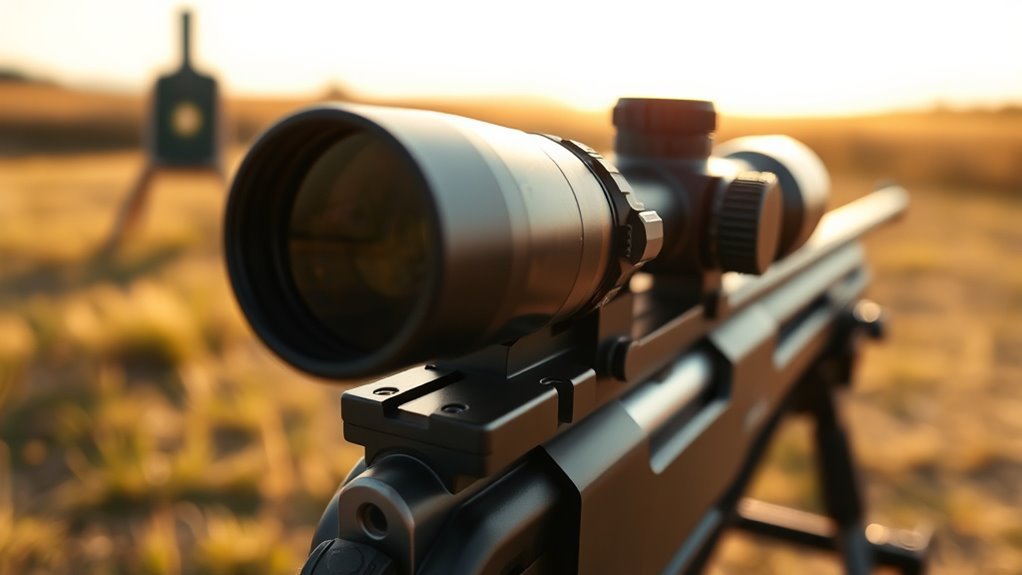
A 150-yard fixed-parallax scope is designed so the target image and reticle are most closely aligned in the same optical plane at about 150 yards. That does not mean the rifle must be zeroed at 150 yards. At other distances, residual parallax can make the reticle appear to move across the target if your eye shifts away from the optic’s centerline.
Quick Answer
A 150-yard fixed-parallax scope is factory optimized to minimize apparent reticle movement at roughly 150 yards. It does not require a 150-yard zero. At closer or farther targets, careful eye centering becomes more important because residual parallax can shift the apparent point of aim.
Key Takeaways
- Parallax distance and rifle zero are separate. A scope can be parallax-free at 150 yards while the rifle is zeroed at another distance.
- Parallax is seen as apparent reticle movement when the eye moves and the target image is not on the same optical plane as the reticle.
- A fixed-parallax scope can still be used at distances other than 150 yards; consistent eye placement reduces the resulting aiming error.
- There is no universal 300-yard threshold or fixed amount of error for every 150-yard scope.
- Higher magnification and precision-focused use make adjustable parallax more valuable.
Warning: Before mounting, focusing, or checking a scope on a firearm, verify that the firearm is unloaded and keep the muzzle pointed in a safe direction. Follow the firearm and optic manufacturers’ instructions. When live firing, use an appropriate range or shooting area, know the target and what is beyond it, and wear suitable eye and hearing protection.
What 150 Yd Fixed Parallax Means

A 150-yard fixed parallax setting means the optic is designed so parallax is minimized at approximately 150 yards. At that distance, the target image and reticle are intended to fall on the same optical plane, so small changes in eye position should produce little or no apparent reticle movement relative to the target.
This setting is normally established by the scope’s optical design rather than a user-accessible adjustment. A fixed-parallax scope therefore has no side-focus or adjustable-objective control for changing the parallax distance in the field.
Leupold’s riflescope owner’s manual states that a fixed-focus optical system can be parallax-free at only one distance and that many of its scopes are set to 150 yards. The same manual lists other values for particular product categories, showing that 150 yards is common for some scopes rather than a universal standard.
When the target is substantially closer or farther away, some residual parallax can remain. If the shooter’s eye stays centered behind the optic, that residual parallax may have little practical effect. If the eye moves off-center, the reticle can appear to move across the target even though the rifle and scope have not moved.
A 150-yard parallax setting tells you where the optic is designed to minimize parallax. It does not tell you where the rifle must be zeroed.
Parallax Distance vs. Zero Distance
Parallax-free distance and zero distance describe two different things. Parallax is an optical condition inside the scope. Zero is the distance at which the rifle’s point of aim and point of impact are intentionally matched through windage and elevation adjustment.
| Setting | What It Controls |
| Fixed parallax distance | The distance where apparent reticle movement from eye displacement is minimized. |
| Rifle zero | The selected distance where the sight setting is matched to the projectile’s impact. |
| Diopter | Focuses the reticle for the individual shooter’s eye. |
| Side focus / adjustable objective | Changes the optical system to reduce parallax at different target distances on an adjustable scope. |
A useful real-world example is the Leupold American Marksman 3-9×40. Its manufacturer specification lists a 150-yard fixed parallax-free distance, while the reticle information on the same product page discusses 200- or 300-yard zeros depending on ammunition. That directly demonstrates why the two distances should not be treated as interchangeable.
Why Fixed Parallax Affects Accuracy
Parallax matters because it can create an apparent point-of-aim shift. When the target image and reticle are on different optical planes, moving the eye within the scope’s exit pupil can make the reticle appear to slide across the target.
The optic is not physically moving the bullet. Instead, the shooter may aim at a slightly different apparent location because the reticle has shifted relative to the target. If a shot is taken with that displaced sight picture, the resulting impact can differ from the intended point.
The amount of possible error cannot be determined from the words “150-yard fixed parallax” alone. It depends on the scope’s optical design, how far the target is from the corrected distance, how far the eye moves from the optical center, and other characteristics of the optic.
Higher magnification can make small reticle movements easier to see and can make precise eye placement more demanding. Nightforce’s NX6 owner’s manual similarly notes that longer distances and higher magnification can make uncorrected parallax more significant, but there is no universal distance such as 300 yards at which every scope suddenly develops a specific amount of error.
Why 150 Yards Is a Common Setting
A 150-yard fixed setting is common on several centerfire-oriented riflescopes because manufacturers can choose a fixed optical compromise that works across a useful range without adding an adjustable parallax mechanism.
It should not be treated as an industry-wide standard. Leupold states that many of its scopes are parallax-free at 150 yards, but its manual also lists other factory settings for rimfire, handgun, shotgun, and muzzleloader products. Other manufacturers likewise use different fixed distances.
The main advantage is simplicity. There is no parallax knob to set before using the optic, and the scope can often be lighter and mechanically simpler than an otherwise comparable adjustable model.
The 150-yard value is also not caliber-specific. A scope does not become more or less parallax-free simply because it is mounted on a rifle chambered in .223, .308, or another cartridge. Cartridge ballistics affect trajectory and zeroing; parallax distance is an optical property of the scope.
When a 150 Yd Scope Works Best
A 150-yard fixed-parallax scope works well when simplicity matters more than the ability to remove parallax at every target distance. It is especially practical on moderate-magnification hunting and general-purpose optics where the shooter can maintain reasonably consistent eye placement.
| Use Case | Why Fixed Parallax Can Work |
| General hunting | Simple operation with no separate parallax control. |
| Informal target shooting | Fewer adjustments to manage at moderate magnification. |
| Lightweight rifle setup | Fixed-focus designs can avoid the added mechanism of side focus. |
| Targets near the specified distance | Residual parallax should be lowest near the factory-corrected distance. |
An adjustable-parallax model becomes more useful when targets vary widely in distance, magnification is high, or small aiming errors matter. The choice should therefore be based on the scope’s intended use rather than an assumption that a fixed 150-yard specification limits the rifle to 150 yards.
[Amazon Products Picked for You]

3-9x40 Configuration: This hunting rifle scope offers a 3-9x magnification range and a 40mm objective lens to gather plenty of light for a bright, clear image, even in low-light conditions like dawn or dusk.


Precision Aiming: The 4x magnification scope features 1/4 MOA click adjustments for precision accuracy
Where Parallax Error Shows Up
Residual parallax becomes easier to identify when the target is away from the scope’s corrected distance and the shooter deliberately moves the eye slightly behind the eyepiece. If the reticle seems to float across a stationary target, parallax is present.
At close distances such as 25 or 50 yards, a scope designed around a 150-yard fixed setting may show more apparent reticle movement than it does near 150 yards. The target may also appear less sharply focused, depending on the optic. Target blur and parallax are related to the optical system but should not be treated as identical tests.
The same principle applies beyond 150 yards. There is no universal rule that every scope produces a particular number of inches of error at 200, 300, or 400 yards. The practical effect depends heavily on how far the shooter’s eye moves away from the optic’s centerline.
Pro Tip: If a fixed-parallax scope shows some reticle movement at a target distance you regularly use, concentrate on a repeatable cheek position and a centered sight picture. If the required precision is still not acceptable, an adjustable-parallax scope is the more appropriate solution.
Fixed Parallax vs. Side Adjustable Scopes
A fixed-parallax scope is optimized around one factory-selected distance. An adjustable scope uses a side-focus control or adjustable objective to change the optical correction for different target distances.
| Feature | Fixed Parallax | Adjustable Parallax |
| User adjustment | None | Side focus or adjustable objective |
| Main advantage | Simple, fast setup | Can minimize parallax across many distances |
| Best fit | Moderate magnification and general field use | Higher magnification and precision-oriented use |
| Tradeoff | Residual parallax away from the fixed distance | More controls and setup |
Nightforce describes parallax as apparent reticle movement caused when the reticle and target appear on different focal planes and recommends adjusting its parallax-equipped scopes until the reticle remains stationary as the eye moves. That is the practical advantage of an adjustable system.
[Amazon Products Picked for You]
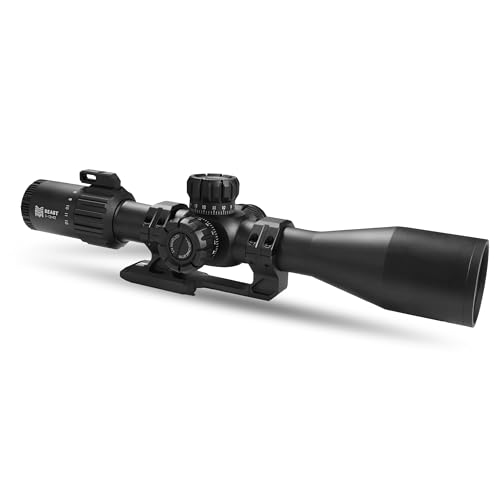
Mid power variable optic MPVO from 3-12x magnification and a wider 44mm objective lens allowing for more light transmission and a wider field of view

Compatible with any Red dot scope
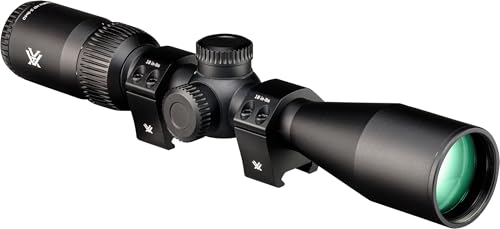
Designed for newer hunters looking for quality gear without complexity, the Triumph HD 3-9x40 riflescope kit simplifies setup and delivers confidence in the field. It includes a riflescope, new 1" Hunter Rings (0.90" Low Height) and a neoprene case.
How to Shoot Well With Fixed Parallax
Consistent eye position is the main way to reduce the practical effect of residual parallax on a fixed-parallax scope. A repeatable cheek weld helps place the eye near the same point in the exit pupil from shot to shot.
Do not assume that a 150-yard parallax specification requires a 150-yard zero. Choose and verify the rifle’s zero separately according to the optic or reticle instructions and the intended application.
| Control | Purpose |
| Repeatable cheek weld | Keeps eye position more consistent. |
| Centered sight picture | Reduces off-axis viewing that exposes parallax error. |
| Correct diopter | Keeps the reticle sharply focused for the shooter’s eye. |
| Verified zero | Confirms the chosen sight-in setting independently of parallax distance. |
At longer distances, parallax is only one potential source of aiming error. Optical quality, target visibility, wind, trajectory, shooter position, and environmental conditions can also affect practical precision.
How to Tell Parallax Is Dialed In
The standard test is simple: stabilize the optic on a target and move the eye slightly without moving the firearm. If the reticle remains stationary relative to the target, parallax is minimized at that distance. If the reticle appears to move, residual parallax is present.
This is the method described in both Leupold and Nightforce documentation.
Reticle Lock Check
For a scope specified as fixed-parallax-free at 150 yards, place a suitable target at or near that distance and stabilize the firearm or optic. Maintain a normal sight picture, then move the eye slightly up, down, left, and right without disturbing the scope.
- Verify that the firearm is unloaded when performing non-firing setup.
- Use a clearly defined point on the target.
- Keep the optic itself completely stationary.
- Move only the eye or head slightly.
- Watch whether the reticle moves relative to the target.
Near the specified fixed-parallax distance, relative reticle movement should be minimal. A fixed scope does not have a control to “dial in” another target distance; the test simply shows how much residual parallax is visible under the conditions being checked.
Head Shift Test
The head-shift test is useful because parallax is specifically linked to eye position. With the optic stable, move the eye slightly across the exit pupil while observing a small target detail.
| Eye Movement | Reticle Behavior | Meaning |
| Left-right | Little or no relative movement | Parallax is well controlled at that distance. |
| Up-down | Little or no relative movement | Target and reticle planes are closely aligned. |
| Any direction | Reticle appears to move | Residual parallax is present. |
On an adjustable scope, the parallax control can then be refined until the movement disappears or is minimized. On a fixed scope, consistent eye centering is the practical way to reduce its effect away from the factory-corrected distance.
Common Fixed Parallax Mistakes
The most common mistakes are confusing parallax with zero, treating a fixed parallax distance as a hard shooting limit, and assuming target focus or reticle focus proves that parallax has been eliminated.
Eye Position Errors
Inconsistent eye position is where residual parallax turns into a practical aiming problem. When the eye moves away from the optic’s centerline, the reticle can appear to move relative to the target.
- Keep a repeatable cheek position.
- Center the eye behind the exit pupil.
- Avoid accepting a sight picture when the eye is visibly off-axis.
- Expect eye-position consistency to matter more as precision demands increase.
- Use the head-shift test to understand how the optic behaves at your target distance.
If the eye remains close to the optical center, residual parallax may have little practical effect even when the target is not exactly at the factory-set distance.
Target Distance Far From the Fixed Setting
A fixed-parallax scope does not have a “wrong distance setting” because there is no user-adjustable parallax distance. Instead, the target may simply be closer to or farther from the factory-corrected distance.
At those ranges, check the sight picture for apparent reticle movement. If the scope is being used for a task where even small aiming errors matter, consider a model with side focus or an adjustable objective.
Do not attempt to modify a factory-fixed optical system unless the manufacturer specifically provides a supported adjustment procedure. Internal optical changes may affect sealing, warranty coverage, focus, or alignment.
Diopter Misadjustment
The diopter focuses the reticle for your eye. It should not be treated as a parallax adjustment.
Nightforce’s current NX6 instructions, for example, describe diopter adjustment separately from parallax adjustment. Leupold likewise instructs the shooter to focus the reticle before checking or adjusting parallax.
- Follow the procedure in the specific scope’s manual.
- Use a plain, light background when instructed by the manufacturer.
- Adjust until the reticle appears immediately sharp.
- Do not keep changing the diopter to focus targets at different distances.
- After the reticle is focused, evaluate parallax separately.
Note: Some manufacturers give model-specific instructions such as placing an adjustable parallax control at infinity while setting the diopter. Do not assume that sequence applies to every scope, particularly a fixed-parallax model that has no such control.
How to Choose the Right Scope
Choose between fixed and adjustable parallax according to magnification, typical target distances, required precision, weight, and how much adjustment you want to manage in the field.
| Criterion | Guidance |
| Magnification | The higher the magnification and precision requirement, the more useful adjustable parallax becomes. |
| Target distances | Widely changing distances favor adjustable parallax. |
| Simplicity | Fixed parallax removes one field adjustment. |
| Precision requirement | Small-target or precision use benefits more from the ability to eliminate residual parallax. |
| Manufacturer specification | Check the exact model rather than assuming every fixed scope is set to 150 yards. |
A fixed 150-yard scope is therefore not automatically better or worse than an adjustable design. It is a simpler optical configuration intended for users who do not need to remove parallax at every distance. Adjustable designs add control when target distance and precision requirements vary more widely.
[Amazon Products Picked for You]
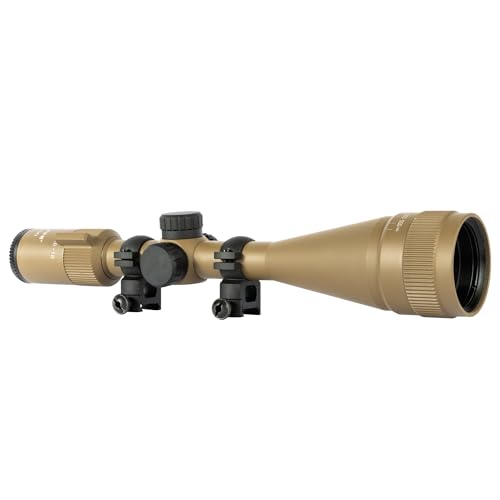
Adjustable 6-18 times magnification, for targeting out to 1000 yards and beyond

Bright. Accurate. Dependable. We'll assume your stand is in the right spot and suggest our Banner Dusk & Dawn series to capitalize on the latter. With their Dusk & Dawn Brightness (DDB) multi-coated lenses, these riflescopes cast clarity and brightness.

4-16x44 FFP Rifle Scope: First Focal Plane design ensures the reticle scales with magnification for precise holdovers and ranging at any distance. The 4-16x44 configuration delivers a bright, sharp image and robust performance for medium-range precision
Frequently Asked Questions
What Is the Difference Between 50 Yard Parallax and 100 Yard Parallax?
A scope set for 50-yard parallax is designed to minimize apparent reticle movement at about 50 yards, while a 100-yard model is optimized around 100 yards. The correct choice depends on the scope’s intended use. The number describes the optical parallax-free distance, not the rifle’s required zero distance.
How Far Can You Shoot Without Parallax Adjustment?
There is no universal maximum distance imposed by fixed parallax. A fixed-parallax scope can be used closer to or farther from its corrected distance, but residual parallax may become more important when eye position changes. Magnification, optical design, target size, eye alignment, and the precision required all affect how noticeable it is.
Is 20X Enough for 1000 Yards?
A 20x scope can provide substantial magnification at long distance, but magnification alone does not determine whether an optic is suitable. Target size, resolution, mirage, atmospheric conditions, reticle design, stability, and parallax control all matter. At high magnification, an adjustable-parallax system is generally more useful than relying only on a fixed setting.
How Do You Properly Adjust Parallax?
On a scope with side focus or an adjustable objective, first make sure the reticle is properly focused for your eye. Stabilize the optic on the target, move your eye slightly, and adjust the parallax control until the reticle remains stationary relative to the target. Treat distance markings on the control as a starting reference and confirm the result with the movement test.
Does 150 Yard Parallax Mean I Should Zero at 150 Yards?
No. The 150-yard specification describes the scope’s optical parallax-free distance. Your zero is a separate sighting decision. Manufacturer documentation can specify a fixed 150-yard parallax distance while using reticle or ballistic systems intended for a different zero distance.
Can You Adjust a Fixed-Parallax Scope?
Not through a normal field control. A true fixed-parallax scope has no side-focus or adjustable-objective mechanism. Some optics may be serviceable or configurable by the manufacturer, but users should not alter internal optical settings unless the manufacturer specifically provides an approved procedure.
Conclusion
A 150-yard fixed-parallax scope is designed to minimize parallax at approximately 150 yards, but that number does not define the rifle’s zero or maximum usable range. Away from the corrected distance, residual parallax matters mainly when the eye moves off the optic’s centerline. Consistent eye placement can keep the effect small, while adjustable parallax provides more control when magnification, distance, or precision demands increase.
Sources
- Leupold Riflescope Owner’s Manual — fixed-parallax distances, reticle focusing, parallax testing, sight-in procedure, and firearm-handling caution.
- Leupold American Marksman 3-9×40 Specifications — example of a 150-yard fixed-parallax scope whose reticle information also supports other zero distances.
- Nightforce NX6 Owner’s Manual — definitions of diopter adjustment and parallax, plus the head-movement verification method.
- NSSF Firearm Safety Rules — safe firearm handling, muzzle direction, unloaded-firearm practices, and eye and hearing protection.
