
When comparing battle rifles and assault rifles, the clearest technical difference is the ammunition they are built around. A battle rifle is a common, but not universally standardized, term for a self-loading military or service rifle that fires a full-power rifle cartridge. An assault rifle has a tighter technical definition: it uses an intermediate-power cartridge, feeds from a detachable magazine, and has selective-fire capability. Those differences affect recoil, ammunition weight, useful range, and the roles the rifles have filled in military service.
Last updated: September 11, 2026 — terminology and current U.S. Army Next Generation Squad Weapon context reviewed.
Quick Answer
A battle rifle generally means a self-loading military rifle built around a full-power cartridge such as 7.62x51mm NATO. An assault rifle uses an intermediate cartridge such as 5.56x45mm NATO or 7.62x39mm, feeds from a detachable magazine, and can switch between semi-automatic fire and automatic or burst fire. “Assault rifle” has a relatively specific technical meaning; “battle rifle” is a looser historical and collector term.
Key Takeaways
- Battle rifles generally use full-power rifle cartridges, which means greater cartridge energy and heavier recoil than typical intermediate-cartridge rifles.
- Assault rifles use intermediate cartridges and selective fire, giving infantry a balance of controllability, ammunition weight, and useful range.
- Selective fire is central to the technical definition of an assault rifle, but it is not required for every rifle commonly described as a battle rifle.
- Battle rifle is a less standardized term, so some historical and modern rifles sit near the edges of the category.
- Military service names do not always follow collector terminology, especially as newer rifle and ammunition systems blur older categories.
Note: Firearm terminology can vary by country, law, military doctrine, historian, and collector usage. “Assault rifle” has a relatively specific technical military meaning, while “battle rifle” is more often used as a retrospective or descriptive category. This article explains technical and historical terminology, not legal classifications or buying advice.
Definition of Battle Rifles

Battle rifle is a common term for a self-loading military or service rifle chambered for a full-power rifle cartridge. Unlike the more tightly defined term “assault rifle,” battle rifle is not a universally standardized classification. It is often used to distinguish full-power self-loading service rifles from later intermediate-cartridge assault rifles.
Common full-power cartridges associated with the category include 7.62x51mm NATO, 7.62x54mmR, and .30-06 Springfield. The defining idea is the cartridge class and military-rifle role, not a fixed bullet-diameter range.
Full-power ammunition generally provides greater retained energy at distance than intermediate cartridges, but it also brings more recoil and greater ammunition weight. Some battle rifles are semi-automatic only, while others have selective-fire mechanisms. Automatic fire is not required for a rifle to be commonly described as a battle rifle.
Frequently cited examples include the FN FAL, M14, and G3. These rifles became especially associated with early Cold War service, when several militaries adopted self-loading rifles while retaining full-power ammunition.
Definition of Assault Rifles
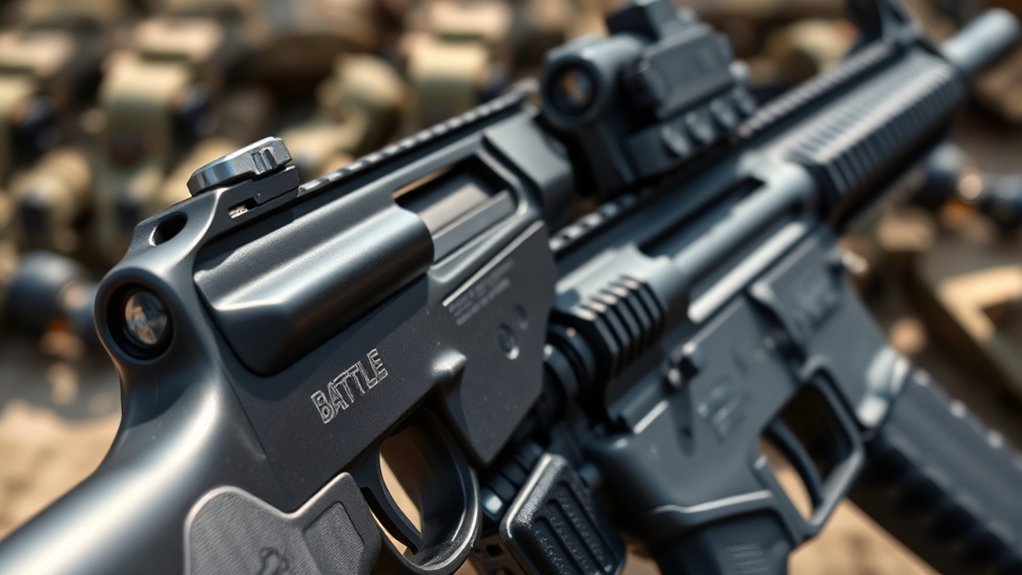
Assault rifles are military rifles built around three central characteristics: an intermediate-power cartridge, a detachable magazine, and a selective-fire mechanism that allows semi-automatic fire plus automatic or burst fire. This combination separates an assault rifle from both a full-power battle rifle and a semi-automatic-only civilian rifle that may look similar.
Intermediate cartridges sit between pistol ammunition and traditional full-power rifle cartridges. Common examples include 5.56x45mm NATO, 5.45x39mm, and 7.62x39mm. Their lower recoil and lighter weight helped militaries issue rifles that were easier to carry and control while allowing soldiers to carry more ammunition for the same overall load.
Core characteristics include:
- Selective Fire: The rifle can switch between semi-automatic fire and at least one additional firing mode, such as automatic or burst fire.
- Intermediate Cartridge: Ammunition is less powerful and generally lighter than traditional full-power service-rifle cartridges.
- Detachable Magazine: Ammunition is normally supplied from a removable box magazine.
- Infantry Role: The design balances controllability, useful range, portability, and ammunition load for general infantry service.
These characteristics explain why assault rifles became common general-issue infantry weapons during the second half of the 20th century.
Battle Rifle vs Assault Rifle: Quick Comparison
| Category | Battle Rifle | Assault Rifle |
| Typical cartridge | Full-power rifle cartridge, such as 7.62x51mm NATO | Intermediate cartridge, such as 5.56x45mm NATO or 7.62x39mm |
| Selective fire required? | No. Battle rifles may be semi-automatic or selective-fire. | Yes, under the standard technical military definition. |
| Definition status | Common descriptive or retrospective category; boundaries can vary | More tightly defined technical military category |
| Main strength | Full-power cartridge performance and extended-range potential | Controllability, mobility, and lighter ammunition |
| Recoil | Generally higher | Generally lower and easier to manage |
| Typical role | Historically general service; today often associated with roles needing full-power cartridge performance | General infantry use across close to medium distances |
| Examples | FN FAL, M14, G3 | AK-47, AKM, M16, M4/M4A1 military carbines |
Key Features of Battle Rifles

The defining feature of a battle rifle is its use of a full-power rifle cartridge in a self-loading military-style rifle. Compared with intermediate ammunition, full-power cartridges generally increase recoil and ammunition weight while retaining more energy at extended distances.
Many classic examples use 7.62x51mm NATO, but caliber diameter alone does not determine the category. The distinction is better understood through the cartridge’s overall power class, the rifle’s military-service design, and its historical context.
Battle rifles may be semi-automatic or selective-fire. Selective fire therefore cannot be used as a requirement for the category. In full-power rifles that provide automatic fire, recoil can make sustained automatic fire less controllable than it is with typical intermediate-cartridge assault rifles.
Features such as barrel length, sights, weight, and operating system vary from model to model. They can influence handling and ballistic performance, but none of those features alone defines a battle rifle.
Key Features of Assault Rifles
Assault rifles combine a fire selector, an intermediate cartridge, and a detachable magazine in a shoulder-fired military rifle. The design concept gives infantry a compromise between the reach of older service rifles and the controllability and ammunition capacity needed for mobile combat.
The category therefore depends on function as well as appearance. A rifle can resemble an assault rifle externally but fall outside the technical definition if it lacks selective-fire capability.
Fire Selector Mechanism
The fire selector mechanism is a defining feature of an assault rifle because it allows the operator to choose between firing modes supported by the specific weapon.
Common selector positions include:
- Semi-Automatic: Fires one round for each trigger pull.
- Automatic: Continues the firing cycle while the trigger remains depressed and ammunition remains available.
- Burst: Fires a preset number of rounds for one trigger pull on rifles equipped with that mode.
- Safe: Prevents the trigger mechanism from firing the weapon during normal handling.
Not every assault rifle provides the same selector positions. Some combine semi-automatic and automatic fire, while others use semi-automatic and burst settings.
Intermediate Cartridge Usage
Intermediate cartridges are central to the assault-rifle concept. Examples such as 5.56x45mm NATO and 7.62x39mm sit below traditional full-power service-rifle cartridges in overall power and ammunition weight.
The lighter cartridge class reduces recoil compared with typical full-power rifle ammunition and lets a soldier carry more cartridges for a similar ammunition load. Those characteristics were major reasons intermediate-cartridge rifles became attractive for general infantry service.
Magazine size varies by rifle and military requirement, so a particular capacity is not part of the technical definition. The important feature is that the rifle normally feeds from a detachable magazine.
Cartridge Power and Effective Range
Cartridge class is the simplest starting point for separating a traditional battle rifle from an assault rifle. Full-power rifle ammunition generally carries more energy and ammunition weight. Intermediate ammunition trades some of that performance for lower recoil, lower carried weight, and greater controllability.
Effective range cannot be assigned from the category name alone. Cartridge design, barrel length, sights or optics, ammunition, environmental conditions, and military requirements all affect practical range. That is why specific range claims should be tied to a particular rifle-and-ammunition system rather than applied universally to every battle rifle or assault rifle.
A useful rule of thumb is that battle rifles are associated with full-power cartridges, while assault rifles are technically defined around intermediate cartridges, detachable magazines, and selective fire.
Weight, Recoil, and Ammunition Load
Full-power rifle ammunition is generally heavier and produces more recoil than intermediate ammunition. That affects both the weapon’s handling and the amount of ammunition an infantry soldier can carry for a given load.
This trade-off was important in the historical movement toward intermediate-cartridge service rifles. Lower recoil made rapid follow-up fire easier to control, while lighter ammunition reduced the burden of carrying a combat load.
Those advantages help explain why assault rifles became common general-issue infantry weapons, although full-power rifles continued to serve where their cartridge characteristics were useful.
Historical Context and Development
The distinction between battle rifles and assault rifles grew out of changes in infantry weapons and ammunition during the 20th century. Militaries increasingly balanced range and cartridge power against recoil, weapon weight, ammunition load, and the distances at which infantry commonly fought.
Key milestones include:
- World War I: Militaries experimented with self-loading and automatic infantry weapons while most soldiers still carried full-power bolt-action rifles.
- World War II: Semi-automatic rifles increased individual firepower, while the German StG 44 became a major early example of the intermediate-cartridge, selective-fire concept later associated with assault rifles.
- Early Cold War: Rifles such as the FN FAL, M14, and G3 continued the full-power service-rifle approach, while designs such as the AK-47 and later M16 demonstrated the growing appeal of intermediate ammunition.
- Later 20th Century: Assault rifles and carbines became dominant general-issue infantry weapons in many forces because they combined useful range with lighter ammunition and more controllable fire.
U.S. Army historical material documents the same transition in American service. The M14 used the 7.62mm NATO cartridge, while the lighter M16 used 5.56mm ammunition and ultimately became the standard U.S. infantry rifle.
Why Do Modern Rifles Blur the Battle-Rifle and Assault-Rifle Categories?
The old battle-rifle-versus-assault-rifle distinction is useful for understanding 20th-century weapons, but modern military nomenclature does not always fit neatly into those two labels.
One current example is the U.S. Army’s M7 Rifle, part of the Next Generation Squad Weapon program. The Army is fielding the M7 with a new 6.8mm ammunition family as a replacement for the M4A1 in portions of the Close Combat Force. In 2026, the Army also advanced the shorter XM8 Carbine, a compact variant of the M7.
The important terminology lesson is not to force every new service rifle into an older collector category. Military organizations may classify weapons according to program, role, logistics, and service nomenclature rather than the informal labels used in historical discussions.
For a related terminology comparison based on weapon size and handling rather than cartridge class, see carbine vs rifle.
Practical Applications in Modern Warfare
Historically, full-power battle rifles served as general infantry rifles, but many later full-power platforms or derivatives moved into more specialized roles as intermediate-cartridge assault rifles became common general-issue weapons.
Full-power rifles can be useful where a military requires additional cartridge performance at extended distances. Some are configured for designated marksman use, overwatch, or other roles that place greater emphasis on precision and range.
An important distinction is that designated marksman rifle describes a battlefield role and configuration, while battle rifle describes a broader firearm category. The terms can overlap, but they are not synonyms.
Assault rifles remain closely associated with general infantry use because intermediate ammunition supports mobility, controllability, and a lighter ammunition load. Actual equipment choices vary by military, terrain, doctrine, and mission.
Common Confusion: Assault Rifle vs Assault Weapon
The term assault rifle has a technical military meaning centered on intermediate ammunition and selective-fire capability. The term assault weapon is different. It is generally a legal or political category whose definition can vary by jurisdiction.
This distinction matters because many semi-automatic civilian rifles do not meet the standard technical definition of an assault rifle. A rifle’s appearance alone does not establish selective-fire capability.
Warning: Firearm laws vary widely by country, state, and locality. Do not use technical firearm categories as a substitute for current legal guidance.
Which Category Fits Which Military Role?
Neither category is universally better because the terms describe different technical trade-offs. A full-power service rifle emphasizes cartridge performance but usually brings greater recoil and ammunition weight. An assault rifle emphasizes a balance of controllability, portability, ammunition load, and useful infantry range.
That trade-off helps explain why intermediate-cartridge assault rifles became dominant general-issue weapons in many forces while full-power rifles continued in selected roles. Modern systems also show that military requirements can move beyond the traditional two-category model.
Frequently Asked Questions
Is every selective-fire rifle an assault rifle?
No. Selective fire alone is not enough. Under the standard technical definition, an assault rifle also uses an intermediate-power cartridge and normally feeds from a detachable magazine. Full-power selective-fire rifles such as the FN FAL, M14, and G3 are commonly classified as battle rifles instead.
Is a semi-automatic AR-15 technically an assault rifle?
Under the standard military-style technical definition, a semi-automatic-only AR-15 does not qualify as an assault rifle because it lacks selective-fire capability. Legal terms such as “assault weapon” are separate and can have different definitions depending on jurisdiction.
Is the M14 a battle rifle?
Yes. The M14 is commonly described as a battle rifle because it is a self-loading military rifle chambered for the full-power 7.62x51mm NATO cartridge. It is one of the most frequently cited examples of the category.
Is a battle rifle just a larger assault rifle?
No. Size can differ, but the more important distinction is ammunition and definition. Battle rifles generally use full-power rifle cartridges. Assault rifles use intermediate cartridges and, by technical definition, include selective-fire capability.
Why did assault rifles replace many battle rifles as general infantry weapons?
Intermediate ammunition reduced recoil and carried ammunition weight while still providing useful infantry range. That combination made assault rifles easier to carry and control, helping them replace many full-power service rifles in general-issue roles during the Cold War and later decades.
Sources and Terminology References
- University of Wyoming Firearms Research Center — Firearms Terminology
- Small Arms Survey — Military Assault Rifles, Research Note 25
- U.S. Army Center of Military History — The Army Before Vietnam, 1953–1965
- U.S. Army — Next Generation Squad Weapon and 6.8mm ammunition update
Conclusion
The most reliable way to understand battle rifle vs assault rifle is to start with cartridge class and fire-control capability. A battle rifle generally refers to a self-loading military rifle using a full-power cartridge. An assault rifle uses an intermediate cartridge, a detachable magazine, and selective fire.
The categories are useful, but they are not equally rigid. “Assault rifle” has a comparatively specific technical definition, while “battle rifle” is a broader historical and descriptive term. Modern service rifles also show why cartridge type, fire-control system, military role, and official service nomenclature should be considered together rather than relying on appearance alone.

