Iconic WWII rifles did more than equip soldiers; they reflected how each nation thought about firepower, logistics, training, and battlefield doctrine. From the American M1 Garand to the German Karabiner 98k, each rifle brought strengths and trade-offs that shaped how infantry fought. Comparing these firearms helps you see why reliability, rate of fire, cartridge choice, production capacity, and soldier training all mattered during World War II.
Quick Answer
The most iconic WWII rifles included the M1 Garand, Lee-Enfield, Mosin-Nagant, Karabiner 98k, Arisaka Type 99, SVT-40, M1903 Springfield, and StG 44. Each stood out for a different reason, from semi-automatic firepower and rugged mass production to long-range accuracy and early assault-rifle design.
Key Takeaways
- The M1 Garand gave U.S. infantry a major rate-of-fire advantage because it was widely issued as a semi-automatic service rifle.
- The Lee-Enfield and Mosin-Nagant earned strong reputations because they were durable, widely produced, and practical in harsh conditions.
- The Karabiner 98k and M1903 Springfield showed how accurate bolt-action rifles remained important even as semi-automatic designs spread.
- The StG 44 introduced features that influenced many later infantry rifles, especially the use of an intermediate cartridge and selective fire.
WWII rifle design shows a turning point in infantry warfare: armies still relied heavily on bolt-action rifles, but semi-automatic and selective-fire weapons pointed toward the future.
M1 Garand: The American Standard

When you think about WWII rifles, the M1 Garand often stands out as the standard American service rifle of the era. Designed by John C. Garand, this semi-automatic rifle was adopted by the U.S. Army in 1936 and became closely associated with American infantry during the war.
Its gas-operated action allowed faster follow-up shots than most bolt-action rifles used by other armies. Instead of manually cycling the bolt after every shot, a soldier could fire multiple rounds more quickly while staying focused on the target area. That gave the M1 Garand a real battlefield advantage, especially during rapid infantry engagements.
Weighing around 9.5 pounds, the rifle used an 8-round en-bloc clip and fired the powerful .30-06 Springfield cartridge. Its sturdy build helped it perform in difficult field conditions, and its practical accuracy made it useful at typical combat ranges. While the en-bloc clip system had limits, the rifle gave U.S. troops a strong balance of firepower, durability, and dependability.
The M1 Garand also reflected a broader American approach to war production. It was not just an advanced rifle for its time; it was a rifle the United States could manufacture and issue in large numbers. That combination of engineering and industrial scale helped make it one of the most recognized firearms of World War II.
Lee-Enfield: The British Workhorse
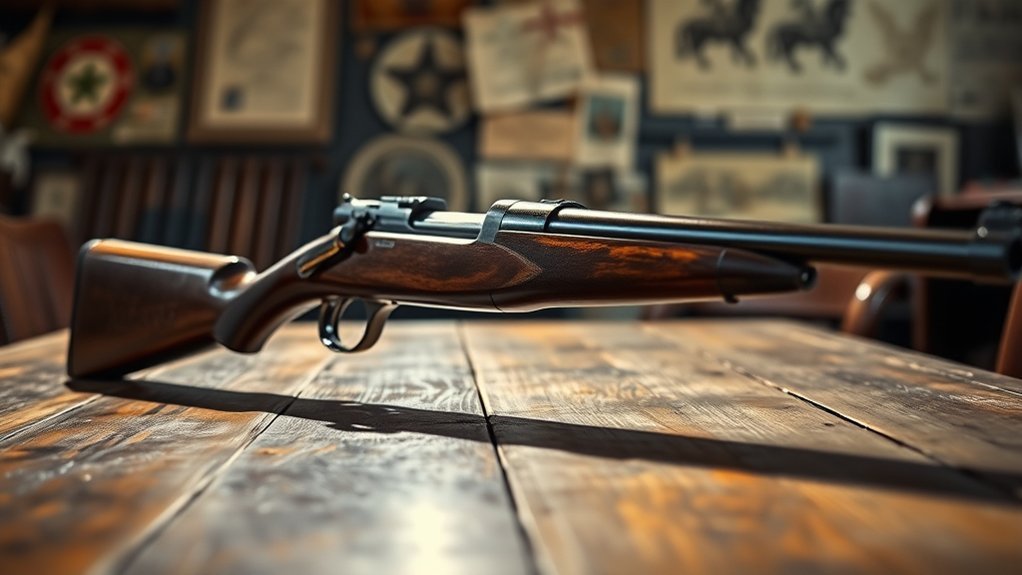
The Lee-Enfield rifle became a cornerstone of British and Commonwealth forces during WWII. Its historical importance comes from more than long service life. It was rugged, familiar to trained soldiers, and adaptable across many theaters of war.
When evaluating its combat performance, you can see why the Lee-Enfield earned a reputation as a reliable workhorse. Its smooth bolt action, 10-round magazine, and practical accuracy helped British troops deliver sustained fire with confidence.
Design and Features
Although often compared with other military rifles of its time, the Lee-Enfield stands out because of its robust design and remarkable versatility. Its distinctive bolt-action mechanism allowed trained soldiers to fire quickly, while its 10-round magazine provided more capacity than many standard bolt-action rivals.
The rifle’s .303 British cartridge provided solid performance for infantry use. Its wooden stock and metal construction contributed to durability, helping it withstand mud, rain, rough handling, and long field service. The Lee-Enfield’s length and weight also helped with stability, which supported accuracy in both long-range and closer battlefield situations.
You’ll also notice the importance of its sights and handling. Adjustable sights helped soldiers aim more precisely, while the rifle’s overall layout made it familiar and manageable for trained users. As a result, the Lee-Enfield combined practicality with reliable field performance, which strengthened its reputation among British and Commonwealth troops.
Historical Significance
Renowned for its functionality, the Lee-Enfield rifle played a major role in British military history during WWII. Its design supported rapid reloading and effective range, making it a dependable choice for British forces across Europe, North Africa, and Asia.
The rifle’s influence extended beyond combat performance. It symbolized British resilience, Commonwealth cooperation, and military continuity during a difficult period. Soldiers valued its accuracy, magazine capacity, and durability, all of which helped support the overall effectiveness of British infantry units.
Here’s a table summarizing key aspects of the Lee-Enfield’s historical significance:
| Aspect | Description |
|---|---|
| Production | Over 17 million units produced across major Lee-Enfield variants |
| Service Life | Used from the late 19th century into the postwar era |
| Global Impact | Adopted and used by British and Commonwealth forces |
| Symbolism | Represents British military heritage and wartime endurance |
| Technological Influence | Showed how a well-refined bolt-action design could remain effective for decades |
Combat Performance
While many rifles served on the battlefield during WWII, the Lee-Enfield stood out for its strong combat performance. Its bolt-action system could be worked quickly by trained soldiers, and accounts of rapid fire helped build its reputation among infantrymen.
The .303 British cartridge gave it useful power for battlefield ranges, while the 10-round magazine reduced the need to reload as often as rifles with smaller magazines. That mattered during defensive actions, patrols, and sudden close-range engagements.
The Lee-Enfield’s accuracy and reliability in adverse conditions also earned respect. Its robust construction helped it survive demanding field use, while its familiar handling made it easier for trained troops to use under stress. Overall, its mix of magazine capacity, durability, accuracy, and speed made the Lee-Enfield a respected presence on the WWII battlefield.
Mosin-Nagant: The Soviet Hero

The Mosin-Nagant became closely tied to the Soviet military experience during World War II. It served as a rugged and widely available infantry rifle at a time when the Soviet Union needed enormous quantities of dependable small arms.
Its robust design, chambered in 7.62x54mmR, gave Soviet troops effective firepower against enemy forces. The rifle used a bolt-action mechanism, which required manual cycling between shots but also helped keep the design simple and durable. That simplicity mattered during a war fought across extreme weather, long supply lines, and intense production pressure.
The Mosin-Nagant’s accuracy, especially in sniper variants, made it important beyond ordinary infantry use. Soviet snipers used scoped versions effectively, and the rifle became part of the wider image of Soviet endurance on the Eastern Front. While it could feel heavy and somewhat cumbersome compared with some other rifles, its strength was reliability at scale.
The rifle also reflected Soviet industrial priorities. It was not the most modern rifle of the war, but it could be produced, repaired, issued, and used in huge numbers. That made it one of the most important rifles of WWII, not only as a weapon but also as a symbol of wartime mass mobilization.
Karabiner 98k: The German Precision
When considering the evolution of military rifles during World War II, the Karabiner 98k stands out as a hallmark of German engineering and traditional bolt-action rifle design. This rifle became the standard issue for German troops and was valued for its accuracy, reliability, and strong cartridge performance.
The Karabiner 98k was shorter and handier than earlier long Mauser rifles, making it more practical for infantry use. Its bolt-action system limited rate of fire compared with semi-automatic rifles, but it supported controlled, accurate shooting. German military doctrine also relied heavily on machine guns for squad firepower, which meant the rifle often served as part of a broader weapons system rather than the squad’s only source of fire.
| Feature | Description | Impact |
|---|---|---|
| Caliber | 7.92×57mm Mauser | Strong power for infantry use |
| Weight | About 3.9 kg (8.6 lb) | Manageable for infantry carry |
| Rate of Fire | Bolt-action, commonly estimated around 15–20 aimed rounds per minute with trained use | Accurate, controlled fire |
| Effective Range | Often cited around 500 meters for practical infantry use | Good long-range capability for a service rifle |
The combination of these features solidified the Karabiner 98k’s reputation as a reliable and respected rifle. It was not as fast-firing as the M1 Garand, but it remained effective because of its accuracy, cartridge power, and proven Mauser action.
Arisaka Type 99: The Japanese Defender
Although many readers may not be as familiar with the Arisaka Type 99, this bolt-action rifle played an important role in Japan’s military strategy during World War II. Introduced in 1939, it was designed to replace or supplement earlier Japanese rifles and provide stronger cartridge performance for infantry troops.
The Type 99 used a 7.7mm cartridge, which offered more power than the 6.5mm cartridge used in the earlier Type 38. Its effective range was suitable for common battlefield use, and its action was known for strength. In many ways, the rifle reflected Japan’s need for a durable service weapon that could be carried across islands, jungles, and rugged terrain.
However, production quality varied as the war progressed. Early rifles often showed better machining and finish, while later examples could be rougher because of material shortages and production pressure. These late-war changes did not erase the rifle’s basic strengths, but they did affect consistency.
Despite its shortcomings, the Arisaka Type 99 remained a key component of the Imperial Japanese Army‘s arsenal. It symbolized Japan’s wartime infantry tradition and showed how national strategy, available materials, and battlefield demands shaped rifle production.
SVT-40: The Soviet Semi-Automatic
Developed before World War II and issued during the early 1940s, the SVT-40 semi-automatic rifle represented a major Soviet effort to improve infantry firepower. Its design allowed for faster firing rates than bolt-action rifles, which could improve combat effectiveness when soldiers had enough training, maintenance support, and ammunition.
You can appreciate the SVT-40 because it showed where rifle design was heading. While the Mosin-Nagant remained simpler and easier to mass-produce, the SVT-40 offered a more modern approach for troops who could take advantage of semi-automatic fire.
- Semi-Automatic Action: This mechanism enabled soldiers to fire repeated shots without manually cycling the bolt after each round.
- Effective Range: The SVT-40’s practical range made it suitable for many common infantry engagements.
- Ergonomic Design: Its overall balance and layout helped handling, though it required more care than simpler bolt-action rifles.
Despite its advantages, the SVT-40 faced production and maintenance challenges. The Soviet Union continued relying heavily on the Mosin-Nagant because it was simpler, familiar, and easier to produce in massive quantities. Even so, the SVT-40 remains important because it represented a pivotal advancement in infantry weaponry during a critical period in history.
Note: A rifle’s battlefield value was never based on specifications alone. Training, maintenance, ammunition supply, terrain, and squad tactics all shaped how effective each weapon became in real combat.
M1903 Springfield: The American Sniper
The M1903 Springfield rifle stands as one of the most iconic bolt-action rifles used by American forces during World War II. Although the M1 Garand became the main U.S. service rifle, the M1903 remained important because of its precision and reliability.
Developed in the early 20th century, the M1903 fired the .30-06 Springfield cartridge, a powerful round suited for longer-range shooting. The rifle’s design supported strong accuracy, which made it valuable for trained marksmen and sniper roles. Its smooth bolt action and sturdy construction also helped it perform under demanding conditions.
During WWII, scoped versions of the M1903 were used by American snipers, especially before more modern sniper rifles became widely available. The rifle’s role shows that older designs did not disappear overnight when newer service rifles arrived. Instead, proven weapons often stayed in service when they still filled a specific need.
Overall, the M1903 Springfield remains a symbol of American military marksmanship. It illustrates how accuracy, reliability, and trained use could keep a bolt-action rifle relevant even during a war that increasingly favored semi-automatic and automatic fire.
StG 44: The Assault Rifle Pioneer
As military tactics evolved during World War II, the StG 44 emerged as a groundbreaking innovation in small arms design. It helped bridge the gap between full-power service rifles and submachine guns by giving infantry a controllable weapon suited for many mid-range engagements.
The StG 44 introduced a new balance of firepower, recoil control, and practical range. Instead of using a full-power rifle cartridge, it used an intermediate cartridge that made automatic fire easier to control than many earlier rifle-caliber automatic weapons.
- Intermediate Cartridge: The StG 44 used the 7.92x33mm Kurz cartridge, balancing recoil, range, and fire rate.
- Selective Fire: It offered both semi-automatic and fully automatic modes, giving soldiers more flexibility across different combat scenarios.
- Ergonomic Design: Its layout, sights, and handling supported practical battlefield use at short to medium ranges.
The StG 44’s influence extended beyond the war. While it arrived too late and in too limited numbers to change Germany’s outcome, its design helped shape later thinking about infantry rifles. Its combination of an intermediate cartridge and selective fire became a key idea behind many postwar rifle developments.
How WWII Rifles Shaped Infantry Tactics
WWII rifles mattered because they affected how infantry squads moved, fired, and supported each other. A bolt-action rifle like the Karabiner 98k or Mosin-Nagant favored controlled shots and depended heavily on squad machine guns or supporting weapons for sustained fire. A semi-automatic rifle like the M1 Garand gave individual soldiers more independent firepower.
Magazine capacity also influenced tactics. The Lee-Enfield’s 10-round magazine helped trained British soldiers maintain a strong rhythm of fire. The M1 Garand’s 8-round clip allowed fast follow-up shots. Meanwhile, rifles with 5-round internal magazines often required more frequent reloading, which could matter during fast-moving fights.
Cartridge power shaped performance as well. Full-power rifle cartridges offered range and penetration, but they produced more recoil and made automatic fire harder to control. The StG 44’s intermediate cartridge showed a new direction by accepting less long-range power in exchange for better control and higher practical fire volume at common combat distances.
Bolt-Action vs. Semi-Automatic Rifles in WWII
World War II sits at an important turning point between older bolt-action doctrine and modern self-loading rifle design. Bolt-action rifles were usually simpler, rugged, and easier to produce. They could be very accurate and reliable, especially in harsh field conditions.
Semi-automatic rifles offered faster follow-up shots and reduced the physical movement needed between rounds. That could help soldiers maintain pressure during assaults, defensive actions, and sudden engagements. However, semi-automatic rifles were often more complex, required more manufacturing resources, and could demand more maintenance.
This trade-off explains why armies did not all move to semi-automatic rifles at the same speed. The United States had the industrial strength to issue the M1 Garand widely. Other nations relied more heavily on bolt-action rifles because they were already proven, easier to manufacture, and available in huge numbers.
Why Production and Logistics Mattered
A rifle’s design only mattered if a nation could produce it, supply it, repair it, and train soldiers to use it. The Mosin-Nagant and Lee-Enfield show how older designs could remain valuable because they were already available in large numbers and supported by existing supply systems.
The SVT-40 and StG 44 show the other side of the problem. Both represented more advanced thinking, but advanced weapons could create production and maintenance challenges. During total war, simplicity often mattered as much as innovation.
Logistics also affected ammunition supply. Different cartridges required separate production lines, storage, transport, and training. A rifle that looked excellent on paper could become less practical if it strained supply systems or required parts that were hard to replace in the field.
Most Influential WWII Rifle Overall
Choosing the most influential WWII rifle depends on how you define influence. The M1 Garand stands out for giving American infantry a widely issued semi-automatic advantage. The Lee-Enfield and Mosin-Nagant stand out for durability, scale, and long service. The Karabiner 98k represents the peak of traditional bolt-action service rifle design.
For long-term influence, however, the StG 44 deserves special attention. It introduced a practical combination of selective fire and an intermediate cartridge, which shaped the direction of many later military rifles. It did not dominate the war, but it helped define what modern infantry rifles would become.
That makes WWII rifle history more than a list of famous weapons. It shows the shift from manually operated rifles toward faster, more flexible infantry firearms designed around real combat distances and changing battlefield needs.
Conclusion
In examining these iconic WWII rifles, you can see how each one shaped military history and infantry tactics in a different way. From the reliable M1 Garand to the influential StG 44, these weapons reflected the strengths, limits, and industrial realities of the nations that built them.
The best rifle was not always the most advanced one. A useful wartime rifle had to be accurate enough, durable enough, simple enough to support, and available in the numbers soldiers needed. That is why older bolt-action rifles served beside newer semi-automatic and selective-fire designs throughout the war.
Just like the soldiers who carried them, each rifle tells a story of adaptation under pressure. Studying their impact gives you insight not only into weapons technology, but also into the larger human and industrial effort behind World War II.