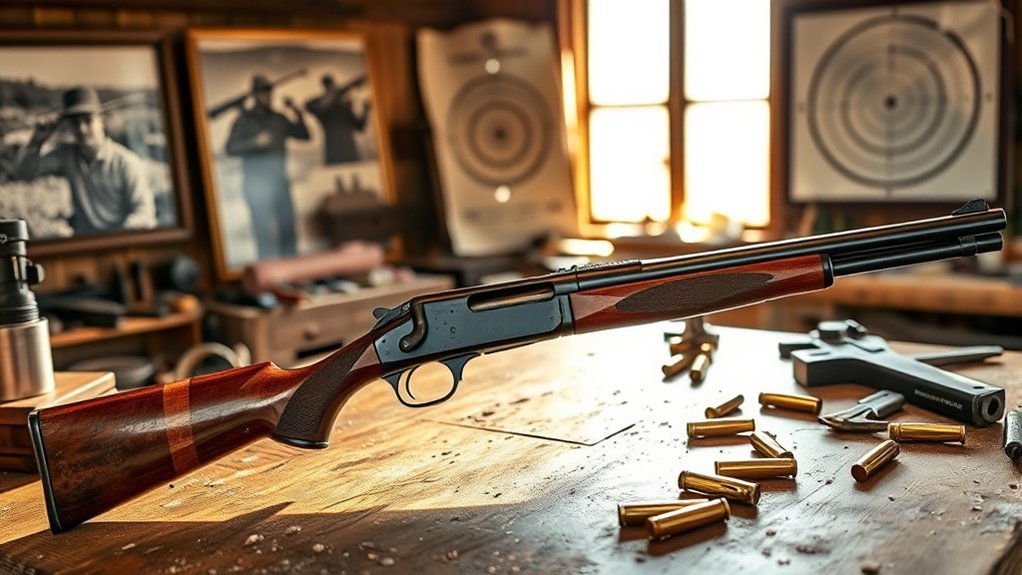
Single-shot bolt-action rifles did matter historically, but their importance needs some context. They were one branch of the much larger nineteenth-century shift from muzzle-loading firearms to breech-loading cartridge rifles. Designs such as the Dreyse Model 1841, Ward-Burton Model 1871, and Mauser Model 1871 helped demonstrate the usefulness of bolt-operated breech actions, while other influential single-shot rifles used trapdoor, rolling-block, or falling-block mechanisms.
Quick Answer
Yes, early bolt-action single-shot rifles were historically important, but they were only part of the breech-loading revolution. Rifles such as the Dreyse Model 1841 and Mauser Model 1871 helped establish bolt-action principles before magazine-fed repeaters became the dominant military form in the late nineteenth century.
Key Takeaways
- Single-shot describes ammunition capacity; bolt-action describes the mechanism that opens and closes the breech.
- The wider move from muzzle-loading to breech-loading rifles was more important than any single action type.
- The Dreyse Model 1841, Ward-Burton Model 1871, and Mauser Model 1871 are genuine historical examples of early single-shot bolt-actions.
- The U.S. Springfield Trapdoor was an important single-shot breech-loader but was not a bolt-action rifle.
- Magazine-fed bolt-actions displaced military single-shots during the late nineteenth century because they allowed repeated shots without manually inserting a new cartridge after every discharge.
What Is a Bolt-Action Single-Shot Rifle?
A bolt-action single-shot rifle is a firearm with a manually operated bolt but no magazine that automatically supplies the next cartridge. It accepts one cartridge for each firing cycle.
The terminology matters because single-shot and bolt-action describe different characteristics. “Single-shot” refers to ammunition capacity, while “bolt-action” describes how the breech is opened, closed, and locked. A single-shot rifle can therefore use a bolt, trapdoor, rolling-block, falling-block, break-action, or another mechanism.
Note: The Ruger No. 1 is a well-known modern single-shot rifle, but it is not a bolt-action. Ruger describes the No. 1 as using a falling-block breech mechanism. This distinction is important when comparing historical rifle designs.
Early single-shot bolt-actions were attractive because they combined breech loading with a comparatively straightforward manually operated locking system. In military development, however, this configuration was usually a transitional stage rather than the final form of the bolt-action rifle.
Were Bolt-Action Single-Shot Rifles Really a Big Deal?
Yes, but mainly as part of a broader technological transition. The truly transformative nineteenth-century change was the move from muzzle-loading arms to practical breech-loading rifles. Loading from the breech made the process faster and eliminated several problems associated with pushing ammunition down a fouled barrel from the muzzle.
The U.S. National Park Service’s history of Springfield Armory explains that Civil War experience exposed serious limitations in muzzle-loading rifles. The United States subsequently adopted metallic-cartridge breech-loaders, including the Springfield Trapdoor system. That rifle was a major single-shot military arm even though it did not use a bolt action.
Single-shot bolt-actions were still significant because they demonstrated that a sliding or rotating bolt could close and secure a breech efficiently. That mechanical idea would later become central to many magazine-fed military and sporting rifles.
The major historical breakthrough was breech loading; the lasting contribution of early single-shot bolt-actions was showing how the bolt mechanism could become a practical foundation for later repeating rifles.
What Came Before Bolt-Action Rifles?
Most military shoulder arms before the widespread adoption of breech-loaders were single-shot muzzle-loaders. The shooter loaded the ammunition from the front of the barrel, a method that became slower as fouling accumulated and was awkward when firing from positions other than standing.
Rifled barrels and improved projectiles increased the useful accuracy of nineteenth-century shoulder arms, but they did not solve the fundamental inconvenience of muzzle loading. Designers therefore experimented with several ways to open the firearm at the breech instead.
Breech-loading development did not begin with bolt-actions. Hinged breeches, rolling blocks, falling blocks, and other mechanisms all competed during the nineteenth century. Springfield Armory’s history of breech-loader development documents several of these approaches.
One especially important bolt-operated design was the Dreyse needle rifle. The Military History Institute Prague explains that Johann Nikolaus von Dreyse developed his needle-fire system during the 1820s and later applied it to a bolt-action breech-loading rifle. The design entered Prussian service as the Model 1841 infantry rifle.
Calling the Dreyse the first successful breech-loader of any type would be too broad because earlier breech-loading designs existed. Its historical importance comes instead from being an early military rifle that successfully combined breech loading with a bolt-operated action.
How Did Bolt-Action Single-Shot Rifles Work?
At a mechanical level, an early single-shot bolt-action used a manually operated bolt to open and close the rear of the chamber. Because the rifle lacked a magazine feeding additional ammunition into position, a new cartridge had to be supplied individually between shots.
After firing, the bolt mechanism allowed the fired case or cartridge remains to be removed before another round could be loaded. Exact extraction, ignition, and locking arrangements differed considerably among nineteenth-century designs.
The key advantage was therefore not an inherent guarantee of superior accuracy. Rather, the configuration combined breech loading, a mechanically secure action, and relatively simple ammunition handling compared with later magazine systems.
Modern claims that a single-shot action is automatically more accurate because it lacks a magazine should also be treated cautiously. Accuracy depends on the entire rifle system, including barrel quality, ammunition, bedding, sights or optics, manufacturing tolerances, condition, and the shooter.
[Amazon Products Picked for You]

Do you support the second amendment to the U.S. Constitution and the right to bear and carry arms or guns? This shirt features an original design with a camouflage silhouette of an AK-47 assault rifle 7.62x39mm.

Caliber: 0.22, Velocity: 1100

Important Early Single-Shot Bolt-Action Rifles
[Amazon Products Picked for You]


High quality metal alloy construction with black oxide finish for extra durability

Dreyse Model 1841
The Prussian Dreyse Model 1841 was one of the most important early military bolt-action breech-loaders. Its significance came from combining a bolt-operated breech with a self-contained paper cartridge at a time when muzzle-loading infantry rifles were still common.
Its limitations were also real. The Military History Institute notes shortcomings involving gas sealing and components of the needle system. Even so, easier breech loading gave the design an important historical role.
Ward-Burton Model 1871
The Ward-Burton Model 1871 provides a useful American example. Springfield Armory National Historic Site identifies it as Springfield Armory’s first bolt-action rifle and records production of 1,327 examples.
It never displaced the Trapdoor as the principal U.S. service rifle, but it demonstrates that the U.S. military was evaluating bolt-action systems well before adoption of the repeating Krag.
Mauser Model 1871
The Mauser Model 1871 was another important single-shot bolt-action. The Australian War Memorial identifies the Model 1871 cavalry carbine as a single-shot bolt-action design.
The original Model 1871 illustrates the transitional nature of these rifles particularly well: bolt-action technology was already useful, but military designers soon combined the bolt with magazine systems to provide repeated shots before individual reloading was necessary.
How Were They Different From Other Single-Shot Breech-Loaders?
Not every historically important single-shot rifle was bolt-operated. Several other mechanisms were widely used:
- Trapdoor: a hinged breechblock, famously used by the U.S. Springfield Trapdoor series.
- Rolling block: a rotating breechblock system used in numerous nineteenth-century military and civilian rifles.
- Falling block: a vertically moving breechblock associated with several sporting and target rifles; the modern Ruger No. 1 belongs to this family.
- Break action: the barrel or barrels pivot away from the receiver to expose the chamber.
This distinction corrects one of the biggest misconceptions surrounding the subject. The historical success of single-shot rifles cannot be credited solely to bolt-actions because several competing breech mechanisms were successful at the same time.
[Amazon Products Picked for You]

SIG1 MPX SPRING AIRSOFT RIFLE - The SIG Sauer SIG1 MPX is an airsoft gun replica of the submachine gun that features a similar look to its real steel counterpart; with velocities up to 300 FPS, this airsoft rifle will provide hour after hour of fun

The Single-Action Army Revolver was produced in several forms and many calibers from 1872 to 1940, with production totalling about 350,000 pieces

SIG SAUER MPX SPRING AIRSOFT RIFLE KIT WITH P226 SPRING PISTOL - This kit contains airsoft gun replicas of both the famous submachine gun and the service pistol in a single package; velocities up to 300 FPS in the rifle and 270 FPS in the pistol
Why Did Hunters and Soldiers Trust Them?
Early breech-loading rifles earned military interest because they addressed practical weaknesses of muzzle-loading systems. Loading through the breech was faster and more convenient, while cartridge-based ammunition increasingly simplified handling.
Some single-shot bolt-actions also offered a relatively straightforward mechanism compared with the magazine-fed repeaters that followed. The Dreyse, Ward-Burton, and Mauser Model 1871 demonstrate how militaries experimented with different bolt arrangements before the repeating bolt-action became mature.
It would be misleading, however, to say that soldiers broadly preferred single-shot bolt-actions because they were more reliable than repeaters. Military adoption depended on many factors, including manufacturing capability, ammunition technology, cost, doctrine, logistics, and reliability.
Likewise, the U.S. Model 1892 Krag-Jørgensen should not be listed as a single-shot example. The U.S. Army Ordnance Corps identifies the Model 1892 Krag as the Army’s first bolt-action magazine rifle, and the National Park Service describes the Krag as the first effective repeating rifle adopted by the U.S. military.
Why Did Repeating Bolt-Action Rifles Replace Single Shots?
The decisive advantage of a repeating bolt-action was straightforward: the rifle could store several cartridges and feed another cartridge from its magazine when the action was cycled. A single-shot rifle required individual replenishment after every discharge.
The transition happened mainly during the late nineteenth century, not during World War I itself. By the 1890s, magazine-fed bolt-action service rifles were already being adopted by major armies.
In the United States, the National Park Service records that the long-running Springfield Trapdoor series ended as the government adopted the Krag-Jørgensen repeating bolt-action in 1892. The Krag used a five-round magazine and represented a clear move away from the Army’s single-shot service-rifle era.
The later Springfield Model 1903 continued the U.S. military’s reliance on repeating bolt-actions. Springfield Armory describes the M1903 as a rugged and accurate service rifle produced in large numbers from the beginning of the twentieth century.
World War I therefore did not introduce the military repeating bolt-action. Instead, the war showed how thoroughly magazine-fed bolt-actions had already become established as standard infantry rifles.
What Happened After Repeating Bolt-Actions?
Repeating bolt-actions eventually faced their own replacement in standard infantry service as reliable semiautomatic rifles became practical.
In the United States, the Army officially adopted the M1 Garand in 1936. Springfield Armory records describe the M1 as replacing the M1903 as the standard service rifle, although M1903 variants continued to be produced and used during World War II in training, specialist, reserve, and sniper roles.
This means there is no accurate single statement that the United States simply “stopped using bolt-actions in 1945.” Standard-rifle status changed in 1936, while actual military use continued in narrower roles afterward.
Did Single-Shot Bolt-Actions Disappear?
No. Once magazine-fed rifles took over mainstream military service, single-shot bolt-actions remained useful in narrower civilian, training, target, and sporting roles.
During the twentieth century, manufacturers produced inexpensive single-shot bolt-action rimfire rifles that were especially suitable for controlled target practice and basic marksmanship training. Specialized target rifles also sometimes used bolt actions without conventional magazines.
At the same time, other single-shot action types remained popular. The Ruger No. 1, introduced commercially in the late 1960s, became a prominent example of a modern sporting single-shot, although its mechanism is a falling block rather than a bolt action.
Warning: Age does not make an antique or surplus firearm safe to fire. Historical firearms may have worn, altered, corroded, or weakened components and should be treated as functional firearms unless confirmed otherwise by an appropriately qualified professional.
Frequently Asked Questions
What Is the Most Famous Single-Shot Rifle?
There is no objective single “most famous” model. Historically important examples include the Springfield Trapdoor, Sharps rifles, various rolling-block rifles, and the later Ruger No. 1. The Ruger No. 1 is a falling-block single-shot rather than a bolt-action.
When Did the U.S. Stop Using Bolt-Action Rifles?
There was no single cutoff date. The U.S. Army adopted the semiautomatic M1 Garand as its standard rifle in 1936, replacing the M1903 in that role. Bolt-action M1903 variants nevertheless continued to serve during World War II and in specialist roles afterward.
What Are the Disadvantages of Single-Shot Rifles?
Their main limitation is capacity. A single-shot design must be replenished after every shot, making repeated fire slower than with a magazine-fed rifle. Single-shot construction does not automatically make a rifle inaccurate; accuracy depends on the complete firearm, ammunition, condition, and shooter.
What Is Considered the Best Bolt-Action Rifle Ever Made?
“Best” depends on the intended standard, so there is no objective winner. The Mauser 98 is, however, one of the most historically influential bolt-action designs and influenced numerous later military and sporting rifles.
Was the Mauser Model 1871 a Single-Shot Bolt-Action Rifle?
Yes. The original Mauser Model 1871 was a single-shot bolt-action design. Later Mauser developments added repeating capability, illustrating the wider transition from early bolt-operated single-shots to magazine-fed military rifles.
Is the Ruger No. 1 a Bolt-Action Rifle?
No. The Ruger No. 1 is a single-shot rifle, but it uses a falling-block breech mechanism. It is useful for showing why “single-shot” should not be treated as a synonym for “bolt-action.”
Conclusion
Bolt-action single-shot rifles were historically important, but describing them as the sole bridge between muzzle-loaders and modern repeaters goes too far. The larger breakthrough was breech loading, which included trapdoor, rolling-block, falling-block, and bolt-operated systems.
Early bolt-actions such as the Dreyse Model 1841, Ward-Burton Model 1871, and Mauser Model 1871 helped establish principles that later repeating bolt-actions refined. By the late nineteenth century, magazine-fed bolt-actions offered the additional capacity armies wanted, and designs such as the U.S. Krag and later Springfield M1903 replaced the single-shot service-rifle era. Their legacy therefore lies less in how long single-shot bolt-actions dominated and more in their role in the evolution of the modern bolt-operated rifle.
Sources
- Springfield Armory National Historic Site — Trap Door Rifle — documents the U.S. transition from muzzle-loaders to Trapdoor breech-loaders and adoption of the Krag in 1892.
- Springfield Armory National Historic Site — Breechloader Miscellany — identifies the Ward-Burton Model 1871 as Springfield Armory’s first bolt-action rifle.
- Military History Institute Prague — Prussian Infantry Rifle Model 1841 — documents Dreyse’s development and the Model 1841’s military significance.
- Australian War Memorial — Mauser Model 1871 — identifies the Model 1871 as a single-shot bolt-action design.
- Springfield Armory National Historic Site — Magazine Loaded Weapons — explains the transition to repeating rifles and the U.S. Krag-Jørgensen.
- National Park Service — Springfield Armory Collection History — documents the M1 Garand’s 1936 adoption and replacement of the M1903 as the standard U.S. service rifle.
