For Indiana long-range target practice, scope parallax adjustment helps prevent the reticle from appearing to shift when your eye moves behind the optic. The need depends on your scope, target distance, magnification, and the precision required. Understanding the difference between reticle focus and parallax correction helps you recognize optical errors without confusing them with the rifle’s zero.
Quick Answer
Check parallax whenever target distance changes, particularly during high-magnification or precision shooting. There is no universal distance at which adjustment becomes necessary. Set the reticle focus first, then use the scope’s parallax control to reduce apparent reticle movement. The correct setting depends on the optic, distance, and your eye position.
Key Takeaways
- Parallax occurs when the target image and reticle are not on the same optical plane.
- A sharp target image does not always prove that parallax has been eliminated.
- The eyepiece focuses the reticle; the side-focus knob or adjustable objective controls target-image focus and parallax.
- Yardage markings are starting points rather than guaranteed exact settings.
- Fixed-parallax scopes have a predetermined setting, while adjustable models provide greater flexibility across distances.
- Indiana shooting ranges have their own operating rules, which must be followed during scope setup and target practice.
What Is Parallax Error in Rifle Scopes?
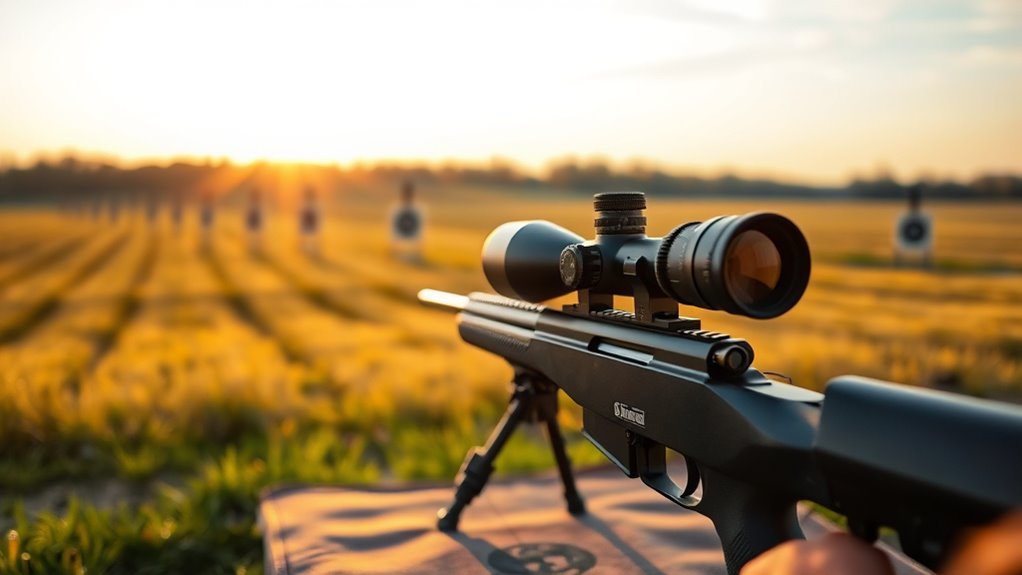
Parallax error is the apparent movement of a rifle scope’s reticle relative to the target when your eye changes position behind the eyepiece.
It occurs when the target image and reticle occupy different optical planes inside the scope. Moving your eye changes their apparent alignment, even when the scope remains stationary.
Think of looking at a nearby object against a distant background. As you move your head, the nearby object appears to shift relative to what is behind it.
Parallax changes where the reticle appears to rest on the target, even though the rifle itself has not moved.
The same optical principle applies to a rifle scope. The apparent movement can introduce aiming error when eye placement varies.
The manufacturer’s optical explanation of parallax illustrates how the target image and reticle can become separated and why eye position affects the apparent point of aim.
How Parallax Affects Long-Range Shots
Parallax can affect long-range precision by changing the apparent position of the reticle. Its practical effect depends on the scope’s design, magnification, target distance, and eye alignment.
It does not directly change the bullet’s trajectory. Instead, it can introduce an aiming error that affects where a shot lands.
Parallax and Point of Impact
The point of aim is where the reticle appears to rest. The point of impact is where the bullet actually strikes.
When parallax is present, an off-center eye position can make the reticle appear aligned with a different part of the target.
This apparent displacement can contribute to a difference between the intended point of aim and the resulting impact.
Parallax adjustment should not be confused with zeroing. The elevation and windage controls establish or change the scope’s zero; the parallax control addresses a separate optical issue.
Eye Position Drift
Eye position drift occurs when your eye moves away from its usual position behind the optic.
With uncorrected parallax, that movement can make the reticle appear to travel across the target. The effect may be noticeable even when the rifle itself remains still.
A repeatable cheek weld, meaning consistent contact between your cheek and the rifle stock, helps maintain a similar viewing position.
However, consistent eye placement and parallax correction serve different purposes. One addresses positioning; the other addresses the optical relationship between the reticle and target image.
Long-Range Reticle Shift
Apparent reticle movement can become more significant during precision work at extended distances, particularly when using higher magnification.
There is no universal point at which this suddenly becomes a problem. A scope’s factory setting and optical design affect its sensitivity.
For example, an optic configured for a shorter target distance may show noticeable parallax when used much farther away.
Reticle movement can also be confused with ordinary sight-picture movement, target-image distortion, or heat mirage. These are separate issues and do not necessarily indicate a parallax adjustment problem.
When Should You Check Parallax?
Parallax is worth checking when target distance changes or when the reticle appears to move relative to the target. The need becomes more relevant as optical precision requirements increase.
Do not treat 50, 100, or 150 yards as a universal threshold. The appropriate setting depends on the scope and the viewing conditions.
- Identify whether the scope has adjustable parallax.
- Check the manufacturer’s specified adjustment range.
- Distinguish target-image blur from reticle blur.
- Recognize that higher magnification can make optical errors easier to notice.
- Account for individual eyesight when more than one person uses the same optic.
For Indiana target practice, range rules are a separate requirement from optical setup.
The Indiana DNR range rules require eye and ear protection at its firearm ranges and restrict shooting to designated targets. Range users must also obey posted instructions.
Always follow the range officer’s commands and the specific rules of the facility.
Why Reticle Focus Comes First
The reticle should appear sharp before you evaluate parallax. Its focus is controlled by the eyepiece, often called the ocular or diopter adjustment.
This adjustment accounts for differences in eyesight. It is separate from the control used to focus the target image.
Warning: Before handling or inspecting a mounted scope, ensure the firearm is unloaded and pointed in a safe direction. Follow all range commands. Never look directly at the sun through a rifle scope or another optical instrument.
What Does the Ocular Focus Ring Do?
The ocular focus ring makes the reticle appear sharp to your eye. It does not perform the same function as the parallax control.
A poorly focused reticle may look fuzzy even when the target image appears clear.
Manufacturer guidance also explains that your eyes can temporarily compensate for imperfect focus. That makes a quick, relaxed view more useful than prolonged staring.
The riflescope support guidance explains the difference between eyepiece focus and adjustable-objective or side-focus controls.
Why Use a Plain, Bright Background?
A plain, light-colored background helps separate reticle clarity from details in the scene behind it.
Without distracting objects, it becomes easier to recognize whether the reticle itself looks sharp.
| Step | Purpose |
|---|---|
| Select a plain background | Remove distracting visual detail |
| Check ocular focus | Assess reticle sharpness |
| Confirm clarity | Distinguish reticle blur from target blur |
| Evaluate parallax separately | Identify apparent movement between reticle and target |
Individual eyesight affects the final appearance. An ocular setting that looks clear to one person may not look equally clear to another.
Why a Sharp Reticle Matters for Parallax
A sharply focused reticle provides a clear visual reference when evaluating the target image.
If the crosshairs appear blurred, it becomes harder to distinguish true optical movement from ordinary focusing problems.
Remember these differences:
- Reticle blur relates primarily to ocular focus.
- Target-image blur may relate to the scope’s target-focus setting or optical limits.
- Apparent reticle movement relative to a stationary target indicates parallax.
- A sharp target image alone does not guarantee that parallax is absent.
Keeping these concepts separate makes scope-related problems easier to identify.
What Does the Parallax Knob Control?
The parallax knob adjusts the optical relationship between the target image and reticle. On many scopes, it is located on the side of the turret housing.
Other models use an adjustable objective, commonly shortened to AO, with a control near the front of the scope.
Both designs serve the same basic optical purpose.
Some adjustable scopes have yardage markings. Others use fewer reference marks or a simpler focus scale.
These numbers are approximate references, not guaranteed measurements of target distance.
Different eyesight, optical tolerances, and viewing conditions can affect the relationship between the marked setting and the observed image.
The manufacturer’s scope setup guidance explains why distance markings should be treated as a guide rather than an exact reference.
The parallax control should also not be mistaken for an elevation or windage turret. These controls perform different functions.
How Can You Recognize Parallax Shift?
The defining sign of parallax is apparent movement between the reticle and a stationary target when eye position changes.
This differs from simple target-image blur. A scope may display a reasonably clear target while still showing some parallax.
A clear target image and a parallax-free sight picture are related, but they are not always identical.
When evaluating the sight picture, distinguish among three observations:
- The reticle itself appears blurry.
- The target image appears blurry while the reticle remains sharp.
- The reticle appears to move relative to the target when the viewing angle changes.
These observations point to different optical conditions.
If the problem persists despite following the manufacturer’s setup guidance, avoid forcing a stiff adjustment control. The optic may require professional inspection.
Why Does Head Position Matter?
Your eye position affects how you see the reticle through the scope. If parallax is present, a change in viewing angle can change its apparent alignment with the target.
Maintaining a repeatable head position reduces one source of variation.
Eye relief, the distance between your eye and the eyepiece, also affects the sight picture. Incorrect positioning can produce a dark border, shadowing, or an incomplete view.
These symptoms are not automatically evidence of parallax.
A consistent cheek weld helps maintain a familiar viewing position, but it does not physically eliminate an optical mismatch between the reticle and target image.
Likewise, correcting parallax does not replace proper eye relief or a correctly mounted scope.
Each contributes to the overall viewing experience in a different way.
Fixed Parallax vs. Adjustable Scopes
The main difference is whether the scope allows its parallax setting to change.
Fixed-parallax scopes have a predetermined setting. Adjustable models provide a separate control for changing the target-image focal relationship.
Neither design is automatically suitable for every distance or application.
Fixed-Parallax Scope Basics
A fixed-parallax scope is configured for a particular distance during manufacture. The user cannot change that setting through a dedicated parallax control.
Many fixed-parallax models are configured around 100 or 150 yards, although the exact distance depends on the model and intended application.
Some rimfire and other specialized scopes use shorter factory settings.
- There is no separate parallax adjustment control.
- The factory setting depends on the specific optic.
- The design generally has fewer controls.
- Parallax may appear when the target is away from the predetermined distance.
- Consistent eye position remains relevant.
A fixed-parallax scope is not necessarily inaccurate outside its factory setting. The practical effect depends on the amount of error and the intended task.
Adjustable-Parallax Scope Benefits
Adjustable-parallax scopes provide greater flexibility when viewing targets at different distances.
They are particularly relevant to high-magnification optics and applications requiring careful alignment.
The benefit is optical control rather than an automatic improvement in every shot.
| Range | Benefit | Effect |
|---|---|---|
| 50 yd | Short-distance focus adjustment | Helps address close-range parallax on compatible scopes |
| 100 yd | Model-dependent calibration reference | May correspond to a factory or marked setting |
| 300 yd | Target-distance adjustment | Helps manage apparent reticle displacement |
| Variable | Adaptability across distances | Allows the optical setting to change with the target |
| Long range | Greater optical flexibility | Useful when precise reticle alignment matters |
Actual performance depends on the optic’s adjustment range and optical design.
Which Scope Type Fits Your Needs?
The appropriate design depends on the distances you expect to use, the scope’s magnification, and the precision your activity requires.
Fixed-parallax models offer a simpler arrangement when a separate adjustment is unnecessary.
Adjustable models provide greater control when target distances vary.
Before evaluating a scope, distinguish its parallax specification from its magnification range, eye relief, and elevation adjustment.
The manufacturer’s explanation of side focus describes how this control differs from the other numbered adjustments on a rifle scope.
Do Parallax Settings Change With Distance?
Yes. The optical setting associated with minimum parallax depends on target distance and the particular scope.
However, the relationship is not identical across all models. A marked distance should not be treated as an exact universal setting.
At approximately 50 yards, a fixed-parallax scope configured for a longer distance may show some apparent reticle movement. Short-range adjustable models provide additional flexibility.
Around 100 yards, some scopes operate near their predetermined factory setting. Others use a different reference distance.
At approximately 150 yards, the same distinction applies. This distance is not an automatic threshold for every optic.
Across 200 to 600 yards, adjustable models provide a way to account for changing target distance. Their actual adjustment range varies by model.
Beyond 600 yards, parallax can still matter. There is no general rule that the optical error becomes unimportant after this distance.
For a fixed-parallax scope, the factory calibration remains unchanged regardless of the target’s location.
For an adjustable scope, the usable range and the accuracy of its markings depend on the manufacturer’s design.
What Else Affects Consistent Groups?
Parallax is only one potential source of variation in target shooting.
A clear reticle and consistent eye placement help reduce optical uncertainty, but group size also depends on factors outside the scope’s parallax system.
These include:
- Rifle and scope mounting condition.
- Ammunition consistency.
- Wind and environmental conditions.
- Rifle support and stability.
- Barrel condition and temperature.
- Individual shooting technique.
An apparent reticle shift does not prove that parallax caused an inconsistent group.
Similarly, a stable reticle does not rule out other mechanical, environmental, or equipment-related problems.
If the optic shows persistent focus problems, unusual resistance in its controls, or unexplained mechanical movement, consult the manufacturer or a qualified gunsmith rather than forcing adjustments.
Note: For firearm handling, mounting concerns, or persistent equipment problems, seek guidance from a qualified firearms instructor or gunsmith. Follow the manufacturer’s instructions and all applicable range safety requirements.
Frequently Asked Questions
At What Distance Do You Need Parallax Adjustment?
There is no universal distance at which parallax adjustment becomes necessary. It depends on the scope’s factory setting, target distance, magnification, and precision requirements. Adjustable models provide flexibility across distances, while fixed-parallax models retain their predetermined setting. Consult the specific scope’s documentation for its adjustment range.
Does Parallax Matter at 50 Yards?
Yes, parallax can matter at 50 yards, depending on the optic. A scope configured for a different distance may show apparent reticle movement when eye position changes. The practical significance depends on the amount of error and the required precision. Some scopes are specifically designed for shorter-distance use.
Is Adjustable Parallax Necessary?
Adjustable parallax is not necessary for every rifle scope or shooting application. It provides greater flexibility when target distances vary or optical precision requirements increase. Fixed-parallax scopes remain suitable for many uses, although their setting cannot be changed. The appropriate design depends on the specific optic and intended application.
Does Parallax Adjustment Change a Rifle Scope’s Zero?
Parallax adjustment and zeroing serve different purposes. The parallax control changes the optical relationship between the target image and reticle. Elevation and windage adjustments establish or change the scope’s zero. Parallax can affect apparent aim and contribute to inconsistent impact placement, but it is not a substitute for proper zeroing.
Conclusion
Scope parallax adjustment helps manage apparent reticle movement caused by differences between the target image and reticle’s optical planes.
There is no universal distance threshold. The need depends on your optic, viewing conditions, and intended use.
Understanding the difference between ocular focus, parallax correction, and zeroing makes scope-related problems easier to recognize. For Indiana target practice, combine that knowledge with the manufacturer’s instructions and your range’s safety requirements.
Sources
- ZEISS — Parallax Compensation: Explains the optical causes of parallax and the relationship between the target image and reticle.
- Indiana Department of Natural Resources — Shooting Ranges: Official public-range information and basic safety requirements.
- Leupold — Riflescope Support: Guidance on reticle focus, side focus, adjustable objectives, and optical troubleshooting.
- Vortex Optics — Frequently Asked Questions: Manufacturer guidance on ocular focus, parallax correction, and approximate yardage markings.
- Leupold — Understanding the Numbers on Your Riflescope: Explains the function of side focus and its relationship to other scope controls.
