
Toyota RAV4 parts can feel expensive when you compare a dealer-supplied genuine component with the cheapest listing online. The price difference alone does not tell you which part is the better value. Your RAV4’s model year, trim, drivetrain, part number, warranty, installation needs, and the part’s effect on safety all matter.
Quick Answer
Toyota RAV4 parts are not always expensive, but genuine Toyota parts often cost more than aftermarket alternatives. The better choice depends on the component. Use exact-fit, well-documented parts for every repair, and favor genuine or manufacturer-approved components for airbags, driver-assistance sensors, hybrid systems, and other safety-critical repairs.
Key Takeaways
- No single price range accurately represents all RAV4 parts. A cabin filter, headlamp assembly, wheel bearing, and hybrid component have very different costs.
- A reputable aftermarket part can be a sensible value, but quality, fitment, warranty coverage, and seller credibility vary by product.
- Using an aftermarket part does not automatically void a U.S. vehicle warranty, although damage caused by that part or its installation may be excluded.
- Confirm fitment with the VIN and exact part number before ordering, especially across different model years, trims, drivetrains, and hybrid versions.
- Compare the total installed cost, not only the purchase price. Labor, shipping, core charges, fluids, hardware, programming, and calibration can change the final bill.
The Cost of Toyota RAV4 Parts: What You Need to Know
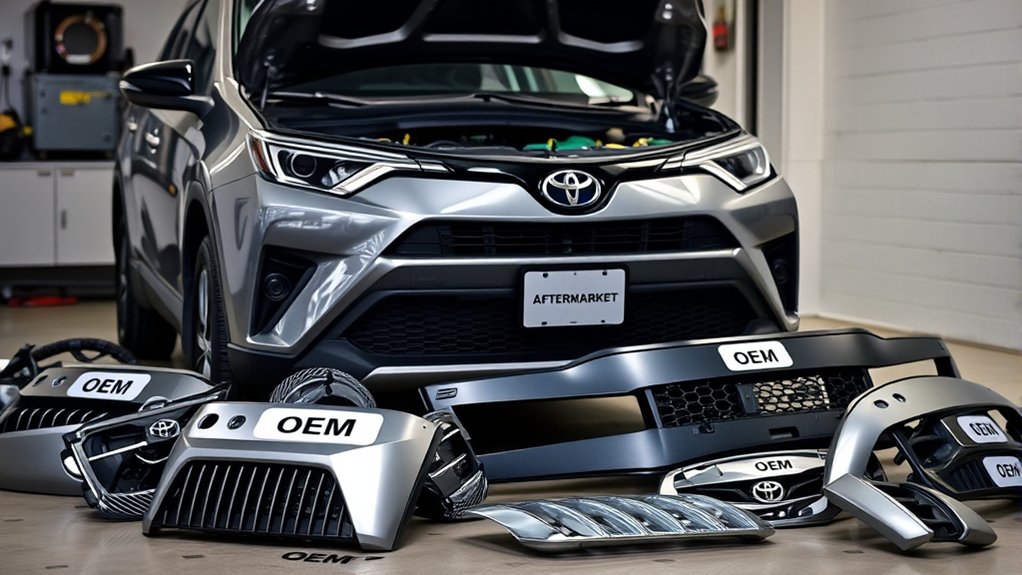
RAV4 parts do not fit one reliable price range. Routine items such as filters and wiper blades usually sit at the lower end of a repair budget, while electronic modules, lighting assemblies, hybrid components, body panels, and complete mechanical assemblies can cost much more.
Genuine Toyota parts often carry a premium because they are sold under Toyota’s brand, cataloged for specific applications, and supported through Toyota’s parts and service network. Aftermarket parts may cost less, match the genuine part’s price, or cost more when they use upgraded materials or performance-focused designs.
The useful comparison is the total cost of completing the repair correctly. Include the part, labor, taxes, shipping, shop supplies, replacement hardware, fluids, refundable core charges, and any programming or calibration that the repair requires.
What Do Genuine, OEM, OE-Supplier, and Aftermarket Mean?
Parts terminology can be confusing because sellers do not always use these labels consistently.
- Genuine Toyota part: A Toyota-branded component sold for a Toyota application. Toyota says its genuine parts are made to fit the exact specifications of the vehicle.
- OEM part: In strict use, this means a part associated with the original equipment manufacturer. In online listings, sellers sometimes use “OEM” loosely, so verify the manufacturer, packaging, and part number.
- OE-supplier part: A part sold under the name of a company that may supply components to automakers. That does not prove every product it sells is identical to the Toyota-branded version.
- Aftermarket part: A replacement made and sold outside Toyota’s genuine-parts channel. Quality can range from economy-grade to premium or performance-focused.
- Remanufactured or used part: A previously used component that has been rebuilt, tested, or resold. Condition, testing, warranty, and return terms need close review.
Toyota provides model-specific manuals and warranty information through its Owners portal, while its official parts site can help you identify genuine parts. A Toyota dealer’s parts department can also check a part number against your VIN.
Are Aftermarket Parts a Smart Choice for RAV4 Owners?
Aftermarket parts can be a smart choice when the product fits your exact RAV4, meets the required specifications, comes from a traceable seller, and includes clear warranty and return terms. The word “aftermarket” does not automatically mean low quality, just as a higher price does not guarantee a better part.
Cost Savings Potential
Aftermarket options can reduce the purchase price for common maintenance and wear items. Savings vary widely by component, brand, model year, retailer, and availability, so percentage-based rules are unreliable.
Compare equivalent products. A basic economy part should not be judged against a genuine assembly that includes brackets, sensors, seals, or installation hardware. Check what is actually included before comparing prices.
Quality Variability Concerns
Aftermarket quality varies because thousands of manufacturers serve different price and performance levels. Review the exact product line, published specifications, warranty, seller history, and independent testing or certification that applies to that part category.
A familiar brand name is not enough by itself. Counterfeit packaging, marketplace sellers, and incorrect cross-references can still create problems. Buy from a seller that provides a real business identity, a clear return process, and a traceable manufacturer part number.
Compatibility and Fit Issues
A listing that says “fits RAV4” may still be wrong for your vehicle. Parts can differ by production date, engine, front-wheel drive or all-wheel drive, hybrid or plug-in hybrid system, trim, wheel size, sensor package, market, and factory option.
Use your 17-character VIN when possible, then compare the original part number, supersession history, connector shape, dimensions, and included hardware. Do not rely on a product photo alone.
Warning: Do not choose airbags, seat-belt components, steering parts, high-voltage hybrid components, or advanced driver-assistance sensors only by price. These systems can create serious safety risks when the part is counterfeit, incompatible, damaged, or installed incorrectly. Use a qualified repair professional and a traceable part source.
How Do Genuine Toyota Parts Compare With Aftermarket Parts?
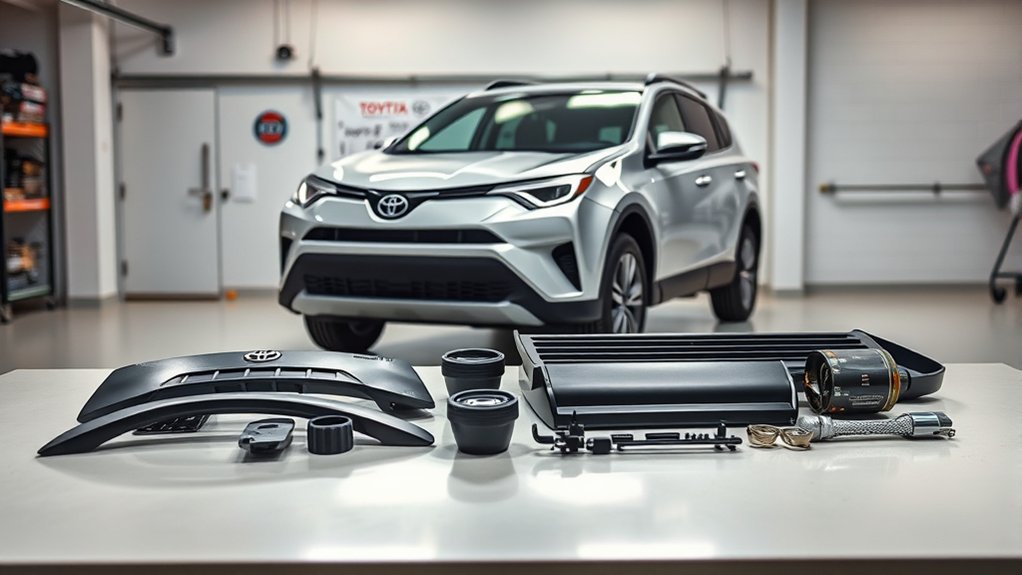
Neither category wins every comparison. Genuine Toyota parts offer predictable catalog fitment and Toyota-backed documentation. Aftermarket parts offer more price levels, broader availability, and sometimes upgraded materials or designs.
Quality Assurance and Documentation
Genuine parts are produced for Toyota applications and sold through Toyota’s parts network. That gives you a direct part-number trail and access to Toyota’s current warranty information.
Aftermarket documentation varies. Strong products identify the vehicle application, technical standard, materials, warranty, country of origin when required, and the company responsible for support. Weak listings may provide only a broad fitment claim and promotional language.
Performance Consistency
A correct genuine part is intended to restore the vehicle to its original design specification. A well-engineered aftermarket part can also perform properly, but its noise, feel, service life, finish, or installation details may differ.
Performance depends on the exact part, not just the category. For example, a premium aftermarket brake pad may suit a driver’s needs, while a poorly matched pad can create noise, dust, uneven wear, or an unsatisfactory pedal feel.
Long-Term Reliability Factors
No reliable rule proves that every genuine part lasts longer than every aftermarket alternative. Service life depends on design, materials, installation, driving conditions, maintenance, surrounding component wear, and whether the original failure’s root cause was corrected.
A cheaper part becomes expensive when replacing it requires substantial labor. For a hard-to-reach water pump, wheel bearing, engine mount, or electronic module, paying more for a well-supported part may reduce the risk of paying the same labor twice.
| Factor | Genuine Toyota | Aftermarket |
|---|---|---|
| Fitment path | Toyota catalog and VIN support | Depends on the maker and seller catalog |
| Price | Often higher, but not always | Ranges from economy to premium |
| Choices | Usually one original-spec route | Many materials, designs, and price levels |
| Warranty | Toyota terms apply and vary by product and purchase timing | Manufacturer and seller terms vary widely |
| Best use | Original-spec repair and sensitive systems | Budget, availability, or specific performance needs |
Which RAV4 Parts Should Be Genuine or Aftermarket?
Use the part’s safety role, labor cost, calibration needs, and failure consequences to guide the decision.
| Part type | Practical approach | Why |
|---|---|---|
| Airbags, seat belts, ADAS cameras and radar | Use genuine or manufacturer-approved parts with professional installation and calibration | Incorrect parts can affect crash protection or driver-assistance operation |
| Hybrid high-voltage and control components | Use a Toyota-qualified or hybrid-trained professional and a documented part source | High voltage, software compatibility, and cooling requirements add risk |
| Brakes, steering, suspension, wheel bearings | Choose genuine or a proven premium aftermarket line that matches the exact specification | These parts directly affect vehicle control and stopping |
| Sensors, modules, and emissions components | Confirm part number, software, connector, and legal emissions compatibility | A physically similar part may not communicate or operate correctly |
| Filters, wiper blades, bulbs, and simple maintenance items | Reputable aftermarket parts are often reasonable when specifications match | Fitment and performance are easier to verify, and replacement labor is usually low |
| Body and interior trim | Compare fit, finish, paint preparation, clips, and return terms | Small shape or color differences can be visible even when the part installs |
What Factors Influence the Price of RAV4 Parts?
- Part category: Maintenance items, mechanical assemblies, electronics, lighting, glass, and body parts have different cost structures.
- Model year and configuration: A gas RAV4, RAV4 Hybrid, and RAV4 Prime may use different components. Trim and option packages can also change fitment.
- New, remanufactured, or used condition: A rebuilt component may include a refundable core charge, while a used part’s price depends on age, mileage, condition, and warranty.
- Supply and location: Dealer inventory, warehouse availability, shipping distance, oversize freight, and discontinued parts can affect price.
- Included hardware: One listing may include seals, brackets, clips, or sensors, while another includes only the base component.
- Labor and calibration: Complex access, rust, seized fasteners, programming, wheel alignment, camera calibration, and post-repair testing can exceed the part’s price.
- Warranty and support: Longer or more complete coverage may add value, especially when labor is expensive.
How Does Warranty Coverage Affect Your Parts Investment?
Read the warranty before buying. Check its duration, mileage limit, exclusions, claim process, transferability, and whether it covers only the replacement part or also labor, towing, fluids, and related damage.
Toyota publishes current vehicle and accessory warranty information on its manuals and warranties page. Coverage varies by product, purchase timing, installation, model year, and market, so do not assume every genuine part has the same warranty.
In the United States, the Federal Trade Commission explains that a company generally cannot void an entire warranty or deny coverage solely because you used a third-party part or an independent repair shop. It may deny coverage for damage caused by the unauthorized part or service. Keep invoices, part numbers, maintenance records, diagnostic results, and installation documentation in case a claim is disputed.
Note: Warranty laws and Toyota coverage differ by country. The U.S. warranty discussion here is general consumer information, not legal advice. Review the warranty booklet for your exact RAV4 and local consumer law.
When Paying More for a RAV4 Part Can Save Money
A higher-priced part can be the better value when failure would create a safety risk, strand the vehicle, damage other components, require expensive repeat labor, or trigger programming and calibration costs.
| Consider paying more when | A lower-cost option may work when |
|---|---|
| The part is safety-critical or requires calibration | The item is simple, easy to verify, and inexpensive to replace |
| Labor is high or the part is difficult to access | Labor is minimal and repeat replacement carries little risk |
| The genuine part includes needed hardware, seals, or software support | A reputable aftermarket kit includes the same required items |
| A warranty claim would be easier through a local supplier or installer | The seller offers clear, practical warranty and return support |
Do not assume genuine parts automatically increase resale value. Buyers usually care more about safe repairs, complete records, correct operation, and a clean inspection than the logo on every maintenance component.
Tips for Finding the Right Parts for Your Toyota RAV4
- Identify the exact vehicle. Record the model year, VIN, trim, engine, drivetrain, hybrid status, build date, and relevant factory options.
- Diagnose before ordering. A trouble code or symptom does not always identify the failed part. Confirm the root cause so the replacement does not fail again.
- Find the correct part number. Use Toyota’s catalog, a dealer parts department, or a trusted repair database. Check whether the number has been superseded.
- Compare complete kits. Note whether seals, clips, bolts, brackets, sensors, and instructions are included.
- Verify the seller and manufacturer. Look for traceable contact details, authorized distribution when applicable, clear packaging, and realistic pricing.
- Check warranty and return terms. Confirm restocking fees, return shipping, installed-part exclusions, electrical-part restrictions, and core-return deadlines.
- Check recalls first. Search the VIN on the NHTSA recall page if the vehicle is in the United States. A covered recall repair should normally be handled through the manufacturer rather than paid for as a routine replacement.
- Plan for installation. Confirm torque specifications, one-time-use fasteners, fluid requirements, alignment, programming, relearn procedures, and calibration.
- Keep records. Save the receipt, packaging label, part number, mileage, installation date, and repair order.
Pro Tip: Ask for both the Toyota part number and the aftermarket manufacturer’s part number on the estimate. Comparing those identifiers helps you spot incomplete kits, incorrect substitutions, and price differences caused by bundled hardware.
Related Guides
Frequently Asked Questions
Can I use aftermarket parts without voiding my Toyota warranty?
In the United States, using an aftermarket part does not automatically void the entire vehicle warranty. A manufacturer may deny coverage for a failure it determines was caused by that part or by improper installation. Keep receipts and repair records, and review the warranty booklet for your model year. Rules differ outside the United States.
How long do genuine Toyota parts last compared with aftermarket parts?
No universal lifespan applies. Durability depends on the exact component, product line, materials, installation, use, maintenance, and surrounding systems. Compare the warranty and technical specifications for the individual part instead of relying only on the genuine or aftermarket label.
Which aftermarket brands are best for RAV4 parts?
No brand is best for every RAV4 component. Evaluate the exact product line, application data, warranty, testing, seller, and repair professional’s experience. A company may make an excellent filter but an unsuitable sensor for your specific model.
What is the return policy for genuine and aftermarket parts?
Return policies come from the seller and may exclude installed, opened, painted, programmed, special-order, or electrical parts. Check the return window, restocking fee, shipping responsibility, and core deadline before buying.
Do genuine Toyota parts require professional installation?
Not always. Many routine maintenance items are suitable for an experienced DIY owner with the correct manual, tools, and safety procedures. Airbags, high-voltage hybrid parts, steering, brake hydraulics, internal engine work, programming, and ADAS calibration should be handled by a qualified professional.
Should I buy RAV4 parts from a dealership?
A dealership is a useful source for genuine parts, VIN-based fitment, warranty support, and repairs that require Toyota tools or calibration. Independent shops and reputable parts retailers can also be good options. Compare the complete estimate, part identity, technician qualifications, and warranty.
Conclusion
Toyota RAV4 parts are not automatically overpriced, and aftermarket parts are not automatically risky. The right choice depends on the exact component, the quality of the product, the accuracy of the fitment, the repair’s labor and calibration needs, and the consequences of failure.
Use genuine or manufacturer-approved parts for sensitive safety and electronic systems. For simpler maintenance and wear items, a reputable aftermarket option can provide good value when it matches the required specification. Verify the VIN, compare the total installed cost, read the warranty, and keep complete repair records.
Sources
- Toyota Manuals and Warranties. Toyota’s current U.S. warranty information and links to model-specific documents.
- Toyota Genuine Parts. Toyota’s official U.S. parts catalog and genuine-parts information.
- Federal Trade Commission: Nixing the Fix. U.S. guidance on third-party parts, independent repairs, and warranty restrictions.
- National Highway Traffic Safety Administration Recall Lookup. Official U.S. VIN recall search.

