Your Toyota RAV4’s tire pressure light is a safety warning, not simply a reminder that needs to be cleared. Before resetting it, check every tire with an accurate gauge, inflate the tires to the cold pressures on the driver’s door-jamb placard, and inspect them for punctures or damage. The correct initialization method then depends on your RAV4’s model year and display system.
Last updated: September 11, 2026
Quick Answer
Inflate all four tires to the cold pressures shown on your RAV4’s door-jamb placard. Most 2013–2018 models use a SET button below the instrument panel. Most 2019–2025 models use Vehicle Settings > TPWS > Set Pressure. The redesigned 2026 RAV4 uses its newer tire-pressure settings interface. Always correct the tire pressure first; do not use initialization to hide a leak or damaged tire.
Jump to: 2013–2018 reset · 2019–2025 reset · 2026 reset · troubleshooting
Key Takeaways
- Never reset the TPMS until you have corrected the tire pressures and checked for visible damage or leaks.
- Use the recommended cold pressures on the driver’s door-jamb placard, not the maximum pressure printed on a tire’s sidewall.
- A steady warning light usually means low pressure. A light that flashes for about a minute and then remains on usually indicates a TPMS malfunction.
- The reset process differs between most 2013–2018, 2019–2025, and redesigned 2026 RAV4 models.
- Pressure initialization, wheel-position registration, and replacement-sensor ID registration are different procedures.
At a Glance
| Time Required | About 10–20 minutes for inspection and adjustment, plus any model-specific parked wait or learning drive |
| Difficulty | Easy, provided the tires are not damaged and the sensors are working |
| Tools Needed | Accurate tire-pressure gauge and an air source; a flashlight may help locate an older model’s SET button |
| Cost | Usually no cost when you already have a gauge and air source; tire repairs or sensor service cost extra |
Warning: Do not continue driving normally if a tire looks flat, has a sidewall bulge, is losing air rapidly, or has suffered an impact. Stop in a safe place and arrange a proper inspection or roadside assistance. Resetting the light does not make a damaged tire safe.
What to Check Before Resetting the Tire Pressure Light
Complete these checks before pressing a button or changing a TPWS setting:
- Park safely and let the tires cool. For the most reliable reading, check the tires before driving or after the vehicle has been parked for at least three hours.
- Read the tire placard. Open the driver’s door and find the label showing the recommended cold front and rear tire pressures. The values may differ by tire size, trim, load configuration, or market.
- Check all four road tires. Remove each valve cap, press the gauge firmly onto the valve stem, and record the reading.
- Inflate or release air as needed. Adjust each tire to the placard specification while the tires are cold.
- Inspect for damage. Look for nails, screws, cuts, bulges, cracked valve stems, and uneven wear.
- Check the spare separately. Maintain it according to the owner’s manual, whether or not your RAV4 monitors or displays its pressure.
Note: Do not inflate a RAV4 tire to the maximum pressure molded into the tire’s sidewall. That marking is a tire limit, not the vehicle manufacturer’s recommended operating pressure. Use the driver’s door-jamb placard.
Understanding the Tire Pressure Monitoring System (TPMS)
The Tire Pressure Monitoring System in a Toyota RAV4 uses transmitters in the wheel assemblies to warn you when one or more monitored tires become significantly underinflated. Depending on the model year and display, you may see only a warning lamp or individual tire-pressure readings.
The TPMS is a backup warning system. It does not replace monthly checks with a gauge, and it may not warn you about every sudden tire failure before the tire becomes unsafe. NHTSA recommends checking tire pressure at least monthly with an accurate gauge.
If you are trying to find individual PSI readings rather than reset the warning system, see our Toyota RAV4 tire-pressure display guide.
Steady Versus Flashing Tire Pressure Light
| Warning pattern | Likely meaning | What to do |
|---|---|---|
| Light remains steadily illuminated | At least one monitored tire is significantly underinflated | Stop safely, inspect the tires, and check all pressures with a gauge |
| Light appears on a cold morning and later turns off | Marginal pressure may have dropped below the warning threshold as the temperature fell | Check and correct the cold pressures rather than waiting for warmer tires |
| Light flashes for about 60–90 seconds and then remains on | The TPMS has detected a system malfunction | Check for recently changed wheels or sensors and arrange professional diagnosis if it continues |
Federal TPMS requirements are designed to warn when pressure becomes substantially lower than the vehicle manufacturer’s placard pressure. NHTSA also notes that a 60–90-second flashing sequence followed by steady illumination indicates a system malfunction. You should not wait for the warning before maintaining your tires.
Common Reasons for the Tire Pressure Light Activation
The warning can appear because of actual pressure loss, changing weather, tire damage, or a malfunction in the monitoring system. Identifying the warning pattern helps you choose the correct response.
Low Tire Pressure
Tires naturally lose small amounts of air over time. A loose valve core, damaged valve stem, wheel-bead leak, or gradual puncture can increase that loss. A sharp drop in outdoor temperature can also lower a tire’s cold pressure enough to activate the warning.
Tire pressure falls as temperatures fall and rises as temperatures increase. Check the tires cold and restore the placard pressure after a significant seasonal temperature change rather than relying on a fixed temperature-to-psi formula.
Tire Damage Detection
A nail, screw, cut, impact break, damaged wheel, or leaking valve can cause repeated pressure loss. If one tire drops again after being inflated, treat it as a leak rather than repeatedly resetting the TPMS.
A bulge, deep cut, exposed cord, severe cracking, or visibly flat tire requires immediate professional attention. Do not rely on the pressure light to determine whether physical damage is safe.
TPMS System Malfunction
A flashing-then-steady light may result from a failed transmitter, an exhausted transmitter battery, an unregistered replacement sensor, incompatible wheels, radio interference, or a fault in the TPMS receiver or control system.
Pressure initialization, position registration, and sensor registration are different jobs. Pressure initialization stores the pressure reference used by the warning system. Wheel-position registration teaches supported systems which transmitter is at each wheel position after events such as rotation. Sensor-ID registration teaches the vehicle a new transmitter or wheel set. A SET button or Set Pressure command does not necessarily perform the other two functions.
Why Regularly Checking Tire Pressure Matters
Correct tire pressure supports predictable steering, braking, traction, load capacity, and tire temperature. Underinflation allows the sidewalls to flex more, creating extra heat and rolling resistance. Overinflation can reduce the tire’s ability to absorb bumps and may contribute to uneven center wear.
Check the pressure at least once a month, before long trips, after major temperature changes, and before carrying a heavy load or towing. Use the load and towing instructions in your RAV4 owner’s manual rather than guessing at a higher pressure.
FuelEconomy.gov reports that properly inflated tires can improve gas mileage by about 0.6% on average and by up to 3% in some cases.
Underinflated tires can reduce fuel economy by about 0.2% for every 1 psi drop in the average pressure of all four tires. Keeping tires properly inflated improves mileage by about 0.6% on average and by up to 3% in some cases.
Correct pressure also helps prevent excessive shoulder wear, heat damage, and premature tire replacement. It cannot correct an alignment problem, worn suspension part, unbalanced wheel, or aggressive driving pattern.
How to Reset the Tire Pressure Light on Most 2013–2018 RAV4 Models
Most U.S.-spec fourth-generation RAV4 models use a physical tire-pressure SET button. Its exact location and appearance can vary, so check the vehicle-specific manual when you cannot find it.
- Adjust the cold tire pressures. Inflate all four road tires to the values on the driver’s door-jamb placard.
- Park the vehicle. Keep the RAV4 stationary with the parking brake applied.
- Turn the ignition to ON. On a keyed model, turn the key to ON without starting the engine. On a push-button model, follow the owner’s manual for entering IGNITION ON mode without moving the vehicle.
- Locate the TPMS SET button. It is commonly positioned below the instrument panel near the steering column on these models.
- Press and hold the button. Continue holding it until the tire pressure warning light blinks three times.
- Release the button and wait. Leave the vehicle in the instructed ignition state for several minutes so initialization can begin or complete.
- Recheck the warning. Start the vehicle normally. If the light remains steadily on, verify the pressures again. If it flashes for about a minute, arrange a TPMS diagnosis.
Pro Tip: Take a photo of the door-jamb placard and record the cold readings before initialization. You will have a clear reference if the light returns the next morning.
How to Reset the Tire Pressure Light on Most 2019–2025 RAV4 Models
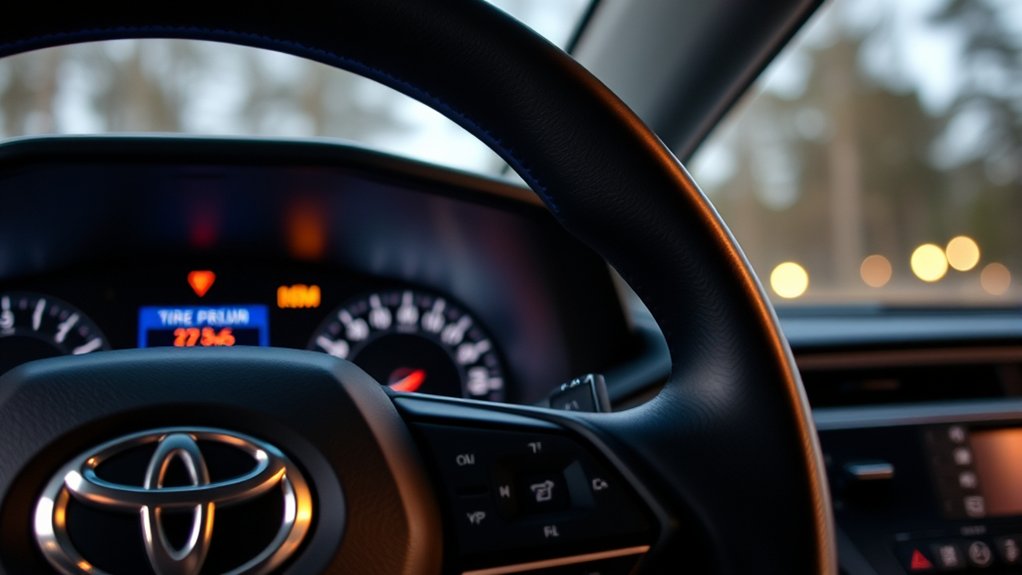
Most fifth-generation RAV4 and RAV4 Hybrid models use the steering-wheel controls and Multi-Information Display. Menu names can appear as “Set Pressure,” “Setting Pressure,” or similar wording, depending on the model year, display, market, and software.
Important: On Toyota procedures for fifth-generation RAV4s equipped with the tire-inflation-pressure display, the manual may instruct you to park safely with the engine or hybrid system off for about 20 minutes before starting initialization. After the pressure setting is accepted, the vehicle may need approximately 10–30 minutes of driving at about 25 mph (40 km/h) or more, with occasional gentle turns, while it determines tire positions. Follow your exact model-year manual when its sequence differs.
Adjust Tire Inflation Pressure
- Park on a level surface and allow the tires to cool.
- Read the recommended front and rear pressures on the driver’s door-jamb placard.
- Check each tire with an accurate gauge.
- Inflate or release air until every road tire matches the applicable specification.
- Inspect any tire that was substantially lower than the others for a puncture or leak.
Access the Vehicle Settings Menu
- Keep the RAV4 stopped and place the transmission in Park.
- Complete any parked waiting period specified in your exact owner’s manual before initialization.
- Turn the vehicle to the required ON/READY state specified by the manual. Do not perform the menu procedure while driving.
- Use the steering-wheel meter controls to open the settings screen on the Multi-Information Display.
- Select Vehicle Settings. On some displays, you must press and hold OK to open the settings.
- Select TPWS.
- Select Set Pressure, Setting Pressure, or the closest tire-pressure initialization option shown.
- Press and hold OK until the warning light blinks three times and a confirmation message appears.
- Wait for the setting message to clear.
- If your manual requires a learning drive, drive at approximately 25 mph (40 km/h) or more for about 10–30 minutes, with occasional gentle left and right turns, until the tire readings/positions return.
| Model group | Common control | Common procedure |
|---|---|---|
| 2013–2018 | Physical SET button | Inflate tires → ignition ON → hold SET until three blinks |
| 2019–2025 | Steering-wheel meter controls | Vehicle Settings → TPWS → Set Pressure, followed by the model-specific learning procedure |
| 2026 | New-generation tire-pressure settings interface | Vehicle tire-pressure settings → choose the specified-pressure or current-pressure method shown for your configuration |
How to Reset the Tire Pressure Light on a 2026 RAV4
The redesigned 2026 RAV4 introduces a newer tire-pressure setting interface with options for using a specified pressure or the current cold pressure, depending on configuration. The steps below reflect U.S.-spec 2026 RAV4 Hybrid documentation; Plug-in Hybrid versions, other markets, or later software revisions can use different wording.
Set a Specified Tire Pressure
- Park the vehicle and start the hybrid system as directed by the owner’s manual. The setting cannot be changed while the vehicle is moving.
- Open the vehicle settings interface.
- Select Vehicle Customize.
- Select Tire Pressure.
- Select the option for setting the system from a specified tire pressure.
- Choose the correct front and rear pressures shown for the vehicle’s tires and operating conditions.
- Confirm the setting.
- Confirm that the tire pressure warning light slowly blinks three times and that the completion message appears.
Set the Current Cold Tire Pressure
- Adjust every road tire to the appropriate cold pressure before starting the procedure.
- Start the hybrid system while the vehicle remains parked.
- Open the vehicle settings interface.
- Select Vehicle Customize.
- Select Tire Pressure.
- Select Set Current Air Pressure.
- Select Continue.
- Confirm that the warning light slowly blinks three times and a setting message appears.
Note: The current-pressure setting procedure may take about three minutes to finish. If the warning light does not blink three times when the procedure begins, restart it from the beginning. Consult the 2026 owner’s manual when your display wording differs.
Troubleshooting Tire Pressure Light Reset Issues

The Light Stays On After Inflation
- Let the tires cool and recheck all four road tires with a separate gauge.
- Confirm that you used the vehicle placard and not the tire sidewall pressure.
- Make sure the gauge sealed correctly against each valve stem.
- Inspect for a puncture, leaking valve, or wheel-bead leak.
- Repeat the correct model-year initialization procedure only after confirming the pressures.
- Complete any parked waiting period or learning drive required by the owner’s manual.
A tire that loses pressure again needs inspection and repair. Repeatedly clearing the warning can hide a developing safety problem.
The Light Flashes and Then Stays On
A flashing light for approximately 60–90 seconds followed by steady illumination usually indicates a TPMS malfunction rather than ordinary low pressure. Possible causes include a failed transmitter, depleted transmitter battery, unregistered replacement sensor, incompatible wheel or sensor, or a system fault.
Check whether the warning started after new tires, wheel replacement, tire rotation, seasonal wheel installation, or sensor service. A qualified tire shop or Toyota service facility can read TPMS diagnostic codes and verify the registered sensor IDs.
The Warning Started After Tire or Wheel Service
Match the procedure to what actually changed:
- Pressure specification changed: perform the tire-pressure setting or initialization procedure required by your manual.
- Tires were rotated: newer RAV4 systems may require wheel-position registration or a Tire Rotation procedure so the displayed locations match the transmitters.
- A new transmitter or wheel set was installed: the sensor ID may need to be registered or the stored wheel set changed. Set Pressure alone does not necessarily register a new transmitter.
If the warning began immediately after service, ask the installer what procedure was performed and whether every transmitter is compatible and communicating.
The Light Appears Only in Cold Weather
Check the tires cold on the next cool morning. A pressure that was barely adequate in warm weather can fall below the warning threshold after a temperature drop. Do not release air when the tires are hot simply because the displayed pressure has risen during driving.
The Pressure Display Shows Dashes
Dashes can appear temporarily while the vehicle identifies tire positions or receives transmitter signals. On applicable fifth-generation systems, Toyota instructs drivers to complete the model-specific learning drive after initialization. Park away from strong radio interference, confirm that compatible sensors are installed, and follow the manual’s driving or registration instructions. Persistent dashes require diagnosis.
Warning: Never deflate every tire, disconnect the vehicle battery, or drive at an arbitrary high speed merely to force the warning light off. Those internet reset methods are not substitutes for the Toyota procedure and may create additional problems.
What Happens If You Ignore the Tire Pressure Light?
Ignoring the light can allow an underinflated or damaged tire to become hotter and less stable. The consequences depend on the amount of pressure loss, vehicle load, speed, road temperature, and tire condition.
| Consequence | Why it happens |
|---|---|
| Higher fuel consumption | Underinflated tires create more rolling resistance. |
| Irregular tire wear | Incorrect pressure changes the tire’s contact pattern and sidewall movement. |
| Reduced handling and braking stability | The tire may not respond or support the vehicle as designed. |
| Heat buildup | Excessive sidewall flex creates heat, especially at speed or under heavy loads. |
| Tire failure | Severe underinflation, damage, heat, and load can combine to weaken the tire. |
How to Properly Inflate RAV4 Tires
- Wait for cold tires. Check before driving or after at least three hours of parking.
- Read the placard. Note the specified front and rear pressures.
- Remove a valve cap. Keep it in a safe place.
- Measure the pressure. Press the gauge straight onto the valve stem until air no longer escapes around the connection.
- Add or release air. Adjust the pressure in small increments.
- Measure again. Confirm the final reading instead of relying on the inflator’s automatic cutoff alone.
- Repeat for every tire. A single correctly inflated tire does not clear a problem in another tire.
- Replace the valve caps. They help protect the valve openings from dirt and moisture.
- Initialize only when required. Follow the applicable model-year procedure after all pressures are correct.
Check the pressures again the next morning when you have repaired a leak, experienced a large temperature change, or found one tire much lower than the others.
Benefits of a Well-Functioning Tire Pressure Monitoring System

A working TPMS gives you an early warning when monitored tire pressure becomes significantly low. This can prompt you to find a slow leak, temperature-related pressure drop, or damaged tire before the condition becomes more serious.
Correct pressure supports safer handling, more predictable braking, reduced heat buildup, better fuel economy, and more even tire wear. The system is most useful when you combine it with monthly gauge checks and visual inspections.
The TPMS also helps after seasonal temperature changes and tire service, but it cannot evaluate tread depth, alignment, sidewall damage, tire age, or whether a repair is structurally sound.
Related Guides
Frequently Asked Questions
Where is the TPMS reset button on a Toyota RAV4?
Most 2013–2018 U.S.-spec RAV4 models use a physical tire-pressure SET button below the instrument panel near the steering column. Most 2019–2025 models use the Multi-Information Display instead of a physical reset button. Check the owner’s manual for your exact year and market when the control is not where expected.
Can I reset the tire pressure light without a gauge?
You should not. A visual inspection cannot reliably show whether a radial tire is correctly inflated. Use an accurate gauge to check every road tire before initializing the system.
How often should I check my RAV4’s tire pressure?
Check it at least once a month while the tires are cold. Check again before long trips, after major temperature changes, before carrying a heavy load, and whenever the TPMS light appears.
What tire pressure is recommended for my Toyota RAV4?
Use the cold front and rear pressures printed on the tire and loading placard inside the driver’s door opening. Do not rely on a universal 30–35 psi range or the maximum pressure molded into the tire sidewall.
Will the tire pressure light turn off by itself after I add air?
It may. When the system has not recently been initialized to an incorrect pressure, restoring the tires to the correct cold specification can turn off a steady warning after the system updates. Initialization or a learning drive may still be required after certain pressure changes or service procedures.
Do I need to reset the TPMS after rotating RAV4 tires?
Not always by using Set Pressure. On newer RAV4 systems, tire rotation can require a separate wheel-position registration or Tire Rotation procedure so the displayed tire locations match the transmitters. Pressure initialization is normally used when the pressure reference itself needs to be set. Follow the procedure for your exact model year.
Can weather affect tire pressure readings?
Yes. Tire pressure falls as temperatures fall and rises as temperatures increase. Check and adjust the tires while cold after significant seasonal temperature changes.
Why does the TPMS light flash before staying on?
Flashing for approximately 60–90 seconds followed by steady illumination normally indicates a system malfunction. The cause may be a failed or unregistered sensor, incompatible wheel equipment, radio interference, or another TPMS fault.
Do new TPMS sensors need to be programmed?
Often, yes. Pressure initialization sets the pressure reference, while sensor registration stores or recognizes transmitter identification codes. Replacement sensors may require a compatible diagnostic procedure or the vehicle’s built-in registration process, depending on model year.
Sources
- Toyota 2015 RAV4 Quick Reference Guide — fourth-generation SET-button initialization procedure
- Toyota 2020 RAV4 Quick Reference Guide — fifth-generation TPWS information
- Toyota 2024 RAV4 and RAV4 Hybrid Quick Reference Guide — later fifth-generation TPWS controls
- Toyota Manuals & Warranties — current 2026 RAV4 owner-manual access; U.S. RAV4 Hybrid owner’s manual is listed as OM0R160U
- NHTSA TireWise — cold-pressure checks, TPMS warning behavior, and tire-safety guidance
- FuelEconomy.gov Vehicle Maintenance Guidance — tire-pressure and fuel-economy figures
Conclusion
Resetting a Toyota RAV4 tire pressure light starts with the tires, not the dashboard. Check them cold, use the driver’s door-jamb specification, and repair any leak or damage before initializing the TPMS.
Most 2013–2018 RAV4 models use a physical SET button, while most 2019–2025 models use the TPWS menu in the Multi-Information Display and may require a model-specific learning drive. The redesigned 2026 RAV4 uses its newer tire-pressure settings interface. A steady light calls for a pressure check; a 60–90-second flashing sequence followed by steady illumination calls for TPMS diagnosis.


1 thought on “Can I Reset Tire Pressure Light Toyota RAV4? TPMS Guide”