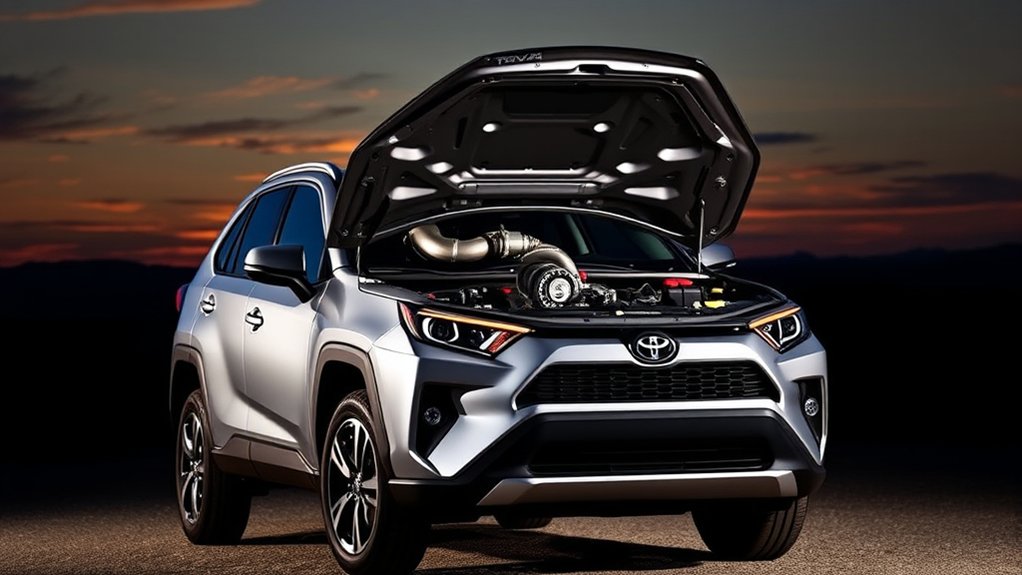
No, the 2026 Toyota RAV4 does not use a turbocharged engine. Toyota redesigned the U.S. lineup around two electrified powertrains: a conventional hybrid and a plug-in hybrid. Both pair a naturally aspirated 2.5-liter four-cylinder gasoline engine with electric motors, so their added response and power come from electric assistance rather than turbo boost.
Quick Answer
The 2026 Toyota RAV4 has no turbocharged engine. Its standard hybrid uses a naturally aspirated 2.5-liter four-cylinder and makes 226 horsepower with front-wheel drive or 236 horsepower with all-wheel drive. The RAV4 Plug-in Hybrid uses the same basic gasoline-engine layout with a larger battery and stronger electric motors to produce 324 net combined horsepower without a turbo.
Last updated: September 19, 2026. Specifications were checked against current U.S.-market Toyota listings and current EPA-rated fuel-economy information.
Key Takeaways
- No 2026 RAV4 sold in the United States has a turbocharged engine.
- The conventional hybrid produces 226 horsepower with front-wheel drive and 236 horsepower with all-wheel drive.
- The plug-in hybrid produces 324 net combined horsepower and has an EPA-estimated 54-mile electric range on the SE trim.
- There is no gasoline-only 2026 RAV4; gasoline-model comparisons refer to the outgoing 2025 version.
- The most-efficient 2026 RAV4 Hybrid FWD configurations are EPA-rated at 47 mpg city, 40 mpg highway, and 43 mpg combined.
- Adding an aftermarket turbo would require extensive custom engineering and is not a practical bolt-on upgrade for a street-driven RAV4 Hybrid.
What Engine Options Does the 2026 Toyota RAV4 Offer?

The 2026 Toyota RAV4 has an electrified-only U.S. lineup. Buyers can choose a conventional hybrid electric vehicle, commonly called an HEV, or the more powerful RAV4 Plug-in Hybrid, also called a PHEV. Neither powertrain uses turbocharging.
Toyota identifies the conventional hybrid’s gasoline engine as the 2.5-liter A25A-FXS four-cylinder. Front-wheel-drive models combine the engine with the hybrid motor-generators that drive the front axle. Electronic On-Demand AWD versions add a dedicated rear electric motor rather than a conventional mechanical driveshaft powering the rear axle.
| 2026 Powertrain | Drivetrain | Net Combined Output | Key Efficiency Rating |
|---|---|---|---|
| Hybrid | Front-wheel drive | 226 horsepower | Up to EPA-estimated 47 mpg city, 40 mpg highway, and 43 mpg combined |
| Hybrid | Electronic all-wheel drive | 236 horsepower | Up to EPA-estimated 46 mpg city, 39 mpg highway, and 42 mpg combined; varies by trim |
| Plug-in Hybrid | All-wheel drive | 324 horsepower | Up to 54 miles of EPA-estimated electric range on SE; MPG and MPGe vary by trim |
The conventional hybrid combines its 2.5-liter gasoline engine with electric motor-generators and a small high-voltage battery. It does not need to be plugged in because the gasoline engine, motor-generators, and regenerative braking manage the battery’s charge while you drive.
The 2026 RAV4 Plug-in Hybrid uses a larger rechargeable battery and more powerful electric motors. Toyota lists 324 net combined horsepower, an EPA-estimated 54-mile all-electric range on the SE trim, and a manufacturer-stated 5.4-second 0–60 mph time.
Note: Net combined horsepower describes the complete gasoline-electric system. It is not the gasoline engine’s output by itself, and the ratings of the engine and electric motors cannot be added together directly.
eCVT note: Toyota’s hybrid eCVT is not a conventional belt-and-pulley CVT. The RAV4 Hybrid uses a planetary power-split arrangement that blends gasoline-engine and electric-motor operation without conventional stepped gear changes.
Does the 2026 Toyota RAV4 Have a Turbo?
No. Toyota has not published a detailed statement saying it rejected turbocharging for one specific reason. Its current specifications show that the company engineered the 2026 RAV4 around naturally aspirated gasoline engines supported by electric motors across both the Hybrid and Plug-in Hybrid lineups.
In practical terms, electric assistance performs some of the jobs drivers often associate with a turbocharged engine. Electric motors can produce useful torque as soon as the driver presses the accelerator, while an exhaust-driven turbocharger must build boost as exhaust flow increases.
- Immediate low-speed response: Electric-motor assistance helps the RAV4 move away from a stop without waiting for turbo boost.
- Strong system output: The hybrid reaches 226–236 horsepower, while the plug-in hybrid reaches 324 horsepower.
- High city efficiency: Regenerative braking recovers energy during deceleration and stores part of it in the traction battery.
- Hybrid-specific optimization: Toyota engineered the RAV4 around its fifth-generation Hybrid system and sixth-generation Plug-in Hybrid system rather than adding forced induction to the gasoline engine.
- Automatic energy management: The conventional hybrid manages gasoline and electric operation without requiring the driver to plug it in.
A non-turbo RAV4 has no exhaust-driven turbocharger, turbo boost-control hardware, or charge-air intercooler. That does not mean the Hybrid is mechanically simple overall: it adds motor-generators, a high-voltage traction battery, inverter electronics, and hybrid-system controls. The difference is a different powertrain architecture, not simply “fewer parts.”
The 2026 RAV4 replaces turbo boost with electric assistance: up to 236 horsepower in the conventional hybrid and 324 horsepower in the plug-in hybrid.
2026 RAV4 Hybrid vs. Plug-in Hybrid
The conventional hybrid and plug-in hybrid share the same basic gasoline-electric idea, but they suit different driving and charging situations. Neither uses a turbocharger.
| Feature | RAV4 Hybrid | RAV4 Plug-in Hybrid |
|---|---|---|
| Turbocharger | None | None |
| External charging | Not required | Recommended to obtain the full efficiency benefit |
| Output | 226 hp FWD or 236 hp AWD | 324 hp with AWD |
| Rated EV range | No dedicated EPA all-electric range | Up to 54 miles on the SE trim |
| Best suited to | Drivers who want high fuel economy without plugging in | Drivers who can charge regularly and want stronger acceleration plus electric commuting |
| Upfront cost | Lower | Higher because of the larger battery and more powerful system |
The regular hybrid is the simpler choice when home charging is unavailable or most trips include long highway distances. The plug-in hybrid makes more sense when you can charge at home or work and your routine trips fit within its electric range.
Pro Tip: A plug-in hybrid delivers its greatest fuel-saving benefit when it is charged regularly. If you rarely plug it in, you carry the larger battery without consistently using its electric-range advantage.
Comparing the 2026 RAV4 Hybrid With the 2025 Gas RAV4
The 2026 RAV4 does not offer a gasoline-only powertrain. However, comparing the new hybrid with the discontinued 2025 gas model helps explain what changed.
| Feature | 2026 RAV4 Hybrid | 2025 RAV4 Gas Model |
|---|---|---|
| Availability | Current standard powertrain | Discontinued for 2026 |
| Total output | 226 hp FWD or 236 hp AWD | 203 hp |
| Transmission type | Planetary-type electronically controlled continuously variable transmission, or eCVT | Eight-speed automatic |
| Best combined fuel economy | EPA-estimated 43 mpg combined | Up to EPA-estimated 30 mpg combined on LE FWD |
| Low-speed response | Electric-motor assistance | Gasoline engine only |
The hybrid offers more total power and substantially better city efficiency. The older gas model had a more conventional drivetrain and a lower purchase price when new, but it is not part of the 2026 lineup.
How Does the 2026 RAV4 Compare in Performance?
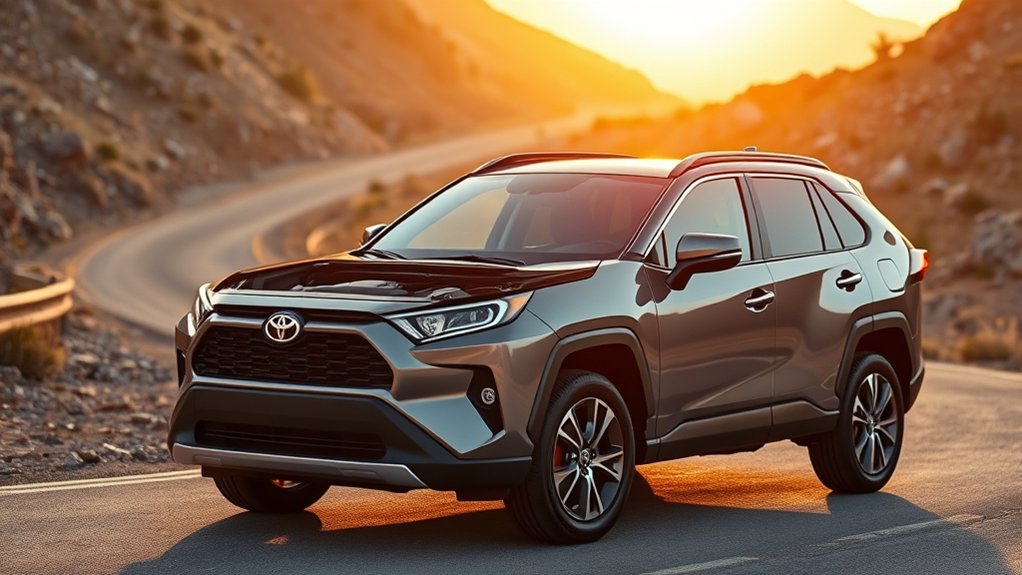
The absence of a turbo does not make the 2026 RAV4 slow. The conventional hybrid’s 226–236 horsepower is suitable for commuting, highway merging, and carrying passengers or cargo. In Car and Driver testing, an all-wheel-drive RAV4 Hybrid reached 60 mph in approximately 7.1 seconds.
The plug-in hybrid is the performance model of the range. Toyota lists 324 net combined horsepower and a 5.4-second 0–60 mph time. Its stronger electric motors provide immediate response before the gasoline engine contributes its full output.
The power delivery feels different from a turbocharged vehicle. A turbo engine can produce a noticeable surge as boost builds. The RAV4’s electric motors respond immediately, while its eCVT adjusts the relationship between engine speed and road speed continuously instead of shifting through fixed gears.
Under hard acceleration, the eCVT may hold the engine at a high, steady speed. That sound is a normal characteristic of the power-split hybrid system rather than evidence that a conventional CVT belt is slipping.
Independent test note: Car and Driver measured the 236-horsepower AWD RAV4 Hybrid at 7.1 seconds from 0–60 mph, 69 dBA at a 70-mph cruise, and 75 dBA at full throttle. Its 75-mph highway fuel-economy test returned 36 mpg.
RAV4 Fuel Efficiency Ratings and What They Mean for You
The 2026 RAV4 Hybrid achieves its best EPA ratings in front-wheel-drive configurations. The LE, SE, and XLE Premium FWD are rated at 47 mpg city, 40 mpg highway, and 43 mpg combined.
All-wheel-drive ratings vary with trim and equipment. LE and SE AWD are rated at 46 mpg city, 39 mpg highway, and 42 mpg combined; XLE Premium AWD is rated at 45/38/41 mpg; XSE and Limited are rated at 43/37/41 mpg; and Woodland is rated at 41/35/38 mpg.
The plug-in hybrid uses two efficiency measurements:
- MPG describes gasoline consumption during gasoline/hybrid operation.
- MPGe converts electrical energy into a gasoline-equivalent measurement so electrified vehicles can be compared on a common energy-use scale.
The 2026 RAV4 Plug-in Hybrid SE is currently listed at 43 mpg combined and 101 MPGe combined, with an EPA-estimated 54-mile all-electric range. Ratings differ by PHEV trim because wheels, tires, weight, and performance equipment affect energy use.
Actual fuel economy and electric range depend on speed, temperature, driving style, tire pressure, cargo, climate-control use, terrain, and charging habits. Cold weather and sustained high-speed driving usually reduce electric range and fuel economy.
RAV4 Towing Capacity and Capability
Towing capacity is configuration-specific. For the 2026 RAV4 Hybrid, Toyota lists a 1,750-pound maximum for LE FWD and AWD and for applicable front-wheel-drive configurations. XLE Premium AWD, SE AWD, Woodland AWD, XSE AWD, and Limited AWD can tow up to 3,500 pounds when properly equipped.
For the RAV4 Plug-in Hybrid, Toyota specifically advertises a 3,500-pound towing capacity for the Woodland, SE, and XSE. Do not automatically apply that rating to a different Plug-in Hybrid configuration; check the exact vehicle documentation before towing.
For a model-by-model breakdown, see the RAV4 Hybrid towing-capacity guide.
Before towing, verify all of the following:
- The exact towing limit shown in the owner’s manual or vehicle documentation
- The maximum payload and gross vehicle weight ratings
- The permitted tongue weight
- Whether trailer brakes or other equipment are required
- The weight of passengers, cargo, accessories, and hitch hardware
Warning: Do not assume that every all-wheel-drive RAV4 can tow 3,500 pounds. Exceeding the rating for your exact vehicle can affect braking, handling, cooling, drivetrain durability, and legal compliance.
Can You Add an Aftermarket Turbo to a 2026 RAV4?
A specialist could theoretically design a custom forced-induction system, but the 2026 RAV4 does not have a factory-supported bolt-on turbo package. Adding one would be far more complicated than installing a turbo on a simple, non-hybrid engine.
A complete conversion could require changes to:
- The exhaust manifold and exhaust system
- Fuel delivery and engine calibration
- Intake plumbing and charge-air cooling
- Engine and inverter cooling
- Ignition timing and knock control
- Hybrid-system torque management
- eCVT load management
- Emissions-control hardware and diagnostics
The original engine, hybrid controls, cooling system, and transmission were not calibrated for turbo boost. A poorly engineered conversion could cause detonation, overheating, drivability problems, emissions faults, or engine and drivetrain damage.
Warning: A turbo conversion may make the vehicle noncompliant with applicable emissions or inspection rules and may lead to denial of warranty coverage for failures caused by the modification. Consult qualified automotive, emissions, insurance, and warranty professionals before modifying the powertrain.
Drivers seeking more factory-engineered performance should compare the 324-horsepower RAV4 Plug-in Hybrid before considering custom forced induction. It is substantially quicker than the conventional hybrid while preserving the integrated calibration, safety systems, emissions certification, and drivability of a factory vehicle.
Related Guides
Frequently Asked Questions
What engine does the 2026 Toyota RAV4 use?
The U.S.-spec 2026 RAV4 Hybrid uses Toyota’s naturally aspirated 2.5-liter A25A-FXS four-cylinder as part of its gasoline-electric hybrid system. The Plug-in Hybrid also uses a naturally aspirated 2.5-liter four-cylinder with a larger traction battery and more powerful electric motors. Neither powertrain uses a turbocharger.
Can I modify a 2026 RAV4 to add a turbo?
It is theoretically possible as a custom engineering project, but it is not a practical bolt-on upgrade. The engine, cooling system, emissions controls, hybrid software, and eCVT would all need to work safely with the added boost. The modification could also affect reliability, emissions compliance, insurance, and warranty coverage.
Does the 2026 RAV4 Plug-in Hybrid have a turbo?
No. Its 324 net combined horsepower comes from a naturally aspirated 2.5-liter four-cylinder engine and powerful electric motors. Toyota lists a 5.4-second 0–60 mph time without using a turbocharger.
Does the 2026 RAV4 offer a gasoline-only engine?
No. The U.S. lineup consists of a conventional hybrid and a plug-in hybrid. References to a 203-horsepower gasoline RAV4 describe the outgoing 2025 model rather than a 2026 configuration.
Does the 2026 RAV4 Hybrid use a conventional CVT?
No. Toyota describes the RAV4 Hybrid transmission as a planetary-type electronically controlled continuously variable transmission, or eCVT. It blends gasoline-engine and electric-motor operation through a power-split system rather than using the conventional belt-and-pulley layout found in many non-hybrid CVTs.
How does the RAV4 Hybrid perform off-road?
An all-wheel-drive RAV4 can handle snow, gravel roads, maintained dirt routes, and light trails. The Woodland adds all-terrain tires and adventure-focused equipment. However, the RAV4 is a unibody crossover without low-range gearing, so it is not designed for extreme rock crawling, deep mud, or similarly severe terrain.
What is the towing capacity of the 2026 RAV4 Hybrid?
The rating depends on drivetrain and grade. The LE and applicable front-wheel-drive Hybrid configurations are rated up to 1,750 pounds, while XLE Premium AWD, Woodland AWD, SE AWD, XSE AWD, and Limited AWD can tow up to 3,500 pounds when properly equipped. Check the documentation for your specific vehicle before towing.
Are safer performance upgrades available for the RAV4 Hybrid?
Quality tires, lighter compatible wheels, upgraded brake pads, carefully selected suspension components, and a professional alignment can improve response without altering the hybrid powertrain. Confirm that every component is compatible with the vehicle’s load rating, driver-assistance systems, warranty, and local regulations.
Conclusion
The 2026 Toyota RAV4 does not use a turbocharger. Its naturally aspirated 2.5-liter gasoline engine works with electric motors to produce 226 horsepower in Hybrid FWD models, 236 horsepower in Hybrid AWD models, or 324 horsepower in the Plug-in Hybrid.
For shoppers specifically trying to avoid a turbocharged engine, both 2026 RAV4 powertrains meet that requirement. The regular Hybrid provides strong fuel economy without external charging, while the Plug-in Hybrid adds quicker acceleration and meaningful electric-only range. A custom aftermarket turbo is technically possible only as an extensive engineering project and is far less practical than choosing the factory 324-horsepower Plug-in Hybrid.
Sources
- Toyota: 2026 RAV4 — current U.S. hybrid lineup, fuel-economy listings, trims, and maximum advertised towing capacity.
- Toyota: 2026 RAV4 Specifications — official mechanical, performance, capacity, equipment, and warranty specification categories.
- Toyota: 2026 RAV4 Plug-in Hybrid — 324-horsepower output, 54-mile EPA-estimated range on SE, 5.4-second 0–60 mph claim, efficiency ratings, and towing information.
- Toyota USA Newsroom: The Next Adventure Begins — 2026 RAV4 — A25A-FXS engine identification, hybrid architecture, drivetrain details, fuel-economy figures, and towing configuration information.
- Associated Press and Edmunds: 2026 RAV4 vs. Honda CR-V — independent comparison of acceleration, technology, value, and estimated combined fuel economy.
- Car and Driver: 2026 RAV4 Hybrid Test — independently measured acceleration, highway fuel economy, sound levels, and driving impressions.

