
For a 2026 U.S.-market Toyota RAV4, AWD means Electronic On-Demand AWD: a dedicated rear electric motor adds rear-wheel drive force automatically when traction, acceleration, or stability can benefit. Used 2019–2025 gas RAV4s are different and may use mechanical Dynamic Torque Control AWD or Dynamic Torque Vectoring AWD. The hardware, drive modes, towing ratings, and maintenance needs therefore depend on model year, powertrain, trim, and market.
Quick Answer
Toyota RAV4 AWD works automatically; you do not normally switch it on. On 2026 U.S. models, AWD-equipped hybrids and plug-in hybrids use a dedicated rear electric motor. On many 2019–2025 gas models, a mechanical driveline sends engine torque rearward, with selected trims adding left-to-right rear torque vectoring. Snow, Trail, and Multi-Terrain Select modes change control strategy but do not provide a permanent AWD lock.
Key Takeaways
- RAV4 AWD can engage proactively during acceleration as well as react to wheel slip.
- Dynamic Torque Vectoring AWD can vary torque between the left and right rear wheels; basic Dynamic Torque Control AWD cannot do the same degree of side-to-side rear distribution.
- RAV4 Hybrid and plug-in-hybrid AWD models use a rear electric motor rather than a mechanical driveshaft to power the rear axle; for the redesigned 2026 U.S. lineup, every AWD RAV4 uses this electric-rear-motor layout.
- Snow, Multi-Terrain Select, and Trail modes change the control strategy; they do not manually lock AWD on or switch the system off.
- AWD improves acceleration traction, but tires, speed, and road conditions still determine braking and cornering grip.
Note: Trim names and drivetrain availability vary by model year and country. This guide mainly uses U.S.-market 2019–2025 RAV4 examples, identifies relevant Canadian differences, and explains how the redesigned 2026 RAV4 changes the lineup.
Last updated: September 19, 2026. AWD hardware, 2023 towing ratings, model-year trim availability, maintenance items, and the 2026 redesign were rechecked against Toyota U.S., Toyota Canada, and NHTSA sources. This article does not claim instrumented AWD, snow, towing, or off-road testing.
How Does the Toyota RAV4 AWD System Work?
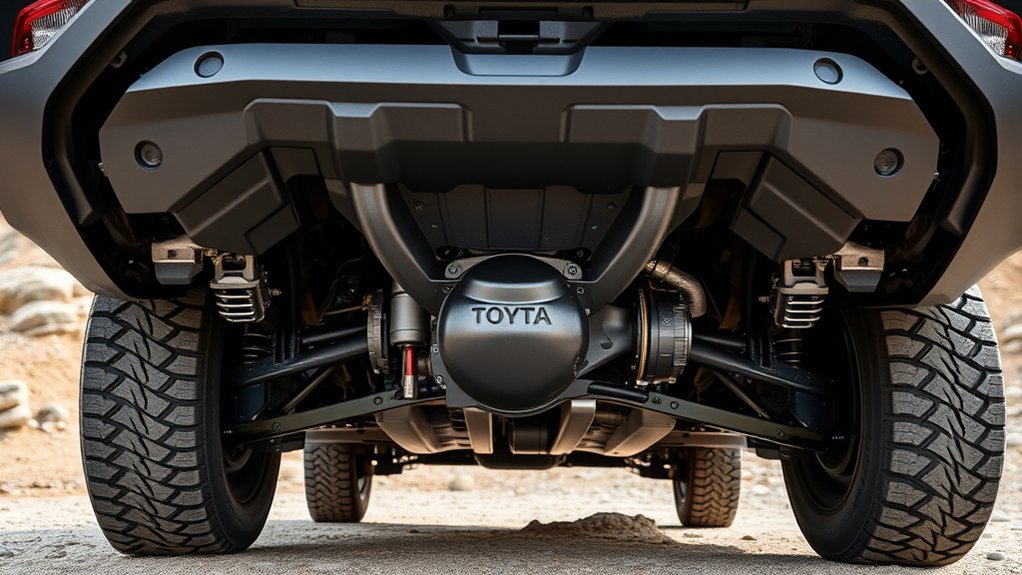
The RAV4’s AWD controller uses information such as accelerator input, vehicle speed, steering angle, wheel speed, yaw movement, and stability-control activity to determine how much rear-wheel assistance is useful.
During steady cruising on a dry road, many RAV4 configurations favor the front wheels to reduce unnecessary drivetrain loss. Rear drive force can then be introduced during a launch, while cornering, on an incline, or when the system detects reduced front-tire traction.
This means the system is both predictive and reactive. It does not always wait for the front tires to spin before responding. Toyota describes its newer electric AWD system as capable of preemptively applying rear drive force during acceleration to help suppress front-wheel slip.
On applicable fifth-generation gas RAV4 models, Dynamic Torque Vectoring AWD can send up to 50% of engine torque to the rear axle and then vary that torque between the left and right rear wheels.
Which RAV4 AWD System Does Your Vehicle Have?
You can usually identify the system from the powertrain and trim, although the original window sticker, Toyota build sheet, or owner’s manual is the safest source. If your main question is which current and used trims offer AWD rather than how the hardware works, see which Toyota RAV4 models have AWD.
| AWD system | Common applications | How rear drive is produced |
|---|---|---|
| Dynamic Torque Control AWD | Many 2019–2025 gas LE, XLE, and XLE Premium configurations in the U.S., depending on year and option selection | A mechanical propeller shaft and electronically controlled coupling send torque to the rear axle |
| Dynamic Torque Vectoring AWD | Adventure, TRD Off-Road, and certain Limited gas configurations in the U.S.; Trail and Limited examples in Canada | A mechanical rear driveline plus rear-axle clutches that vary torque from side to side |
| Electronic On-Demand AWD | RAV4 Hybrid and RAV4 Prime or Plug-in Hybrid models; AWD-equipped 2026 hybrids and plug-in hybrids | A dedicated electric motor directly powers the rear axle without a mechanical propeller shaft from the engine |
For the 2023 U.S. lineup, Toyota listed AWD as available on gas LE, XLE, and XLE Premium trims. Adventure and TRD Off-Road used Dynamic Torque Vectoring AWD as standard equipment, while it was available on Limited. The complete configuration chart appears in Toyota’s 2023 RAV4 eBrochure.
Canadian equipment differed. All 2023 Canadian RAV4 models had AWD, and the rugged gas trim was called Trail rather than Adventure. Toyota did not offer a 2023 RAV4 Platinum trim in either cited lineup.
How the Three RAV4 AWD Systems Differ
[Amazon Products Picked for You]

RAV4 NX200t NX300 Rear Axle Differential Carrier 2.28 Ratio

Attention: This differential assembly is shipped without oil. During installation, add 75W-90 gear oil and fill only to the specified level to ensure proper performance and avoid leaks. For any questions, please contact us

[Compatible Vehicle]: Fit for 2016-2019 Toyota Highlander 2.7L L4 Gas /2016-2019 Toyota Highlander 3.5L V6 Gas /2016-2019 Toyota Highlander 3.5L V6 Full Hybrid EV-Gas/2015-2018 Toyota Rav4 2.5L L4 Gas/2016-2018 Toyota Rav4 2.5L L4 Full Hybrid EV-Gas OEM:41303-48030ċ03-48010ċ03-48011ċ03-48012ċ03-48013
Dynamic Torque Control AWD
Dynamic Torque Control AWD is the more conventional mechanical system used on many fifth-generation gas RAV4 models. The engine and transmission normally drive the front wheels, while an electronically controlled coupling can route part of the available torque through a propeller shaft to the rear differential.
The system may add rear torque during acceleration, on a hill, while cornering, or when reduced traction is detected. Because the rear differential distributes torque through a conventional arrangement, this system does not independently command the left and right rear wheels in the same way as Dynamic Torque Vectoring AWD.
Dynamic Torque Vectoring AWD
Dynamic Torque Vectoring AWD adds separate control of the rear wheels. In addition to varying front-to-rear torque, rear-axle clutches can favor the left or right rear wheel to support cornering response and traction.
For example, the system may send more rear drive force toward the outside wheel during a turn when doing so helps the vehicle follow the driver’s intended path. It works with stability and brake-control systems rather than operating as an isolated mechanical feature.
Applicable configurations also use a rear driveline disconnect. When rear drive is unnecessary, disconnect clutches can stop the propeller shaft and portions of the rear driveline from rotating, reducing mechanical drag.
Electronic On-Demand AWD
RAV4 Hybrid and plug-in-hybrid models use a different layout. The gasoline engine and front motor-generators drive the front axle, while a separate electric motor drives the rear axle.
There is no mechanical propeller shaft carrying engine torque to the rear wheels. The hybrid control system can command the rear motor during acceleration, cornering, slippery conditions, or other situations where rear assistance is useful.
The redesigned U.S.-market 2026 RAV4 makes this electric layout the only AWD architecture in the lineup because gas-only models were dropped. Toyota lists a dedicated rear electric motor for AWD hybrid models and states that the system can apply rear drive force proactively during acceleration and respond when front-wheel slip occurs.
Can You Manually Engage or Disengage RAV4 AWD?
No. On the systems covered here, you do not receive a traditional transfer-case lever, a permanent center-differential lock, or a normal AWD-off button.
The vehicle decides how much rear drive force to use. Selecting a drive or terrain mode changes the control strategy, but it does not force a fixed 50/50 torque split and does not guarantee that all four wheels will receive equal torque continuously.
Warning: Do not treat Snow, Trail, or Multi-Terrain Select as a locked 4WD mode. These systems cannot create traction when the tires have no usable grip, and they do not make the RAV4 suitable for every deep-mud, rock-crawling, or high-clearance off-road situation.
Snow Mode
On applicable gas AWD models, Snow mode softens and coordinates power delivery to help the vehicle pull away more smoothly on slippery surfaces. Toyota’s 2023 quick-reference guide notes that Snow mode is canceled when the vehicle is switched off or when certain Multi-Terrain Select modes are chosen.
Multi-Terrain Select
Multi-Terrain Select is available on applicable gas AWD models. The 2023 system offers settings such as Mud & Sand, Rock & Dirt, and Snow. A selected mode coordinates AWD, brake intervention, steering feel, and drive-force control for the chosen surface.
- Mud & Sand: Allows a control strategy intended for loose, dirty, muddy, or sandy surfaces.
- Rock & Dirt: Adjusts the system for uneven unpaved roads and rougher low-speed surfaces.
- Snow: Supports smoother response on snow-covered or similarly slippery roads.
Use only the mode that matches the actual surface, and return to Normal mode when the special condition ends. Toyota’s 2023 RAV4 Quick Reference Guide provides the original control descriptions.
Trail Mode on Hybrid Models
Trail mode on applicable RAV4 Hybrid and plug-in-hybrid models coordinates electric AWD, brake control, and drive-force control on bumpy or loose surfaces. Brake intervention can help manage a spinning wheel so that usable drive force reaches wheels with better traction.
Trail mode remains an electronic traction aid. It does not turn the RAV4 into a low-range 4WD vehicle and should not be used to justify entering terrain that exceeds the vehicle’s ground clearance, tire capability, water-fording limits, or recovery options.
How RAV4 AWD Affects Fuel Efficiency

AWD adds hardware, weight, and potential drivetrain loss, so it should not be described as a guaranteed fuel-economy improvement over an equivalent front-wheel-drive RAV4.
Toyota reduces that penalty in two main ways:
- On-demand torque: The system limits rear drive force when it is unnecessary instead of maintaining a fixed front-to-rear split.
- Driveline disconnect or electric rear drive: Applicable mechanical systems can disconnect parts of the rear driveline, while hybrid AWD avoids an engine-driven propeller shaft altogether.
The result may be a small difference between comparable FWD and AWD EPA ratings, and in some configurations the combined estimate may be the same. The exact result depends on model year, trim, wheels, tires, powertrain, and test configuration.
Claims that the system universally adds one or two mpg over “standard options” or all traditional 4WD vehicles are not supported. A more accurate description is that Toyota’s on-demand designs help limit the normal efficiency cost of AWD.
RAV4 AWD vs. Traditional 4WD
AWD and 4WD terminology is not perfectly standardized across the industry, but the RAV4 systems are designed mainly for automatic, everyday traction rather than heavy-duty low-range off-roading.
| Feature | RAV4 AWD | Traditional truck-based 4WD |
|---|---|---|
| Operation | Automatically varies rear assistance | May offer selectable 2WD, 4-High, 4-Low, automatic 4WD, or full-time modes |
| Low-range gearing | No | Often available |
| Typical strengths | Rain, snow, gravel, dirt roads, light trails, everyday handling | Deep mud, steep technical terrain, heavy off-road work, low-speed control |
| Driver input | Mostly automatic, with optional drive and terrain modes | Varies; modern systems may be manual, automatic, or both |
It is inaccurate to say that all 4WD systems require manual shifting. Many modern 4WD vehicles include an automatic mode, while some full-time systems remain engaged without driver intervention.
[Amazon Products Picked for You]

Requires low operating space around drive tires

Durable Quik Grip Wide Base Link Chain

【Enhanced grip】The unique design of the snow chains provides excellent traction on ice and snow, preventing slipping and ensuring safe driving.
How RAV4 AWD Performs in Different Conditions
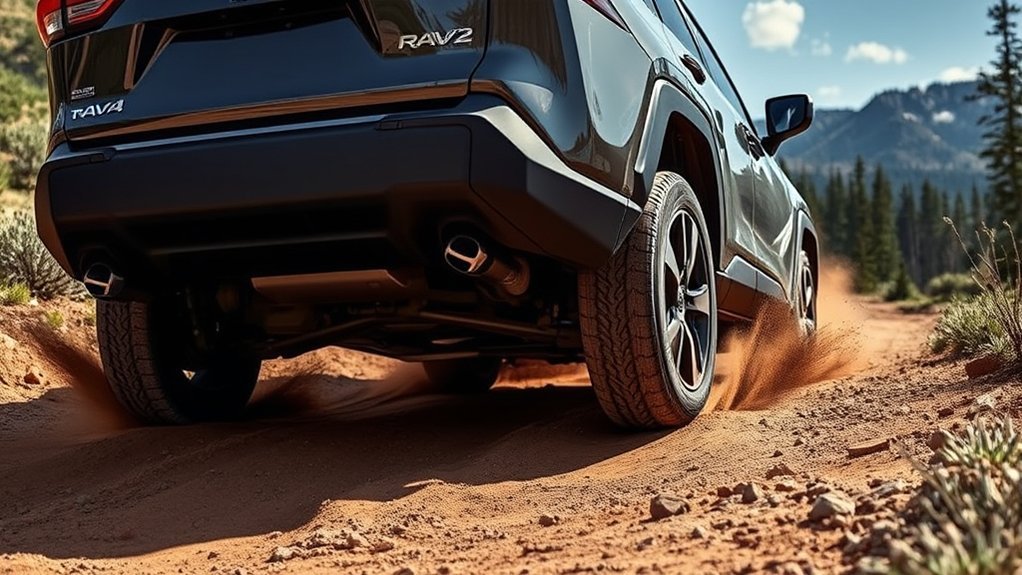
Snow and Ice
AWD can make it easier to start moving, climb a slippery grade, and maintain forward drive when one axle has less traction. Torque vectoring or brake-based traction control may also help the vehicle remain composed while turning.
However, AWD does not create extra braking grip. All four tires already participate in braking regardless of drivetrain, so stopping distance depends heavily on tire compound, tread, road surface, temperature, speed, and available space.
Warning: AWD may help you accelerate on snow or ice more easily than you can stop. Slow down early, increase following distance, and do not use improved launch traction as evidence that the road has adequate braking grip.
Rain and Wet Roads
Automatic rear assistance can reduce front-wheel strain during acceleration on a wet road, while stability and traction-control systems can respond to emerging wheel slip. These features support the driver but cannot prevent hydroplaning when speed, standing water, tread depth, or tire pressure creates the conditions for it.
Gravel and Light Off-Road Use
RAV4 AWD is well suited to maintained dirt roads, gravel access roads, snowy parking areas, and moderate trails that remain within the vehicle’s clearance and tire limits.
Dynamic Torque Vectoring AWD offers the most capable mechanical setup in the 2019–2025 gas lineup, while Trail mode can help electrified models manage uneven or loose surfaces. Neither replaces low-range gearing, locking differentials, underbody protection, recovery equipment, or appropriate off-road tires where those features are required.
Pro Tip: For winter use, four matching winter tires usually make a larger difference to braking and cornering grip than changing between two modern AWD systems. NHTSA notes that winter tires are more effective than all-season tires in deep snow.
How AWD Affects RAV4 Towing Capacity
AWD can support traction and stability while starting on a slippery ramp or pulling on a loose surface, but it does not determine the tow rating by itself. Cooling hardware, suspension, braking, hitch equipment, powertrain calibration, vehicle weight, and manufacturer certification also matter.
For reference, Toyota listed the following maximum ratings for the 2023 U.S. RAV4:
| 2023 U.S. configuration | Maximum advertised towing capacity |
|---|---|
| LE, XLE, XLE Premium, and Limited gas models | 1,500 lb |
| Adventure and TRD Off-Road | 3,500 lb |
| RAV4 Hybrid trims | 1,750 lb |
| RAV4 Prime SE and XSE | 2,500 lb |
Those numbers are model-year specific. Do not transfer them to another RAV4 solely because it has AWD. Confirm the owner’s manual, hitch requirements, payload limit, Gross Vehicle Weight Rating, and Gross Combined Weight Rating for the exact vehicle.
Warning: Passengers, cargo, accessories, and trailer tongue weight all consume payload capacity. A trailer can remain below the published tow rating while still causing the vehicle to exceed its payload or axle limits.
RAV4 AWD Maintenance Requirements
Maintenance depends on whether the vehicle has a mechanical rear driveline or an electric rear motor. Use the schedule for the exact model year rather than a generic AWD-fluid interval.
Mechanical Gas AWD
Applicable gas AWD models have components such as a propeller shaft, transfer assembly, rear differential, seals, couplings, and driveline fasteners. Toyota’s U.S. maintenance schedules include inspections or service for these parts at specified mileage points and under special operating conditions.
For a 2023 U.S. RAV4, the official guide includes:
- Tire rotation at the scheduled 5,000-mile or six-month service points.
- Inspection for leakage from applicable transfer-case and rear-differential components.
- Propeller-shaft fastener checks under listed conditions.
- Additional rear-differential or transfer-case oil service when towing, carrying heavy loads, or operating under other specified severe conditions.
Hybrid and Plug-In-Hybrid AWD
Electronic On-Demand AWD does not have an engine-driven propeller shaft or a conventional mechanical transfer case connecting the front and rear axles. That removes several mechanical AWD service items, but the rear drive unit still has serviceable components. Toyota’s 2023 RAV4 Hybrid maintenance guide, for example, lists rear differential oil inspections and calls for rear differential oil and automatic-transmission-fluid replacement under specified towing, car-top-carrier, or heavy-loading conditions.
Use the maintenance guide that matches the exact powertrain: 2023 RAV4 gas, 2023 RAV4 Hybrid, or 2023 RAV4 Prime. Service requirements can change when the vehicle regularly tows, travels on dirt roads, carries heavy loads, idles extensively, or operates under other special conditions defined by Toyota.
Tire Requirements for AWD
Use four tires of the specified size, load rating, and compatible construction. Avoid mixing substantially different tread patterns, tire types, or overall diameters between axles.
Uneven tire circumference can make the control system work unnecessarily and may change handling. Rotate the tires on schedule and investigate abnormal wear rather than replacing a single tire without checking the remaining tread depths.
For winter driving, install winter tires on all four wheel positions. Toyota’s tire guidance and NHTSA TireWise both emphasize maintaining a compatible set rather than combining winter and non-winter tires across the vehicle.
AWD Warning Messages and Troubleshooting
If an AWD, hybrid-system, traction-control, or drivetrain warning appears, read the complete message in the multi-information display. The correct response depends on the wording and may range from reducing speed to stopping safely and arranging service.
Useful first checks include:
- Confirm that all four tires are the specified size and are inflated to the door-label pressure.
- Look for a recently installed temporary spare, mismatched replacement tire, or visibly damaged tire.
- Allow the vehicle to cool if a warning appeared during prolonged wheel spin, deep sand, mud, a steep climb, or heavy towing.
- Check beneath a mechanical AWD vehicle for signs of drivetrain-fluid leakage.
- Restart only when the manual or displayed instructions permit it.
- Have the vehicle inspected if the warning remains, returns repeatedly, or is accompanied by noise, vibration, leakage, or reduced performance.
Note: When the vehicle reports that AWD is unavailable, drive as though rear assistance may not be present. Do not continue into snow, sand, mud, a steep grade, or another low-traction area based on normal AWD capability.
Choosing the Right RAV4 AWD System
| AWD system | Best fit | Main trade-off |
|---|---|---|
| Dynamic Torque Control AWD | Drivers seeking automatic all-weather assistance in a conventional gas RAV4 | Less rear side-to-side torque control than the vectoring system |
| Dynamic Torque Vectoring AWD | Drivers who want the most capable fifth-generation gas AWD setup for rough roads, towing-rated trims, or more responsive cornering | More mechanical hardware and model-year-dependent availability |
| Electronic On-Demand AWD | Drivers prioritizing hybrid efficiency, immediate electric rear assistance, and fewer mechanical connections | Capability remains limited by tires, clearance, battery and motor control, and the absence of low range |
For most buyers, the more important choice is not between two AWD badges. It is between the complete vehicles: powertrain, tires, ground clearance, towing rating, suspension, cargo capacity, fuel use, and the conditions you actually encounter. If you are deciding whether you need rear-wheel assistance at all, compare RAV4 AWD vs. FWD separately from this hardware guide.
[Amazon Products Picked for You]

Patented tread pattern: Provides a comfortable and quiet ride

Features an all-season tread design

Product Overview: The Fullway PC369 is a 235/65R17 108V XL-Extra Load, 4 Ply Rated Performance Tire Manufactured For Trucks & SUVs
Frequently Asked Questions
What maintenance does the RAV4 AWD system require?
Rotate the tires on schedule, keep four compatible tires fitted, inspect for abnormal wear or fluid leakage, and follow the model-specific maintenance guide. Mechanical gas AWD models may require transfer-case, rear-differential, propeller-shaft, and fastener service that electric rear-motor AWD models do not share.
How does AWD affect RAV4 towing capacity?
AWD can improve traction while launching or climbing, but the tow rating comes from the complete vehicle configuration. For the 2023 U.S. model, ratings ranged from 1,500 pounds on many gas trims to 3,500 pounds on Adventure and TRD Off-Road. Always use the rating for the exact model year, trim, and powertrain.
Can the RAV4 AWD system be manually engaged or disengaged?
No. The RAV4 automatically determines how much rear drive force to use. Snow, Multi-Terrain Select, and Trail modes change throttle, brake, steering, traction, and AWD control strategies, but they do not provide a permanent AWD lock or normal AWD-off function.
What tires are best for RAV4 AWD?
Use four matching or closely matched tires in Toyota’s specified size and load rating. Quality all-season tires suit moderate climates, four winter tires are preferable for regular snow and freezing conditions, and suitable all-terrain tires may help on dirt and gravel at the cost of some noise, ride comfort, or fuel economy.
How well does RAV4 AWD perform in winter?
It can improve starting traction, hill climbing, and drive-force distribution on snow. It does not shorten braking distance by itself. Four winter tires, lower speed, smooth inputs, and increased following distance remain essential on snow and ice.
Is the RAV4 AWD system always active?
The controller is always monitoring conditions, but the rear wheels are not necessarily receiving significant drive force at every moment. During steady, low-demand driving, many configurations favor the front axle and reduce or disconnect rear drive to limit energy loss.
Did the RAV4 AWD system change for 2026?
Yes. The redesigned U.S.-market 2026 RAV4 uses hybrid and plug-in-hybrid powertrains rather than the previous gas-only configurations. AWD-equipped models use a dedicated rear electric motor, so fifth-generation mechanical AWD descriptions apply mainly to 2019–2025 gas models.
How can I tell which AWD system my RAV4 has?
Start with the model year, powertrain, and factory trim specification. Many 2019–2025 gas AWD models use Dynamic Torque Control, selected gas trims use Dynamic Torque Vectoring AWD, and hybrid or plug-in-hybrid AWD models use a rear electric motor. The original window sticker, Toyota vehicle specification, or owner’s manual is more reliable than an exterior badge alone.
Does the 2026 RAV4 still use Dynamic Torque Vectoring AWD?
No on the U.S.-market 2026 lineup. The redesigned RAV4 uses hybrid and plug-in-hybrid powertrains, and AWD-equipped models use Electronic On-Demand AWD with a dedicated rear electric motor. Dynamic Torque Vectoring AWD applies to selected gas-powered RAV4s from the previous generation.
Conclusion
The Toyota RAV4 AWD system is best understood as a family of automatic traction systems rather than one fixed design. For the current 2026 U.S. lineup, AWD-equipped models use Electronic On-Demand AWD with a dedicated rear electric motor. Used 2019–2025 gas models may instead use Dynamic Torque Control or Dynamic Torque Vectoring AWD.
Each system can improve acceleration traction and stability in rain, snow, gravel, and moderate off-pavement driving. None replaces suitable tires, safe speed, model-specific towing limits, routine maintenance, or the low-range hardware needed for severe off-road terrain. Before using a drive mode, ordering AWD service, or relying on a tow rating, confirm the exact year, market, trim, and powertrain in the original Toyota documentation.
Sources
- Toyota 2023 RAV4 eBrochure — U.S. trim equipment, AWD systems, drive modes, EPA estimates, and towing ratings.
- Toyota 2023 RAV4 Quick Reference Guide — Snow mode, Multi-Terrain Select, Trail mode, and driver-control operation.
- Toyota 2023 RAV4 Warranty & Maintenance Guide — gas-model scheduled and severe-service maintenance requirements.
- Toyota 2023 RAV4 Hybrid Warranty & Maintenance Guide — hybrid rear-differential, transmission-fluid, tire, and HV-system maintenance requirements.
- Toyota 2023 RAV4 Prime Warranty & Maintenance Guide — plug-in-hybrid maintenance requirements.
- Toyota USA: 2025 RAV4 Technical Overview — Dynamic Torque Vectoring AWD, hybrid Electronic On-Demand AWD, and rear-driveline disconnect operation.
- Toyota USA: 2026 RAV4 Technical Overview — redesigned powertrains and rear electric-motor AWD behavior.
- Toyota Canada: 2023 RAV4 Lineup — Canadian AWD availability, Trail naming, and Dynamic Torque Vectoring AWD equipment.
- NHTSA TireWise — all-season, winter, summer, and all-terrain tire guidance.
