
A Toyota Tundra rough idle can come from an air leak, ignition misfire, fuel-delivery problem, contaminated or faulty sensor, throttle-body issue, or an internal engine problem. The right diagnosis depends heavily on your Tundra’s model year and engine, so scan the truck and identify the operating conditions before replacing parts. Older V8 Tundras and 2022-and-newer twin-turbo models do not share the same troubleshooting details.
Quick Answer
A Toyota Tundra rough idle is a symptom, not a diagnosis. Start by scanning for stored and pending codes, then check for intake or vacuum leaks, ignition misfires, fuel-delivery problems, and sensor faults. Model year matters because Toyota has issued Tundra-specific service bulletins for certain older flex-fuel and 2022–2024 trucks.
Key Takeaways
- Scan for diagnostic trouble codes and save freeze-frame data before clearing anything or replacing parts.
- Your model year and engine matter: a second-generation V8 Tundra and a 2022-and-newer twin-turbo Tundra can require different diagnostic paths.
- Vacuum or intake leaks, spark plugs, ignition coils, fuel injectors, fuel pressure, sensors, wiring, and mechanical faults can all produce similar symptoms.
- Do not follow generic MAF, throttle-body, fuel-system, or spark-plug intervals; use Toyota’s maintenance guide for your exact truck.
- Severe shaking, repeated stalling, a flashing check-engine light, fuel leakage, or heavy abnormal smoke deserves prompt professional diagnosis.
At a Glance
| Time Required | About 20–60 minutes for basic scanning and visual checks; advanced testing can take longer. |
| Difficulty | Moderate for basic diagnosis; advanced fuel and mechanical tests are better suited to an experienced technician. |
| Tools Needed | OBD-II scan tool, flashlight, basic hand tools, and model-specific service information; a smoke machine, multimeter, pressure-testing equipment, or compression tester may be needed later. |
| Cost | Basic visual and scan checks may cost nothing if you already have the tools; repair cost varies widely with the actual fault. |
Common Symptoms of Rough Idle in Toyota Tundra
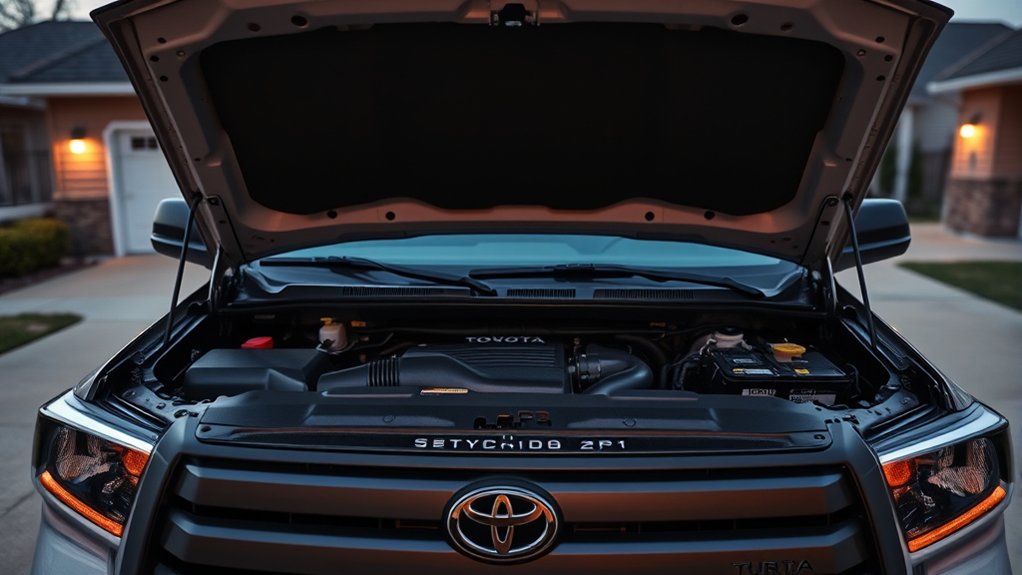
A true rough idle usually feels like the engine is not producing smooth, even power while the truck is stopped. The exact idle speed varies with model year, engine temperature, electrical load, air conditioning, transmission state, and engine calibration, so a single RPM number should not be used to diagnose every Tundra.
- Shaking or stumbling: You may feel an uneven pulse through the seat, steering wheel, or body while the engine is running.
- Unstable engine speed: RPM may surge, dip, hunt, or occasionally approach a stall.
- Misfire symptoms: The truck may hesitate, shake, lose power, or store cylinder-specific or random-misfire codes.
- Poor drivability: Hesitation when pulling away, sluggish response, or reduced fuel economy may occur with some faults.
- Warning lights: The malfunction indicator lamp or check-engine light may illuminate when the ECM detects a fault.
- Abnormal exhaust: Persistent blue, white, or black smoke is not simply a rough-idle symptom and may point toward a separate fuel, coolant, oil-burning, turbocharger, or engine problem.
If the RPM remains steady but the truck vibrates strongly, do not assume the engine is misfiring. Engine or transmission mounts and other vibration sources can sometimes mimic a rough idle.
Note: On applicable newer non-hybrid Tundras, Toyota’s Stop & Start system can intentionally shut the engine off while the vehicle is stopped and restart it when the brake is released. That normal operation should not be confused with an uncontrolled stall. See Toyota’s Tundra Quick Reference Guide for model-specific operation.
How to Diagnose Rough Idle Problems
Diagnose a Toyota Tundra rough idle systematically. Begin with the truck’s model year, engine, symptoms, and diagnostic data instead of guessing which component should be replaced.
Common Diagnostic Tools
- OBD-II scan tool: Read confirmed, pending, and history codes and save freeze-frame information before clearing anything.
- Flashlight and inspection mirror: Check intake tubes, connectors, hoses, wiring, and visible damage.
- Smoke machine: A properly used automotive smoke tester can help locate intake or vacuum leaks that are difficult to see.
- Digital multimeter: Useful for electrical, power, ground, and circuit checks when the correct service specifications are available.
- Compression or leak-down equipment: Used when ignition, air, and fuel tests do not explain a persistent cylinder problem.
- Model-specific service information: Specifications, connector pinouts, pressure values, and test procedures differ across Tundra generations.
Warning: Keep hands, clothing, tools, and test leads away from belts, fans, hot exhaust components, and other moving parts while the engine is running. Newer Tundras also use sophisticated fuel-injection systems; do not loosen high-pressure fuel lines as a casual DIY test.
Step-by-Step Troubleshooting Process
- Identify the exact truck. Record the model year, engine, hybrid/non-hybrid configuration, mileage, recent repairs, and whether the problem started after fueling, battery work, maintenance, or another event.
- Define when it happens. Note whether the idle is rough only when cold, only after warm-up, in Drive but not Park, with the A/C on, after refueling, or all the time.
- Scan before clearing codes. Save stored and pending DTCs plus freeze-frame data. A code tells you what condition the ECM detected; it does not automatically identify the failed part.
- Inspect the intake system. Check air-cleaner housings, intake tubes, clamps, vacuum hoses, PCV-related plumbing, and electrical connectors. On turbocharged trucks, the intake/boost system deserves model-specific inspection as well.
- Evaluate airflow and throttle data. Inspect the MAF sensor and throttle body for obvious contamination or damage and compare scan-tool data with model-specific specifications. Do not touch delicate MAF sensing elements or use a random solvent.
- Check ignition if a misfire is indicated. Inspect the spark plug, ignition coil, connector, wiring, and plug well on the affected cylinder before replacing multiple parts.
- Check fuel delivery. Depending on the engine, diagnosis may involve fuel trims, injector operation, fuel quality, low-pressure delivery, or high-pressure system testing. Use the appropriate Toyota procedure.
- Check mechanical condition if needed. Persistent cylinder-specific misfires may require compression, leak-down, valve-timing, or other mechanical tests.
- Check Toyota service information. Before authorizing expensive parts, confirm whether a Toyota technical service bulletin applies to the exact VIN, model year, engine, DTCs, and calibration.
Pro Tip: Record codes, freeze-frame data, fuel trims, and the conditions under which the rough idle occurs before disconnecting the battery or clearing the ECM. That information can disappear after a reset and may be the best clue to an intermittent fault.
Common Causes of Rough Idle in Toyota Tundra
There is no single cause that applies to every Tundra. The following problems are reasonable starting points, but testing should determine which one actually affects your truck.
Vacuum Leaks and Intake Leaks
Unmetered air entering the engine can disturb the air-fuel calculation and produce unstable idle, lean fuel trims, hesitation, or mixture-related DTCs.
Inspect intake ducting, hose connections, gaskets, PCV-related plumbing, and other model-specific vacuum connections. A smoke test is generally more useful for a hidden leak than spraying chemicals around a running engine.
On a turbocharged Tundra, do not assume that an older V8 vacuum-leak checklist covers every possible air-path problem. The intake and forced-induction system differs significantly.
Worn or Fouled Spark Plugs
A worn, fouled, damaged, incorrectly gapped, or otherwise unsuitable spark plug can contribute to a misfire and rough idle. However, a misfire code does not prove that the spark plug itself has failed.
Inspect the plug condition and compare it with the correct specification for your engine. Oil, fuel, or abnormal deposits on a plug can also provide clues about another underlying fault.
Do not use a generic 60,000–100,000-mile replacement rule for every Tundra. For example, Toyota’s 2025 Tundra Warranty & Maintenance Guide schedules spark-plug replacement at 120,000 miles. Always verify the interval for your exact model year and engine.
Faulty Ignition Coils or Ignition Circuits
A weak ignition coil, poor electrical connection, wiring problem, or related ignition fault can produce an intermittent or constant misfire. If a scan identifies one cylinder, inspect that cylinder’s ignition components instead of replacing every coil immediately.
On coil-on-plug engines, technicians sometimes compare components between cylinders as part of diagnosis when the service procedure and access allow it. If a misfire consistently moves with a suspected component, that is stronger evidence than replacing parts based only on a code.
MAF, Throttle, and Airflow Problems
The engine control module relies on accurate airflow information. A contaminated or faulty MAF sensor, damaged connector, air leak downstream of the sensor, or throttle-body problem can affect idle quality.
Inspect first and use scan data where possible. Cleaning should not be treated as an automatic maintenance step, and delicate sensor elements should never be scrubbed or exposed to unsuitable solvents.
Fuel Delivery and Injector Problems
Low or unstable fuel delivery, injector faults, poor fuel quality, electrical problems, or incorrect fuel-control data can cause lean, rich, or cylinder-specific running problems.
Fuel-system design varies greatly by generation. On newer direct-injected engines, high-pressure diagnosis and repair require appropriate procedures and equipment. Do not open pressurized lines without the correct depressurization and service procedure.
Mechanical Engine Problems
If spark, air, and fuel tests do not explain the rough idle, consider mechanical causes such as low compression, valve problems, incorrect valve timing, internal wear, or other cylinder-sealing faults.
A compression or cylinder leak-down test can help separate an electrical/fuel problem from an internal engine problem.
Troubleshooting Rough Idle Issues
Use the symptom pattern to decide where to concentrate your testing.
| Symptom or Finding | What to Check Next |
|---|---|
| Random or multiple-cylinder misfire | Air leaks, fuel quality/delivery, shared sensor inputs, wiring, applicable ECM calibration or TSB, and mechanical condition. |
| One cylinder repeatedly misfires | Spark plug, ignition coil, injector, connector/wiring, compression, and cylinder-specific mechanical condition. |
| Rough only when cold | Cold-start fueling, fuel quality, intake leaks, ignition condition, sensor data, and applicable model-specific DTCs. |
| Rough only after warm-up | Fuel trims, vacuum leaks, sensor behavior, purge operation, ignition components, and mechanical condition. |
| Strong vibration but steady RPM | Engine/transmission mounts and other vibration sources in addition to checking for a true misfire. |
| Lean codes | Unmetered air, intake leaks, MAF data, fuel delivery, injector operation, exhaust leaks, and model-specific fuel-control issues. |
| Fuel odor, visible leak, or severe rich running | Stop treating it as routine DIY troubleshooting and arrange professional inspection. |
Model-Year-Specific Tundra Issues Worth Checking
A model-year-specific Toyota bulletin can completely change the correct repair path, which is why replacing parts before checking service information can become expensive.
2022–2024 Tundra and Tundra Hybrid Misfire Bulletin
Toyota issued Technical Service Bulletin T-SB-0085-24 for certain 2022–2024 Tundra and Tundra Hybrid vehicles that may illuminate the MIL with P030000, P030027, and/or P030085 random/multiple-cylinder misfire DTCs.
Toyota states that ECM logic was modified to address the condition. If your truck matches the bulletin’s applicability and DTC pattern, verify calibration and bulletin eligibility before buying coils, plugs, injectors, or other expensive parts.
Older 3UR-FBE Flex-Fuel Tundras
Toyota’s T-SB-0166-19 Rev1 applies to specified 2009–2019 Tundras equipped with the 3UR-FBE flex-fuel engine. The bulletin addresses hard-start/MIL conditions involving fuel-trim DTCs and an alcohol-density estimate that may not match the fuel actually in the vehicle.
If your flex-fuel Tundra has the matching engine, symptoms, and codes, this Toyota procedure deserves attention before generic sensor or ignition parts are replaced.
Do Not Use the Same Checklist for Every Generation
Toyota substantially redesigned the Tundra for 2022, replacing the previous V8 powertrain with twin-turbo V6 and available i-FORCE MAX hybrid configurations. Toyota’s 2022 Tundra technical introduction documents that powertrain change.
That means vacuum routing, intake plumbing, injection systems, electronics, normal operating behavior, and service procedures can differ from an older Tundra. Identify the year and engine before following repair advice.
Key Repairs for Rough Idle in Tundra
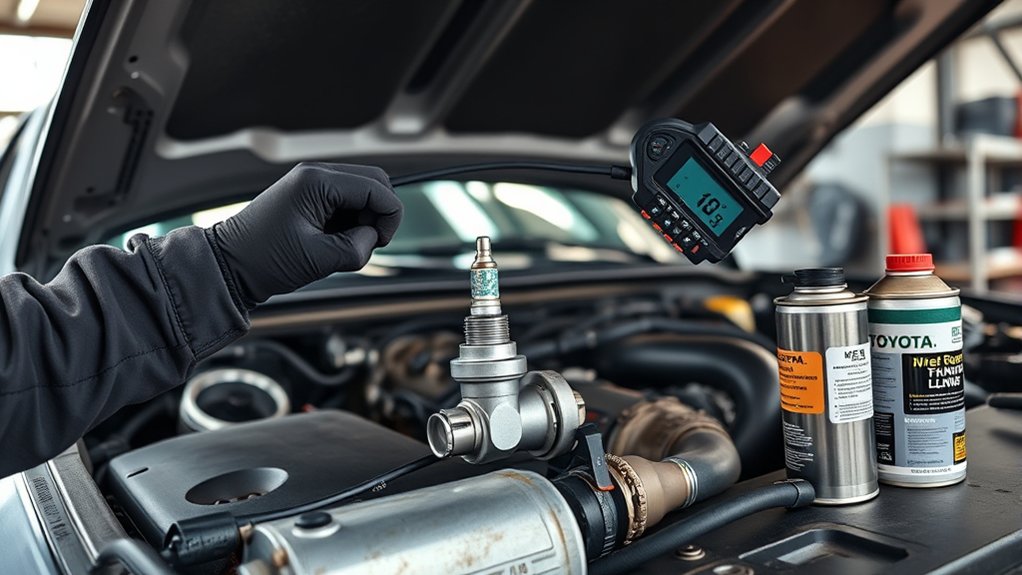
The correct repair is the one supported by your diagnostic results. Depending on what testing reveals, common repairs may include:
- Repairing an intake or vacuum leak: Replace a cracked hose, damaged seal, loose connection, or other confirmed source of unmetered air.
- Replacing a failed spark plug: Use the correct plug specification and investigate abnormal fouling rather than treating deposits as normal wear.
- Replacing a confirmed faulty ignition coil: Verify the coil or circuit is responsible before replacing a complete set.
- Correcting MAF or airflow faults: Repair wiring, connections, air leaks, contamination, or a failed sensor according to the applicable test results.
- Servicing the throttle body when justified: Deposits or throttle-related faults should be confirmed rather than treated as an automatic mileage-based service.
- Repairing injector or fuel-delivery faults: Follow the correct low-pressure/high-pressure fuel-system procedure for the engine.
- Updating ECM calibration when applicable: Toyota TSBs may specify a software-related repair for particular model years and DTC patterns.
- Repairing mechanical faults: Low compression, valve problems, timing issues, or internal damage require a different repair path than ignition or sensor faults.
Preventative Maintenance Tips to Avoid Idle Issues
Preventive maintenance helps reduce avoidable drivability problems, but use Toyota’s schedule for your exact Tundra rather than generic internet intervals.
| Maintenance Item | Recommended Approach |
|---|---|
| Spark plugs | Replace at the interval listed for your exact model year and engine. The 2025 U.S. Tundra guide, for example, schedules replacement at 120,000 miles. |
| Engine air filter | Inspect and replace according to the applicable Toyota maintenance schedule and operating conditions. |
| MAF sensor | Do not assume a fixed cleaning interval. Inspect or test it when symptoms, codes, or scan data justify doing so. |
| Throttle body | Inspect and service when condition or model-specific service information indicates it is needed; do not assume a universal 30,000-mile interval. |
| Vacuum/intake system | Inspect damaged hoses, loose connections, or leaks when symptoms or fuel-trim data suggest unmetered air. |
| Fuel system | Use Toyota’s model-specific scheduled maintenance and diagnostic procedures rather than a generic fuel-system-service interval. |
You can obtain the correct documentation for your truck through Toyota’s official Manuals and Warranties portal.
When Should You Get Professional Help for Rough Idle?
Some basic inspection and scanning can be done at home, but a rough idle can also signal a fault that should not be driven or repaired casually.
- The check-engine light is flashing or the truck is shaking severely.
- The engine repeatedly stalls in traffic or is difficult to keep running.
- You smell raw fuel or see a fuel leak.
- There is persistent blue, thick white, or heavy black exhaust smoke.
- The truck has major power loss, overheating, abnormal mechanical noise, or low oil pressure.
- The same cylinder continues to misfire after basic ignition checks.
- Testing points toward injectors, high-pressure fuel components, compression, valve timing, turbocharger plumbing, or internal engine damage.
- A Toyota TSB appears applicable and ECM calibration or dealer-level diagnostic equipment is required.
Professional diagnosis is especially valuable when several systems can create the same symptom. A good technician should verify the fault rather than replace components solely because a DTC mentions a particular cylinder or mixture condition.
User Experiences: How Others Resolved Rough Idle Issues

Owner reports can provide useful clues, but they should not substitute for diagnosis. One Tundra may improve after replacing a failed ignition coil, while another with nearly identical shaking may have an intake leak, injector fault, ECM calibration issue, or low compression.
The most useful owner experiences are those that include the truck’s model year, engine, exact DTCs, freeze-frame or live data, tests performed, and evidence showing why the final repair solved the problem.
Be especially cautious with advice to replace oxygen sensors simply because the engine is running lean or rich. An oxygen or air-fuel sensor may be reporting a mixture problem created somewhere else in the engine. Test the underlying air, fuel, ignition, and mechanical systems before assuming the sensor is the cause.
Related Guides
Frequently Asked Questions
What is the most common cause of a Toyota Tundra rough idle?
There is no single cause that applies to every Tundra. Intake or vacuum leaks, worn spark plugs, ignition-coil faults, fuel-delivery problems, sensor faults, and mechanical problems can all create similar symptoms. Model year also matters because some Tundras have Toyota-specific service bulletins that change the diagnostic path.
Why does my Toyota Tundra run rough only at idle?
A small air leak, weak ignition component, fuel-control problem, injector issue, sensor fault, or low compression can be most noticeable when engine speed and airflow are low. Scan for codes and compare cold, warm, Park, Drive, and A/C-on conditions before replacing parts.
What is the most common problem with a Toyota Tundra?
There is no accurate single “most common problem” covering every Tundra generation. Engines, transmissions, electronics, and known service issues changed substantially over the model’s history. For a rough-idle complaint, diagnose the exact truck by model year, engine, symptoms, DTCs, and applicable Toyota service information.
Why is my Toyota Tundra shaking when idling?
If the RPM is unstable and the engine is stumbling, investigate misfire, air, fuel, sensor, and mechanical causes. If the engine speed remains steady but the truck vibrates, also inspect engine or transmission mounts and other vibration sources instead of assuming the engine is misfiring.
Is it safe to drive a Tundra with a rough idle?
A mild intermittent rough idle may allow limited driving to obtain diagnosis, but stop and arrange service if the check-engine light flashes, the engine shakes severely, the truck repeatedly stalls, power drops sharply, fuel is leaking, or abnormal mechanical noise or heavy smoke appears.
Why does my Tundra idle rough only when cold?
Cold-only rough running can point toward fuel quality, cold-start mixture control, ignition weakness, air leaks, sensor information, or another condition that changes as the engine warms. Record the codes and freeze-frame data before the truck reaches operating temperature because the fault may become harder to reproduce afterward.
Sources
- Toyota Manuals and Warranties — official model-year-specific owner and maintenance documentation.
- Toyota 2025 Tundra Warranty & Maintenance Guide — maintenance schedule, including the verified spark-plug interval.
- Toyota 2024 Tundra Quick Reference Guide — Stop & Start system operation on applicable trucks.
- Toyota: All-New 2022 Tundra — documents the third-generation twin-turbo V6 and hybrid powertrain change.
- Toyota T-SB-0085-24 — 2022–2024 Tundra/Tundra Hybrid P030000-family misfire bulletin.
- Toyota T-SB-0166-19 Rev1 — specified 3UR-FBE flex-fuel Tundra hard-start and fuel-control bulletin.
Conclusion
A Toyota Tundra rough idle should be diagnosed from evidence rather than by replacing the most commonly mentioned part. Identify the model year and engine, preserve diagnostic codes and freeze-frame data, inspect the air path, test ignition and fuel systems as indicated, and consider mechanical testing when simpler checks do not explain the problem. Most importantly, check Toyota’s model-specific service information because a known calibration or engine-specific issue may change the correct repair completely.
