
A weight distribution hitch and sway control solve related but different towing problems. Weight distribution manages how trailer tongue weight affects the tow vehicle’s and trailer’s axles, while sway control resists unwanted side-to-side movement. Many conventional trailer combinations benefit from both, but neither system should be selected by trailer weight alone. The correct setup depends on actual loaded weights, equipment ratings, compatibility, and the instructions for your tow vehicle, receiver, hitch, brakes, and trailer.
Quick Answer
No universal rule says every trailer needs both. A weight distribution hitch restores load toward the tow vehicle’s front axle and trailer axles; sway control resists side-to-side motion. Many larger or high-profile conventional trailers benefit from both, but the correct setup depends on loaded weights, equipment ratings, compatibility, and each manufacturer’s instructions.
Key Takeaways
- A weight distribution hitch manages axle loading; sway control manages lateral movement.
- A hitch does not increase your vehicle’s tow rating, payload, axle ratings, receiver rating, or combined-weight rating.
- There is no universal 5,000-pound or “50% of vehicle weight” rule that applies to every tow vehicle and trailer.
- Correct loading, tongue weight, tire condition, speed, and equipment compatibility must be addressed before relying on sway-control hardware.
- Always follow the most restrictive instruction or rating supplied by the tow-vehicle, receiver, hitch, brake, and trailer manufacturers.
Understanding Sway Control: Definition and Function
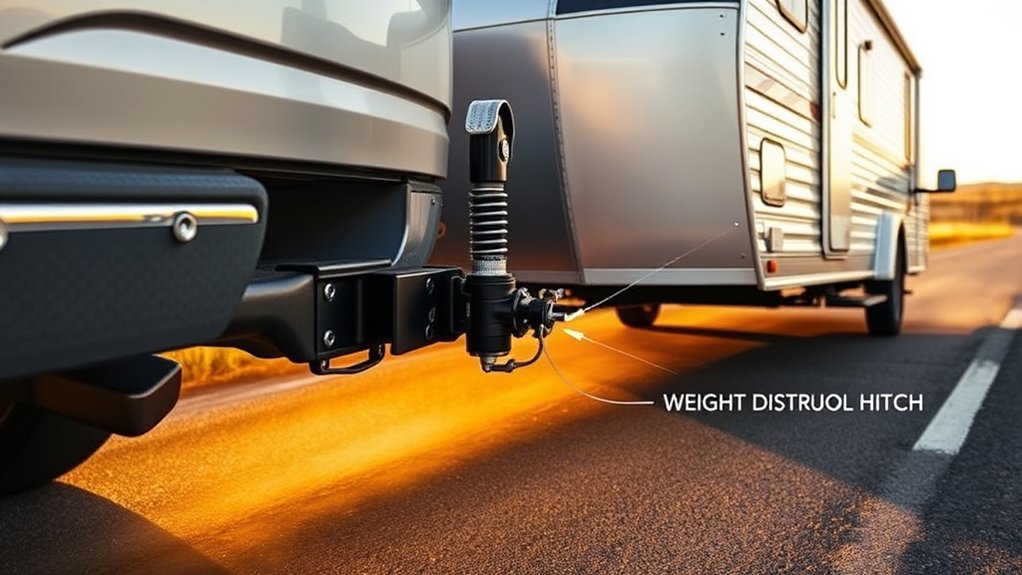
Trailer sway is an unwanted side-to-side yawing motion around the hitch ball. It may begin or worsen because of crosswinds, bow waves from passing trucks, abrupt steering, excessive speed, insufficient tongue weight, shifted cargo, incorrect tire pressure, worn suspension parts, or a mismatch between the tow vehicle and trailer.
A sway-control system adds resistance or corrective force to help keep a conventional trailer aligned behind the tow vehicle. It is a supplement to a correctly loaded and maintained towing combination—not a substitute for one.
Common Types of Sway Control
- Friction sway-control bar: A separate telescoping device that uses adjustable friction to resist pivoting at the hitch. Its instructions may require removal or adjustment during backing, wet conditions, or other specific situations.
- Integrated friction or four-point sway control: Resistance is built into a weight distribution hitch at the hitch head, frame brackets, or both.
- Cam-style or geometry-based control: Shaped components help the trailer return toward a centered position while still allowing normal turns.
- Electronic trailer-sway mitigation: Some tow vehicles use wheel-speed, steering, and yaw sensors to detect instability and selectively apply brakes or reduce engine torque. This feature does not automatically replace mechanical equipment required by the vehicle, receiver, or trailer manufacturer.
Warning: Do not use tighter sway-control adjustment to hide persistent instability. Stop and inspect the loading, tongue weight, tires, suspension, hitch, coupler, wheel bearings, and equipment ratings. If sway continues after the setup is corrected, discontinue towing until the cause is identified.
What Is a Weight Distribution Hitch and How Does It Work?
When a conventional trailer places tongue weight on a ball located behind the tow vehicle’s rear axle, the rear axle carries more load and the front axle may carry less. Excessive front-axle unloading can reduce steering response, braking balance, headlight aim, and overall control.
A weight distribution hitch, often shortened to WDH, uses spring bars and leverage to transfer part of that imposed load toward the tow vehicle’s front axle and the trailer axles. Official towing guidance describes this as distributing tongue load among the axles rather than leaving the rear axle to carry the entire effect. See the Nissan Towing Guide and the California DMV Recreational Vehicles and Trailers Handbook.
A weight distribution hitch changes where load is carried; it does not increase any published weight rating.
Purpose and Functionality Explained
A properly selected and adjusted WDH can:
- Restore the amount of front-axle load specified by the tow-vehicle manufacturer
- Reduce excessive rear suspension sag caused by tongue weight
- Improve steering feel and braking balance
- Help the tow vehicle and trailer remain at their specified towing attitudes
- Provide a mounting platform for integrated sway-control features on compatible systems
A WDH does not create additional payload or towing capacity. The loaded tow vehicle must still remain within its gross vehicle weight rating, front and rear gross axle weight ratings, payload limit, receiver rating, tongue-weight limit, and gross combined weight rating.
Some manufacturer guides use a specific trailer-weight threshold. For example, Nissan’s 2020 guide recommends a WDH above 5,000 pounds for certain listed Nissan vehicles. That is a model-specific instruction, not a universal towing rule. Your own vehicle manual and receiver label control.
Key Components Overview
| Component | Function | What to Verify |
|---|---|---|
| Receiver | Attaches the towing equipment to the vehicle structure. | It must be approved and rated for weight-distributing use. |
| Shank and hitch head | Positions the hitch ball and provides attachment points for the spring bars. | Drop or rise, ball size, torque, tilt, and component ratings. |
| Spring bars | Apply leverage to redistribute the effect of tongue weight. | Their operating range must suit the actual loaded tongue weight. |
| Frame brackets or chains | Connect the spring bars to approved points on the trailer frame. | Frame clearance, propane and battery placement, bracket spacing, and bolt torque. |
| Hitch ball | Connects the trailer coupler to the hitch head. | Correct diameter, shank size, rating, installation, and torque. |
| Sway-control components | Add friction, cam action, or other resistance to lateral movement. | Adjustment, lubrication restrictions, backing instructions, and wear limits. |
Installation and Adjustment Tips
Begin with the tow vehicle and trailer loaded as they will actually travel. Include passengers, fuel, water, batteries, propane, cargo, accessories, and anything carried in the tow vehicle. Empty or “dry” trailer weight is not enough for choosing or adjusting a hitch.
- Confirm that the tow vehicle and receiver permit weight-distributing operation.
- Measure the loaded trailer and tongue weight.
- Select a hitch, ball, shank, spring bars, and brackets whose operating ranges cover the measured loads.
- Set the hitch-ball height and head angle according to the hitch instructions.
- Adjust spring-bar tension to meet the tow-vehicle manufacturer’s front-axle restoration or ride-height target.
- Verify axle loads at a certified scale whenever possible.
- Torque fasteners and inspect all clearances exactly as the manufacturer directs.
Pro Tip: Record the tow vehicle’s front and rear axle weights in three conditions: vehicle only, trailer coupled without spring-bar tension, and trailer coupled with the WDH adjusted. This shows what the hitch is actually doing instead of relying only on how level the combination looks.
Warning: A WDH may interfere with some surge-brake systems, couplers, trailer frames, or other equipment. Confirm compatibility with the tow-vehicle, receiver, hitch, brake, and trailer manufacturers before installation.
Key Differences Between Weight Distribution Hitches and Sway Control Bars
Weight distribution and sway control are not interchangeable. One manages the vertical and fore-aft effect of tongue load on the axles; the other resists rotation around the hitch ball.
| Question | Weight Distribution Hitch | Sway Control |
|---|---|---|
| Main job | Redistributes the effect of tongue weight among the tow-vehicle and trailer axles. | Resists unwanted side-to-side pivoting or applies corrective action. |
| Primary concern | Rear-axle loading and front-axle unloading. | Lateral instability and oscillation. |
| Typical hardware | Hitch head, spring bars, shank, and trailer-frame brackets. | Separate friction bar, integrated friction points, cams, or electronic controls. |
| Can it fix overloading? | No. | No. |
| Can it correct poor tongue weight? | No. Cargo must first be loaded and secured correctly. | No. It must not conceal an unstable load. |
| May both be integrated? | Yes. Many WDH products include sway resistance. | Yes. The sway function may be part of the WDH rather than a separate bar. |
Do You Need Both Systems for Towing?
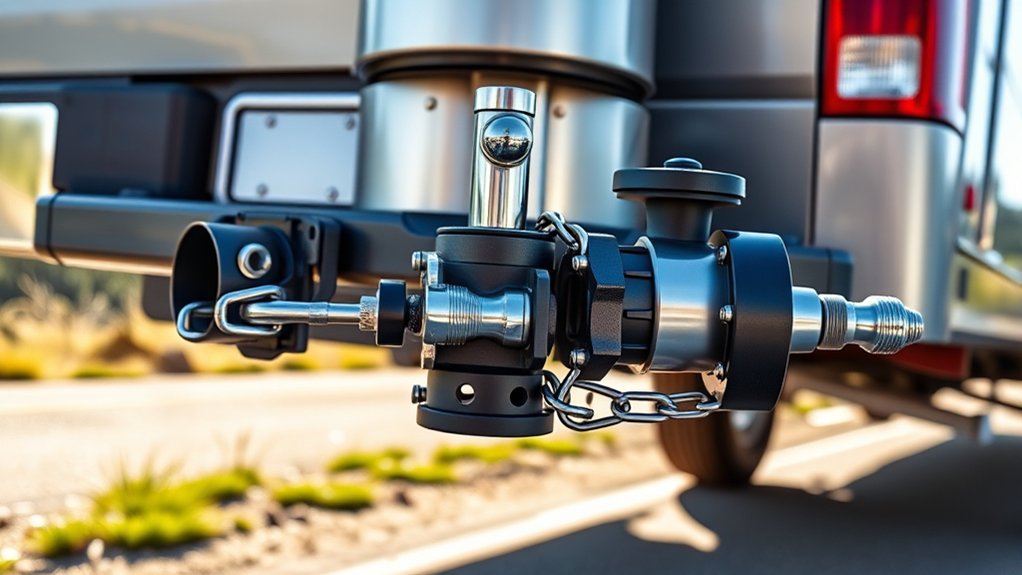
You may need both, one, or neither. There is no safe universal answer based solely on trailer weight.
A Weight Distribution Hitch May Be Needed When
- The tow-vehicle or receiver manual requires one for the trailer weight or tongue weight.
- The receiver has separate weight-carrying and weight-distributing ratings and the loaded combination exceeds the permitted weight-carrying limit.
- Coupling the loaded trailer removes more front-axle load than the vehicle manufacturer permits.
- Rear-axle load, steering feel, braking balance, or headlight aim is adversely affected, while all ratings remain within their limits.
- The trailer and tow vehicle are compatible with a WDH and the system can be adjusted to the specified target.
Sway Control May Be Beneficial or Required When
- The vehicle, hitch, or trailer manufacturer calls for it.
- The trailer is long, tall, or has a large side profile that is more exposed to crosswinds and passing traffic.
- The trailer is used frequently at highway speeds.
- The properly loaded and maintained combination needs additional lateral damping.
- An integrated WDH and sway-control design is approved for the complete setup.
Both Systems May Be Appropriate When
Both functions are often useful for larger conventional travel trailers because tongue load affects the tow vehicle’s axles while the trailer’s size and side area can make it sensitive to wind. An integrated product can simplify the hardware. For example, systems such as the CURT TruTrack combine weight distribution with built-in sway resistance. The product name does not remove the need to verify its rating, installation requirements, brake compatibility, and approval for the tow vehicle and trailer.
Neither System May Be Needed When
A small, stable, correctly loaded trailer may not need a WDH or a separate sway-control device when every applicable manual permits simple weight-carrying operation and all ratings are respected. Even then, correct tongue weight, tire pressure, cargo restraint, safety chains, lighting, brakes where required, and conservative driving remain essential.
Note: Do not use “the trailer is more than half the vehicle’s weight” as a decision rule. Compare measured loads with the specific tow rating, payload, tongue-weight limit, receiver ratings, GVWR, front and rear GAWR, and GCWR instead.
Benefits of Using Both Systems for Towing Safety
When both functions are required or beneficial and the equipment is compatible, the combination addresses two separate handling concerns:
- Better front-axle load restoration: A correctly adjusted WDH can reduce excessive front-axle unloading.
- More controlled lateral movement: Sway resistance can dampen movement caused by wind, passing vehicles, or minor steering inputs.
- More predictable steering and braking: Correct axle loading helps the tow vehicle respond more consistently.
- Reduced driver workload: A stable, correctly matched combination usually requires fewer steering corrections.
- Integrated operation: A properly sized combined system may avoid the need for a separate friction bar.
These benefits depend on correct setup. Too little spring-bar tension may not restore enough front-axle load, while too much tension may conflict with the vehicle manufacturer’s target. Excessive sway-control friction can also affect normal turning or conceal a deeper stability problem.
How to Decide Which Towing Equipment You Need
1. Find the Loaded Trailer Weight
Weigh the trailer with the cargo, water, batteries, propane, accessories, and supplies it will carry. Do not size the equipment from dry weight alone. Confirm that the measured trailer weight is within the tow vehicle’s and hitch components’ ratings.
2. Measure the Actual Tongue Weight
For many conventional trailers, a tongue weight around 10% to 15% of actual loaded trailer weight is a commonly published range. The trailer manufacturer’s specified range controls because some trailer types require a different percentage.
Remember that tongue weight is carried by the tow vehicle and normally counts against its available payload. Passengers, pets, tools, cargo, bed accessories, and aftermarket equipment also consume payload.
3. Check Every Relevant Rating
- Tow rating: Maximum trailer weight permitted for the exact vehicle configuration
- Payload: Available capacity for occupants, cargo, accessories, and tongue weight
- GVWR: Maximum permitted total weight of the loaded tow vehicle
- GAWR: Maximum permitted load on each axle
- GCWR: Maximum permitted combined weight of the tow vehicle and trailer
- Receiver ratings: Separate limits may apply to weight-carrying and weight-distributing operation
- Hitch and ball ratings: Every component must be rated for the load
- Trailer GVWR and axle ratings: The trailer itself must remain within its limits
4. Confirm Compatibility
Check the tow vehicle, receiver, WDH, sway-control device, trailer frame, coupler, and brake-system instructions. A system that fits physically may still be prohibited or require special procedures.
5. Verify the Adjusted Combination
After adjustment, remeasure ride height if the manual uses that method and weigh the tow vehicle’s axles when possible. Confirm that the front-axle restoration meets the vehicle maker’s target and that no axle or vehicle rating is exceeded. Then complete a low-speed test in a safe area before entering traffic.
Choosing the Best Hitch for Your Trailer Needs
Choose towing equipment from measured loads and manufacturer instructions, not from the largest rating available or a visual guess.
Match the Spring-Bar Range
The spring bars must operate within the hitch manufacturer’s stated range for the actual setup. Bars that are underrated cannot provide the intended load transfer. Bars that are unnecessarily stiff may produce harsh operation or make correct adjustment difficult. Use the hitch maker’s method for calculating the load applied to the system.
Check the Receiver Label
Many receivers display two sets of limits: weight carrying and weight distributing. Do not assume a receiver accepts a WDH merely because a hitch shank fits into it.
Choose the Right Sway-Control Type
Consider trailer length, side profile, expected wind exposure, backing requirements, road use, maintenance, and whether the system is approved for the trailer’s brakes and frame. Review instructions for lubrication because friction surfaces that must remain dry can lose effectiveness if they are greased.
Verify Component Standards and Ratings
Use clearly marked towing components from established manufacturers, and confirm that the ball, coupler, receiver, shank, hitch head, fasteners, brackets, and safety equipment all have suitable ratings. SAE J684 is an established reference concerning trailer coupling and hitch-system performance, although vehicle and product instructions remain the direct authority for a particular installation.
How to Measure Tongue Weight and Check the Setup
Measure tongue weight with the trailer loaded as it will travel and held at its normal towing attitude. Depending on the load, you may use a purpose-built tongue-weight scale, a suitable platform scale, or a certified vehicle scale and an accepted calculation method.
- Load and secure the trailer exactly as it will be towed.
- Measure total loaded trailer weight.
- Measure the downward load at the coupler at the normal hitch height.
- Calculate the percentage: tongue weight divided by loaded trailer weight, multiplied by 100.
- Compare the result with the trailer manufacturer’s specified range and every applicable tongue-weight limit.
- Weigh the tow vehicle’s front and rear axles with the WDH adjusted.
- Confirm that GVWR, GAWR, payload, receiver, hitch, and GCWR limits are all respected.
A level appearance is useful, but it is not proof of a safe setup. Air springs, self-leveling suspension, or a stiff rear suspension can make a vehicle look level while an axle or payload limit is still exceeded.
When Should You Not Use a Weight Distribution Hitch?
Do not use a WDH when:
- The tow-vehicle manufacturer prohibits it.
- The receiver is not approved or rated for weight-distributing operation.
- The trailer manufacturer does not approve the frame or coupler for the imposed forces.
- The hitch is incompatible with the trailer’s surge brakes or other brake hardware.
- The system cannot be installed with the required frame-bracket spacing and component clearances.
- The equipment is damaged, worn, incorrectly sized, or cannot be adjusted to the manufacturer’s target.
- You are using a fifth-wheel or gooseneck hitch, which uses a different coupling and load path rather than a conventional ball-mounted WDH.
- Product instructions require disconnection for a specific maneuver or operating condition.
A WDH may also be unnecessary for a light, stable trailer that remains within all weight-carrying limits and for which the relevant manufacturers do not call for weight distribution. “Unnecessary” and “prohibited” are not the same, so check the documents rather than guessing.
Top Mistakes to Avoid in Towing Setup

Ignoring Weight Distribution Importance
Poor trailer loading can create too little or too much tongue weight. Too little may make the trailer prone to instability, while too much can overload the tow vehicle, receiver, or rear axle and remove excessive load from the front axle.
Do not try to correct excess tongue weight merely by tightening the spring bars. Move or reduce cargo as permitted, measure again, and keep every rating within its limit.
Overlooking Sway Control Needs
A properly loaded trailer can still benefit from approved sway control, especially when it is long, tall, or regularly exposed to crosswinds and highway traffic. Review the vehicle and trailer instructions before deciding that weight distribution alone is enough.
Incorrect Hitch Adjustments
Common errors include using the wrong ball height, choosing unsuitable spring bars, applying too much or too little tension, failing to torque fasteners, lubricating friction surfaces that must remain dry, and setting the hitch only by visual appearance.
Recheck the adjustment after the initial break-in distance specified by the hitch manufacturer and whenever cargo, water, batteries, propane, accessories, or tow vehicles change.
Treating Sway Control as a Cure for Bad Loading
Sway-control equipment cannot make an overloaded trailer, insufficient tongue weight, underinflated tire, worn wheel bearing, loose coupler, or damaged suspension safe. Correct the cause before towing again.
Forgetting the Pre-Trip Inspection
Before every trip, check:
- Coupler engagement, latch, pin, and hitch-ball size
- Receiver pin and clip
- Spring bars, brackets, chains, clips, and sway-control components
- Safety-chain attachment with enough turning clearance
- Breakaway cable routing and battery condition
- Trailer-brake operation and controller settings
- Tire condition, cold pressure, load rating, and lug-nut torque
- Lights, turn signals, reflectors, and electrical connector
- Cargo restraint and side-to-side balance
- Mirrors, doors, steps, jacks, awnings, and loose exterior items
What to Do If Trailer Sway Starts
Warning: Follow the emergency instructions in your tow-vehicle, trailer, and brake-controller manuals. Do not make abrupt steering inputs or panic-brake, because sudden maneuvers can worsen instability or cause a skid or jackknife.
- Keep the steering wheel steady and maintain control of the lane.
- Ease off the accelerator smoothly.
- Avoid sudden tow-vehicle braking unless required to prevent a collision.
- If an electric trailer-brake controller is fitted and its manufacturer instructs you to do so, use the controller’s manual function as directed to help bring the trailer back in line.
- Reduce speed gradually and pull over at the first safe location.
- Inspect cargo position, tongue weight, hitch connections, spring bars, sway equipment, tires, pressures, wheels, bearings, and suspension.
- Do not resume normal-speed towing until the cause has been corrected.
If sway continues despite correct loading, intact equipment, suitable tires, and compliance with all ratings, stop towing and consult the tow-vehicle, trailer, or hitch manufacturer or a qualified towing-equipment specialist. The Nissan Towing Guide likewise advises discontinuing towing when instability persists after the basic causes have been checked.
Related Guides
Frequently Asked Questions
Do I need a weight distribution hitch with sway control?
Possibly, but not automatically. Use a WDH when the tow-vehicle or receiver instructions require it or when it is needed to achieve the specified front-axle load restoration. Add compatible sway control when required or when the properly loaded combination benefits from additional lateral damping. Many larger conventional trailers use an integrated system that performs both functions.
Is sway control necessary?
It is necessary when a manufacturer requires it and may be beneficial for long, tall, or high-profile conventional trailers. Trailer weight by itself is not enough to decide. Correct tongue weight, secure cargo, proper tires, sound suspension, suitable speed, and compliance with all ratings come first.
When should you not use a weight distribution hitch?
Do not use one when the tow vehicle, receiver, trailer frame, coupler, or brake manufacturer prohibits it; when the receiver is not rated for weight distribution; or when the equipment is incompatible, damaged, incorrectly sized, or cannot be adjusted properly. Fifth-wheel and gooseneck systems also use a different hitch design.
Do I need a sway bar for towing a 3,300-pound trailer?
A 3,300-pound weight alone does not answer the question. Check the tow-vehicle, receiver, and trailer manuals; measure loaded tongue weight; consider the trailer’s length and side area; and confirm whether the combination is stable in normal conditions. Use approved sway control if the manufacturer requires it or the properly configured setup benefits from it.
Can a weight distribution hitch increase towing capacity?
No. It redistributes the effect of tongue weight but does not raise the tow vehicle’s tow rating, payload, GVWR, GAWR, GCWR, receiver rating, or trailer rating. A receiver may display a higher limit in weight-distributing mode, but every other applicable limit still applies.
Does electronic trailer sway control replace a mechanical sway-control hitch?
Not unless the vehicle and trailer manufacturers explicitly say it does. Electronic stability features may intervene after motion is detected, while mechanical systems add resistance at the hitch. Neither system corrects overloading, poor tongue weight, damaged tires, or a mechanical fault.
Conclusion
A weight distribution hitch and sway control are complementary, not interchangeable. A WDH manages how tongue load affects the axles, while sway control resists lateral movement. Many larger conventional trailers benefit from both functions, but the safe answer is never an automatic “yes” based on a single weight threshold.
Use actual loaded weights, verify every vehicle and equipment rating, measure tongue weight, confirm compatibility, and follow the most restrictive manufacturer instruction. A stable towing combination begins with correct loading and suitable equipment; sway-control hardware is the final layer, not a shortcut around those fundamentals.
Sources
- 2020 Nissan Towing Guide — towing ratings, weight distribution, tongue-load measurement, surge-brake compatibility, loading, inspections, and instability troubleshooting.
- California DMV Recreational Vehicles and Trailers Handbook — hitch terminology, load distribution, tongue weight, sway control, trailer brakes, and pre-trip safety.
- SAE J684: Trailer Couplings, Hitches, and Safety Chains — established engineering reference for trailer-coupling and hitch-system performance.
