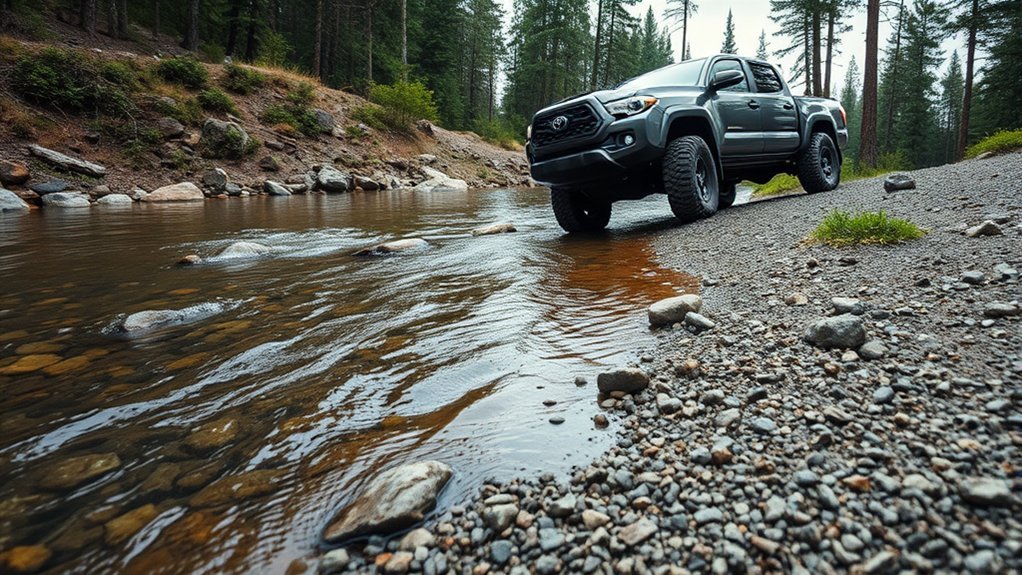
A Toyota Tacoma water crossing should be attempted only on a legal, controlled off-road route where the water is shallow, slow, and the bottom and exit are verified. Toyota does not publish one universal fording-depth number for every Tacoma, so do not rely on 27 inches, half a tire, or another internet rule. Never drive into floodwater, fast-moving water, or water of unknown depth. For a trail ford, use the owner’s manual for your exact model year and configuration, then inspect the truck immediately after crossing.
Last updated: September 22, 2026 — reviewed against Toyota owner and maintenance guidance and current National Weather Service flood-safety guidance.
Quick Answer
No single Tacoma fording depth should be applied across every model year and configuration. Never enter floodwater, fast-moving water, or water of unknown depth. For a legal, controlled off-road crossing, follow your exact owner’s manual, verify a firm route and visible exit, protect vulnerable components, and turn back whenever conditions are uncertain.
Key Takeaways
- Do not treat 27 inches, half a tire, or any other single number as a universal Tacoma water-depth limit.
- Never drive through floodwater, fast-moving water, barricaded roads, or water that hides the road surface.
- Use the owner’s manual for your exact year, drivetrain, trim, tire size, and modifications before any controlled off-road crossing.
- A snorkel or breather extension may protect one component, but it does not waterproof the engine bay, cabin, electronics, seals, or driveline.
- After a crossing, check braking, fluids, the air box, underbody, breathers, bearings, and electrical systems before continuing.
At a Glance
| Time Required | No fixed time; stop long enough to verify legal access, depth, current, bottom condition, weather, recovery options, and a clear exit |
| Difficulty | Advanced and high risk; beginners should avoid water crossings without experienced support |
| Tools Needed | Owner’s manual, long depth-checking pole used from stable ground when possible, tire gauge, gloves, rated recovery gear, communication device, and basic inspection light |
| Cost | No required cost when properly equipped; recovery gear, professional modifications, fluid service, or repairs vary |
Warning: The National Weather Service says it is never safe to drive into floodwater. Fast-moving water can hide a washed-out road, move a truck sideways, stall the engine, or trap occupants. Turn around at flooded roads, barriers, rising water, or any crossing with unknown depth or current.
Essential Pre-Crossing Checks for Tacoma Water Crossings
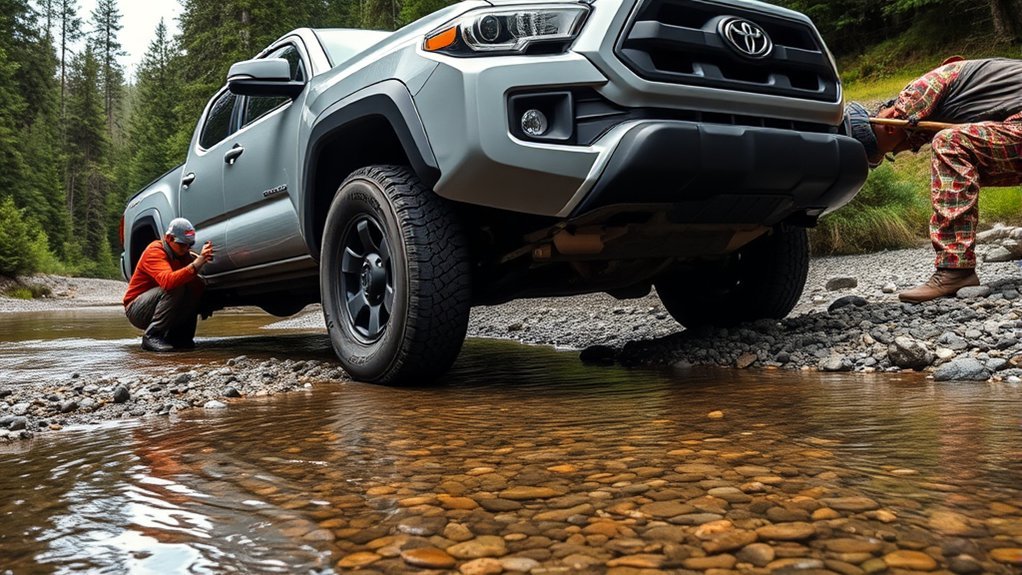
Start by deciding whether the crossing is floodwater or a controlled off-road ford. Do not enter floodwater on a road. For a trail crossing, confirm that motor vehicles are allowed, the route is open, the weather is stable, and the water level is not rising. Avoid creating a new line around a damaged crossing because road and streambank disturbance can increase erosion and sediment.
Next, open the Toyota manual for your exact model year. Tacoma generations, engines, hybrid systems, four-wheel-drive controls, air-intake layouts, tire sizes, and electronic systems differ. Toyota’s Tacoma guidance focuses on checking water depth and bottom firmness, driving slowly, avoiding deep water, and inspecting the truck after off-road water exposure rather than giving every Tacoma one universal fording number.
- Inspect the air intake and air box: Confirm that the housing, filter, clamps, and ducts are dry, sealed, and undamaged.
- Check drivetrain breathers: Inspect the axle, transmission, and transfer-case breather locations that apply to your truck. A raised breather can reduce risk, but it cannot stop leakage through damaged seals.
- Inspect door and body seals: Look for tears or loose trim, but do not assume factory door seals make the cabin watertight.
- Check tires and underbody: Verify tire pressure, usable tread, skid-plate security, recovery points, and ground clearance.
- Protect occupants and cargo: Keep seat belts fastened, secure loose gear, keep windows and locks operable, and agree on an emergency exit plan.
- Prepare recovery support: Cross with another capable vehicle when possible. Use only rated recovery points and gear, and keep people away from tensioned straps or winch lines.
If you are unsure which transfer-case mode applies to your truck, review when to engage 4WD on a Toyota Tacoma before reaching the crossing and then follow the instructions in your exact owner’s manual.
Pro Tip: Stop far enough from the bank to inspect the approach, bottom, and exit without blocking the trail. A visible exit, firm base, and safe recovery path matter more than a guessed depth number.
[Amazon Products Picked for You]

Fitment:for Toyota Tacoma 2.7L 2005-2015, for Toyota Tacoma 4.0L 2005-2015

Fitment: for Toyota 4Runner 2.7L 1996-2000, for Toyota 4Runner 3.4L 1996-2002, for Toyota Tacoma 2.4L 1995-2004, for Toyota Tacoma 2.7L 1995-2004, for Toyota Tacoma 3.4L 1995-2004

FITMENT: Fit 1995-2004 1st gen For Tacoma 1996-2002 3rd 4runner v6 3.4L
What’s the Safe Water Fording Depth for Your Tacoma?
No single water depth is safe for every Toyota Tacoma. The original 27-inch figure should not be used as a universal rating because it lacks a Toyota model-year source and does not account for current, hidden washouts, tire size, lift height, payload, intake location, driveline breathers, or aftermarket changes.
Toyota’s Tacoma owner guidance has used a condition-based approach: check the water depth and riverbed firmness first, drive slowly, and avoid deep water. The National Weather Service separately warns that 12 inches of rushing floodwater can carry away most cars, while 2 feet can carry away SUVs and trucks. Those figures describe flood danger, not an approved Tacoma fording depth. A Tacoma’s weight and four-wheel drive do not make moving floodwater safe.
| Decision Factor | Turn Back When |
|---|---|
| Water movement | The current is fast enough to move debris, form standing waves, rise visibly, or push the vehicle off its intended line |
| Depth | The depth is unknown, changing, or near a vulnerable intake, breather, electrical component, or cabin opening |
| Bottom and road | You cannot confirm a firm surface, stable banks, and a clear exit |
| Weather | Rain is falling upstream, storms are forecast, or water is rising |
| Vehicle setup | The truck has a damaged seal, exposed wiring, unknown breather layout, unsuitable tires, or no safe recovery point |
| Legal access | The road is closed, barricaded, restricted, or outside a designated motor-vehicle route |
A depth number cannot account for current, a washed-out road, hidden rocks, a soft bottom, or a rising stream. When any part of the crossing is uncertain, the safer decision is to turn back.
Essential Modifications for Enhanced Water Crossing Capability
Water-crossing modifications can reduce specific risks, but none of them converts a Tacoma into an amphibious vehicle. Choose parts for the exact generation, engine, transmission, and drivetrain. Have critical intake or breather work installed and leak-tested by a qualified technician.
[Amazon Products Picked for You]

⭐Built to Last: Constructed from premium PE using a rotational molding process, this snorkel kit is solid and durable. It maintains its practicality and beauty over time, reducing the need for frequent replacements.

Compatible With:2005-2015 Toyota Tacoma 2.7L 4 Cylinder

KEEPING YOUR ENGINE SAFE: It is vital to count with ARB SS172HP Safari Snorkel every time you may encounter severe environmental conditions such as deep water, heavy raining, dust and more. Safari snorkel will protect and safe your engine from any of these constant threats every time you hit the road into wild adventures.
Snorkel or Raised Air Intake
A correctly sealed snorkel may raise the engine’s air-entry point. It does not protect the alternator, starter, ignition system, control modules, cabin, axle seals, transmission, transfer case, or breathers. A decorative or poorly sealed snorkel can create false confidence and may still allow water into the intake system.
Driveline Breather Extensions
Breather extensions can move vent openings higher for the rear differential and other driveline components when the specific Tacoma design allows it. They must remain open, routed away from heat and moving parts, and protected from kinks. Water can still enter through worn axle, pinion, transmission, or transfer-case seals.
Underbody and Recovery Equipment
Secure skid plates can help protect exposed components from rocks, while rated recovery points, a suitable strap or winch system, gloves, and a line damper support safer recovery. Recovery equipment requires training. Never attach a strap to a tow ball, suspension arm, or an unrated tie-down point.
Note: Aftermarket equipment does not increase the official capability of every Tacoma by a fixed amount. Recheck intake sealing, breather routing, payload, tire clearance, and warranty terms after any modification.
Your Step-by-Step Guide to Water Crossings
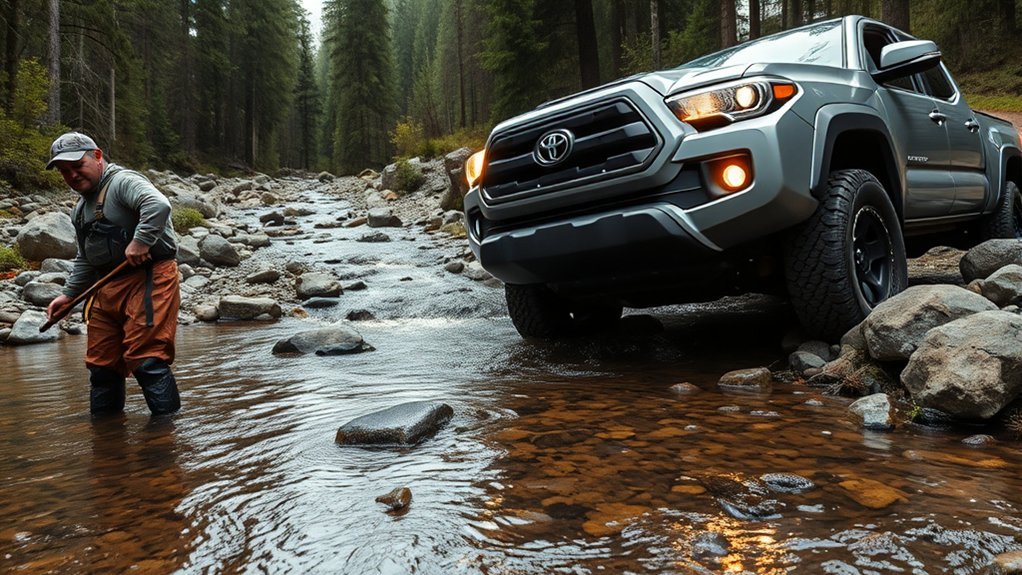
- Stop and classify the hazard. Turn around if the water covers a public road, crosses a barricade, moves quickly, hides the surface, or has unknown depth. Do not enter water during a flood watch or warning.
- Confirm a legal, controlled route. Check trail status, local rules, upstream weather, the bank angle, the bottom, and the exit. Do not walk into swift, contaminated, cold, or unknown water to measure it.
- Plan recovery before entering. Identify rated recovery points, position the support vehicle, choose a safe direction of pull, and keep bystanders clear.
- Select the correct drive setting. Follow the owner’s manual. Use four-wheel drive or low range only when your Tacoma is equipped with it, the surface requires it, and the manual permits that setting. Do not shift modes halfway through the water unless the manual specifically allows it.
- Enter slowly and smoothly. Use a controlled crawl that avoids a large splash. Keep a consistent line, avoid sudden acceleration or steering, and do not stop unless safety requires it.
- Exit without spinning the tires. Maintain gentle momentum onto firm ground. Clear the bank before stopping so the next vehicle has room.
- Check braking immediately. In a safe, clear area, apply the brakes lightly at low speed. Stop driving if braking feels weak, uneven, noisy, or abnormal.
If the engine stalls in the water, switch the ignition off and do not attempt to restart it. Restarting an engine that has ingested water can cause severe internal damage. Exit only when it is safer than remaining inside, then recover or tow the truck for inspection.
[Amazon Products Picked for You]

Premium Material: This recovery ring winch is made of 7075 aluminum alloy for superior strength and durability. It is stronger, corrosion-resistant and less prone to rust than traditional grip blocks, ensuring a longer service time for a wide range of off-road gear and winch lines

🔧 2" Hitch Receivers with 3/4 D-ring Shackle: The Tow Hitch Receiver is made of carbon steel with a rated working load of 11,000 lbs and a breakpoint of 45,000 lbs. Black silicone isolators to prevent scratching when mounted. This shackle hitch receiver accessory is suitable for all towing applications.

AMERICAN OWNED, FAMILY OPERATED - Join the Rhino Family & Support a USA based Father/Son Business!c
When to Turn Around Instead of Crossing
- The road is flooded, closed, or barricaded.
- The water is moving rapidly, muddy enough to hide the bottom, carrying debris, or rising.
- You cannot see a stable exit or verify a firm, obstacle-free route.
- The crossing approaches the air intake, driveline breathers, electrical components, or cabin openings.
- You are alone, lack rated recovery gear, or have no reliable communication.
- The truck has warning lights, damaged seals, worn tires, weak brakes, fluid leaks, or loose underbody parts.
- Rain is falling upstream or thunderstorms are possible in the drainage.
- Crossing would leave a designated route, damage a streambank, or violate land-use rules.
Post-Crossing Maintenance for Tacoma Water Crossings
Post-crossing checks can catch contamination before it damages bearings, gears, electrical connectors, or the engine. Complete these checks as soon as the truck is on safe, level ground.
Toyota Maintenance-Guide Check
Toyota’s 2025 Tacoma Hybrid Warranty & Maintenance Guide says that after off-road driving through deep sand, mud, or water, owners should perform additional daily checks. These include ball joints and dust covers, brake lines and hoses, brake pads and discs, differential oil, drive-shaft boots, the engine air filter, chassis and body fasteners, steering linkage and boots, transfer-case oil, transmission fluid or oil, and propeller-shaft bolts.
If your Tacoma is a different model year or powertrain, use the maintenance guide for that exact vehicle rather than applying the 2025 Hybrid list as a universal service specification.
- Test and dry the brakes: Use light brake applications at low speed in a safe area. Stop and arrange service if braking remains weak, pulls to one side, grinds, or triggers a warning light.
- Inspect the air box: Check the air filter, lower air-box housing, intake ducts, and clamps for moisture or silt. Do not start or restart the engine when water may have entered the intake.
- Check fluids for contamination: Inspect the engine oil and, where service access allows, the transmission, transfer case, and differential fluids. Milky, cloudy, foamy, overfilled, or separated fluid needs prompt professional service.
- Inspect breathers and seals: Look for disconnected, kinked, or submerged breather hoses. Check axle, pinion, wheel, and driveline areas for leaks.
- Check the underbody: Remove packed mud from skid plates, brakes, suspension, and cooling areas without forcing high-pressure water into electrical connectors or seals.
- Dry the cabin and electrical areas: Remove wet floor mats, dry standing water, and inspect low-mounted connectors. Persistent warning lights, no-start conditions, or wet control modules require professional diagnosis.
- Listen during the next drive: Humming bearings, vibration, new drivetrain noise, steering changes, or brake noise may indicate damage or trapped debris.
For differential-specific guidance after deeper water exposure, see when to service Tacoma differentials after a water crossing.
Troubleshooting Problems After a Water Crossing
| Symptom | What to Do |
|---|---|
| Engine stalled in water | Do not restart it. Recover or tow the truck and have the intake, cylinders, fluids, and electrical system inspected. |
| Milky or overfilled fluid | Stop driving and arrange the correct fluid and filter service before bearings or gears are damaged. |
| Weak or uneven brakes | Stop in a safe place. Have the brakes inspected if gentle drying does not restore normal operation. |
| Warning lights or electrical faults | Avoid spraying connectors or repeatedly cycling the ignition. Arrange a scan and moisture inspection. |
| Humming, grinding, or vibration | Inspect wheel bearings, brakes, driveshafts, skid plates, and trapped debris before highway driving. |
| Wet carpet or cabin odor | Dry the interior quickly, inspect low-mounted wiring, and address contaminated padding to prevent corrosion and mold. |
Frequently Asked Questions
How deep of water can a Tacoma drive through?
No single depth should be treated as universal for every Tacoma year and configuration. Toyota’s guidance is to check water depth and bottom firmness, drive slowly, and avoid deep water. Also treat current, intake height, breathers, electronics, tires, payload, and modifications as separate limits. Never use a recreational fording estimate for floodwater.
Can you drive through 4 inches of water?
Four inches of still, known-bottom trail water may be physically shallow, but depth alone does not make a crossing safe. Shallow-looking water can hide a hole, damaged pavement, sharp debris, soft mud, or a strong cross-current. Do not enter floodwater or unknown water, even when it appears shallow.
Does Toyota publish an official Tacoma water-fording depth?
No single official maximum should be assumed across all Tacoma years and configurations. Toyota owner guidance focuses on checking depth and bottom firmness, driving slowly, avoiding deep water, and inspecting the truck after off-road water exposure. Use the manual for your exact model year and drivetrain.
Does the Tacoma model year affect water-crossing safety?
Yes. Intake routing, electronics, drivetrain controls, ground clearance, tires, hybrid components, and breather layouts can change by year and trim. Use Toyota’s model-specific manual and maintenance guide for the exact truck.
Is a snorkel enough for deep water?
No. A sealed snorkel may raise the engine’s air entry, but it does not waterproof breathers, seals, the alternator, starter, control modules, cabin, or driveline. It also does not protect the truck from current, hidden holes, or a failed exit bank.
Should you use 4LO during a water crossing?
Use low range only when the Tacoma is equipped with it, the owner’s manual permits it, and a legal, controlled off-road crossing requires low-speed torque. Low range does not make floodwater safe and should not replace route assessment.
What should you do if the engine stalls in water?
Turn the ignition off and do not restart the engine. Move occupants to safety only when exiting is safer than staying inside. Recover or tow the Tacoma, then inspect the intake, cylinders, oils, driveline fluids, electronics, and brakes before running it again.
Should you change Tacoma differential fluid after a water crossing?
Not after every shallow splash. After deeper water exposure, inspect the differential oil and service it promptly if it is milky, cloudy, overfilled, separated, or otherwise suspected of water contamination. Follow the maintenance guide for your exact Tacoma. See when to service Tacoma differentials after a water crossing for the full checklist.
Sources
- Toyota Manuals and Warranties — model-specific owner guidance and manuals
- Toyota 2025 Tacoma Hybrid Warranty & Maintenance Guide — Toyota’s off-road daily-maintenance checks after deep sand, mud, or water exposure
- National Weather Service: Turn Around Don’t Drown — floodwater and moving-water vehicle hazards
- National Highway Traffic Safety Administration: Flood-Damaged Vehicles — inspection precautions after vehicle flooding
- U.S. Environmental Protection Agency: Sediments — stream-bank erosion and suspended sediment from vehicle fording
Conclusion
A Toyota Tacoma can handle difficult trails, but water removes many of the visual clues you need to judge traction, depth, and road condition. Skip floodwater and any crossing with fast current, an unknown bottom, rising levels, or no clear exit. For a controlled trail ford, use your exact owner’s manual, prepare recovery support, cross only when every condition is known, and inspect the truck immediately afterward. If the drivetrain was submerged or contamination is suspected, follow Toyota’s maintenance guidance and inspect the affected fluids before normal driving.
