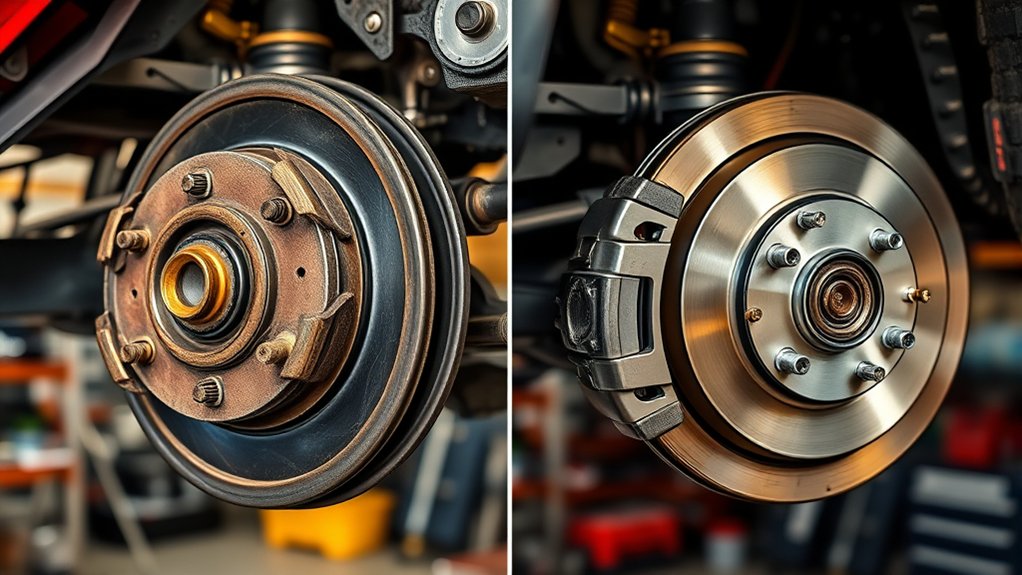
For Toyota Tacoma drum brakes vs. disc brakes, model year is the first thing to check. U.S.-spec 2016–2023 third-generation Tacomas use front disc and rear drum brakes, while the fourth-generation Tacoma introduced for 2024 uses four-wheel discs. Healthy factory drums are suitable for normal use when correctly maintained. A rear-disc conversion makes the most sense only when an engineered, model-specific system addresses a real heat, maintenance, or specialized-use need.
Quick Answer
Your Tacoma’s model year decides the basic answer. U.S.-spec 2016–2023 third-generation Tacomas use front disc and rear drum brakes, while Toyota changed the 2024 redesign to four-wheel discs. Healthy factory drums are adequate for normal use. A rear-disc conversion makes sense only when an engineered, model-specific system solves a real heat or service need.
Key Takeaways
- The 2016–2023 third-generation Tacoma uses front disc brakes and rear drums, while the fourth generation introduced for 2024 uses four-wheel discs.
- Disc brakes manage heat and water better, but brake type alone does not determine stopping distance.
- Rear drum shoes can last a long time, although the enclosed hardware usually takes more labor to inspect and service.
- A healthy factory rear-drum system is suitable for normal street, towing, and off-road use within the truck’s ratings.
- Rear-disc conversions must match the axle, ABS system, parking brake, hydraulic system, brake hoses, and wheels.
Toyota Tacoma Drum vs. Disc Brakes: Quick Decision Guide
If you are deciding whether to keep the factory brakes or convert an older Tacoma, start with the truck’s actual use rather than assuming discs are automatically better in every situation.
| Situation | Best Starting Point | Why |
|---|---|---|
| 2016–2023 Tacoma used for normal driving | Keep and maintain the factory rear drums | The complete factory brake system was engineered around that layout. |
| Repeated mountain descents or demanding towing | Inspect and service the complete system first | Heat, trailer-brake condition, tires, fluid, load, and driving technique can all affect performance. |
| Persistent repeat-stop heat problems after the factory system is confirmed healthy | Evaluate a model-specific rear-disc conversion | Discs release heat more effectively, but the conversion must preserve brake balance, ABS, hoses, and the parking brake. |
| Poor braking during one emergency stop | Diagnose the existing system | Tires, front brakes, hydraulics, ABS faults, load, and friction condition may matter more than rear brake type. |
| 2024 or newer fourth-generation Tacoma | Maintain the factory four-wheel discs | Toyota already changed the fourth-generation Tacoma to front and rear disc brakes. |
First, Identify Your Tacoma’s Factory Brake System
Before comparing the two designs, confirm what your truck actually has. Toyota’s 2023 Tacoma specifications list power-assisted ventilated front disc brakes and rear drum brakes across the U.S. lineup. Toyota says the redesigned 2024 Tacoma added four-wheel disc brakes and an electronic parking brake for improved braking performance compared with the previous generation.
| Tacoma Generation | Typical U.S. Brake Layout | Parking Brake |
|---|---|---|
| Third generation, 2016–2023 | Front discs and rear drums | Mechanical rear parking-brake system |
| Fourth generation, 2024 and newer | Four-wheel disc brakes | Electronic parking brake |
| Earlier Tacoma models | Confirm by model year, trim, axle, or visual inspection | Check the exact service information |
Use Toyota’s manual and warranty portal to select your exact truck. You can also look through the wheel: a rotor and caliper indicate a disc brake, while a closed, round metal housing indicates a drum.
Note: Aftermarket axles, salvage-yard repairs, and previous conversions can make a used Tacoma different from its original factory specification.
How Do Tacoma Rear Drum Brakes Work?
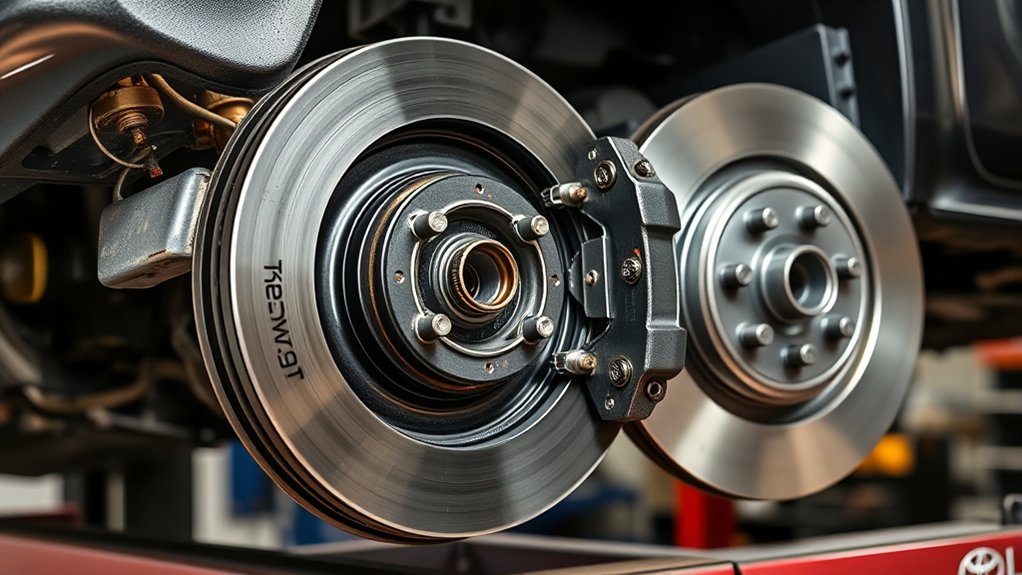
When you press the brake pedal, hydraulic pressure moves pistons inside a wheel cylinder. Those pistons push curved brake shoes outward against the inner surface of the rotating drum. Friction slows the wheel and converts the truck’s motion into heat.
Many drum designs use a self-energizing effect. The rotating drum helps pull one shoe into firmer contact, allowing the assembly to produce useful braking force with modest hydraulic pressure. The enclosed design also makes it straightforward to integrate a strong mechanical parking brake.
Rear drums can work well on a pickup because weight transfers toward the front axle during braking. The front brakes therefore handle a larger share of the work in an ordinary or hard stop. That front-heavy load transfer helps explain why a correctly engineered rear-drum system can provide adequate rear braking without matching the front brakes’ size or heat capacity.
- Lower production cost: Drum assemblies are generally economical for a manufacturer to install on a rear axle.
- Effective parking brake: The shoe-and-drum layout provides a large friction area for holding a stationary truck.
- Potentially long shoe life: Rear shoes may wear slowly because the rear axle normally contributes less braking than the front.
- Protected hardware: The drum shields the friction surfaces from direct exposure to stones and some road debris.
- Useful low-speed force: The self-energizing design can provide strong braking without an oversized hydraulic actuator.
Rear drum brakes are not automatically weak or unsafe. Their main limitation appears when repeated braking creates more heat than the enclosed assembly can release.
Why Are Disc Brakes Better at Managing Heat and Water?
A disc brake uses a caliper to squeeze brake pads against both sides of a rotor. The open rotor is exposed to moving air, making heat and water easier to release than they are inside a drum.
- Better heat management: Rotors cool more effectively during repeated braking, reducing the chance of heat-related fade.
- Faster wet recovery: Water can leave the rotor and pad surfaces quickly as the rotor spins.
- Consistent pedal response: Disc brake force remains more predictable as temperatures rise.
- Easier visual inspection: A technician can often inspect pad and rotor condition without removing an enclosed drum assembly.
- Simpler friction-service access: Replacing pads is usually less complicated than removing shoes, springs, retainers, and adjusters.
These advantages matter during repeated mountain descents, frequent trailer use, aggressive driving, or other conditions that generate substantial brake heat. They do not mean that every disc-equipped truck will stop in a shorter distance during a single emergency stop.
Tire traction, road surface, load, front brake capacity, brake temperature, ABS operation, and driver input all affect the final stopping distance.
Toyota Tacoma Drum vs. Disc Brakes: Which Performs Better?
The most useful comparison is not “good versus bad.” It is how each design behaves under heat, moisture, service, and parking-brake demands.
| Category | Rear Drum Brake | Rear Disc Brake |
|---|---|---|
| Normal street driving | Dependable when adjusted and maintained | Dependable with consistent pedal response |
| Repeated heavy braking | Retains more heat and can fade sooner | Releases heat more effectively |
| Wet recovery | Water can remain inside the drum temporarily | Open rotor usually clears water faster |
| Inspection | Drum normally must be removed for a complete inspection | Pads and rotor are more accessible |
| Parking brake | Simple and effective mechanical integration | May use a caliper mechanism, drum-in-hat design, or electronic actuator |
| Service labor | More enclosed hardware and adjustment points | Pads are generally quicker to access |
Stopping Power and Brake Balance
A Tacoma’s front brakes usually handle most of the force during a hard stop because weight shifts forward. Rear brakes still matter, but increasing rear brake torque without preserving the factory balance can make the rear wheels approach lockup too early.
ABS and electronic brake-force controls help manage wheel slip, but they cannot correct every incompatible mechanical conversion. Caliper piston area, rotor diameter, pad friction, master-cylinder volume, tire size, and vehicle load all affect brake balance.
This is why replacing rear drums with discs does not guarantee a dramatic reduction in stopping distance. The larger benefit may instead be more consistent braking during repeated stops and easier servicing.
Heat Dissipation and Brake Fade
Both systems convert movement into heat. Disc brakes expose the rotor to airflow, while drum brakes trap much of the friction surface inside an enclosed housing. During long descents or repeated stops, the drum can expand as its temperature rises, increasing shoe travel and reducing consistency.
Disc brakes can also fade if the pads, rotors, or brake fluid overheat. Their open design simply gives them an advantage in releasing heat and recovering between applications.
Pro Tip: On long downhill grades, select an appropriate lower gear and avoid riding the brake pedal continuously. Controlled speed and engine braking reduce heat in either brake design.
Which Tacoma Brake Type Is Easier to Maintain?
Disc brakes are usually easier to inspect and service, while rear drum shoes may last longer between friction-material replacements. Those are different advantages, and neither means one system can be ignored.
Long component life does not equal maintenance-free operation. Drum hardware, adjusters, seals, parking-brake parts, and wheel cylinders still need inspection.
Rear Drum Maintenance
A complete drum-brake inspection may include the shoes, drum surface, wheel cylinder, return springs, hold-down hardware, adjuster, backing-plate contact points, parking-brake lever, cable, seals, and brake-fluid leakage.
Because these parts sit behind the drum, a quick look through the wheel cannot reveal their full condition. Rust around the drum also can make removal harder on trucks exposed to road salt or water.
Rear Disc Maintenance
Disc pads and rotor surfaces are easier to see, but the caliper slides, piston boots, hoses, electronic parking-brake actuator, and parking-brake mechanism still require attention. Exposed rotors can also develop surface corrosion when a truck sits unused.
Do not rely on a universal mileage interval. Inspect the brakes according to your Tacoma’s maintenance information and sooner when you tow, drive in mountains, cross water, operate in road salt, or notice a symptom. If you are checking the hydraulic system, this Toyota Tacoma brake-fluid guide explains how to inspect the reservoir without treating a low level as a routine top-off.
Warning Signs That Need Inspection
- A soft, sinking, or unusually firm brake pedal
- The truck pulls to one side while braking
- Grinding, scraping, repeated clicking, or severe squealing
- Brake pedal pulsation or steering-wheel vibration
- A burning smell or smoke near a wheel
- Fluid near a wheel, hose, caliper, backing plate, or master cylinder
- A parking brake that will not hold the truck
- An ABS, brake, or electronic parking-brake warning light
Warning: Stop driving if the pedal suddenly becomes soft, brake fluid is leaking, smoke appears near a wheel, or braking ability changes sharply. Have the truck inspected before returning it to the road.
Which Costs More to Maintain: Drum or Disc Brakes?
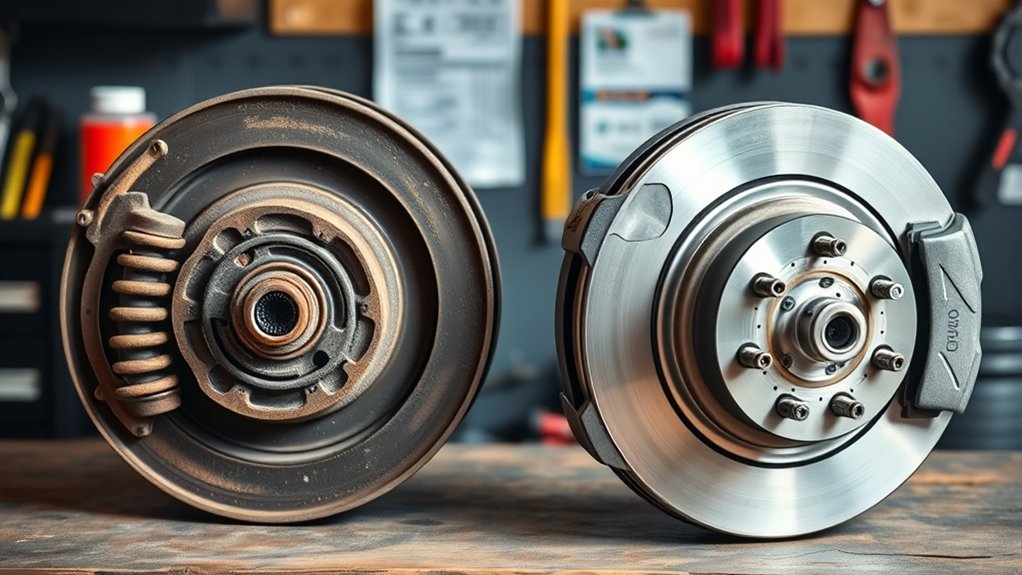
Rear drum parts are often inexpensive, and shoes can provide long service in a lightly loaded rear application. However, a complete service may require shoes, drums, wheel cylinders, springs, adjusters, seals, parking-brake parts, and additional labor.
Rear disc service often involves pads and rotors, but seized calipers, damaged slide pins, electronic parking-brake components, or corroded brackets can increase the bill. Rotor replacement frequency also varies with corrosion, heat, thickness, and the manufacturer’s service limits.
Your final cost depends on:
- Model year and trim
- Two-wheel drive or four-wheel drive
- OEM, aftermarket, or performance-grade parts
- Whether drums or rotors can remain in service
- Condition of hydraulic and parking-brake components
- Road salt, water, mud, and corrosion exposure
- Local labor rates
Compare a written estimate that lists every required component. A low price for shoes or pads alone may not represent the complete repair.
When Should You Keep Drum Brakes or Choose Discs?
Most Tacoma owners do not need to choose between systems. The safest default is to maintain the brake design Toyota installed for that truck.
- Keep the factory rear drums when your 2016–2023 Tacoma stops straight, the pedal feels normal, the parking brake works, and you use the truck within its ratings.
- Keep the factory four-wheel discs on a fourth-generation Tacoma unless you are installing a complete brake upgrade designed for the exact configuration.
- Investigate a rear-disc conversion only when repeated heat, motorsport use, specialized equipment, or service requirements create a clear need.
- Service the existing system first when poor braking comes from worn parts, old fluid, incorrect adjustment, seized hardware, damaged tires, or excess load.
Choose brakes as a complete engineered system, not as an isolated rotor-or-drum preference.
Towing and Mountain Driving
Repeated deceleration with a trailer can generate substantial heat. Rear discs may provide more consistent recovery, but a conversion does not increase the Tacoma’s tow rating or replace a correctly adjusted trailer-brake system.
Use the truck and hitch within their published ratings. Confirm that the trailer brakes, controller, tires, brake fluid, cooling system, and truck brakes are ready before a demanding trip. For model-specific load limits, see the Toyota Tacoma towing-capacity guide rather than relying on one advertised maximum.
Off-Road and Water Use
Drums shield their internal parts from direct stone strikes, but mud and water can enter and remain inside. Disc brakes are exposed, yet their open design makes cleaning, inspection, and water recovery easier.
After deep water, mud, or heavy sand exposure, test the brakes gently in a safe area. Inspect the assemblies if braking feels uneven, noisy, or delayed.
What Do Tacoma Owners Report About Drum and Disc Brakes?
Owner reports can help identify symptoms and service patterns, but they are anecdotes rather than failure-rate data. In one Tacoma owner discussion, drivers described the factory rear drums as satisfactory and long-wearing. In a separate third-generation Tacoma conversion report, an owner documented repeated rear-drum component problems before converting to discs. Different climates, maintenance histories, loads, and modifications make either experience unsuitable as a universal prediction.
Owner Insights on Drum Brakes
Long rear-shoe life does not prove that the rear brakes are doing nothing. It can reflect normal front-to-rear braking distribution, the large friction area of the shoes, driving conditions, and how frequently the truck carries rear-axle load.
When a Tacoma develops grabbing, leakage, noise, weak parking-brake operation, or uneven braking, inspect the actual components rather than assuming the symptom is simply a characteristic of drum brakes.
Performance Preferences Among Owners
Drivers who regularly descend steep grades or make repeated heavy stops may prefer the heat management and service access of rear discs. Owners using a stock truck for commuting, trail driving, or moderate towing may find properly serviced rear drums entirely satisfactory.
Compare experiences from trucks with the same generation, cab, axle, tire size, and use. A modified second-generation Tacoma is not a reliable comparison for a stock fourth-generation truck.
Conversion Experiences and Challenges
Successful conversions depend on more than mounting a rotor and caliper. Common compatibility concerns include:
- Axle-flange and bearing-retainer dimensions
- Caliper-bracket strength and alignment
- Rotor offset and wheel clearance
- ABS tone rings and wheel-speed sensors
- Brake hose length, routing, and suspension travel
- Caliper piston area and master-cylinder volume
- Mechanical or electronic parking-brake operation
- Brake-force balance and pedal travel
- Replacement-part availability after the conversion
A conversion assembled from unrelated 4Runner or Tacoma parts may physically bolt together but still produce incorrect hydraulic balance, poor parking-brake performance, hose interference, warning lights, or difficult future servicing.
What Does a Safe Tacoma Drum-to-Disc Conversion Require?
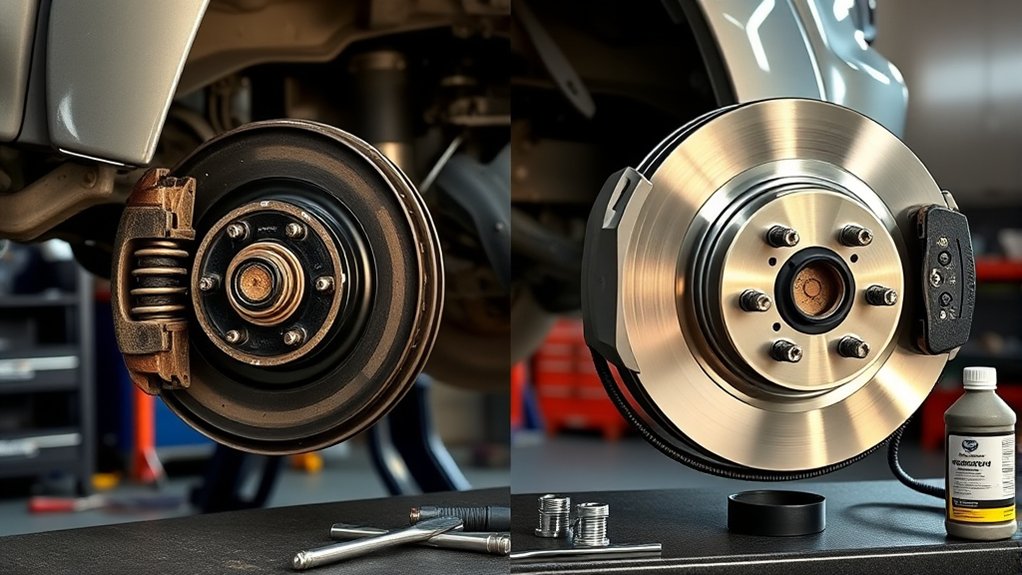
A rear-disc conversion can improve heat recovery and service access on an older Tacoma, but it should be treated as a complete brake-system modification.
For a concrete example, current SOS Performance documentation for one 2005–2023 Tacoma conversion kit lists rear calipers, rotors, pads, lines, brackets, optional parking-brake hardware, and an optional master-cylinder configuration. The manufacturer also estimates approximately eight hours for installation and recommends professional installation. Those details apply to that specific kit, not every conversion, but they show why a safe conversion involves more than replacing drums with rotors.
- Confirm the exact truck and axle. Record the model year, trim, drivetrain, axle code, wheel size, tire size, ABS equipment, and parking-brake design.
- Choose a complete model-specific kit. The kit should identify the supported axle and include engineered brackets, rotors, calipers, hoses, parking-brake hardware, fasteners, and documented instructions.
- Verify ABS compatibility. Wheel-speed sensors, tone rings, wiring, and clearances must remain correct through the full suspension travel.
- Verify hydraulic compatibility. Caliper piston area, fluid volume, hose routing, pedal travel, and front-to-rear balance must suit the truck.
- Confirm parking-brake operation. The system must hold the truck securely and release fully without cable, lever, or actuator interference.
- Check wheel clearance. Test the normal wheels and the spare wheel around the caliper, bracket, and hose.
- Use correct service procedures. Fastener torque, bearing installation, hose support, bleeding sequence, and parking-brake adjustment must follow the applicable instructions.
- Complete controlled testing. Check for leaks, warning lights, abnormal pedal travel, dragging, pulling, heat imbalance, and parking-brake performance before normal driving.
Warning: Do not mix brake components based only on forum photos or physical bolt spacing. An incorrect bracket, caliper, hose, parking-brake setup, or hydraulic combination can reduce braking control. Use an engineered kit and qualified installation for this safety-critical modification.
A separate proportioning valve is not automatically required for every conversion. Modern trucks may use ABS and electronic brake-force control instead of a simple standalone valve. Follow the conversion manufacturer’s verified requirements for the exact vehicle and kit rather than applying another Tacoma owner’s parts list universally.
Safety: Which Brake Type Is More Reliable?
Neither design is universally more reliable. Reliability depends on engineering, condition, adjustment, fluid integrity, hardware quality, corrosion, heat exposure, and correct service.
- Drums can provide durable rear braking and effective parking-brake operation.
- Discs provide better cooling, wet recovery, and inspection access.
- Either system can lose performance after overheating, contamination, a fluid leak, seized hardware, or incorrect repair.
- Hydraulic redundancy comes from the truck’s complete brake-system design, not from the friction surface being a drum or disc.
- ABS cannot compensate for worn tires, leaking hydraulics, incompatible conversion parts, or severely overheated brakes.
Before paying for brake-related repairs, enter your VIN in the NHTSA recall lookup. Safety campaigns can apply only to certain model years, drivetrains, or production ranges.
How to Decide: Choosing the Right Brakes for You
Use your Tacoma’s model year, current condition, and actual operating demands to make the decision.
- You own a 2024 or newer fourth-generation Tacoma: Your truck already has four-wheel disc brakes. Maintain the factory system unless a complete model-specific upgrade is required.
- You own a 2016–2023 Tacoma with healthy rear drums: Keep them for normal driving, towing within ratings, and recreational off-road use.
- Your drums overheat during repeated demanding use: Confirm that the existing system, trailer brakes, fluid, adjustment, tires, and load are correct before considering a conversion.
- You want easier rear-brake inspection: A model-specific disc conversion may offer easier access, but weigh the installation cost and long-term parts support.
- Your truck stops poorly during one emergency stop: Inspect tires, front brakes, hydraulic condition, ABS faults, payload, and friction parts rather than assuming the rear drums are the cause.
For most owners, restoring the factory brakes to correct condition provides more value and less risk than changing the rear brake design.
If you install new pads and rotors, follow the bedding procedure supplied by their manufacturer. Bedding cycles are product specific. For example, PowerStop publishes different controlled-stop sequences for its brake products.
Frequently Asked Questions
Why do older Toyota Tacomas have rear drum brakes?
Rear drums provide an economical rear-brake design with straightforward mechanical parking-brake integration. Because weight transfers forward during braking, the front brakes perform a large share of hard-stop work. Toyota changed the fourth-generation Tacoma to four-wheel discs for model year 2024.
Which Toyota Tacoma years have rear disc brakes?
The fourth-generation Tacoma introduced for model year 2024 uses four-wheel disc brakes and an electronic parking brake. Third-generation 2016–2023 U.S.-spec trucks use front discs and rear drums. Verify earlier or modified trucks by model year, axle, manual, and visual inspection.
Do drum brakes have any advantage over disc brakes?
Yes. Drum brakes can be economical, provide a strong mechanical parking brake, and deliver long shoe life in a rear application. Their main disadvantages are enclosed service access, slower water recovery, and greater heat retention during repeated braking.
Will a rear-disc conversion shorten my Tacoma’s stopping distance?
Not automatically. A conversion may improve heat recovery and repeat-stop consistency, but emergency stopping distance also depends on tires, road surface, front brakes, ABS operation, load, friction material, and brake balance.
Is a rear-disc conversion worth it on an older Tacoma?
For most normally driven Tacomas with healthy factory drums, keeping the original system is the lower-risk choice. A conversion becomes more reasonable when repeated heat, specialized use, easier service access, or another documented need justifies the cost and complexity of an engineered, model-specific system.
What is the 30-30-30 rule for brakes?
It is not a universal Toyota inspection or replacement rule. Similar numbers sometimes appear in informal bedding advice, but pad and rotor manufacturers publish different procedures. Follow the instructions supplied with your exact brake components.
What is the biggest disadvantage of a drum brake system?
The main disadvantage is heat retention. Repeated braking can heat and expand the drum, reduce consistency, and increase the risk of fade. The enclosed assembly also makes complete inspection and shoe replacement more labor intensive.
Conclusion
Your Tacoma’s model year determines the most important part of the drum-versus-disc comparison. Third-generation 2016–2023 U.S.-spec trucks use rear drums that can provide dependable service when correctly adjusted and maintained. The fourth-generation Tacoma introduced for 2024 uses four-wheel disc brakes.
Disc brakes offer better heat management, wet recovery, and service access. Rear drums can offer long shoe life, effective parking-brake operation, and adequate braking for normal truck use. Neither design can compensate for worn tires, leaking hydraulics, incorrect loads, poor maintenance, or incompatible parts.
Keep the factory system when it meets your needs. Consider a rear-disc conversion only when a complete, engineered, model-specific system addresses a real performance or service requirement.
Sources
- Toyota: 2023 Tacoma Specifications — lists ventilated front disc brakes and rear drum brakes across the 2023 U.S. Tacoma lineup.
- Toyota USA Newsroom: 2024 Toyota Tacoma Is the Ultimate Adventure Machine — confirms the fourth-generation change to four-wheel disc brakes and an electronic parking brake.
- Toyota Manuals and Warranties — provides model-year-specific owner information and maintenance documents.
- National Highway Traffic Safety Administration Recall Lookup — allows owners to check open safety recalls by VIN.
- Federal Motor Vehicle Safety Standard No. 135 — outlines federal performance requirements for applicable light-vehicle brake systems.
- PowerStop Brake Pad and Rotor Break-In Procedure — demonstrates why bedding instructions must follow the specific component manufacturer.
- SOS Performance: 2005–2023 Toyota Tacoma Rear Disc Brake Conversion — provides a current example of conversion components, parking-brake options, master-cylinder considerations, and installation requirements.
