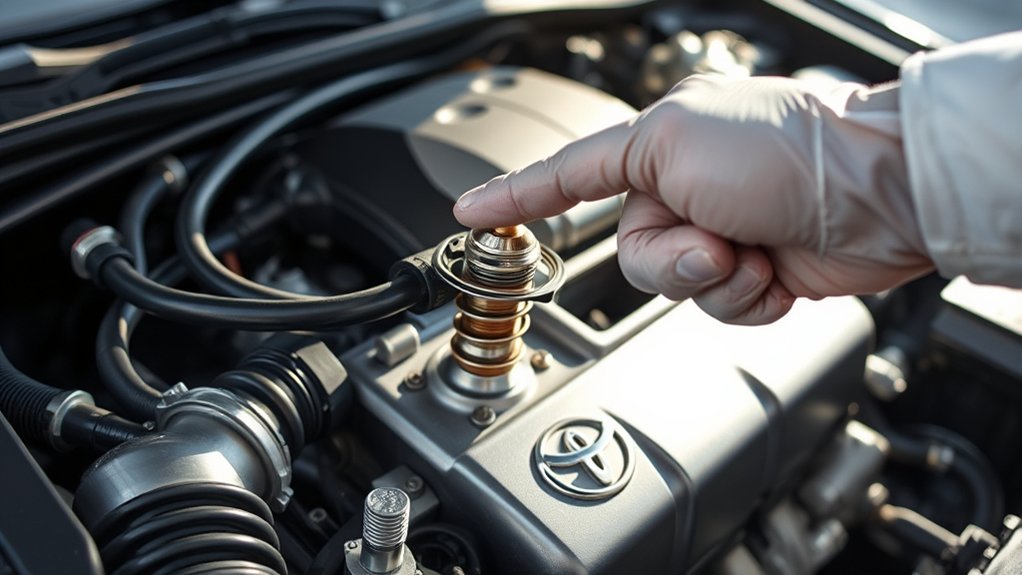
A Toyota Camry thermostat is a temperature-controlled valve that regulates coolant flow through the radiator as the engine warms. If it sticks closed, the engine can overheat quickly; if it sticks open, the engine may warm slowly, cabin heat may weaken, and code P0128 may appear. Because thermostat design, location, coolant routing, and service procedures vary by model year, engine, market, and hybrid configuration, diagnose the complete cooling system before replacing parts.
Last updated: September 11, 2026
Quick Answer
A Toyota Camry thermostat controls when coolant flows through the radiator. A thermostat that stays closed can contribute to rapid overheating; one that stays open can cause slow warm-up, weak cabin heat, reduced fuel economy, and P0128. Check coolant level, sensor data, leaks, recalls, and service bulletins before replacing it.
Key Takeaways
- A thermostat that remains closed can restrict radiator flow and contribute to rapid overheating.
- A thermostat that remains open can delay warm-up, reduce heater output, and contribute to a P0128 code.
- P0128 does not prove the thermostat has failed; low coolant, sensor faults, trapped air, wiring, and even model-specific ECM calibration can be involved.
- Check your VIN for recalls and review Toyota service bulletins before ordering parts.
- Thermostat location, opening specification, seal design, torque values, coolant, and bleeding procedures vary by Camry configuration.
- Never open a hot cooling system, and keep used coolant away from children, pets, drains, and other waste fluids.
Thermostat Symptom Pattern at a Glance
| Pattern | What It Can Suggest | First Checks |
|---|---|---|
| Temperature rises rapidly toward hot | Restricted coolant flow, including a thermostat that may not be opening | Stop driving, let the engine cool fully, then check coolant level, leaks, codes, fan operation, and the broader cooling system. |
| Slow warm-up, weak heat, or recurring P0128 | A thermostat that may be staying open, or another problem keeping measured coolant temperature too low | Check cold coolant level, compare cold sensor data with ambient conditions, graph warm-up data, and review applicable Toyota bulletins. |
| Coolant residue or wetness near the thermostat area | A housing, seal, hose connection, or nearby component may be leaking | Inspect only when fully cold and pressure-test the system when the leak source is not obvious. |
Important: These patterns are diagnostic clues, not proof that the thermostat itself has failed.
How the Thermostat Works in Your Toyota Camry
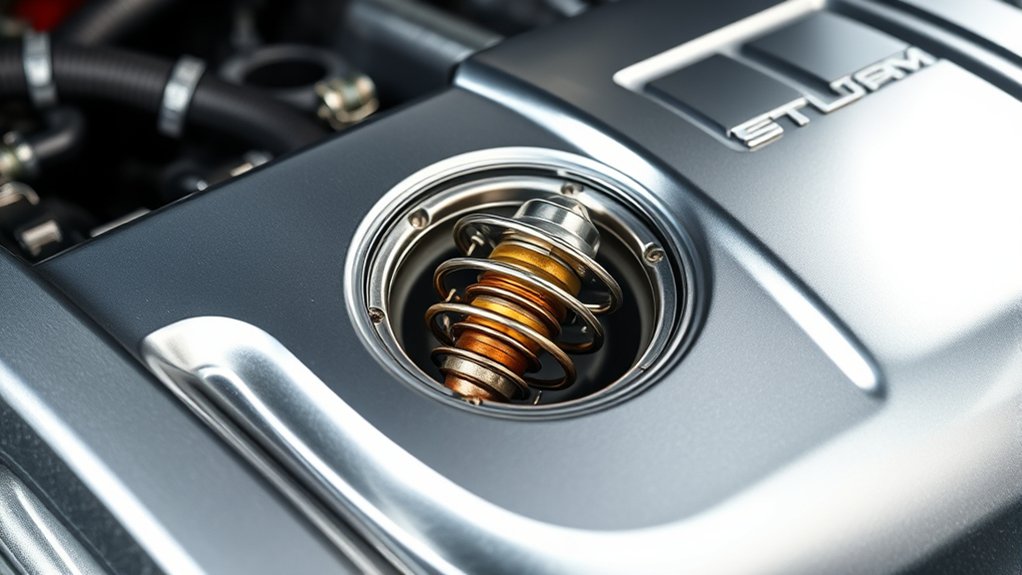
The thermostat acts as a temperature-controlled valve within your Camry’s engine cooling system. Its basic job is to regulate coolant movement between the engine and radiator.
During a cold start, the thermostat remains closed or mostly closed to the radiator circuit. Restricting radiator flow helps the engine reach its designed operating range more quickly.
As coolant temperature rises, the thermostat’s temperature-sensitive mechanism moves the valve toward its open position. Hot coolant can then pass through the radiator, release heat, and return to the engine.
The thermostat does not create cooling. It controls when radiator flow begins so the radiator, coolant, water pump, fans, and airflow can manage engine temperature together.
A thermostat that stays closed may restrict circulation through the radiator and contribute to overheating. One that stays open may allow radiator flow too early, causing slow warm-up, weak heater performance, and inefficient warm-up operation.
For a broader view of how the radiator, water pump, thermostat, hoses, coolant, and fans work together, see Toyota Camry cooling system components explained.
Where Is the Thermostat Located on a Toyota Camry?
Do not assume every Camry has the same thermostat or that it sits at the end of the upper radiator hose. Depending on the generation and engine, the thermostat may be installed near a lower hose connection, inside a separate housing, or as part of a larger coolant-control or housing assembly.
Some housings are metal, while others contain plastic sections that can crack or distort. Thermostat temperature ratings, seals, vent positions, fastener torque, access steps, and refill procedures also vary.
Use the Toyota manuals portal for owner information and Toyota’s Technical Information System for applicable repair manuals and service bulletins. Confirm the vehicle by VIN, model year, engine, drivetrain, and market before buying parts.
How to Spot a Failing Toyota Camry Thermostat
A failed thermostat can create a recognizable temperature pattern, but no single symptom confirms the diagnosis. Low coolant, trapped air, leaks, a faulty temperature sensor, radiator restriction, fan-control trouble, water-pump failure, or an internal engine problem can behave similarly.
Can a Bad Camry Thermostat Cause Overheating?
A thermostat that remains closed can prevent enough hot coolant from reaching the radiator. Possible warning signs include:
- A rapidly rising temperature reading: The gauge, warning lamp, or display moves toward the hot range soon after the engine begins warming.
- An overheating warning: A red temperature warning or model-specific high-temperature message appears.
- Steam or a strong coolant odor: Coolant may boil or escape through a leak, weak cap, hose, reservoir, or another vulnerable point.
- Sudden heater changes: Cabin heat may fluctuate or turn cold if the coolant level drops, coolant boils, or air moves through the heater circuit.
- Coolant pushed into or out of the reservoir: Abnormal pressure or boiling may move coolant beyond its normal level.
Warning: Stop driving if the engine overheats, a red temperature warning appears, steam rises from the engine compartment, the heater suddenly turns cold during an overheating event, or coolant is escaping. Park safely, switch the vehicle off, and let it cool completely. Never remove a radiator or pressurized reservoir cap while the system is hot.
Overheating does not automatically mean the thermostat is responsible. Continuing to drive can turn a hose, cap, fan, coolant-level, or thermostat problem into cylinder-head, head-gasket, or complete engine damage.
What Happens When a Camry Thermostat Sticks Open?
A thermostat that remains open may allow coolant to circulate through the radiator before the engine has warmed sufficiently. You may notice:
- The engine takes longer than normal to warm up.
- The temperature display remains below its usual stabilized position.
- Cabin heat is weak, especially in cold weather or during steady highway driving.
- Fuel economy decreases because the engine spends longer in its warm-up strategy.
- The check engine light appears with a code such as P0128.
P0128 generally means the engine did not reach the expected temperature within the conditions monitored by the engine-control system. A stuck-open thermostat is one possible cause, but low coolant, trapped air, inaccurate sensor data, damaged wiring, or another cooling-system problem can produce the same result.
Note: Many dashboard temperature gauges are damped warning displays and may not show small changes accurately. Scan-tool live data provides a more useful record of the cold-start and warm-up pattern.
Diagnosing Toyota Camry Thermostat Problems
Begin with the simplest checks before draining coolant or removing parts. Work only on a fully cooled engine and use information written for your Camry’s exact configuration.
- Review the recent history: Note previous overheating, coolant repairs, unexplained coolant additions, stop-leak use, coolant mixing, or recurring air in the system.
- Check the coolant level when cold: Verify the level using the procedure in the owner’s manual. Do not open a hot pressurized cap.
- Inspect for leaks: Check hoses, clamps, the radiator, reservoir, water pump, thermostat housing, drain points, splash shields, and the ground beneath the vehicle.
- Scan every control module that applies: Record trouble codes and freeze-frame data before clearing anything.
- Compare cold-start sensor data: Before the first start of the day, coolant-temperature data should be reasonably close to intake-air or ambient temperature.
- Monitor the warm-up curve: Coolant temperature should rise in a controlled pattern and stabilize under normal conditions rather than remaining abnormally low or climbing rapidly.
- Check heater operation: Weak or changing heat can point to low coolant, trapped air, restricted flow, or insufficient engine temperature.
- Check recalls and bulletins: Look for VIN-specific campaigns and model-specific Toyota diagnostic guidance.
- Confirm the fault: Use the appropriate service tests before ordering a thermostat, housing, sensor, fan, or water pump.
Check Recalls and Toyota Service Bulletins First
Before replacing a thermostat, enter the vehicle’s 17-character VIN in the NHTSA recall lookup and review Toyota service information for the exact model.
Two Camry-specific examples show why this step matters:
- Certain 2010–2011 Camrys: Toyota bulletin T-SB-0045-13 applies to specified vehicles with the 2AR-FE engine and automatic transmission. Toyota revised ECM logic to reduce the possibility of a P0128 condition. The repair procedure says that if other DTCs are present, this bulletin does not apply and diagnosis should continue under the repair manual.
- Certain 2020 Camry and Camry Hybrid vehicles: Toyota safety recall 20TA04, also identified as NHTSA recall 20V-064, involved certain vehicles with 2.5-liter four-cylinder engines and an engine-block manufacturing condition that could cause internal or external coolant loss, overheating, engine damage, stalling, or fire risk. Only a VIN lookup can confirm whether a particular vehicle is included.
Note: A service bulletin is diagnostic or repair guidance, not automatically a recall or a free repair. Applicability, warranty coverage, emissions coverage, and recall status depend on the VIN, vehicle history, location, and campaign terms.
How Can You Tell if a Camry Thermostat Is Stuck Closed?
A thermostat that will not open may produce a fast temperature rise because engine heat cannot move through the radiator circuit effectively. The engine side of the system may become very hot while radiator flow remains limited.
Do not rely on touching the upper and lower radiator hoses. Hot hoses and coolant can cause burns, and a temperature difference can have several causes. A technician may instead use scan data, a noncontact thermometer, flow observations, and pressure testing while following the applicable service procedure.
Cooling-fan operation alone does not confirm a closed thermostat. Fans may run because of air-conditioning demand, high sensor readings, diagnostic fail-safe operation, or an electrical control condition.
Warning: Electric cooling fans can start unexpectedly when the ignition is on, when the hybrid system is in READY mode, or when air-conditioning or temperature control commands fan operation. Keep hands, clothing, tools, and test leads away from the fan area.
How Can You Tell if a Camry Thermostat Is Stuck Open?
A stuck-open thermostat usually creates an engine that warms too slowly rather than one that overheats immediately. The delay may become more obvious during cold weather or steady highway driving.
Useful evidence includes a repeatable slow warm-up pattern in scan data, weak cabin heat, lower-than-normal operating temperature, and a returning P0128 code after coolant level, sensor plausibility, wiring, recalls, and applicable bulletins have been checked.
A code should guide diagnosis rather than trigger automatic part replacement. On-board diagnostics store fault and operating information so the underlying problem can be located. The California Air Resources Board OBD II fact sheet explains the general purpose of this system.
How Do You Test a Toyota Camry Thermostat?
Several methods can help confirm or reject a thermostat diagnosis:
- Scan-tool warm-up test: Monitor engine coolant temperature from a true cold start. Note how quickly it rises, where it stabilizes, and how it changes during idle and driving.
- Sensor plausibility check: Compare coolant-temperature data with intake-air or ambient temperature before the first cold start.
- Infrared temperature check: A technician can compare housing, hose, radiator, and engine temperatures without touching hot components.
- Cooling-system pressure test: Use the correct adapter and model-specific pressure limit to identify leaks that may be mistaken for thermostat trouble.
- Cap test: A cap that opens too early or fails to recover coolant can alter level and pressure behavior.
- Removed-thermostat bench test: Heat the thermostat gradually in a dedicated container while monitoring water temperature with a thermometer. Observe when movement begins and compare it with the exact service specification.
Caution: A bench test involves hot water and a metal component that can cause burns. Suspend the thermostat so it does not rest against the heated container, use suitable tools, and allow it to cool before handling.
A thermostat can pass a simple bench test yet still bind intermittently, leak internally, move too slowly, or fail under actual cooling-system pressure and flow. Consider the complete symptom pattern rather than one isolated result.
Hybrid Camry Diagnostic Differences
On a Camry Hybrid, the gasoline engine may stop and restart during normal operation. Electric coolant pumps, heater demand, drive mode, outside temperature, and hybrid control strategy can affect the warm-up pattern.
Do not assume that a conventional Camry’s idle test, fan behavior, or heater test applies unchanged to a hybrid. Confirm that the READY indicator is off before service, keep the smart key away from the vehicle, and follow the hybrid-specific Toyota procedure. Do not touch orange high-voltage cables, connectors, covers, or components.
Other Problems That Can Mimic a Bad Thermostat
Check for these faults before assuming the thermostat is the only cause:
- Low coolant or an external leak
- Air trapped after previous cooling-system work
- An inaccurate engine coolant-temperature sensor
- Damaged sensor wiring or connectors
- A restricted radiator or coolant passage
- A weak, leaking, damaged, or electronically controlled water pump
- A faulty cooling fan, relay, fuse, control module, resistor, or wiring circuit
- A damaged or incorrect pressure cap
- A cracked or distorted thermostat housing
- Incompatible coolant or contamination from mixed products
- Stop-leak material restricting small passages
- An applicable ECM calibration bulletin
- A VIN-specific recall or service campaign
- Internal engine leakage, including a possible head-gasket or engine-block problem
Recurring coolant loss, persistent bubbles after correct bleeding, sweet-smelling white exhaust after full warm-up, combustion gases in the cooling system, or coolant contamination on the dipstick or in drained oil requires broader diagnosis. A small amount of creamy residue only beneath the oil-filler cap can also result from condensation, so do not diagnose an internal leak from that sign alone.
If repeated coolant loss is the main symptom, see the Toyota Camry coolant leak guide. If the temperature problem appears mainly under sustained road load, the Camry highway-speed overheating guide covers that pattern separately.
What the Thermostat Affects Besides Engine Temperature
Your Camry’s thermostat has three central functions:
- Support efficient warm-up: Restricting radiator flow while the engine is cold helps it reach its designed operating range sooner.
- Regulate radiator flow: Opening as temperature rises allows the radiator to remove excess engine heat.
- Support stable vehicle operation: Controlled temperature helps cabin heating, fuel-management strategy, emissions monitoring, lubrication performance, and consistent engine operation.
A thermostat is not normally replaced at one universal maintenance interval. Replace it when diagnosis shows that it is faulty, when a model-specific repair procedure requires it, or when inspection during related cooling-system work shows damage or unacceptable wear.
Correct part selection matters. Use the thermostat temperature rating, dimensions, seal, housing configuration, and orientation specified for the exact Camry. Do not substitute a 180°F or 195°F unit merely to change operating temperature.
Steps for Replacing Your Toyota Camry Thermostat
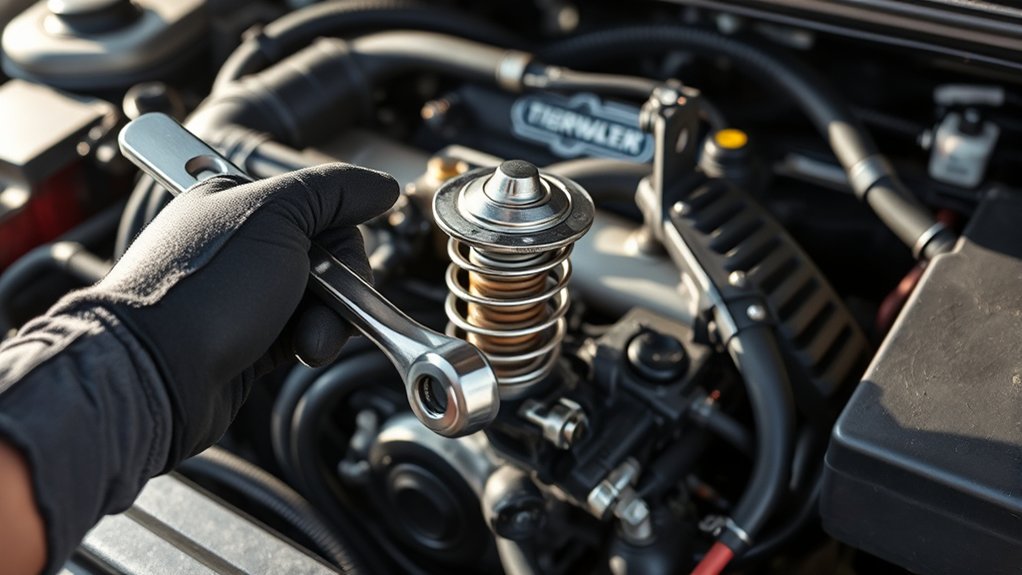
At a Glance
| Time Required | Set aside several hours. Access, full cool-down, draining, cleaning, refill, bleeding, testing, and a second cold-level check can make the job substantially longer than the part replacement itself. |
| Difficulty | Intermediate to advanced. Difficulty rises when access requires intake, bracket, hose, underbody, or hybrid-area disassembly. |
| Tools Needed | Engine-specific instructions, socket set, calibrated torque wrench, drain pan, hose tools, surface-safe scraper, filling equipment, gloves, eye protection, and preferably a scan tool. |
| Cost | Depends on the year, engine, separate versus integrated housing, seal, coolant quantity, access time, local labor, and whether another cooling-system fault must also be repaired. |
Warning: Begin only after the engine and cooling system are completely cold. Ethylene-glycol coolant can cause severe and potentially fatal poisoning if swallowed. Wear gloves and eye protection, contain every spill, and prevent access by children and pets. Seek immediate poison-centre or emergency medical guidance after ingestion. Never drain coolant onto the ground or into a household, sanitary, or storm drain.
The following sequence explains the general workflow. Thermostat location, removed components, torque values, coolant type, and bleeding instructions must come from the procedure for the exact Camry.
Before You Begin
- Confirm the thermostat diagnosis rather than replacing it from symptoms alone.
- Check the VIN for recalls and review applicable Toyota bulletins.
- Obtain the correct thermostat, housing if required, new seal, and specified coolant.
- Verify that torque specifications and the complete bleeding procedure are available.
- Make sure the vehicle can remain parked through a complete cool-down and final level check.
- Arrange approved storage and disposal for used coolant.
- Identify the vehicle configuration: Confirm the model year, engine, drivetrain, market, and whether the vehicle is a hybrid. Obtain the correct repair procedure before disassembly.
- Verify the replacement parts: Match the thermostat, housing if applicable, and seal to the VIN or exact application. Compare the new and old parts before installation.
- Let the vehicle cool fully: Park on a level surface, apply the parking brake, switch the vehicle off, confirm the READY indicator is off on a hybrid, and keep the smart key away.
- Protect the work area: Position a suitable drain pan beneath the specified drain point and keep coolant-safe absorbent material available.
- Drain enough coolant: Follow the applicable Toyota procedure. Capture the coolant in a clean, sealable, clearly labeled container.
- Locate the correct housing: Use the engine-specific diagram rather than assuming the thermostat is attached to a particular radiator hose.
- Remove obstructing parts carefully: Label connectors, hoses, brackets, shields, and fasteners when necessary. Do not disturb orange high-voltage cables or components.
- Remove the housing and thermostat: Loosen fasteners evenly. Note the thermostat’s direction, vent or jiggle-valve position, and seal arrangement before removal.
- Inspect the housing: Check for cracks, distorted flanges, damaged hose necks, corrosion, stripped threads, and an eroded thermostat seat.
- Clean the mating surfaces: Remove old gasket material without gouging the housing or engine surface. Prevent debris from entering the coolant passage.
- Install the new thermostat and seal: Position both exactly as specified. Use sealant only when the Toyota procedure or gasket instructions explicitly require it.
- Torque the housing fasteners: Seat the housing squarely and tighten fasteners evenly to the exact specification. Do not guess or overtighten.
- Reconnect removed components: Restore every hose, clamp, connector, bracket, ground, shield, and air duct to its original position.
- Refill with the specified coolant: Use the coolant type and concentration listed for the vehicle. Do not mix incompatible coolant products or pour dirty recovered coolant back into the system.
- Bleed trapped air: Follow the exact refill and air-removal procedure. Do not assume that leaving the cap off and idling is correct for every Camry.
- Inspect and test: Check for leaks, monitor warm-up, verify heater output, and recheck the coolant level only after the engine has cooled completely again.
Pro Tip: Photograph the original hose routing, connector positions, thermostat orientation, seal placement, and fastener locations before removing anything. Also label bolts of different lengths so they return to the correct holes.
When to Replace the Thermostat Housing
Replace the housing when it is cracked, warped, heavily corroded, damaged at a hose neck, unable to retain the thermostat or seal correctly, or supplied as a required integrated assembly for the vehicle.
Do not replace a sound separate housing automatically unless the service procedure, part design, or inspection supports it. Conversely, installing a new thermostat in a damaged housing will not correct a leak or sealing problem.
Tools and Materials for Thermostat Replacement
Gather everything before opening the cooling system. Depending on your Camry, you may need:
- The correct Toyota service procedure or reliable year-and-engine-specific repair information
- An application-correct thermostat or integrated thermostat assembly
- A replacement housing when inspection or the part design requires it
- A new O-ring, gasket, or seal
- The Toyota-specified coolant type and concentration
- A socket set, extensions, universal joints, and suitable hand tools
- A calibrated torque wrench covering the required range
- Hose-clamp pliers or other model-appropriate hose tools
- A large coolant drain pan and sealable storage container
- A plastic scraper or other surface-safe cleaning tool
- A funnel, spill-free funnel, or model-appropriate vacuum filling tool
- Shop towels and coolant-safe absorbent material
- Safety glasses and chemical-resistant gloves
- An OBD II scan tool with live coolant-temperature data
- An infrared thermometer for noncontact temperature comparisons
- A cooling-system pressure tester and correct adapter when the diagnosis requires one
Do not assume that universal coolant, a generic gasket, an arbitrary thermostat rating, or cooling-system stop-leak is acceptable. Verify all parts and fluids by VIN, model year, and engine.
Keep used coolant in a closed, clearly labeled container and do not mix it with oil, fuel, brake fluid, solvents, or other waste. The U.S. Environmental Protection Agency’s household hazardous-waste guidance recommends checking with local environmental, health, or solid-waste authorities for collection and disposal options.
Ensuring a Proper Thermostat Installation
A new thermostat can still leak or operate incorrectly if its orientation, seal, housing, or refill procedure is wrong.
- Confirm orientation: Install the thermostat in the direction required by the service procedure. Do not assume the vent belongs at one universal clock position.
- Use a new seal: Reusing a compressed, swollen, cut, or hardened gasket can cause leakage.
- Seat the thermostat fully: Make sure it remains in its recess while the housing is positioned.
- Keep mating surfaces clean: Coolant, oil, debris, scratches, and old gasket material can prevent an even seal.
- Install the housing squarely: Do not use the bolts to drag a tilted housing into position.
- Use the exact torque value: Uneven or excessive tightening can crack a housing, distort a flange, damage threads, or displace a seal.
- Inspect every disturbed connection: Confirm that hoses, clamps, connectors, grounds, brackets, shields, and ducts are secure.
- Use the specified refill method: Trapped air can create misleading temperature readings, heater changes, hot spots, and repeated coolant-level loss.
If the housing contains plastic, inspect it under good lighting for hairline cracks, damaged hose necks, softened areas, and distorted sealing surfaces. Replace it when its condition prevents reliable sealing.
Testing Your Camry’s New Thermostat
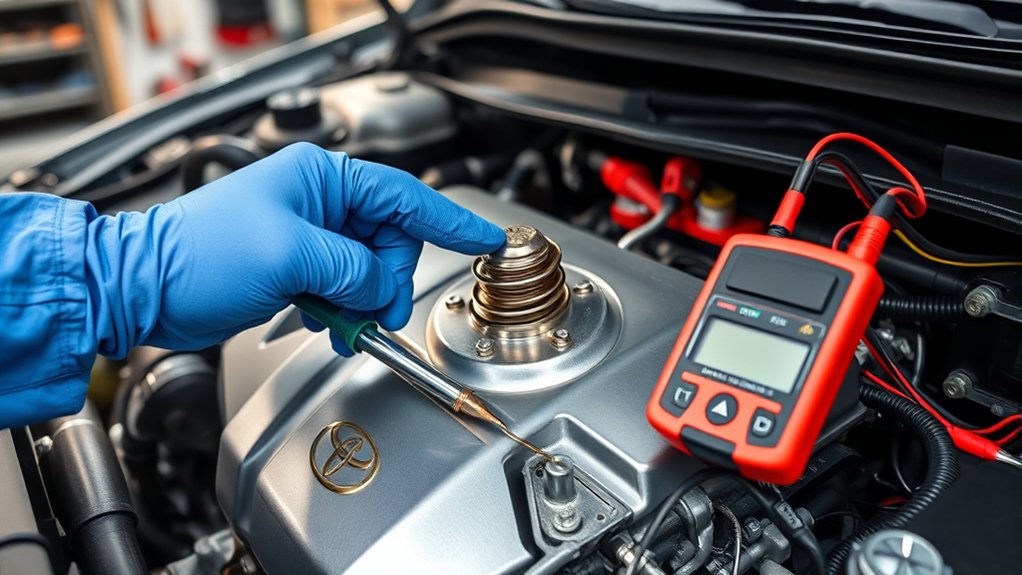
Test the repair in stages rather than immediately beginning a long drive.
- Perform a cold visual inspection: Check the housing, hoses, drain points, clamps, radiator, and reservoir before starting the vehicle.
- Start the vehicle and monitor it: Watch the dashboard and scan-tool coolant-temperature data when available.
- Confirm a controlled warm-up: Temperature should rise steadily rather than remaining abnormally low or climbing rapidly toward an overheating condition.
- Check cabin heat: Stable warm air after engine warm-up supports coolant circulation, although it does not prove that every component is functioning correctly.
- Inspect for leaks again: Check the thermostat housing and every connection disturbed during service.
- Complete the bleeding procedure: Follow every specified warm-up, cool-down, pump-operation, heater, and refill step until trapped air has been removed.
- Take a controlled test drive: Use a route that allows you to stop safely if temperature, warning messages, heater output, or coolant level becomes abnormal.
- Allow a complete cool-down: Recheck the reservoir level and inspect for dried coolant residue or fresh leakage.
- Rescan the vehicle: Review returning codes and live data rather than assuming a new thermostat is defective.
- Inspect again after several heat cycles: Look for seepage, an unexplained level drop, or a repeat of the original symptom.
Do not use a generic 180–195°F range to approve or reject the thermostat. Compare measured temperature and opening behavior with the exact specification for the installed component and engine.
Warning: Stop testing if temperature rises rapidly, a warning appears, the heater repeatedly turns cold, coolant escapes, or the system cannot retain its level. Shut the vehicle off and allow it to cool before further inspection.
If temperature remains unstable, coolant disappears, bubbles persist after correct bleeding, or P0128 returns, diagnose the broader cooling and control systems instead of repeatedly replacing the thermostat.
Should You Consult a Mechanic for Thermostat Issues?
Consult a qualified technician when the fault cannot be confirmed safely or the repair requires tools, access, programming, or service information you do not have.
Professional diagnosis is especially appropriate when:
- The engine has overheated or entered a warning condition.
- Coolant is leaking rapidly or the source is hidden.
- P0128 or another cooling-system code returns after repair.
- The vehicle may be covered by a recall, service campaign, emissions warranty, or calibration bulletin.
- Temperature-sensor data appears implausible or intermittent.
- The radiator fans do not operate as commanded.
- The vehicle repeatedly loses coolant without an obvious external leak.
- Coolant appears in the drained oil or oil appears in the cooling system.
- White exhaust, persistent pressure, combustion gases, or continuous bubbling suggests an internal engine leak.
- Corroded or seized fasteners could damage the housing or engine.
- The thermostat is part of a more complex coolant-control assembly.
- The Camry is a hybrid and the work area is close to high-voltage components.
- You cannot obtain the correct torque, coolant, refill, or bleeding procedure.
If the engine is overheating, do not drive it to the shop. Arrange a tow. Toyota directs owners to consult the vehicle-specific manual for warning meanings and required actions through its warning-lights resource.
Frequently Asked Questions
What symptoms can a bad Toyota Camry thermostat cause?
Possible symptoms include rapid overheating, slow engine warm-up, weak cabin heat, a low or unstable temperature reading, reduced fuel economy, coolant leakage near the housing, or a check engine light. Other cooling, sensor, wiring, and engine faults can cause the same symptoms.
What are the three main functions of an engine thermostat?
The thermostat helps the engine warm efficiently, controls coolant flow through the radiator as temperature rises, and supports a stable operating range for cabin heating, fuel control, emissions monitoring, lubrication, and engine performance.
Where is the thermostat located on a Toyota Camry?
The location varies by model year and engine. It may sit near a lower radiator-hose connection, inside a separate water inlet or housing, or within a larger thermostat or coolant-control assembly. Use the repair information for your exact VIN, model year, engine, and market instead of following a universal Camry location diagram.
Should I use a 180°F or 195°F thermostat in my Toyota Camry?
Use the thermostat rating specified for the exact model year and engine. Do not choose a different rating based only on climate, performance claims, or personal preference. The wrong unit can alter warm-up, heater performance, emissions monitoring, and diagnostic behavior.
How can I tell whether my Camry needs a new thermostat?
Check the cold coolant level, inspect for leaks, record all trouble codes, compare cold sensor data with ambient conditions, monitor the warm-up pattern, and review recalls and Toyota bulletins. Replace the thermostat only when the combined evidence supports a stuck, leaking, damaged, or out-of-specification unit.
Does code P0128 always mean the thermostat is bad?
No. A stuck-open thermostat is one possibility, but P0128 can also involve low coolant, trapped air, inaccurate coolant-temperature data, wiring trouble, another warm-up problem, or a model-specific control-module calibration issue.
Can I drive a Toyota Camry with a suspected bad thermostat?
Do not continue driving if the vehicle is overheating, losing coolant, producing steam, or displaying a red temperature warning. A slow-warm-up condition may be less immediate, but it still needs prompt diagnosis because the coolant level and actual cause may be uncertain.
How long does Toyota Camry thermostat replacement take?
The time varies greatly by generation, engine, housing design, and access. The complete job includes cooling the engine, draining coolant, gaining access, cleaning, installation, refill, bleeding, testing, and a final cold-level check, so set aside several hours rather than judging the job by removal time alone.
How much does Camry thermostat replacement cost?
Cost depends on the model year, engine, separate versus integrated housing, coolant quantity, labor access, local rates, and related damage. A VIN-specific estimate is more reliable than a universal price because Camry designs and labor requirements differ substantially.
Should I replace the thermostat housing at the same time?
Replace the housing if it is cracked, warped, corroded, damaged at a hose connection, unable to hold the seal correctly, or supplied as an integrated assembly. A sound separate housing does not always require replacement, but it must be inspected carefully.
Should I check for recalls or service bulletins before replacing the thermostat?
Yes. Enter the VIN in NHTSA’s recall lookup and review Toyota service information. Certain 2010–2011 Camrys had P0128 calibration guidance, while certain 2020 Camry and Camry Hybrid vehicles were included in an engine-block recall involving possible coolant loss and overheating.
Conclusion
Your Toyota Camry’s thermostat is a small component with an important role in engine warm-up and radiator-flow control. Rapid overheating may be consistent with a thermostat that will not open, while slow warm-up, weak cabin heat, and P0128 may point toward one that remains open.
Symptoms and codes alone do not prove that the thermostat has failed. Check coolant level, leaks, sensor plausibility, warm-up behavior, housing condition, applicable Toyota bulletins, open recalls, and the rest of the cooling system before replacing it.
When replacement is justified, use the correct thermostat or assembly, new seal, specified coolant, exact torque values, required orientation, and model-specific bleeding procedure. Stop driving during an overheating or coolant-loss condition, and seek professional diagnosis whenever the cause or safe repair method remains uncertain.
Sources
- Toyota Manuals and Warranties and Toyota Technical Information System — vehicle-specific owner information, repair manuals, service bulletins, and technical procedures.
- Toyota Warning Lights — model-specific warning meanings and directions to consult the applicable owner’s manual.
- NHTSA Recall Lookup, Toyota T-SB-0045-13, and NHTSA Recall 20V-064 — VIN recall research and Camry-specific P0128 and coolant-loss history.
- California Air Resources Board: OBD II Systems Fact Sheet — how onboard diagnostics detect faults, illuminate warning lights, and store diagnostic information.
- ATSDR Medical Management Guidelines for Ethylene Glycol — antifreeze exposure, ingestion toxicity, skin and eye contact, and urgent medical considerations.
- U.S. EPA Household Hazardous Waste Guidance — safe storage, separation, collection, recycling, and local disposal guidance.
