Last updated: September 22, 2026 — repair-cost data, Toyota service information, recall guidance, and model-year troubleshooting notes rechecked.
If your Toyota Camry’s engine revs without a matching increase in road speed, the car hesitates before moving, or propulsion drops unexpectedly, treat it as a drivetrain fault—not proof that the whole transmission has failed. On a 2025 or 2026 U.S.-market Camry, the hybrid eCVT can change engine speed without the stepped shifts of a conventional automatic, so RPM behavior alone does not prove “slipping.” Stop driving if acceleration becomes unreliable, Drive or Reverse will not engage, a major leak appears, or severe noise or a warning accompanies the symptom. Then identify the model year, powertrain, warning lights, and exact conditions before authorizing fluid service or replacement.
Quick Answer
A slipping Toyota Camry usually shows engine RPM rising without matching road speed, delayed engagement, or a brief loss of propulsion. A hybrid eCVT can raise engine speed normally under load, so confirm that acceleration is actually falling behind. Stop driving if power delivery is unreliable, Drive or Reverse will not engage, a major leak appears, or severe symptoms come with a warning. Have the exact powertrain scanned and inspected before approving fluid service or replacement.
Key Takeaways
- True slipping usually means engine speed rises while the vehicle fails to accelerate as expected.
- Identify the model year and powertrain first. Conventional automatic and hybrid Camry systems do not use the same diagnostic assumptions.
- Do not assume a fluid change or flush will fix slipping. Leaks, electrical faults, software issues, engine problems, and internal wear can produce similar symptoms.
- Stop driving and arrange towing if the Camry loses drive, repeatedly acts as though it is in neutral, develops a substantial leak, or cannot engage Drive or Reverse.
- Use the fluid specification, level procedure, and maintenance schedule listed for the exact model year and powertrain.
At a Glance
| Time Required | About 10–15 minutes for safe owner observations. Professional diagnosis may require one or more labor hours depending on road testing, module access, electrical testing, pressure testing, or disassembly. |
| Difficulty | Basic for observing symptoms and checking for visible leaks; advanced for fluid-level verification, hybrid diagnosis, electrical testing, or internal service |
| Tools Needed | Owner’s manual, flashlight, clean cardboard or paper, and an optional OBD-II scanner; professional testing may require Toyota-capable scan equipment and model-specific service tools |
| Cost | Safe owner checks cost little or nothing. RepairPal’s September 3, 2026 average for a Toyota Camry transmission fluid change is about $254–$328. KBB’s broad $2,900–$7,100 replacement range is not a Camry-specific or hybrid-transaxle quote. |
Note: The U.S.-market 2025 Camry went exclusively hybrid, and Toyota describes the 2026 Camry as all-hybrid. Toyota calls the current unit an electronically controlled continuously variable transmission (eCVT). It can change engine speed without the stepped shifts expected from a conventional automatic, so confirm the powertrain before interpreting the symptom or requesting transmission service.
Conventional Automatic vs. Hybrid Transaxle: Why the Difference Matters
The word “transmission” is often used for every Camry drivetrain, but the correct diagnosis depends on the system installed. Earlier Camry model years may have a conventional stepped automatic, a hybrid transaxle, or more than one available powertrain. All U.S.-market 2025 and 2026 Camrys are hybrids. For a year-by-year overview of the major designs, see Toyota Camry Transmission Types Explained.
| System | Normal Behavior | Diagnostic Implications |
|---|---|---|
| Conventional stepped automatic | Distinct gear changes are normally felt or seen as engine speed rises and falls. | Torque-converter, shift-solenoid, valve-body, hydraulic-pressure, and clutch-element faults may apply, depending on the exact unit. |
| Camry hybrid transaxle | Engine speed may change with load without a conventional gearshift. The engine may also start or stop as the hybrid system manages propulsion and battery charge. | Diagnosis may require hybrid-control, inverter, motor-generator, battery, cooling, transaxle, and network data. Do not assume that every conventional automatic part or test applies. |
Normal hybrid engine-speed changes should not cause an unexplained loss of acceleration, repeated neutral-like behavior, warning messages, grinding, a burning odor, or fluid leakage. Those symptoms still require diagnosis.
Model-Year Patterns That Can Feel Like Transmission Slipping
Some Camry complaints are model-specific. Matching the symptom, speed, engine, transmission, and VIN to Toyota service information can prevent a normal hybrid behavior or a documented calibration issue from being mistaken for a failed transmission.
| Camry Group | Documented Pattern | What to Do |
|---|---|---|
| Certain 2012–2014 Camrys with the U760 transmission | Toyota bulletin T-SB-0312-17 describes a brief, intermittent torque-converter flex lock-up shudder under light load at about 25–50 mph. | Confirm the exact transmission and whether the symptom matches the bulletin before calling it generalized slipping or approving a full transmission replacement. |
| Certain 2018–2019 Camrys with an A25A engine | Toyota bulletin T-SB-0152-19 Rev1 describes hesitation from a slow roll or rolling stop at 6 mph or below, immediately after a 3–1 downshift, with less than 40% accelerator input. The bulletin specifies an ECM calibration update for the listed condition. | Have the VIN, transmission serial number where required, and ECM calibration checked. If the symptom does not match the bulletin, continue normal diagnosis. |
| Certain 2025–2026 Camry Hybrids | NHTSA campaign 25V869 covers certain vehicles with an inverter-terminal bolt condition that can cause loss of motive power and can increase crash or fire risk. | If propulsion drops or a hybrid warning appears, stop safely and check the VIN in the NHTSA recall lookup. Do not assume the eCVT itself has failed. |
Common Symptoms of Transmission Slipping in a Toyota Camry

Transmission slipping describes a loss of expected power transfer. The clearest sign is a rise in engine speed without a matching increase in vehicle speed. However, drivers also use “slipping” to describe harsh shifts, hesitation, shuddering, or unusual hybrid engine-speed changes that may have a different cause.
Watch for these symptoms:
- Engine revs without normal acceleration: The tachometer rises, but the vehicle gains speed slowly, inconsistently, or not at all.
- Delayed engagement: The Camry pauses longer than normal before moving after you select Drive or Reverse.
- Unexpected neutral-like behavior: Propulsion briefly disappears even though the selector remains in Drive.
- Harsh, flared, or irregular shifts: On a stepped automatic, engine speed jumps between gears or the vehicle jolts as a gear engages.
- Shuddering under load: Vibration appears during acceleration or at a repeatable road speed.
- Warning lights or messages: The check-engine, master-warning, hybrid-system, or other drivetrain warning appears.
- Abnormal noises or odors: Whining, grinding, growling, or a hot or burnt odor develops near the drivetrain.
- Visible fluid leakage: Fresh fluid appears beneath the engine, transaxle, transmission, cooler-line, or axle-seal area.
Warning: Stop driving when the vehicle cannot maintain propulsion, repeatedly drops into neutral-like behavior, cannot engage Drive or Reverse, makes severe mechanical noise, or leaves a substantial fluid leak. Park in a safe location and arrange towing. Continuing to drive can create a traffic hazard and increase damage.
Drive or Tow Decision Guide
| Condition | Recommended Response | Reason |
|---|---|---|
| Minor, repeatable hesitation with no leak, warning, noise, or loss of drive | Avoid hard acceleration and schedule prompt diagnosis. | The car may remain controllable, but an early fault can worsen. |
| Warning light with otherwise normal propulsion | Read the owner’s manual, reduce load, and obtain a full scan as soon as practical. | A stored code may identify a control, cooling, engine, hybrid, or drivetrain fault. |
| Repeated loss of propulsion, severe slipping, inability to select a range, grinding, overheating, or a substantial leak | Stop safely and arrange towing. | Continuing can be unsafe and may turn a limited failure into major internal damage. |
Potential Causes Behind Transmission Slipping
A slipping sensation does not identify one failed part. The cause may be hydraulic, electrical, mechanical, software-related, hybrid-system-related, or outside the transmission entirely.
| Possible Cause | Applies Most To | What It May Cause | How It Is Confirmed |
|---|---|---|---|
| Low fluid from a leak | Both systems, using the applicable fluid and procedure | Delayed engagement, lubrication loss, overheating, abnormal operation, or internal wear | Leak inspection and model-specific fluid-level procedure |
| Incorrect, degraded, or contaminated fluid | Both systems | Poor lubrication, pressure-control problems, overheating, or abnormal operation | Service history, fluid inspection, specification verification, and further testing |
| Solenoid, wiring, sensor, connector, or control fault | System-dependent | Wrong operating state, delayed response, warning lights, fail-safe operation, or intermittent propulsion | Diagnostic codes, electrical tests, live data, network checks, and command tests |
| Valve-body or hydraulic-pressure problem | Conventional stepped automatic | Shift flare, harsh engagement, delayed engagement, or slipping after warm-up | Scan data, pressure testing, controlled road testing, and specialist inspection |
| Torque-converter problem | Conventional automatic where equipped | Shudder, poor launch, abnormal lockup behavior, excessive heat, or RPM flare | Road test, scan data, fluid inspection, and targeted converter or lockup testing |
| Hybrid control, inverter, motor-generator, cooling, battery, or transaxle fault | Camry Hybrid, including U.S. 2025 and 2026 models | Reduced propulsion, warning messages, overheating, fail-safe operation, unusual noise, or inconsistent power delivery | Toyota-capable hybrid-system scan, live data, isolation and electrical tests, cooling inspection, and model-specific procedures |
| Internal clutch, bearing, gear, differential, motor, or seal wear | Component depends on the installed system | Persistent slipping, metal debris, mechanical noise, or loss of one or more operating functions | Operating-data analysis, fluid or pan inspection where applicable, and internal examination |
| Software calibration or adaptation issue | Both systems | Shift-quality, response, warning, or drivability complaints without confirmed internal damage | VIN-specific bulletin, calibration, adaptation, and update check |
| Engine, mount, axle, wheel, tire, brake, or traction-control issue | Both systems | Hesitation, vibration, surging, drag, or a sensation that resembles slipping | Whole-vehicle diagnosis rather than transmission-only testing |
Overheating can be both a cause and a result of abnormal operation. Low fluid, excessive load, restricted cooling, electrical faults, or internal friction can raise temperature and accelerate damage. A technician should identify why the system overheated instead of treating heat as a stand-alone diagnosis.
Recommended Repairs for Slipping Transmissions
The correct repair depends on the confirmed cause. Begin with diagnosis rather than automatically replacing fluid, a filter, a valve body, or the complete transmission or transaxle.
- Confirm the complaint. Record whether the problem occurs cold or hot, during acceleration, at a certain speed, after selecting Drive or Reverse, while climbing a hill, or after extended driving.
- Identify the exact vehicle. Record the model year, VIN, engine or hybrid powertrain, mileage, and recent service or collision history.
- Scan every relevant control module. Retrieve current, pending, permanent, and history codes plus available freeze-frame data before clearing anything. A basic generic scanner may not access Toyota hybrid, transmission, ABS, or body-network modules.
- Inspect for leaks and physical damage. Check the transmission or transaxle case, cooler lines where equipped, seals, axle areas, electrical connectors, underbody, and evidence of overheating or impact damage.
- Verify fluid correctly. Use the exact Toyota procedure for the model year and powertrain. Many units require a temperature-based level check with the vehicle level.
- Rule out look-alike problems. Check engine operation, mounts, axles, wheels, tires, brakes, battery voltage, charging behavior, cooling systems, and traction-control events.
- Check VIN-specific information. Determine whether a recall, service campaign, technical service bulletin, warranty extension, or software calibration applies.
- Perform targeted testing. Depending on the findings, this may include live-data analysis, electrical or isolation testing, solenoid testing, pressure tests, a controlled road test, cooling-system inspection, fluid or pan inspection, or internal examination.
- Approve the narrowest effective repair. The solution may involve a leak repair, connector or wiring repair, software update, cooling repair, correct fluid service, solenoid or valve-body work, torque-converter repair, hybrid-component repair, rebuilding, or replacement.
- Verify the repair. Confirm that codes do not return, leaks are absent, fluid is correctly set, required programming is complete, and the original symptom is gone during a controlled road test.
Pro Tip: Ask the shop to document the diagnostic codes, freeze-frame data, test results, confirmed cause, recommended repair, fluid specification, programming requirements, parts source, and parts and labor warranties. A written diagnosis makes estimates easier to compare and reduces trial-and-error parts replacement.
When to Consider a Transmission or Transaxle Replacement
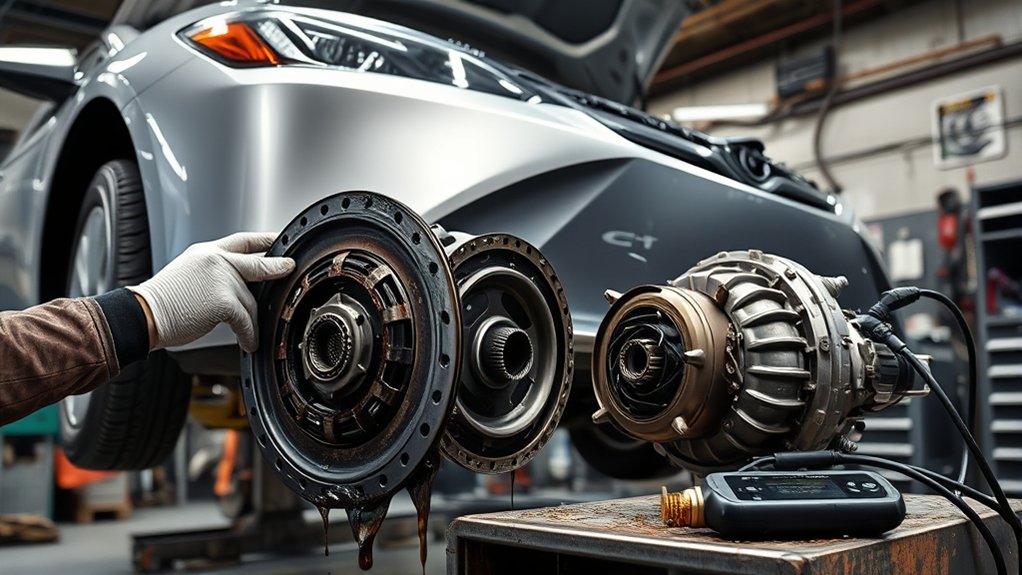
A complete replacement is not the automatic answer to every slipping complaint. It becomes more reasonable when testing confirms extensive internal damage, the case or major hard parts are damaged, required repair parts are unavailable, or rebuilding would cost nearly as much as a warranted replacement unit.
Signs of Severe Damage
Severe damage is more likely when several of these conditions appear together:
- The vehicle consistently loses propulsion or cannot engage one or more operating ranges.
- Abnormal operation remains after fluid level, electrical systems, software, cooling, and external components have been checked.
- The fluid or pan contains substantial metal debris or friction material where inspection is applicable.
- Grinding, growling, or another mechanical noise accompanies the loss of power.
- The transmission, transaxle, inverter, or related drivetrain system repeatedly overheats.
- Pressure testing on a conventional automatic confirms an internal hydraulic failure.
- The case, differential, bearings, gears, motors, or multiple internal elements are damaged.
A burning odor or dark fluid can support a diagnosis, but neither proves that the complete unit must be replaced. The decision should be based on documented testing and inspection.
Cost-Benefit Analysis
Do not use mileage alone or a fixed percentage of vehicle value to decide. A well-maintained, otherwise sound Camry may justify a major repair, while a vehicle with serious rust, collision damage, engine problems, battery concerns, or several overdue repairs may not.
Compare these factors:
- The confirmed diagnosis and likelihood that the proposed repair will solve the complaint
- The cost of a targeted repair, rebuild, remanufactured unit, used unit, and new replacement when available
- Parts source, mileage, testing, and included accessories
- Parts and labor warranty length, coverage, exclusions, and nationwide applicability
- Programming, calibration, fluid, cooler, seal, mount, and axle work included in the estimate
- The vehicle’s overall mechanical and structural condition
- Remaining loan balance and current local market value
- How long you plan to keep the vehicle
- The cost and risk of replacing the entire vehicle
Targeted Repair, Rebuild, Used Unit, Remanufactured Unit, or New Unit?
| Option | Potential Advantage | Questions to Ask |
|---|---|---|
| Targeted repair | Lowest cost when testing isolates a leak, wire, sensor, solenoid, cooling, software, or external-component fault | What test proves this part caused the symptom, and what happens if the symptom remains? |
| Rebuild | Retains the original case while replacing identified wear items and damaged parts | Which parts are replaced routinely, which are reused, and who backs the warranty? |
| Used unit | May lower the initial price | What are the donor mileage, identification numbers, test results, return terms, and labor-warranty terms? |
| Remanufactured unit | Factory-style rebuilding process and often a broader warranty | Who remanufactured it, what updates are included, and is warranty labor covered? |
| New unit | Known condition and manufacturer-backed parts coverage when available | Is a new unit available for this VIN, and what additional programming or installation parts are required? |
Obtain at least one itemized written estimate before authorizing a rebuild or replacement. A second opinion is especially valuable when the first recommendation is based only on symptoms or a generic trouble code rather than documented test results.
The Importance of Model-Specific Transmission Fluid Service
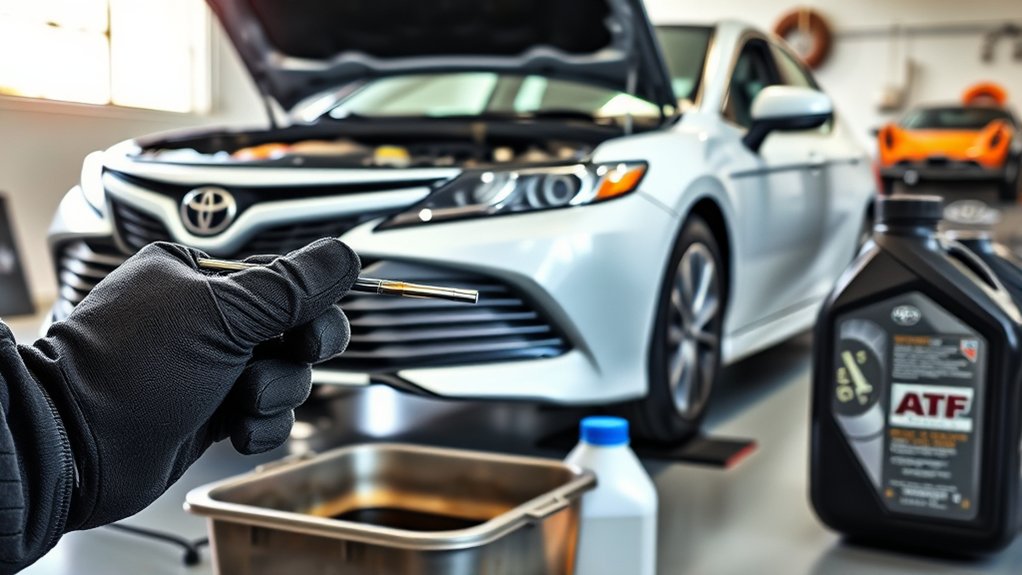
Transmission and transaxle fluid service is not one-size-fits-all. The correct interval, fluid, level-check procedure, and service method depend on the Camry’s model year, powertrain, transmission or transaxle design, and operating conditions.
Drivetrain fluid lubricates moving parts, removes heat, and supports proper operation. In a conventional automatic, it also supports hydraulic control and clutch operation. Low, incorrect, or contaminated fluid can contribute to delayed engagement, abnormal shifting, overheating, noise, and internal wear.
Owners should not follow a universal 30,000-mile or 60,000-mile rule. Toyota’s schedule varies by model year and use. The 2026 Camry Warranty & Maintenance Guide lists automatic-transmission-fluid inspections at specified intervals and replacement at 60,000 miles under listed special operating conditions such as towing, using a car-top carrier, or heavy vehicle loading.
The 2024 Camry guide also calls for scheduled transmission inspections. Its special-use fluid-replacement conditions vary with the installed powertrain: towing, using a car-top carrier, or heavy vehicle loading can trigger a 60,000-mile replacement, while some conventional-automatic schedules also add extensive idling or prolonged low-speed commercial-style use. That variation is why the exact model-year and powertrain guide matters.
For hybrid-specific fluid examples and the change from Toyota Genuine ATF WS on older U.S. Camry Hybrids to Toyota Genuine e-Transaxle Fluid TE on newer examples, see Toyota Camry Hybrid Transmission Fluid Explained. Always confirm the specification for the exact VIN before service.
Many Camry drivetrains use a sealed level-check procedure rather than a traditional owner dipstick. Fluid level may need to be set at a specified temperature with the vehicle level. Use Toyota’s Manuals and Warranties portal to locate the documentation for the exact model year.
Do not judge fluid solely by whether it appears bright red. Color changes during service life, and appearance cannot measure hydraulic pressure, electrical control, internal wear, or hybrid-system performance. A burnt odor, contamination, metal debris, or low level deserves investigation, but each finding must be interpreted with the full diagnosis.
Fluid Change vs. Flush
A drain-and-fill removes and replaces the amount that drains through the service procedure. A fluid-exchange or flushing process may replace more fluid and may use different equipment. Neither method should be approved simply because the vehicle is slipping.
- Use only the exact fluid specification required for the VIN and powertrain.
- Ask whether Toyota specifies a drain-and-fill, exchange, pan service, filter or strainer service, or another procedure for the unit.
- Do not use additives as a substitute for diagnosis unless Toyota specifically approves the product and application.
- Do not treat a flush as a repair for worn clutches, bearings, gears, motors, electrical faults, serious pressure loss, or damaged hard parts.
- If the fluid contains substantial metal or friction debris, ask whether further inspection is required before new fluid is installed.
Diagnosing Transmission Issues in Your Camry
A systematic diagnosis prevents unnecessary repairs and helps separate a transmission or transaxle failure from an engine, hybrid, axle, wheel, brake, or electrical problem.
1. Identify the Exact Camry
Record the model year, engine or hybrid powertrain, mileage, VIN, and service history. Current U.S. 2025 and 2026 Camrys use hybrid powertrains, while earlier years may use conventional automatic transmissions, hybrid transaxles, or different drivetrain designs. If the installed unit is unclear, start with the VIN and use the identification steps in Toyota Camry Transmission Code Location Explained.
2. Describe the Symptom Precisely
Note the engine and drivetrain temperature, road speed, accelerator position, selected range, warning lights, and whether engine speed rises without matching acceleration. Record whether the fault appears only after warm-up, during a hill climb, under heavy acceleration, or at a repeatable speed. A repeatable description is more useful than the word “slipping” alone.
3. Retrieve Diagnostic Information
Scan the engine, transmission, hybrid, battery, ABS, and related modules when the vehicle supports them. Save codes and freeze-frame data—the operating conditions captured when a fault was detected—before clearing the system. A trouble code identifies a circuit, system, or detected condition; it does not automatically prove that the complete transmission or transaxle has failed.
4. Inspect the Vehicle
Look for leaks, damaged cooler lines where equipped, loose connectors, wiring damage, accident damage, restricted cooling inlets, and evidence of overheating. Never crawl beneath a vehicle supported only by a jack. Use approved lifting equipment on a stable, level surface or leave the inspection to a qualified shop.
5. Verify Fluid and Operating Data
Check fluid only through the model-specific procedure. A technician may compare commanded operating state, engine speed, transmission or motor speed, output speed, electrical commands, temperatures, battery data, and pressure-related information during a controlled road test.
6. Check Recalls and Manufacturer Communications
Search the vehicle’s VIN through the NHTSA recall lookup and Toyota’s owner resources. Ask the technician to check for applicable service campaigns, Toyota service bulletins, calibration updates, or warranty extensions. A bulletin is diagnostic or repair guidance; it is not proof that every vehicle has the described defect.
Model-year check: Certain 2012–2014 U760 Camrys have Toyota bulletin T-SB-0312-17 for a light-load 25–50 mph torque-converter shudder. Certain 2018–2019 A25A Camrys have T-SB-0152-19 Rev1 for hesitation from a slow roll or rolling stop under specific conditions. Certain 2025–2026 Camry Hybrids are included in NHTSA campaign 25V869 for an inverter-terminal condition that can cause loss of motive power. Match the VIN and exact symptom before deciding the transmission or transaxle is the failed part.
7. Review Warranty Coverage Before Authorizing Repairs
Confirm the in-service date, mileage, model-year warranty booklet, prior repairs, and whether the proposed component is covered. Do this before approving teardown or paying for a major assembly.
| Symptom | Possible Causes | Best Next Step |
|---|---|---|
| Engine revs but speed does not increase normally | Low pressure or clutch wear on a conventional automatic, torque-converter fault where equipped, hybrid-system fault, engine problem, or traction-control intervention | Stop aggressive driving and obtain a full-system scan plus controlled road-test diagnosis. |
| Delay after selecting Drive or Reverse | Low fluid, pressure loss, control fault, valve-body or solenoid problem where applicable, weak electrical supply, or internal wear | Check for leaks, scan all relevant modules, and verify fluid through the correct procedure. |
| Jolt or harsh shift | Control fault, mount wear, adaptation or calibration issue, valve-body fault on a conventional automatic, axle play, or engine problem | Scan modules and inspect mounts, axles, software status, and engine operation. |
| Shudder at a repeatable speed | Torque-converter behavior where equipped, axle or inner-CV-joint problem, tire issue, engine misfire, brake drag, or mount wear | Perform a controlled road test and compare engine, wheel-speed, and drivetrain data. |
| Whining or growling | Low fluid, pump fault where equipped, bearing damage, differential damage, motor or gear noise, wheel bearing, or another rotating component | Avoid extended driving and have the noise localized under controlled conditions. |
| Burning odor or overheating warning | Low fluid, excessive load, restricted cooling, inverter or electrical heat, internal friction, or an external fluid leak contacting a hot surface | Stop safely, follow the owner’s manual, and arrange inspection or towing if the warning remains or propulsion is affected. |
| Problem appears only after warm-up | Temperature-sensitive pressure loss, electrical resistance change, overheating, fluid-level error, worn seals, or control adaptation | Do not let the vehicle cool before every inspection; arrange testing under the conditions that reproduce the fault. |
Problems That Can Be Mistaken for Transmission Slipping
Not every hesitation or vibration comes from the transmission. A complete diagnosis may need to consider:
- Engine misfires, weak ignition components, or fuel-delivery problems
- Throttle-body, accelerator-pedal, or engine-management faults
- Worn engine or transmission mounts
- Damaged CV axles or inner CV joints
- Wheel imbalance, damaged tires, or wheel-bearing noise
- Brake drag or a parking-brake fault
- Traction-control intervention on a slippery surface
- Weak 12-volt battery or unstable charging voltage affecting control modules
- Restricted hybrid-battery or inverter cooling
- Normal changes in engine speed from a hybrid powertrain under varying load
Warranty Coverage, Recalls, and Service Information
Warranty terms depend on the market, model year, in-service date, mileage, component, maintenance history, and exclusions. Review the warranty booklet for the exact VIN rather than relying on a general online statement.
For the U.S.-market 2026 Camry, Toyota’s warranty guide lists:
- Powertrain coverage: 60 months or 60,000 miles for listed components, including the transaxle/motor/generator case and internal parts, mounts, seals, and gaskets
- Hybrid-system coverage: 8 years or 100,000 miles for listed components including the hybrid battery control module, hybrid control module, and inverter with converter
- Hybrid-battery coverage: 10 years or 150,000 miles
These periods do not mean every slipping complaint or damaged component is covered. Confirm the covered part, failure cause, exclusions, and remaining term with Toyota or an authorized dealer before authorizing customer-pay repairs.
A recall, service campaign, bulletin, or software update also has a different meaning:
- Recall: A safety-related remedy associated with eligible VINs
- Service campaign: A manufacturer program that may apply to specified vehicles and conditions
- Technical service bulletin: Diagnostic or repair guidance for technicians, not proof of a universal defect
- Calibration update: Revised control software that may address a documented operating condition when applicable
Safe DIY Checks for Your Toyota Camry’s Transmission
Owner-level checks can provide useful information, but they should not replace a diagnosis or model-specific service procedure.
Hybrid High-Voltage Warning: A hybrid Camry contains dangerous high-voltage DC and AC systems. Do not touch, disconnect, test, remove, or replace orange-colored wiring or connectors, the hybrid service plug, inverter components, or the hybrid battery assembly. After a collision, fire, flooding event, or suspected high-voltage damage, keep away from damaged hybrid components and use qualified emergency or hybrid-service personnel.
Regular Fluid and Leak Checks
- Park on a level surface and note any warning lights or messages before turning the vehicle off.
- Photograph the instrument panel if a warning or message is present.
- Place clean cardboard beneath the engine and transmission or transaxle area overnight to help identify fresh drips.
- Note the drip’s position, approximate size, odor, and color without touching an unknown fluid after a collision or high-voltage incident.
- Check the owner’s manual to determine whether the vehicle has an owner-serviceable transmission dipstick.
- If a dipstick is provided, follow the manual’s temperature, gear-selection, surface-level, and engine-running instructions exactly.
- If the unit is sealed, do not remove fill, drain, or overflow plugs without the correct temperature-monitoring and level-setting procedure.
- Record visible contamination or a burnt odor without assuming color alone proves fluid condition.
- Use only the exact fluid specification listed for the model year and powertrain.
Do not add fluid merely because the vehicle shifts or accelerates poorly. Overfilling, using the wrong fluid, opening the wrong plug, or checking at the wrong temperature can create additional problems.
Filter Replacement Guidelines
A transmission filter or strainer is not a universal routine DIY item on every Camry. Access may require pan removal, safe lifting, careful cleaning, a new gasket or sealant, model-specific torque values, and an accurate refill and level-setting procedure.
| Before Pan or Filter Service | Why It Matters |
|---|---|
| Confirm that the model uses a serviceable filter, screen, or strainer | Design and service requirements vary by transmission and transaxle. |
| Obtain the exact Toyota procedure and torque values | Incorrect fastener torque can damage the pan, threads, sealing surface, or case and cause leaks. |
| Use approved lifting equipment on a level surface | A vehicle supported only by a jack can fall without warning. |
| Measure drained fluid and follow the final level procedure | The final level may depend on fluid temperature and an overflow procedure rather than drained volume alone. |
| Inspect the pan and magnets for debris where applicable | Excess metal or friction material may indicate internal damage requiring diagnosis. |
| Keep clear of hybrid high-voltage components | Transmission-fluid service does not authorize contact with orange wiring, the service plug, inverter, or battery assembly. |
If the transmission or transaxle is already operating abnormally, a filter replacement, fluid change, or flush should not be presented as a guaranteed cure. Ask what test results show that restricted flow, incorrect level, or fluid condition is the actual cause.
When to Consult a Transmission Specialist
Arrange professional diagnosis when you notice any of the following:
- Engine speed rises without matching acceleration
- Drive or Reverse takes more than a brief normal moment to engage
- The vehicle unexpectedly loses power delivery
- A drivetrain, check-engine, master-warning, or hybrid-system light appears
- A leak lowers the fluid level or continues to spread
- Whining, grinding, growling, or repeated shuddering develops
- The problem becomes worse after the vehicle warms up
- A previous fluid service did not correct the complaint
- Diagnostic codes return after being cleared
- The vehicle enters reduced-power or fail-safe operation
- The diagnosis involves high-voltage components, hybrid isolation testing, or internal transaxle work
A general repair shop can handle many external leaks, wiring faults, mounts, axles, engine problems, and maintenance services. A transmission specialist is more appropriate for hydraulic-pressure testing, valve-body work, internal automatic-transmission repair, or rebuilding. A properly trained hybrid technician is required when diagnosis involves the inverter, motor-generators, high-voltage battery, orange wiring, isolation faults, or internal hybrid-transaxle expertise.
How Much Do Repairs Typically Cost?
Costs vary by model year, powertrain, location, labor rate, parts availability, diagnostic depth, and the amount of damage. Diagnostic fees may be separate from the final repair.
| Service or Repair | Cost Guidance | Important Limitation |
|---|---|---|
| Diagnostic scan and inspection | Shop-specific; advanced diagnosis may be billed by labor time | Ask whether the fee includes all-module scanning, road testing, electrical tests, pressure testing, hybrid tests, or teardown. |
| Transmission fluid change | RepairPal’s Camry average is about $254–$328 as of September 3, 2026. | The estimate excludes taxes, fees, location adjustments, and related repairs. The exact year and service procedure can change the price. |
| Leak, wiring, sensor, solenoid, valve-body, cooling, software, or torque-converter repair | Varies widely with access, parts, system design, and confirmed failure | Request an itemized VIN-specific estimate after testing. Some listed parts do not apply to every Camry powertrain. |
| Hybrid-system or internal transaxle repair | Vehicle- and component-specific | Confirm technician qualifications, warranty status, high-voltage procedures, programming, and whether the complete assembly is actually required. |
| Transmission rebuild or replacement | KBB gives a broad general range of about $2,900–$7,100. | This is not a Camry-specific quote and may not reflect hybrid-transaxle work, local labor, programming, fluid, shipping, or installation parts. |
Before approving a major repair, compare the diagnosis, replacement source, included parts, programming requirements, fluid and cooling work, seals, mounts, labor hours, taxes, core charges, and warranty. A low quote may exclude items required to complete the installation correctly.
Frequently Asked Questions
What are the symptoms of a slipping Toyota Camry transmission?
The strongest sign is engine speed rising without a matching increase in vehicle speed. Other symptoms include delayed engagement, unexpected neutral-like behavior, shift flare on a conventional automatic, harsh engagement, shuddering, warning lights, abnormal noise, a burning odor, or visible leakage.
Do Toyota Camrys have transmission issues?
Any vehicle can develop drivetrain faults as components age, damage occurs, or electrical and software problems develop. The likely causes and correct procedures vary by model year and powertrain. A symptom or trouble code does not prove that the entire transmission or transaxle has failed.
Does a 2025 or 2026 Camry have a conventional automatic transmission?
The U.S.-market 2025 and 2026 Camry lineups are hybrid-only. Their hybrid transaxles do not behave like conventional stepped automatics, so a diagnosis should not automatically assume that torque-converter, clutch-pack, valve-body, or conventional shift complaints apply.
How can I tell normal hybrid engine speed from a fault?
A hybrid engine may change speed as load, battery charge, and propulsion needs change, even without a conventional gearshift. Normal behavior should not cause repeated loss of acceleration, neutral-like operation, severe noise, a burning odor, fluid leakage, or warning messages. Those signs justify a full hybrid-system diagnosis.
What can be mistaken for a slipping transmission?
Engine misfires, throttle or fuel-delivery faults, worn mounts, damaged CV axles, dragging brakes, wheel or tire problems, traction-control intervention, unstable 12-volt power, restricted hybrid cooling, and normal hybrid operating behavior can resemble slipping, hesitation, or shuddering.
Can a slipping Camry transmission be repaired?
Sometimes. A leak, connector, wiring fault, software issue, cooling problem, solenoid, or valve-body fault may be repairable without replacing the complete unit. Extensive damage to internal clutches, bearings, gears, motors, the case, or differential may require rebuilding or replacement. Testing must identify the cause first.
Can I keep driving if the transmission is slipping?
Do not continue driving when propulsion is unreliable, the vehicle repeatedly behaves as though it is in neutral, a severe warning appears, a substantial leak is present, mechanical grinding develops, or Drive or Reverse will not engage. Park safely and arrange towing. Mild but repeatable symptoms still deserve prompt inspection.
Will changing the transmission fluid fix slipping?
A correct fluid service may help when testing confirms an incorrect level, unsuitable fluid, contamination, or a service-related condition. It will not repair worn clutches, damaged bearings, failed gears or motors, serious pressure loss, electrical faults, or damaged hard parts. Diagnose the vehicle before treating fluid service as the cure.
Should I flush a slipping Camry transmission?
Do not approve a flush solely because the vehicle is slipping. First identify the installed unit, correct fluid, service history, fluid condition, and failure cause. Use the Toyota procedure appropriate for the VIN. A flush cannot repair mechanical, electrical, hydraulic, or hybrid-component damage.
Why does the problem happen only after the Camry warms up?
Warm-only symptoms may involve temperature-sensitive pressure loss, worn seals, fluid-level errors, electrical resistance changes, overheating, adaptation, or an internal component that behaves differently when hot. The vehicle should be tested under the conditions that reproduce the fault.
Could a Camry transmission or hybrid-transaxle repair be covered by warranty?
Possibly. Coverage depends on the model year, market, in-service date, mileage, failed component, cause, and exclusions. The U.S. 2026 guide lists specified transaxle, hybrid-control, inverter, and hybrid-battery coverage periods, but the exact VIN and failure must be reviewed before coverage is confirmed.
Could rolling-stop hesitation on a 2018 or 2019 Camry be a software issue?
Yes, on certain 2018–2019 Camrys with an A25A engine. Toyota bulletin T-SB-0152-19 Rev1 covers hesitation from a slow roll or rolling stop at 6 mph or below, immediately after a 3–1 downshift, with less than 40% accelerator-pedal input. The bulletin specifies an ECM calibration update for the listed condition. If your symptom or vehicle does not match those conditions, continue normal diagnosis.
Is there a recall for loss of power on a 2025 or 2026 Camry Hybrid?
NHTSA campaign 25V869 covers certain 2025–2026 Camry Hybrids with an inverter-terminal bolt condition that can cause loss of motive power and can increase crash or fire risk. The recall is VIN-specific, so use the NHTSA recall lookup or Toyota’s owner resources to confirm whether a particular vehicle is included and what current remedy information applies.
Conclusion
A Toyota Camry that genuinely slips or loses propulsion needs diagnosis before parts or fluid are replaced. Record the conditions that reproduce the problem, identify the model year and powertrain, save diagnostic codes, check for visible leaks, and follow the exact Toyota fluid procedure. For certain 2012–2014, 2018–2019, and 2025–2026 Camrys, compare the symptom with the model-specific Toyota bulletin or NHTSA recall information above before calling it a generic transmission failure. Conventional automatic and hybrid-transaxle complaints require different assumptions and testing. Stop driving if the vehicle loses reliable propulsion, cannot engage a driving range, develops severe mechanical noise, overheats, or leaves a substantial leak. Prompt, evidence-based diagnosis provides the best chance of limiting damage and choosing a repair that makes mechanical and financial sense.
Sources
- 2026 Toyota Camry — current U.S. model and all-hybrid powertrain information
- 2026 Toyota Camry Warranty & Maintenance Guide — maintenance schedule, sealed-component guidance, hybrid safety precautions, and U.S. warranty terms
- 2024 Toyota Camry Warranty & Maintenance Guide — transmission inspections and special-operating-condition fluid replacement
- Toyota T-SB-0312-17 — certain 2012–2014 U760 Camry torque-converter flex lock-up shudder
- Toyota T-SB-0152-19 Rev1 — certain 2018–2019 A25A Camry rolling-stop hesitation and ECM calibration update
- NHTSA Campaign 25V869 — certain 2025–2026 Camry Hybrid inverter condition and loss-of-motive-power risk
- National Highway Traffic Safety Administration Recall Lookup — VIN-based U.S. safety-recall information
- RepairPal Toyota Camry Transmission Fluid Change Cost — September 3, 2026 consumer fluid-service estimate and limitations
- Kelley Blue Book Transmission Repair and Replacement — broad consumer replacement-cost guidance and limitations
