
Last updated: September 22, 2026
Toyota Camry starter lifespan has no fixed Toyota replacement mileage. On a conventional gasoline, non-hybrid Camry, replace the starter when testing confirms a fault rather than simply because the odometer reaches a certain number. Frequent start cycles, a weak battery, corroded or high-resistance cables, heat, moisture, oil contamination, extended cranking, and internal wear can all shorten starter life.
For U.S.-market Camrys, this conventional-starter guide mainly applies to 2024-and-earlier non-hybrid gasoline models. Toyota made the 2025 Camry exclusively hybrid, and the 2026 U.S. Camry remains an all-hybrid model. Hybrid Camrys use a motor-generator starting system rather than the conventional starter described in this guide.
Editorial basis: This guide is based on Toyota model-year and maintenance resources plus established automotive electrical-testing guidance. It does not claim a vehicle-specific hands-on starter test.
Quick Answer
A Toyota Camry starter has no Toyota-specified replacement interval. Mileage alone cannot confirm that it needs replacement. One heavy click, intermittent no-crank operation, slow cranking, grinding, free-spinning, or a starter that remains engaged are warning signs, but the battery, cables, grounds, relay, and start-control circuit can produce similar symptoms. Test the complete starting circuit before condemning the starter.
Key Takeaways
- Toyota does not list a conventional Camry starter as a routine mileage-based replacement item.
- A click or slow crank does not prove the starter is bad because a weak battery or high-resistance cable can create the same symptoms.
- Frequent starts, extended cranking, heat, corrosion, moisture, contamination, and poor electrical connections can shorten starter life.
- For the U.S. market, conventional-starter guidance mainly applies to 2024-and-earlier non-hybrid gasoline Camrys; the 2025 and 2026 Camry lineups are hybrid-only.
- Smoke, melted insulation, a burning odor, or a starter that remains engaged requires immediate professional attention.
Important model note: This article applies to gasoline Toyota Camrys equipped with a conventional starter motor. For the U.S. market, Toyota’s 2025 Camry became exclusively hybrid, and the 2026 Camry remains all-hybrid. A Camry Hybrid uses its high-voltage hybrid system and motor-generator to start the gasoline engine rather than the conventional starter described here. Do not apply conventional starter-terminal or alternator tests to a hybrid. Use the exact model-year information in the Toyota owner manual portal or seek a hybrid-qualified technician.
What Are the Signs of a Failing Toyota Camry Starter?
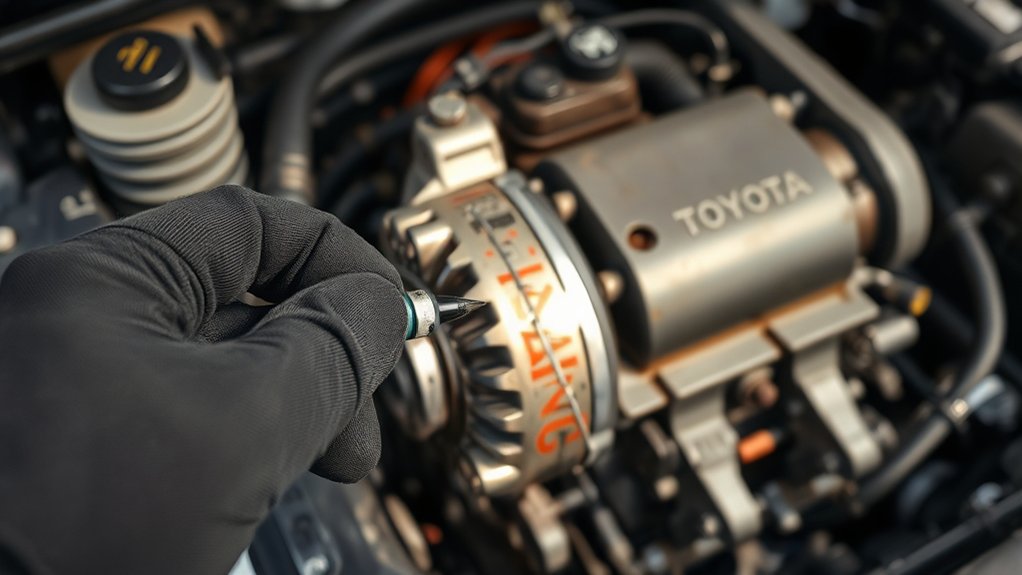
A failing starter can produce recognizable symptoms, but none of them proves the starter itself is bad without testing the battery and starting circuit. Pay attention to the exact sound, whether the lights dim, whether the engine turns, and whether the problem changes when you select Neutral instead of Park.
| Symptom | Possible Meaning | What to Check First |
|---|---|---|
| One heavy click | The solenoid may be operating, but the starter motor may not turn. A weak battery, poor cable connection, seized starter, or mechanical engine problem can cause the same result. | Battery condition, terminal tightness, cable voltage drop, starter current draw, and engine rotation. |
| Rapid repeated clicking | Voltage is often collapsing as the solenoid repeatedly engages and releases. | Battery charge, battery health, terminals, and ground connections. |
| Slow cranking | The starter is turning, but available voltage, current, or mechanical speed is too low. | Battery load test, cable resistance, engine-ground path, oil viscosity, temperature, and starter current draw. |
| No click and no crank | The starter may not be receiving a valid start command. | Park/Neutral switch, starter relay, fuse, ignition or smart-key circuit, brake-pedal input on push-button-start models, immobilizer, and wiring. On older manual-transmission Camrys, also consider the clutch-start circuit. |
| Grinding during starting | The starter pinion may not mesh correctly with the flywheel or flexplate ring gear. | Stop repeated attempts and inspect the starter drive, mounting, and ring-gear teeth. |
| Whirring without engine rotation | The starter motor may spin without its drive engaging the ring gear. | Starter drive mechanism and ring gear. |
| Starter continues running | The solenoid, relay, ignition circuit, or mechanical drive may be stuck. | Turn the vehicle off and obtain immediate professional service. |
Dim dashboard lights or headlights during a start attempt are not starter-specific symptoms. They can point to a discharged battery, excessive resistance in a cable or ground, or unusually high current draw. A battery that powers the dashboard can still be too weak to crank the engine because the starter requires far more current than the interior electronics.
Warning: Stop attempting to start the car if you see smoke, melting insulation, sparks, or a glowing cable, or if you smell hot electrical insulation. Repeated cranking can overheat the starter and wiring. Arrange professional diagnosis or towing.
Can You Drive With a Failing Toyota Camry Starter?
A conventional starter normally affects whether the engine begins running, not propulsion after the engine has successfully started. A Camry with an intermittent starter fault may therefore drive normally and then fail to crank after you shut it off. That makes continued use risky because the next stop can leave the vehicle stranded.
If the starter remains engaged after the engine starts, if wiring becomes hot, or if you see smoke or melting insulation, stop using the vehicle and arrange professional service. Those symptoms are different from a starter that simply fails to engage.
| Issue | Impact |
|---|---|
| Intermittent starting | Unpredictable delays and risk of a no-start after parking |
| Grinding or free-spinning noises | Possible damage to the starter drive or ring gear if repeated |
| High-resistance cables or grounds | Heat, slow cranking, voltage loss, and unnecessary parts replacement |
| Complete no-crank condition | Vehicle cannot be started normally and may require towing |
Do not assume the starter is responsible simply because the engine will not start. A no-crank condition is different from an engine that cranks normally but does not fire. Normal-speed cranking with no ignition points toward fuel, ignition, sensor, security, compression, or engine-management problems rather than the starter motor itself.
How Long Should Your Toyota Camry Starter Last?
Toyota does not publish a universal Camry starter replacement mileage. The starter is normally replaced according to its condition and test results rather than an odometer number. Online mileage ranges should therefore be treated as rough experience-based estimates, not Toyota maintenance specifications or automatic replacement points.
Starter life is better judged by start cycles, operating conditions, symptoms, and circuit testing than by odometer mileage alone.
The following factors have the greatest effect on service life:
- Number of start cycles: A vehicle that is started many times per day places more operating cycles on the starter than a highway-driven vehicle with similar mileage.
- Battery condition: A weak or undercharged battery can contribute to slow engagement, repeated solenoid operation, voltage collapse, and extended cranking.
- Cable and ground condition: Corrosion, loose fasteners, damaged cables, or poor engine grounds can restrict current and create heat.
- Cranking duration: Holding the key or start command while the engine cannot start can overheat the starter.
- Temperature and contamination: Severe heat, cold, water, road salt, oil, and debris can affect electrical and mechanical components.
- Part and installation quality: Correct fit, clean mounting surfaces, secure electrical connections, and replacement-unit quality all matter.
Regular inspection cannot guarantee a particular lifespan, but correcting battery, charging, cable, and ground faults can reduce unnecessary stress on the starting system. Toyota’s maintenance schedule should be checked for the exact vehicle rather than using a generic starter mileage.
What Affects the Lifespan of Your Toyota Camry Starter?
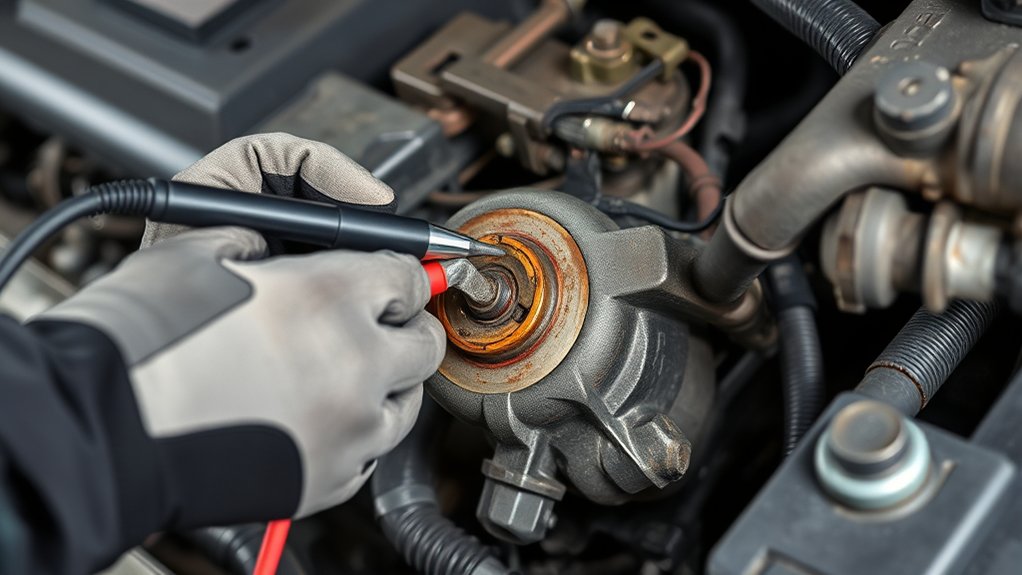
Your starter’s working conditions matter more than a single mileage estimate. Electrical resistance, repeated starts, weather, contamination, and extended cranking can all increase heat or mechanical wear.
Electrical System Integrity
The starting system depends on the battery, positive cable, engine and body grounds, relays, switches, connectors, solenoid, and starter motor. A fault anywhere in that path can imitate a failed starter or force the starter to operate under poor conditions.
- Battery health: A battery can show normal open-circuit voltage yet fail under starter load. Use a proper battery conductance or load test when symptoms persist.
- Charging-system operation: A discharged battery may result from a charging fault, but charging voltage is not a universal fixed number. It varies by model, temperature, electrical load, battery state, and control strategy. Compare readings with the exact Toyota service information.
- Wiring and grounds: Loose, corroded, internally damaged, or otherwise high-resistance connections can create voltage drop and heat.
- Starter control circuit: Relays, fuses, the ignition or smart-key system, brake-pedal input on push-button-start models, the Park/Neutral switch, immobilizer, and wiring may prevent starter operation. Older manual-transmission Camrys can also use a clutch-start circuit.
A visual inspection is useful, but it cannot reveal every internal cable or connector fault. Loaded voltage-drop testing is often more informative because it checks the circuit while high current is flowing. Fluke’s automotive voltage-drop guide explains why restrictions in cables, connections, and grounds can create starting-system problems.
If the battery itself is questionable, our Toyota Camry battery types guide explains why chemistry, size, venting, terminal layout, and vehicle configuration matter when evaluating a replacement.
Driving Habits Impact
Your driving pattern affects starter life mainly through the number and quality of engine starts. Frequent short trips can create many start cycles while giving the charging system less operating time between starts. The concern is the repeated starting load, not aggressive acceleration after the engine is already running.
These habits can increase wear:
- Starting the engine many times each day
- Continuing to crank when the engine is not firing
- Repeatedly trying to start with a weak battery
- Turning the key again while the engine or starter is already spinning
- Ignoring intermittent clicks or slow cranking
Pro Tip: If the engine does not start during a normal brief attempt, release the key or button and investigate the cause. Repeated long cranking attempts can overheat the starter and discharge the battery.
Environmental Conditions Effects
Environmental conditions affect the battery, wiring, connections, lubricant viscosity, and starter itself.
- Cold weather: Battery output falls as temperature drops, while colder engine oil can increase the effort required to turn the engine.
- High heat: Underhood heat can accelerate deterioration of insulation and starter components.
- Moisture and road salt: Water and salt can promote corrosion at terminals, grounds, connectors, and starter mounting points.
- Oil contamination: An engine leak that reaches the starter can damage insulation and attract dirt.
- Dirt and debris: Heavy buildup can retain heat or interfere with connections and moving parts.
Correct leaks, protect damaged wiring, and keep battery and ground connections clean and secure. Do not coat electrical contact surfaces with paint or thick grease before the connection is tightened.
How Do You Diagnose a Toyota Camry Starter Problem?
Diagnose a no-crank or slow-crank condition in a safe order. First confirm that the vehicle uses a conventional starter and identify the exact symptom. Then check the battery, terminals, grounds, start authorization, loaded voltage drop, control signal, and starter operation before replacing parts.
At a Glance
| Time Required | Varies by test scope; visual and battery checks are quicker than loaded circuit, control-signal, and current-draw diagnosis |
| Difficulty | Basic visual inspection and battery checks can be owner-level tasks; starter-terminal, current-draw, control-circuit, and hybrid testing require appropriate skill and service information |
| Tools Needed | Safety glasses, gloves, flashlight, digital multimeter, battery tester, and model-specific wiring information |
| Cost | Varies by whether the diagnosis uses owner-level checks, battery testing, or professional electrical and starter testing |
Warning: Set the parking brake, place the transmission in Park or Neutral as appropriate, keep hands and tools away from belts and fans, and wear eye protection. Never bridge starter terminals with a screwdriver. Never disconnect a battery cable while the engine is running. Do not touch orange hybrid cables or high-voltage components.
Common Symptoms to Observe
Record exactly what happens when you try to start the vehicle:
- Listen: Is there no sound, one click, rapid clicking, grinding, or a smooth whir?
- Watch the lights: Do the dashboard and headlights remain bright, dim slightly, or go nearly dark?
- Confirm whether the engine cranks: Does the engine turn slowly, normally, or not at all?
- Try the correct alternate position: On an automatic Camry, hold the brake and try Neutral if Park does not work. Do not repeatedly move the shifter while holding the key or Start command.
- Check messages and indicators: Smart-key, immobilizer, brake-switch, or transmission-position warnings may help explain a no-crank condition.
If the engine cranks at a normal speed but does not start, the starter has performed its main job. Diagnose the fuel, ignition, air, sensor, security, compression, or engine-control system instead.
Testing Battery Voltage
A voltage reading is a useful first screen, but it does not replace a battery test under load.
- Turn off the lights, climate control, and accessories.
- Allow a conventional 12-volt battery to rest after charging or driving so surface charge does not distort the reading.
- Measure voltage directly at the battery posts, not only at the cable clamps.
- A fully charged conventional 12-volt lead-acid starting battery is commonly around 12.6 volts or higher at rest, but temperature, battery chemistry, state of charge, and resting time affect the result.
- Observe voltage during cranking with a meter that can capture the minimum value if the applicable procedure calls for it.
- Do not condemn the starter from one voltage number. Compare the result with battery condition, temperature, cable voltage drop, and Toyota service information.
DENSO’s battery performance-testing guidance uses 12.6 volts or above as the fully charged starting point before a conventional battery load test, while also emphasizing performance testing rather than open-circuit voltage alone.
A battery may show acceptable resting voltage and still be unable to supply adequate current. If the battery is discharged, charge and test it before diagnosing the starter. If it repeatedly becomes discharged, inspect the charging system and possible parasitic draw.
Inspecting Electrical Connections
High-current starting circuits are sensitive to small amounts of unwanted resistance. Inspect the following:
- Battery posts and clamps: Look for looseness, corrosion, cracks, heat discoloration, or damaged terminals.
- Positive cable: Follow the cable toward the starter and fuse or junction area where safely visible.
- Negative cable and grounds: Check the battery-to-body and engine-to-body ground paths.
- Starter connector: Have a technician inspect the main terminal and control connector if access is restricted.
- Relay and fuse: Use the exact model-year fuse-box diagram. Do not replace a fuse with a higher rating.
Do not assume a connection is good because the outside looks clean. Internal corrosion, broken cable strands, loose crimps, or poor contact pressure may only become obvious during a loaded voltage-drop test.
Testing Voltage Drop Safely
A voltage-drop test measures how much electrical potential is lost while current flows through a cable, connection, switch, or ground. It is often more useful than measuring resistance with the high-current circuit switched off.
- Test the positive path from the battery positive post toward the starter while cranking.
- Test the ground path between the starter or engine block and the battery negative post while cranking.
- Use the limits in the applicable Toyota repair information whenever available.
- If model-specific limits are unavailable, do not treat generic figures as automatic proof that a component has failed.
- Repair excessive cable or ground voltage drop before replacing the starter.
Fluke’s general guidance lists maximum fallback values of 0.20 volt across a wire or cable, 0.30 volt across a switch, and 0.10 volt at a ground when the applicable manual does not provide a value. These are general diagnostic references, not replacements for Toyota specifications.
Battery, Starter, or Alternator: Which Is More Likely?
| Observation | More Likely Areas |
|---|---|
| Rapid clicking and lights dim heavily | Discharged or weak battery, loose terminal, or high-resistance cable |
| One click, lights stay fairly bright, battery and cables test good | Starter solenoid, starter motor, starter drive, or mechanical engine condition |
| No click, lights stay bright | Relay, fuse, ignition or smart-key circuit, brake-pedal input, Park/Neutral switch, immobilizer, wiring, or an older manual-model clutch-start circuit |
| Battery repeatedly goes dead after the car has been driven | Charging-system problem, weak battery, loose connection, or parasitic draw |
| Engine cranks normally but will not run | Fuel, ignition, sensor, engine-management, compression, or security issue rather than the starter |
For charging-system-specific symptoms and testing context, see our Toyota Camry alternator lifespan guide.
Should You Replace or Refurbish Your Starter?
Choose replacement or refurbishment only after the battery, cables, grounds, relay, control circuit, starter mounting, and mechanical engine condition have been checked.
Replacement is usually the better choice when:
- The starter has damaged windings, bearings, armature, commutator, solenoid, or drive components.
- The housing or terminals are heat-damaged or heavily corroded.
- The starter has failed more than once.
- A quality new or professionally remanufactured unit includes useful warranty coverage.
- Labor access is difficult enough that repeating the repair would be costly.
Professional rebuilding may make sense when:
- The original starter is rebuildable and the fault is limited to serviceable internal parts.
- A reputable automotive electrical shop can test the armature, field components, solenoid, bearings, drive, and insulation.
- Correct model-specific components are available.
- The rebuilt unit will receive a proper bench test and warranty.
Cleaning or replacing internal contacts may restore some starters, but it is not a universal repair. Starter construction differs by Camry generation, engine, production market, and replacement brand. A low-cost remanufactured starter can also be false economy if workmanship or internal parts are poor.
Note: Starter replacement access, torque specifications, cable routing, and disconnection procedures vary by model year and engine. Use Toyota’s Technical Information System or another reliable model-specific repair procedure.
What Troubleshooting Steps Should You Follow Before Replacing the Starter?

Use a structured sequence instead of replacing parts based only on the sound the car makes.
Test the battery and complete starting circuit under load before replacing the starter motor.
- Confirm the vehicle type: Stop if the Camry is a hybrid and use hybrid-specific service information.
- Identify crank versus no-start: Determine whether the engine is turning at normal speed.
- Check battery condition: Charge and properly test a discharged or questionable battery.
- Inspect terminals and grounds: Correct loose, corroded, burnt, or damaged connections.
- Try Park and Neutral: A change in behavior may point toward the transmission-range or neutral-safety circuit.
- Review warning messages: Check smart-key, immobilizer, brake-pedal, transmission-position, and other relevant indications.
- Check the correct fuse and relay: Follow the model-year diagram and never install a higher-rated fuse.
- Measure voltage drop: Test both the positive and ground sides while the circuit is under starter load.
- Verify the control signal: A qualified technician can confirm whether the starter solenoid receives the correct command.
- Measure starter current draw: Current draw interpreted together with cranking speed and voltage can help identify an internal starter fault, electrical restriction, or mechanical problem.
- Inspect starter mounting and ring gear: Grinding or free-spinning requires mechanical inspection.
- Bench-test when appropriate: Free-speed testing should be performed with proper equipment and secure mounting, normally by a starter shop or technician.
Do not strike the starter as a repair. Although impact may temporarily move worn internal parts, it can damage the housing, magnets, electrical connections, or nearby components and does not correct the underlying fault.
After repair, confirm that the engine cranks at normal speed, the starter disengages immediately, no cables heat up, the battery remains charged, and no related warning lights or diagnostic trouble codes remain.
Frequently Asked Questions
How do I know if my Toyota Camry starter is bad?
A bad starter may produce one heavy click, intermittent no-crank operation, grinding, free-spinning, slow cranking with a proven-good battery and cables, or failure to operate despite a correct control signal. Test the battery, connections, grounds, relay, Park/Neutral circuit, and voltage drop before replacing it.
How long do Camry starters last?
Toyota does not publish a fixed starter replacement mileage. Service life varies with start cycles, battery and cable condition, heat, moisture, contamination, cranking duration, installation quality, and internal wear. Use symptoms and electrical testing rather than a mileage number as the replacement trigger.
Can a weak battery make the starter seem bad?
Yes. A weak or discharged battery can cause rapid clicking, one click, slow cranking, dim lights, or intermittent starting. Resting voltage alone does not prove the battery is healthy, so charge it as appropriate and perform a suitable load or conductance test before condemning the starter.
How can I tell a starter problem from an alternator problem?
A conventional starter problem mainly affects engine cranking. A charging-system fault can leave the battery undercharged and cause repeated dead-battery complaints or charging warnings after the engine is running. Because a weak battery can result from either condition, test the battery, starting circuit, and charging system separately.
Does a 2025 or 2026 Toyota Camry have a conventional starter?
U.S.-market 2025 and 2026 Camrys are hybrid-only. They use Toyota’s hybrid motor-generator starting system rather than the conventional starter motor described in this guide. Use the hybrid-specific owner and service information for a no-start or no-READY complaint.
Can I drive a Camry with a failing starter?
If a conventional gasoline Camry is already running, an ordinary starter fault usually does not affect propulsion, but the engine may fail to restart after you shut it off. Do not continue using the car if the starter remains engaged, wiring overheats, smoke appears, or electrical insulation begins to melt.
Conclusion
A conventional Toyota Camry starter does not have a Toyota-specified mileage lifespan. Clicking, intermittent no-crank operation, slow cranking, grinding, or free-spinning can indicate starter trouble, but the battery, cables, grounds, relay, start-authorization circuit, and mechanical engine condition can create similar symptoms.
For U.S. Camrys, remember that this conventional-starter guidance mainly applies to 2024-and-earlier non-hybrid gasoline models because the 2025 and 2026 Camry lineups are hybrid-only. Start with safe battery and connection checks, then use loaded voltage-drop and control-circuit testing before authorizing starter replacement. Stop immediately if wiring overheats, smoke appears, or the starter stays engaged.
Sources
- Toyota Maintenance Schedule — factory-recommended maintenance resources and vehicle-specific service scheduling
- Toyota Manuals and Warranties — model-year-specific owner manuals, warranty information, and maintenance guidance
- Toyota USA: 2024 Toyota Camry — confirms the 2024 U.S. lineup included gasoline and hybrid powertrains
- Toyota USA: 2025 Camry Goes Exclusively Hybrid — confirms the U.S. 2025 Camry changed to an exclusively hybrid lineup
- Toyota: 2026 Camry — current U.S. model information identifying the Camry’s all-hybrid powertrain
- Toyota Technical Information System — official Toyota repair manuals, wiring information, procedures, and specifications
- Fluke: Diagnosing Voltage Drops — loaded voltage-drop testing principles and general fallback limits
- DENSO: Battery Visual Inspection and Performance Testing — conventional battery charge and load-testing guidance
- Oak Ridge National Laboratory: Evaluation of the 2007 Toyota Camry Hybrid Synergy Drive System — technical analysis of the Camry Hybrid drive system
