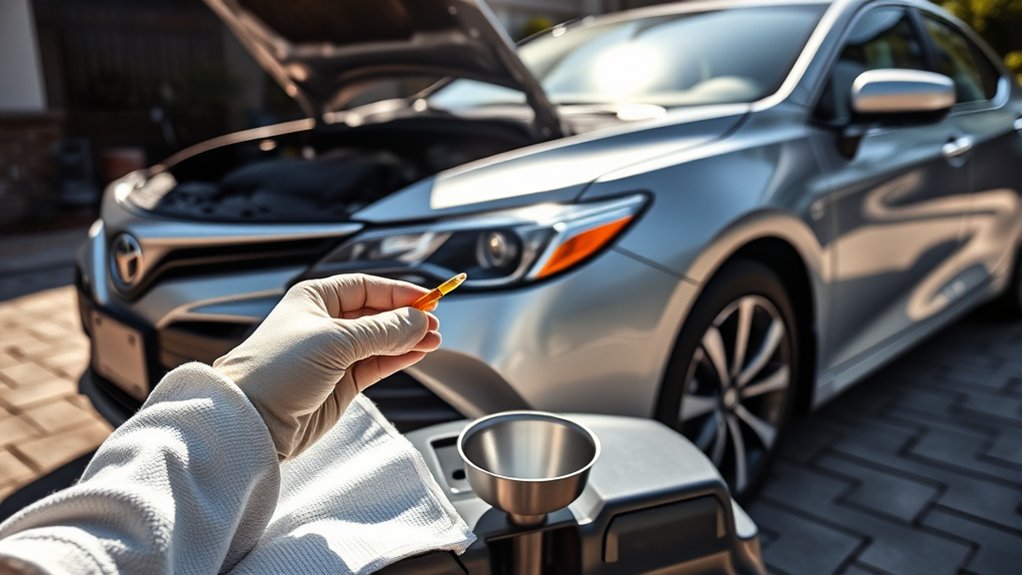
To check Toyota Camry oil consumption, start with the oil exactly at the full mark, record the odometer, then recheck under the same conditions and measure every top-up. For a home trend, check every 250 to 500 miles and calculate quarts used per 1,000 miles. If you are dealing with Toyota’s historical 2AZ oil-consumption procedure, that dealer test is different: Toyota specified a 1,100–1,300-mile return window and tamper-marked service points.
Last updated: September 19, 2026. This guide covers U.S.-market Camrys and separates owner tracking from Toyota’s historical dealer procedure for certain 2AZ-equipped vehicles.
Quick Answer
For home monitoring, start at the full mark, record the odometer, recheck every 250 to 500 miles under the same conditions, and measure each top-up. After about 1,000 miles, calculate quarts used per 1,000 miles. For Toyota’s historical 2AZ dealer test, do not substitute this home method: the official procedure used a 1,100–1,300-mile return window, sealed service points, and a one-quart final check.
Key Takeaways
- Use the same parking surface, engine temperature, wait time, and dipstick method for every home reading.
- Do not confuse a home oil-use log with Toyota’s historical 2AZ dealer test; the dealer procedure used a 1,100–1,300-mile return window and tamper-marked service points.
- Toyota’s ZE7 program included certain 2007–2009 Camrys and certain 2007–2011 Camry Hybrids equipped with 2AZ-family engines; eligibility was VIN- and test-dependent.
- Measure every amount you add and record the date, odometer reading, driving conditions, and symptoms.
- Stop the engine if the red oil-pressure warning stays on or you hear knocking or loud mechanical noise.
At a Glance
| Time Required | Home trend: about 10 minutes per check over roughly 1,000 miles; historical Toyota 2AZ dealer test: two visits with 1,100–1,300 miles between |
| Difficulty | Easy for home monitoring; professional skill is needed for internal-engine diagnosis |
| Tools Needed | Dipstick, lint-free cloth or paper towel, funnel, correct engine oil, measuring container, and mileage log |
| Cost | Home monitoring has no diagnostic fee apart from oil used for top-ups; dealer-test or repair costs depend on current VIN-specific coverage and shop policy |
Toyota Camry Oil Consumption Test: Home vs. Dealer

Oil consumption means engine oil is leaving the crankcase between oil changes. It may be burned inside the engine, lost through an external leak, or drawn through the crankcase-ventilation system. This is different from low oil pressure, which means the engine may not be receiving adequate lubrication and can require immediate action.
A small change on the dipstick does not automatically prove that the engine is burning oil. Parking angle, engine temperature, drain-back time, and an incomplete dipstick insertion can all change the reading. That is why each check must be performed under the same conditions.
| Method | Best Use | Mileage | Key Rule |
|---|---|---|---|
| Home trend | Measure current oil use and document a pattern | Check every 250–500 miles; calculate after about 1,000 miles | Use the same full-mark baseline and measure every top-up |
| Historical Toyota 2AZ dealer test | Apply Toyota’s controlled 2AZ inspection procedure | Return after 1,100–1,300 miles | Dealer marks service points and performs the final one-quart check |
Identify Your Model Year and Engine
Do not apply one oil-consumption standard to every Camry. Engine designs, oil capacities, viscosity requirements, maintenance schedules, and dashboard reminders vary by model year.
In the United States, Toyota’s ZE7 warranty-enhancement material listed certain 2007–2009 Camrys and certain 2007–2011 Camry Hybrids equipped with 2AZ-family engines. The non-hybrid U.S. Camry received a new 2.5-liter four-cylinder engine for the 2010 model year. Other engines and years can still leak or consume oil, but they should not automatically be diagnosed as having the same 2AZ condition.
You can confirm your model year from the VIN label and verify the engine through owner documentation, service records, Toyota VIN-based information, or the guidance in this Toyota Camry engine-code location guide.
Toyota’s historical 2AZ dealer test did not simply tell owners to estimate “one quart per 1,200 miles.” The bulletin specified a 1,100–1,300-mile return window, marked service points, and a controlled one-quart final check.
Oil Consumption Versus an External Oil Leak
Oil that disappears from the dipstick may be leaving the engine in more than one way:
- Internal consumption: Oil enters the combustion chamber through worn or stuck rings, valve-stem seals, or another internal path.
- External leakage: Oil escapes through a gasket, seal, timing-cover joint, oil pan, drain plug, filter, or damaged component.
- Crankcase-ventilation problem: A faulty or restricted PCV system can affect crankcase pressure and move oil into the intake.
- Measurement error: The vehicle was parked at an angle, checked at a different temperature, or not given the same drain-back time.
Inspecting for leaks and standardizing the dipstick procedure should come before assuming the engine needs internal repairs.
Before Starting an Oil Consumption Test
Choose a Home Log or the Historical Dealer Procedure
Use a home oil-consumption log when you want to measure the rate your Camry is using oil now. Use the historical Toyota 2AZ dealer procedure only when a Toyota dealer is applying that specific bulletin or reviewing a related VIN history. A home log is useful evidence, but it is not the same as Toyota’s controlled dealer test.
Gather the correct information and supplies before establishing a home-test baseline:
- Your exact Camry model year, engine, and current mileage
- The viscosity and oil specification listed in the owner’s manual
- A clean funnel and a way to measure partial quarts accurately
- A notebook, spreadsheet, or phone note for dates and odometer readings
- A consistent, level parking location
- Enough correct oil for safe top-ups during the monitoring period
Download the correct manual and Warranty and Maintenance Guide from the Toyota Manuals and Warranties portal. Do not rely on another model year’s viscosity, capacity, or service interval.
Warning: Do not begin or continue a mileage test when the red oil-pressure warning stays on, the dipstick is dry, the engine is knocking, or a major leak is visible. Stop safely, shut off the engine, and arrange professional help if the warning remains after the level is corrected.
How to Check the Engine Oil Level Correctly
- Park on level ground. Even a slight slope can move oil toward one end of the oil pan and change the dipstick reading.
- Use the procedure in your manual. Many Camry procedures call for checking after the engine has reached operating temperature, been shut off, and sat long enough for the oil to drain into the pan. Use the exact instructions for your model and repeat the same method each time.
- Open the hood and locate the dipstick. Keep loose clothing, hands, and tools away from hot surfaces and moving components.
- Remove and wipe the dipstick. Use a clean, lint-free cloth or paper towel.
- Insert it fully. Pull it out again and hold it level enough to prevent oil from running along the blade.
- Read both sides. Use the clearer side when oil has smeared unevenly. Repeat the reading if the mark is uncertain.
- Add oil only when needed. Use the specified viscosity and add a small measured amount through a funnel.
- Wait and recheck. Do not assume the entire distance between the dipstick marks equals a specific volume unless your manual confirms it.
- Stop at the full mark. Do not pour oil above the maximum mark.
- Record the result. Note the date, mileage, oil level, amount added, and any smoke, leaks, warning lights, odor, or engine noise.
Note: Fresh oil can be difficult to see on the dipstick. Move the dipstick into good light, check both sides, and repeat the wipe-and-read process rather than guessing.
How to Measure Toyota Camry Oil Consumption at Home
A home test can establish a useful trend and give a technician better evidence, but it does not replace Toyota’s historical 2AZ dealer procedure. Keep the home method simple: establish one repeatable full-mark baseline, measure each top-up, and calculate the rate from actual miles driven.
1. Establish a Baseline
Check the level using the repeatable method above. Add the correct oil only as needed to reach the full mark without going over it. Record:
- Date
- Odometer reading
- Oil brand, viscosity, and specification if known
- Exact amount added
- Whether an oil and filter change was just completed
- Visible leaks or smoke
2. Drive Normally
Continue your usual driving rather than deliberately changing your speed or route. High engine speed, sustained highway driving, heavy loads, extreme heat, and frequent short trips can affect the observed rate, so note any unusual operating conditions.
Check the dipstick every 250 to 500 miles during the test. This keeps the engine from becoming dangerously low before the final mileage is reached.
3. Measure Every Top-Up
When the oil is below the starting level, add a measured amount to return it to the same full mark. Do not estimate from the bottle by sight when an accurate measuring container is available.
Record the exact amount added. The total amount added during the test is the amount used for your calculation.
4. Calculate the Consumption Rate
Use this formula:
Quarts added ÷ miles driven × 1,000 = quarts consumed per 1,000 miles
For example, if you add 0.5 quart over 1,000 miles:
0.5 ÷ 1,000 × 1,000 = 0.5 quart per 1,000 miles
Do not compare this home-calculated rate with a universal Toyota “normal” number. Toyota’s historical 2AZ bulletin used a controlled 1,100–1,300-mile return window and a one-quart final check. That service procedure was designed for specific 2AZ applications and should not be treated as a health target for every Camry.
Pro Tip: Take a dated photo of the dipstick beside the odometer at each check. Written measurements remain more important, but photos can help show the trend to a technician.
5. Repeat to Confirm the Trend
One test can be distorted by a reading error, an incomplete starting fill, or unusual driving. If the engine remains safe to operate, repeat the same process over another controlled interval. A consistent or worsening loss is more meaningful than one isolated reading.
How Did Toyota’s Historical 2AZ Dealer Oil-Consumption Test Work?
Toyota Technical Service Bulletin T-SB-0158-14 used a controlled procedure for certain 2AZ-equipped vehicles. It is more specific than a home dipstick log and was tied to Toyota’s service and warranty process.
- The dealer confirmed the complaint and filled the engine to the full mark.
- The dealer marked service points. Toyota’s procedure identified the dipstick, oil drain plug, fill cap, oil cooler line, and oil filter so tampering could be detected.
- The owner drove 1,100–1,300 miles. Returning outside that mileage window made the official test result void under the bulletin.
- The dealer checked the marks and the dipstick. If the level was still full, the bulletin did not apply.
- If the level was below full, the dealer added exactly one quart. The engine was warmed, shut off, allowed to rest for five minutes, and checked again.
- If the level remained below full after that one quart, the bulletin directed the technician to the 2AZ oil-consumption repair procedure.
Safety note: Do not keep driving merely to finish a mileage test when the red oil-pressure warning stays on, the engine becomes noisy, or the level cannot be established safely. Shut the engine off and contact the dealer or a qualified repair facility.
Which Camrys Were Listed in Toyota’s ZE7 Program?
Toyota’s published ZE7 material included certain 2007–2009 Camrys and certain 2007–2011 Camry Hybrids equipped with 2AZ-family engines. Coverage depended on the vehicle, the dealer-performed test, and the program’s time and mileage limits; it was not a blanket lifetime warranty for every Camry with oil use.
The published ZE7 terms provided primary coverage through October 31, 2016, regardless of mileage, followed by secondary coverage for 10 years from the date of first use or 150,000 miles, whichever came first. Do not assume that historical ZE7 coverage still applies in 2026. Ask Toyota or a dealer to check your VIN and current assistance status.
Recognizing Signs of Excessive Oil Consumption
A falling dipstick level is the main evidence, but other symptoms can help a technician identify where the oil is going.
Blue Smoke Emission
Blue or blue-gray exhaust smoke can indicate that engine oil is entering the combustion chamber. Smoke during acceleration may be associated with ring or cylinder wear, while smoke after startup or following a long period of idling can point toward valve-seal leakage. These patterns are clues rather than a complete diagnosis.
An engine can consume oil without producing obvious smoke. The smoke may be intermittent, difficult to see, or partly masked after passing through the catalytic converter.
Rapid Oil Level Drop
A repeatable drop between checks deserves attention, especially when the rate increases. Confirm the reading under the same conditions and inspect the engine, underbody, and parking surface for leaks.
Do not use oil color alone to diagnose engine damage. Oil normally darkens as it holds contaminants in suspension. Thick deposits, gritty material, a burnt odor, fuel smell, or a milky appearance require investigation, but color by itself does not prove internal failure.
External Leaks and Burning-Oil Odors
Look for fresh wetness around the valve cover, timing cover, oil filter, drain plug, oil pan, and the lower part of the engine. Oil may leak onto a hot exhaust component and create a burning smell without leaving a large puddle.
A mechanic may clean the engine and use fluorescent dye when the leak source is difficult to find.
Oil-Fouled Spark Plugs
Wet, oily, or heavy ash deposits on one or more spark plugs can provide useful evidence. Plug appearance should be interpreted with misfire data, cylinder condition, oil use, and other test results rather than used alone.
What Causes Oil Consumption Problems?
Stuck or Worn Oil-Control Rings
Oil-control rings are designed to remove excess oil from the cylinder wall. Deposits can restrict their movement, or the rings and cylinder surfaces can wear. Oil left on the wall may then enter the combustion chamber and burn.
This mechanism was central to the historical concern involving certain 2AZ-FE engines, but the engine and vehicle application must be verified before making that diagnosis.
Worn Valve-Stem Seals
Valve-stem seals limit the amount of oil reaching the valve guides. Hardened or worn seals can allow oil to enter the intake or exhaust ports, sometimes producing smoke after startup or extended idling.
PCV System Problems
The Positive Crankcase Ventilation system routes crankcase vapors back into the intake. A restricted, damaged, or incorrect PCV component can affect crankcase pressure and oil movement.
There is no single PCV replacement interval that should be imposed on every Camry. Inspect the system when symptoms, maintenance guidance, or diagnosis justify it.
External Gasket and Seal Leaks
Valve-cover gaskets, timing-cover joints, crankshaft seals, oil-pan sealing surfaces, the filter, and the drain plug can leak. An external leak should be repaired before internal engine work is considered.
Incorrect Oil or Overfilling
Oil with the wrong viscosity or specification may not provide the performance intended for the engine. Overfilling can also cause aeration, increased crankcase pressure, leakage, or oil entering places it should not.
Use the viscosity listed for your exact engine and choose an oil carrying the required current certification. The American Petroleum Institute engine-oil resource explains its licensing and certification system.
Sludge and Maintenance History
Long oil-change intervals, severe operating conditions, overheating, contamination, or neglected maintenance can contribute to deposits. However, dark oil alone does not prove that sludge is present. A technician may need to inspect under the valve cover or use other evidence before making that conclusion.
How a Mechanic Diagnoses Oil Consumption
A reliable diagnosis usually begins with the simplest and least invasive checks:
- Verify the oil level, oil specification, and consumption log.
- Inspect for external leaks and signs of oil reaching the intake or exhaust.
- Scan for diagnostic trouble codes, misfire data, and fuel-control problems.
- Inspect the PCV system and intake tract.
- Examine the spark plugs.
- Perform compression and cylinder leak-down tests when appropriate.
- Use a borescope to inspect cylinder walls, piston crowns, and deposits when useful.
- Compare the results with Toyota service information for the exact engine and VIN.
A compression test can reveal certain sealing problems, but acceptable compression does not automatically rule out stuck oil-control rings. Compression rings and oil-control rings perform different jobs, so the result must be considered with the consumption rate and other evidence.
Effective Maintenance Tips to Minimize Oil Consumption
Follow the Correct Oil-Change Schedule
Use the schedule in the Warranty and Maintenance Guide for your Camry’s year, engine, and operating conditions. Do not assume that every Camry requires the same mileage interval. For a model-year-specific overview, see the Toyota Camry oil-change interval guide.
Severe-use conditions may include repeated short trips in low temperatures, extensive idling, dusty operation, or other conditions defined in the vehicle’s maintenance guide. Follow Toyota’s definition rather than applying a generic severe-service rule.
Monitor Oil Levels Regularly
If your Camry is known to consume oil, check the dipstick weekly and before a long trip. A vehicle with no established problem should still be checked regularly and more often after a repair, oil change, warning light, or newly noticed leak. Use the same repeatable method described in this Camry oil-level checking guide.
Do not wait for the maintenance reminder to check the level. A maintenance reminder tracks a service interval; it is not an oil-level sensor. The Camry maintenance-reminder guide explains that distinction in more detail.
Use the Correct Oil
Use the viscosity and specification listed for the exact engine. Do not switch to thicker oil or add an aftermarket treatment merely to hide consumption. Such changes can affect cold-start lubrication, variable valve timing, fuel economy, emissions systems, and diagnostic results.
Use an additive only when Toyota documentation or a qualified technician specifically approves it for your vehicle and purpose.
Inspect Related Components
During routine service or diagnosis, inspect:
- Oil filter and drain-plug area
- Valve-cover and timing-cover areas
- Oil-pan sealing surfaces
- PCV valve, hoses, and intake connections
- Spark plugs when symptoms justify removal
- Cooling system for overheating or contamination concerns
Repairing a leak or ventilation fault early can prevent a misleading consumption test and reduce the risk of the level becoming dangerously low.
When to Seek Professional Help for Oil Consumption Issues
Arrange a professional inspection when:
- The oil level falls repeatedly after you establish a controlled baseline.
- You need frequent top-ups or the rate is increasing.
- Blue or blue-gray exhaust smoke appears.
- You find oil-fouled spark plugs or repeated misfires.
- Fresh oil appears under the vehicle or around the engine.
- The exhaust or engine bay smells like burning oil.
- The Check Engine Light appears with rough running or misfires.
- The engine rattles, knocks, or becomes unusually noisy.
- The red oil-pressure warning comes on.
- No oil appears on the dipstick.
Bring your complete mileage and top-up log. Ask the shop to record the starting oil level, inspect for external leaks, verify the PCV system, and explain which tests support its diagnosis before approving major internal-engine work.
Warning: When no oil appears on the dipstick, do not assume that adding one quart will make the level safe. Add only the correct oil in measured stages, recheck frequently, and do not run the engine if it is noisy or the oil-pressure warning remains illuminated.
Checking Toyota Service Information and VIN Status
Toyota issued Technical Service Bulletin T-SB-0158-14 for the 2AZ oil-consumption inspection procedure and Warranty Enhancement Program ZE7 for certain affected vehicles. ZE7 included certain 2007–2009 Camrys and certain 2007–2011 Camry Hybrids, but the coverage was time- and mileage-limited and depended on the dealer-performed test. That history does not mean every Camry qualifies for a current free repair.
You can review the NHTSA-hosted Toyota ZE7 program document and the NHTSA-hosted T-SB-0158-14 inspection bulletin for the historical U.S. procedure and coverage details.
Use Toyota’s Safety Recall and Service Campaign lookup to check the VIN for open items. You can also ask a Toyota dealer to review the VIN, service history, applicable bulletins, and whether any manufacturer assistance is available.
Toyota’s Technical Information System provides factory service information, repair manuals, diagnostic material, and service bulletins for North American Toyota vehicles. Some material requires a subscription.
For an additional federal recall check, use the National Highway Traffic Safety Administration recall portal. A recall search and a historical warranty-enhancement inquiry are not the same process, so discuss both with Toyota when applicable.
Frequently Asked Questions
How do you check Toyota Camry engine oil consumption?
For a home trend, bring the oil to the full mark without overfilling, record the mileage, and drive normally. Check under the same conditions every 250 to 500 miles and measure each top-up. After about 1,000 miles, divide the total quarts added by miles driven and multiply by 1,000. Toyota’s historical 2AZ dealer test used a separate controlled 1,100–1,300-mile procedure.
How do you run an accurate oil-consumption test?
Use level ground, the same engine-temperature procedure, the same wait time, and the same full-mark baseline for every reading. Record the odometer and every measured top-up. Inspect for leaks before the test, because externally leaked oil can otherwise be mistaken for oil burned inside the engine.
What does Toyota consider normal oil consumption?
There is no single healthy-use figure that should be applied to every Toyota engine, age, condition, and model year. Toyota’s historical 2AZ inspection bulletin used a controlled 1,100–1,300-mile return window and a one-quart final check for specific applications. That procedure should not be presented as an ideal oil-use rate for every Camry.
How do you find the oil-life reading on a Toyota Camry?
The answer depends on the model year and instrument system. Many Camrys display a Maintenance Required reminder based mainly on mileage rather than a calculated remaining oil-life percentage. This reminder does not measure the oil level. Check the exact owner’s manual to learn what your display provides and how it is reset after service.
Can a Camry burn oil without showing blue smoke?
Yes. Smoke may appear only during startup, acceleration, or deceleration, and a small amount may be hard to see. The catalytic converter can also make visible evidence less obvious. A controlled dipstick log is more dependable than waiting for continuous smoke.
Will thicker oil or an additive stop oil consumption?
It may temporarily change the observed symptoms, but it does not prove that the underlying fault is repaired. Using an unapproved viscosity or additive can also affect lubrication, variable valve timing, emissions equipment, and diagnostic results. Use the oil listed for your engine unless Toyota or a qualified technician directs otherwise.
What should you do if no oil appears on the dipstick?
Shut off the engine and park on level ground. After the proper wait time, check again. Add the correct oil in small measured amounts and recheck frequently. Do not drive when the red oil-pressure warning remains on, the engine is knocking, or you cannot establish a safe level.
What is the Toyota 1,200-mile oil-consumption test?
For the historical 2AZ procedure, “1,200-mile test” is shorthand. Toyota’s bulletin actually required the vehicle to return after 1,100–1,300 miles. The dealer started at the full mark, marked specified service points, checked the level on return, and used a controlled one-quart final check when the level was below full.
Which Toyota Camry years were listed in the ZE7 oil-consumption program?
Toyota’s ZE7 material listed certain 2007–2009 Camrys and certain 2007–2011 Camry Hybrids equipped with 2AZ-family engines. Coverage depended on VIN, the dealer-performed test, and the program’s time and mileage limits, so historical inclusion does not guarantee current free repair coverage.
Does normal compression rule out an oil-control-ring problem?
No. Compression rings and oil-control rings have different functions. An engine may produce acceptable compression readings while the oil-control rings are restricted or not controlling cylinder-wall oil correctly. A technician should consider leak checks, spark plugs, PCV operation, leak-down results, borescope findings, and the measured consumption rate together.
Conclusion
A useful Toyota Camry oil-consumption check starts by choosing the right method. For home monitoring, use one full-mark baseline, repeat the same dipstick procedure, measure every top-up, and calculate the rate from actual mileage. For Toyota’s historical 2AZ dealer procedure, the controlled 1,100–1,300-mile test and dealer markings matter.
Confirm the model year and engine before applying 2AZ information, and inspect for external leaks before assuming the engine is burning oil internally. Seek professional help when oil loss is rapid or worsening, smoke or leaks are present, the dipstick is dry, or an oil-pressure warning or abnormal engine noise appears.
Sources
- Toyota T-SB-0158-14: 2AZ Engine Oil Consumption Inspection Procedure — historical dealer test steps, 1,100–1,300-mile return window, marked service points, and final one-quart check
- Toyota Warranty Enhancement Program ZE7 — affected vehicle groups, dealer-test requirement, and published coverage terms
- Toyota Manuals and Warranties — model-specific owner manuals, oil requirements, warnings, and maintenance guides
- Toyota Technical Information System — factory repair manuals, diagnostic information, and service bulletins
- Toyota Safety Recall and Service Campaign Lookup — VIN-based lookup for open Toyota recall and campaign information
- National Highway Traffic Safety Administration Recall Lookup — federal VIN-based safety recall information
- American Petroleum Institute Engine Oil Program — engine-oil licensing and certification information
