If your Toyota Camry blows warm air while you are driving but turns cool at idle, the problem usually points to weak coolant flow through the heater core at low engine speed. Low coolant, trapped air, a restricted heater core, a weak water pump, or an engine that is not warming correctly are more likely than an electrical fault when the blower still moves air normally.
Quick Answer
Start with the engine completely cold and check the coolant level and visible leaks. Then watch the temperature gauge and compare the two heater-hose temperatures after warm-up. Heat that returns when engine speed rises often indicates low coolant, trapped air, heater-core restriction, or weak coolant circulation.
Key Takeaways
- First determine whether the vents have normal airflow that turns cold or little to no airflow at all.
- Low coolant and trapped air are common reasons cabin heat becomes weaker at idle.
- A large temperature difference between the heater-core hoses can indicate restricted coolant flow.
- A stuck-open thermostat usually causes slow engine warm-up or a low temperature reading, not only an idle-specific problem.
- Stop driving if loss of heat occurs with overheating, steam, a warning light, or rapid coolant loss.
At a Glance
| Time Required | About 20 to 45 minutes for basic checks; longer if the heater core must be flushed |
| Difficulty | Beginner for visual checks; intermediate for hose testing, coolant bleeding, or heater-core flushing |
| Tools Needed | Gloves, eye protection, flashlight, infrared thermometer, catch pan, basic hand tools, and an optional scan tool |
| Cost | Little or no cost for inspection; repair cost depends on whether coolant, hoses, a thermostat, a water pump, a heater core, or an HVAC component is needed |
Warning: Never remove a radiator or pressurized coolant cap while the engine is hot. Hot coolant can spray out and cause severe burns. If the temperature gauge rises, a warning light appears, or you see steam, stop safely, switch off the engine, and arrange professional service.
Common Causes of Heating Issues in Your Toyota Camry
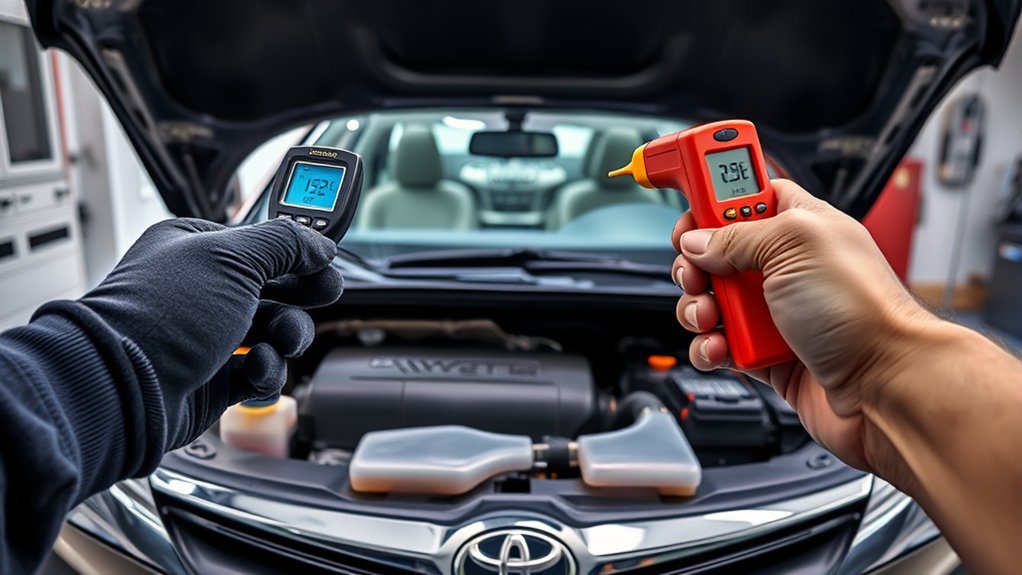
Your Camry’s heater uses hot engine coolant flowing through a small heat exchanger called the heater core. The blower pushes cabin air across that core. When heat fades at idle but returns while driving, focus first on anything that can reduce coolant flow at low engine speed.
Low Coolant or a Coolant Leak
Low coolant can leave the heater core partly empty or allow air to enter the system. The water pump may move enough coolant at higher engine speed to create some heat, while flow remains too weak at idle.
Check the reservoir only when the engine is completely cold. On models with a separate radiator or pressurized expansion-tank cap, follow the exact instructions in your Toyota owner’s manual before opening it.
If the coolant is low, inspect for wet areas or dried coolant residue around the radiator, reservoir, hoses, thermostat housing, water pump, and under the vehicle. Adding coolant without finding the reason it disappeared may only provide temporary relief.
Air Trapped in the Cooling System
Air may enter after a coolant leak, hose repair, thermostat replacement, water-pump replacement, or an incomplete refill. An air pocket can interrupt flow through the heater core and cause gurgling sounds, changing vent temperatures, or heat that comes and goes.
The correct bleeding method varies by Camry model year, engine, and hybrid configuration. Use the model-specific manual rather than assuming that running the engine with a cap removed is safe for every Camry.
Restricted Heater Core
Old coolant, contamination, mixed coolant types, sealant products, or internal corrosion can restrict the heater core’s narrow passages. A partial blockage may still pass enough coolant at higher engine speed but provide little heat at idle.
A restricted core often produces one very hot heater hose and another that is much cooler. A small temperature drop between the inlet and outlet is normal because the core gives up heat to the cabin. A large difference deserves further testing.
Weak Water-Pump Circulation
A worn, loose, damaged, or slipping water-pump impeller can reduce coolant circulation. Depending on the failure, you may also notice overheating, coolant leakage near the pump, bearing noise, or temperature changes when engine speed changes.
A weak pump is more concerning if the cabin heat fades at idle while the engine temperature begins to rise. Do not continue driving an overheating vehicle.
Thermostat Stuck Open
A thermostat that remains open can keep the engine from reaching its normal operating temperature. Common clues include slow warm-up, a temperature gauge that stays unusually low, weak heat during both idling and driving, and worse symptoms in cold weather.
If the gauge reaches its normal position and heat improves mainly when engine speed rises, low coolant, trapped air, restricted heater-core flow, or weak circulation may be more likely than a stuck-open thermostat.
Blend Door or HVAC Control Problem
If both heater hoses are hot but the vents still blow cold air, the engine may be producing heat while the HVAC case fails to direct air through the heater core. A stuck blend door, failed actuator, damaged linkage, control-panel problem, or wiring fault can cause this condition.
A separate heater control valve may also restrict coolant flow on systems that use one. Do not assume your Camry has this valve. Confirm the layout for the exact model year and engine through the owner’s manual or Toyota Technical Information System.
How to Diagnose Your Camry’s Heating Problems
Use the symptom pattern to avoid replacing parts that are not causing the problem.
1. Separate an Airflow Problem From a Heat Problem
- Normal airflow but cold air: Check coolant level, engine temperature, coolant circulation, heater-core flow, and the blend door.
- Little or no airflow: Check the blower motor, blower fuse, resistor or control module, electrical connections, and cabin air filter.
- Heat fades only at idle: Focus first on low coolant, trapped air, heater-core restriction, or weak pump circulation.
2. Check the Coolant Level With the Engine Cold
Park on level ground and allow the engine to cool fully. Check the reservoir against its cold-level marks. Use only coolant that meets the specification in the manual for your exact Camry.
Do not mix coolant types based only on color. Different products may have similar colors but different chemical packages.
3. Watch the Engine Temperature
Start the engine and allow it to warm while watching the temperature gauge or coolant-temperature data from a scan tool.
- Gauge remains unusually low: The thermostat may be stuck open, or the temperature sensor or gauge reading may be wrong.
- Gauge reaches its normal position: The engine is likely producing usable heat, so test heater-core flow and air-mixing controls.
- Gauge rises above normal: Stop the engine. Low coolant, circulation loss, a stuck thermostat, cooling-fan trouble, or another cooling-system fault may be present.
4. Compare Heat at Idle and Slightly Higher Engine Speed
With the vehicle parked safely, the transmission in Park, and the parking brake applied, observe whether the vent air becomes warmer when engine speed is raised slightly for a brief period. Do not hold the engine at high speed.
A clear improvement can support a coolant-flow diagnosis, but it does not identify the failed part by itself.
5. Compare the Heater-Hose Temperatures
After the engine reaches normal temperature, use a noncontact infrared thermometer to compare the two heater hoses near the firewall. Keep hands, clothing, and tools away from belts, fans, and hot exhaust parts.
| Temperature Pattern | What It May Mean |
|---|---|
| Both hoses hot, with a moderate difference | Coolant is likely flowing through the core. Check the blend door, actuator, and air distribution. |
| One hose hot and the other much cooler | Possible heater-core restriction, trapped air, low flow, or a coolant valve problem if the vehicle has one. |
| Both hoses remain cool after normal warm-up | The engine may not be warming correctly, coolant may be too low, or circulation to the heater core may be interrupted. |
Pro Tip: Record coolant temperature, vent temperature, and both heater-hose temperatures at idle. Repeat the readings after a brief increase in engine speed. The pattern is more useful than judging hose temperature by touch.
6. Test the HVAC Temperature Control
Move the temperature setting from full cold to full hot while listening near the dashboard. A clicking sound, repeated tapping, or no change in outlet temperature may indicate a blend-door actuator or linkage problem.
Dual-zone systems may have more than one actuator. If one side is warm and the other remains cold, a zone-specific door or actuator is more likely than a coolant-flow problem affecting the entire heater core.
7. Scan for Relevant Trouble Codes
A capable scan tool may find HVAC actuator or communication faults, especially on automatic climate-control systems. However, low coolant, trapped air, a partially blocked heater core, and many mechanical water-pump problems may not set a diagnostic trouble code.
Inspecting Your Coolant System
Inspect the cooling system before replacing HVAC controls. A small leak or incomplete refill can create an idle-only heating problem even when the engine appears to run normally.
| Inspection | What to Look For | What the Result Suggests |
|---|---|---|
| Cold coolant level | Level below the cold mark or repeated need to add coolant | Possible external leak, internal leak, or incomplete previous refill |
| Hoses and connections | Cracks, swelling, loose clamps, dampness, or dried residue | External coolant loss or air entering the system |
| Passenger compartment | Sweet odor, greasy windshield film, damp carpet, or coolant near the HVAC case | Possible leaking heater core or heater-hose connection |
| Coolant condition | Rust, sludge, oil contamination, or particles | Possible corrosion, mixed fluids, internal leakage, or restricted passages |
| Heater-hose temperatures | Both hot, both cool, or a large difference | Helps separate HVAC air-mixing faults from coolant-flow faults |
If the coolant keeps dropping without an obvious external leak, a technician may need to pressure-test the cooling system and test for internal engine leakage.
[Amazon Products Picked for You]
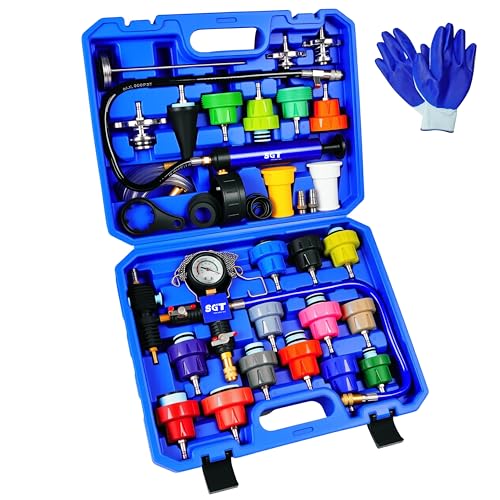
Versatile Applications: This Super Garage Tool’s coolant pressure tester kit is designed for comprehensive cooling system pressure testing and coolant refill tasks, helping quickly identify leaks in critical components such as the cylinder head, expansion tank, head gasket, radiator core, heater matrix, water pump, hoses, and pipes. This radiator pressure tester kit allows technicians to accurately locate cooling system leaks and refill coolant without introducing air pockets or air bubbles, ensuring efficient coolant circulation and reliable engine cooling performance.

A comprehensive coolant system pressure test & refill kit locates system leaks from header and expansion tanks and fittings, head gasket, radiator core, heater matrix, water pump, hoses and pipes, and is designed for refilling radiators with coolant without introducing air pockets.
The Role of the Thermostat in Heater Performance

The thermostat helps the engine warm up and then regulates coolant flow to maintain the correct operating temperature. Cabin heat depends on that hot coolant reaching the heater core.
- Stuck open: The engine may warm slowly, run cooler than intended, and produce weak heat in cold weather.
- Stuck closed: The engine may overheat because coolant cannot flow correctly through the radiator.
- Incorrect installation or wrong part: Coolant flow and warm-up behavior may be abnormal after replacement.
- Normal gauge but idle-only heat loss: Check coolant level, air pockets, heater-core restriction, and pump circulation before blaming the thermostat.
When cabin heat returns as soon as engine speed rises, investigate coolant flow before replacing electrical HVAC controls.
[Amazon Products Picked for You]

Genuine Lexus OEM product

【THERMOSTAT REPLACEMENT】90916-A3003, 90916A3003, 90916-03129, 9091603129 Engine Thermostat For Toyota Is 100% Rigorously Tested Before Shipping. Check The Part Number To Confirm The Compatibility Before Purchase. High Quality Materials, Engine Thermostat Is Constructed Of Premium Material For Long Lasting Durability And Reliability. Direct Replacement, Easy Installation.

【 Replacement Number】 This is a high-quality replacement thermostat for THT-019, 90916-03145. Our part number THT-019 ensures perfect fit and performance, matching the original factory specifications for your vehicle.
How Do You Flush the Heater Core?
Flush the heater core only after testing suggests a restriction. A flush will not repair a leaking heater core, failed blend door, low coolant caused by a leak, stuck thermostat, or damaged water pump.
Warning: The engine must be switched off and completely cold before you disconnect any coolant hose. Never run the engine with the heater hoses disconnected. Avoid full household water pressure because excessive pressure can damage an older heater core.
[Amazon Products Picked for You]

Heater Core Flush Kit: Includes 1 flushing gun, 2 garden hose connectors, and 1 roll of PTFE tape. Crafted from corrosion resistant materials, this kit efficiently performs coolant, radiator, or heater core system flushing, delivering reliable, long lasting performance even in demanding automotive and industrial environments

Complete Flush Gun Kit: includes 1 coolant system flush gun, 1 garden hose connector, 1 air line fitting and PTFE tape, providing the main parts needed for heater core flush, radiator hose cleaning and garage coolant service
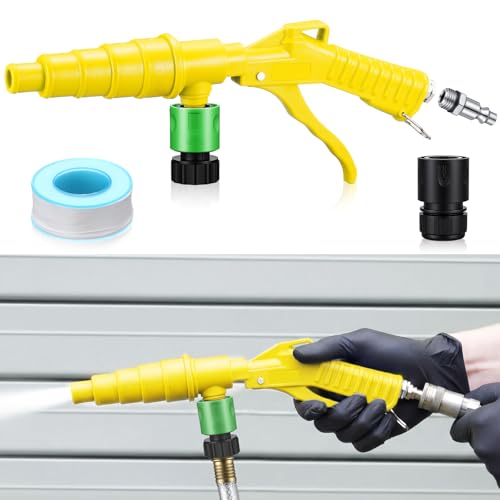
Complete Flush Gun Kit: includes 1 coolant system flush gun, 1 garden hose connector, 1 air line fitting and PTFE tape, providing the main parts needed for heater core flush, radiator hose cleaning and garage coolant service
Tools Needed for Flushing
- Safety glasses and coolant-resistant gloves
- Drain pan and sealable waste container
- Pliers or the correct clamp-removal tool
- Short lengths of hose or suitable adapters
- A low-pressure clean-water supply
- Shop towels and absorbent material
- The correct replacement coolant for your exact Camry
- The model-specific hose-routing and refill procedure
Steps to Flush the Heater Core
- Let the engine cool completely. Park on level ground, switch off the engine, and wait until the cooling system is cold and no longer pressurized.
- Confirm the hose routing. Identify the heater-core inlet and outlet using the correct Toyota repair information. Do not guess based only on hose position.
- Place a catch pan underneath. Drain enough coolant to lower the level below the heater-hose connections. Capture every fluid release.
- Disconnect the hoses carefully. Twist and release them without crushing the heater-core tubes. Replace damaged clamps or hoses.
- Backflush with low pressure. Send clean water through the outlet side in short, gentle pulses so debris exits through the inlet side.
- Reverse the flow. Flush in the normal direction and then backflush again until the water runs clear. Do not use compressed air or uncontrolled water pressure.
- Use chemicals only when appropriate. If you use a cooling-system cleaner, confirm that its manufacturer approves it for aluminum heater cores and the coolant system in your vehicle. Follow its instructions exactly and rinse it out fully.
- Reconnect the hoses. Seat each hose fully and secure it with the correct clamp in its original position.
- Refill with the specified coolant. Follow the exact Toyota procedure for your model year, engine, and powertrain. Do not mix unknown or incompatible coolants.
- Bleed and inspect the system. Follow the model-specific air-removal procedure, check for leaks, monitor engine temperature, and confirm stable heat at idle.
Note: Keep drained coolant in a labeled, sealed container away from children and animals. Do not pour it onto the ground, into a sink, toilet, street drain, or storm sewer. Use a local recycling or household hazardous-waste program.
Diagnosing and Fixing Electrical Problems in Your Heating System
Electrical testing becomes more important when the blower does not run, airflow is weak, the temperature setting does not change the vent temperature, or one climate-control zone behaves differently from another.
Common Electrical Issues
- Blower fuse or circuit problem: May cause no airflow from the vents.
- Blower motor or speed controller: May cause no airflow, limited speeds, or intermittent operation.
- Blend-door actuator: May leave the air stuck hot, cold, or at one temperature.
- Climate-control panel: May fail to send the requested temperature or mode command.
- Wiring or connector damage: Can cause intermittent operation or stored communication faults.
- Coolant control valve, if equipped: May prevent hot coolant from reaching the heater core.
A dirty cabin air filter can reduce airflow, but it does not normally explain air that becomes cold only while the vehicle idles.
Diagnosing Wiring Problems
Begin with a visual inspection. Look for loose connectors, damaged insulation, corrosion, water intrusion, or previous repair work near the blower motor, HVAC actuators, and control panel.
| Component | Check | Possible Finding |
|---|---|---|
| Blower motor | Power, ground, connector condition, and current draw | Open circuit, poor ground, worn motor, or damaged connector |
| Blend-door actuator | Commanded movement, power, ground, and feedback signal | Failed actuator, jammed door, broken gear, or wiring fault |
| Fuse and control circuit | Correct fuse rating, continuity, and reason for failure | Short circuit, overloaded motor, or failed module |
Do not install a larger fuse. A replacement fuse that fails again indicates an unresolved circuit problem.
Testing Control Modules
A scan tool that can access the HVAC system may show actuator positions, temperature-sensor readings, communication faults, and active-test functions. Compare the requested temperature with actual door movement rather than replacing the control panel based only on a fault code.
Voltage, resistance, and continuity tests must follow the correct wiring diagram. Probing the wrong terminal can damage a control module. On hybrid models, stay away from orange high-voltage cables and components unless you have the required training and protective equipment.
When Should You Call a Mechanic for Heating Problems?
Arrange professional diagnosis when basic cold-engine inspections do not reveal the problem or when the work requires opening the cooling system.
Seek prompt service if you notice any of the following:
- The temperature gauge rises above normal or an overheating warning appears.
- Steam comes from under the hood.
- Coolant drops repeatedly after being topped up.
- The heater stops working at the same time the engine begins overheating.
- You smell coolant inside the cabin or find wet carpet near the dashboard.
- The windshield develops a greasy film while the heater is operating.
- You see continuous bubbles in the coolant reservoir after proper filling.
- The exhaust produces persistent white vapor after the engine is fully warm.
- The water pump leaks, makes bearing noise, or shows poor circulation.
- The heater core remains restricted after a careful low-pressure flush.
- The blend door or actuator requires dashboard disassembly.
- Your Camry Hybrid diagnosis involves high-voltage HVAC components.
A technician may use cooling-system pressure testing, combustion-gas testing, vacuum filling, scan-tool active tests, and measured heater-core temperature drops to isolate the fault.
Frequently Asked Questions
Why does my Toyota Camry heater not work when idling?
If airflow is normal but the air turns cold at idle, coolant may not be moving through the heater core fast enough. Check for low coolant, leaks, trapped air, heater-core restriction, or weak water-pump circulation. If both heater hoses are hot, test the blend door and actuator.
Why does the heater get hot only while I am driving?
Higher engine speed can increase coolant circulation enough to push hot coolant through a partly empty or restricted heater core. Low coolant, an air pocket, a restricted core, or a weak pump may therefore become more noticeable at idle.
Can a stuck thermostat cause no heat at idle?
Yes, but a stuck-open thermostat usually causes slow warm-up and weak heat during both idling and driving. If the engine reaches normal temperature and heat returns mainly when RPM rises, investigate coolant level and circulation first.
How can I tell whether the heater core is clogged?
After the engine reaches normal temperature, compare the two heater hoses with an infrared thermometer. One very hot hose and one much cooler hose can indicate restricted flow. Both hoses being hot while the vents remain cold points more toward a blend-door problem.
Can a dirty cabin air filter cause no heat at idle?
A heavily restricted cabin filter can reduce airflow from the vents, but it does not usually make otherwise normal airflow turn cold only at idle. That symptom points more strongly toward engine temperature, coolant flow, or air-mixing controls.
Can I drive my Camry if the heater stops working?
Do not continue driving if the loss of heat occurs with a rising temperature gauge, warning light, steam, or rapid coolant loss. Those signs may indicate a serious cooling-system problem. If engine temperature stays normal, arrange diagnosis soon and keep checking the cold coolant level.
Conclusion
When a Toyota Camry has no heat at idle but warms up while driving, begin with coolant level, leaks, trapped air, heater-core flow, and water-pump circulation. Use the temperature gauge and heater-hose readings to narrow the problem before replacing parts.
A thermostat problem usually affects overall engine warm-up, while hot heater hoses and cold vent air point more toward a blend door or actuator. Follow the exact Toyota procedure whenever you open, refill, or bleed the cooling system, and stop driving immediately if the engine begins to overheat.
Sources
- Toyota Manuals and Warranties — model-specific owner instructions, coolant information, warnings, and maintenance guidance
- Toyota Technical Information System — model-year repair procedures, wiring diagrams, component locations, and coolant-system service information
- U.S. Environmental Protection Agency: Household Hazardous Waste — safe storage, handling, and local disposal guidance for potentially hazardous household products
