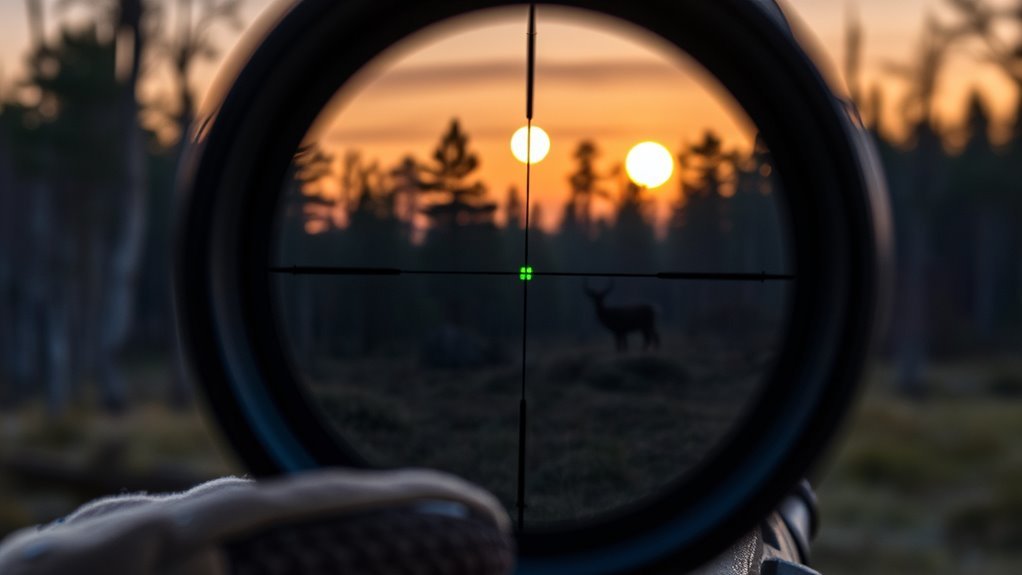
The best reticles for low-light shooting combine a highly visible aiming structure with restrained illumination. Bold outer posts, such as those used in German #4 and Duplex-style reticles, remain easier to find against dark backgrounds than very fine lines. A finely adjustable illuminated center point can improve visibility further without overwhelming the sight picture.
Quick Answer
For low-light hunting, a German #4 or heavy Duplex-style reticle with a finely adjustable illuminated center point is usually the most practical choice. The bold outer posts remain easy to locate against dark backgrounds, while low-intensity center illumination gives you a clear aiming reference without excessive flare in twilight.
Key Takeaways
- Bold outer posts remain easier to see: Very fine reticle lines can blend into dark vegetation, while thicker outer bars continue to provide a visible frame around the aiming point.
- Low illumination matters more than maximum brightness: In deep twilight, an illuminated point that is too bright can flare and obscure detail around the target.
- German #4 keeps the upper field open: Its three bold posts provide strong visual guidance without placing a heavy post at the top of the sight picture.
- FFP visibility depends on reticle design: First Focal Plane reticles become visually smaller at low magnification, so bold outer features or useful illumination can make a major difference.
- Exit pupil matters, but objective size alone does not: Magnification, exit pupil, contrast, transmission, coatings, and reticle design all affect what you can see in fading light.
What Makes a Good Low-Light Reticle?
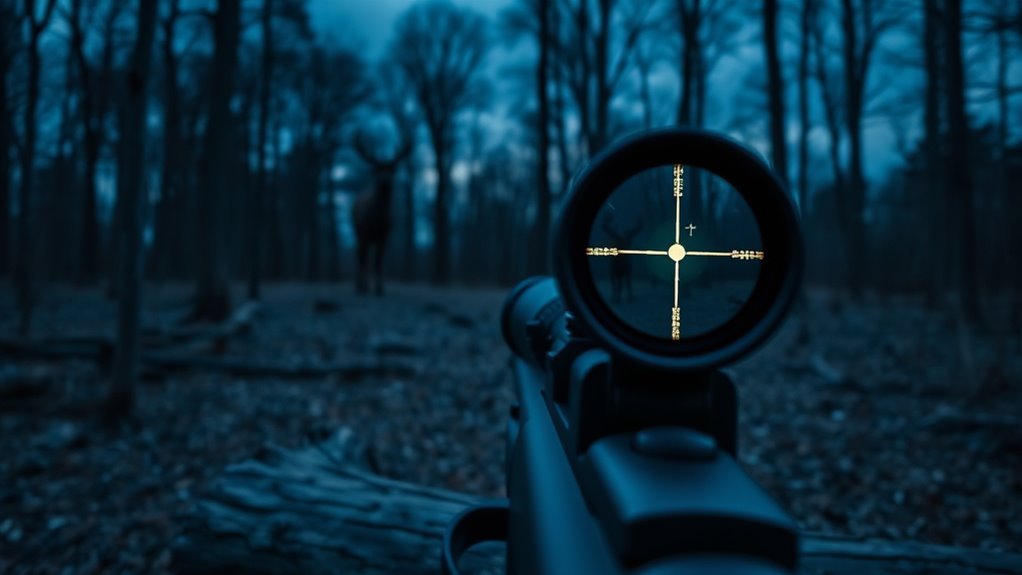
During lawful dawn and dusk hunting periods, both the optical system and the reticle become harder to use as contrast falls. Fine reticle markings that look crisp in bright daylight can blend into dark vegetation or an animal’s outline. Angular measurements such as Minutes of Angle (MOA) and milliradians describe reticle spacing and subtension, but line visibility still depends on the actual reticle design, magnification, background, and available light.
An effective low-light reticle balances three main factors:
- Subtension and Contrast: The visible portions of the reticle need enough thickness and contrast to remain distinguishable against dark or low-contrast backgrounds.
- Natural Visual Gating: Bold posts, tapered bars, circles, or other simple geometric features can guide your eye toward the center even when the finest part of the crosshair is difficult to resolve.
- Controlled Illumination: Illumination should adjust low enough for twilight use. Maximum brightness is useful in daylight, but the lowest usable settings often matter more after sunset approaches.
Note: An illuminated reticle does not amplify ambient light or turn a conventional riflescope into night vision. It only makes the aiming reference easier to see. Image quality still depends on available light, optical transmission, contrast, magnification, exit pupil, and the quality of the scope’s optical system.
Why Illuminated Reticles Help at Dawn and Dusk
Illumination can turn a hard-to-see crosshair into a distinct aiming reference, but more brightness is not automatically better. As ambient light falls, the eye becomes more sensitive to light and the pupil enlarges, although the amount varies by age, individual physiology, and adaptation conditions. A reticle that is excessively bright can cause flare around the aiming point, reduce local contrast, and interfere with useful dark adaptation.
In deep twilight, the most useful illuminated reticle is often the one that can be dimmed enough to remain visible without flaring across or obscuring the target.
Manufacturers use several illumination approaches, but two broad designs are common:
- Center-Only Illumination: Only the central dot, cross, or small aiming element glows. This keeps most of the reticle dark and can provide a clean aiming reference against low-contrast backgrounds. Some Trijicon AccuPoint models use fiber-optic and tritium-based illumination rather than relying solely on a conventional battery-powered LED.
- Broader Reticle Illumination: Some scopes illuminate larger portions of the crosshair or graduated reticle. This can work well when the brightness range is appropriate, but too much illumination in deep twilight may create flare or visual clutter. The quality of the dimming system matters more than whether the illuminated area is large or small.
Red is a common reticle color for low-light use because very dim red illumination can be less disruptive to useful dark adaptation than a bright white light. However, red is not universally superior for every user or background. Green can appear very conspicuous to the human eye at low power settings. In practice, brightness range, contrast against the target, and personal visibility matter more than choosing a color by itself.
Warning: Check the lowest illumination setting before relying on a scope for twilight use. If the center point blooms, throws visible flare into the tube, or hides detail around the aiming area, the setting is too bright for those conditions.
[Amazon Products Picked for You]

Optical scope with fiber optic sight for quick and accurate acquisition

Purpose Built to Hunt: Hair-splitting contrast, resolution and supreme low-light performance are yours for the taking in this optical upgrade of our legendary Banner series. It's built tough for deadly accuracy when you need it most. It’s Purpose-Built to Hunt.

3-9x40 Configuration: This hunting rifle scope offers a 3-9x magnification range and a 40mm objective lens to gather plenty of light for a bright, clear image, even in low-light conditions like dawn or dusk.
Duplex vs. German #4 for Low-Light Use
Simple hunting reticles remain popular because they provide a clear aiming reference without filling the sight picture with unnecessary marks. Complex graduated grids can be useful for specialized applications, but bold thick-to-thin designs are usually easier to interpret when contrast becomes poor.
| Reticle Type | Optical Layout | Primary Low-Light Advantage | Best Practical Application |
|---|---|---|---|
| Duplex / Heavy Duplex | Four thicker outer sections taper toward a finer central crosshair | Strong visual centering from all four directions with an uncluttered center | General hunting across mixed cover and open terrain |
| German #4 | Three bold posts at the sides and bottom with an open upper field and finer center | Bold visual references while leaving the upper sight picture relatively open | Woodland, brush, and other low-contrast hunting environments |
| Illuminated Center Dot | Duplex, German-style, or fine crosshair with a small illuminated center point | Keeps the exact aiming reference visible when the unlit center becomes difficult to see | Twilight conditions where carefully controlled illumination is useful |
| BDC / Graduated | Central aiming point with additional elevation-reference marks | Provides extra reference marks, although visibility depends heavily on line thickness and illumination | Open terrain where a user wants additional references without a dense grid |
| MIL / MOA Grid | Multiple hash marks or dots arranged in a graduated pattern | Offers detailed reference information, but fine grids can become visually busy in poor light | Specialized precision use where the extra reference marks are genuinely needed |
[Amazon Products Picked for You]

4X15MM DUPLEX RETICLE

✔【4-16x44AO Rifle Scope for Hunting】:This 4-16x44AO rifle scope provides versatile magnification for hunting and target shooting. The 44mm objective lens delivers a clear sight picture and dependable performance for medium to long range use, length:12.72"(323mm);exit pupil diameter:85mm ~ 96mm;field of view:10’-23’@100yds; Windage and elevation click value:1/4 MOA 1/4"@100 yards.

Precision Aiming: The 4x magnification scope features 1/4 MOA click adjustments for precision accuracy
The Heavy Duplex
The Duplex reticle was introduced by Leupold in 1962 and is defined by heavy outer posts that narrow toward a finer center. That thick-to-thin pattern is useful in low contrast because the outer portions remain easier to locate while the center stays relatively precise. A heavier variation increases the prominence of those outer bars further.
The design’s main advantage is simplicity. Even when the finest central lines become difficult to see, the heavier outer portions still provide a clear visual path toward the center of the sight picture. The tradeoff is that extremely thick posts can cover more of the surrounding scene than a finer reticle.
The German #4 Standard
The German #4 is a European-influenced hunting design with bold side and lower posts and a comparatively open upper field. That geometry gives the eye several strong reference points without placing a heavy post at the 12 o’clock position. Illuminated versions commonly add a small central point or cross for additional contrast in dim conditions.
Its uncluttered layout is especially useful when the background contains dark timber, brush, or shadows. The benefit comes from visibility and simplicity rather than from any special ability to increase the amount of light reaching the eye.
Pro Tip: When comparing low-light reticles, inspect them at the lower magnification settings you are likely to use in fading light. A design that looks excellent at high power may become surprisingly fine or difficult to see after magnification is reduced.
FFP vs. SFP: The Low-Light Tradeoff
First Focal Plane (FFP) and Second Focal Plane (SFP) scopes change the apparent behavior of the reticle as magnification changes. Neither system is automatically better in all low-light situations; the result depends on reticle design, magnification, illumination, and how much reference information you need.
[Amazon Products Picked for You]

BATTERY-FREE ILLUMINATION: Features a tritium/fiber optic illuminated reticle that automatically adjusts the brightness based on available light RUGGED ALUMINUM-ALLOY...
Why Fine FFP Reticles Can Be Harder to See at Low Power
In an FFP scope, the reticle scales together with the viewed image. At higher magnification, its features appear larger. At lower magnification, those same features appear smaller. That scaling preserves the reticle’s angular relationship to the target, but a very fine FFP design can become difficult to see against dark backgrounds when the scope is turned down.
Lower magnification is often useful in poor light because it increases the scope’s exit pupil. The basic nominal relationship is:
Exit Pupil (mm) = Objective Lens Diameter (mm) ÷ Magnification Power
For example, a nominal 3–18x50mm scope produces an exit pupil of about 2.8mm at 18x. At 4x, the nominal exit pupil is 12.5mm. An exit pupil larger than your own pupil does not force additional light into the eye, but reducing magnification can prevent a small exit pupil from becoming the limiting factor in twilight.
This creates a practical design issue with some FFP reticles: the magnification setting that produces a larger exit pupil may also make a fine reticle look very small. Bold perimeter features or carefully controlled center illumination can help maintain visibility.
Why SFP Remains Popular for Low-Light Hunting
In an SFP scope, the reticle remains the same apparent size as magnification changes. When magnification is reduced, a bold Duplex or German-style reticle therefore stays visually prominent rather than shrinking with the image. This is one reason simple SFP reticles remain common in hunting optics.
The tradeoff is that graduated SFP reticle subtensions are generally calibrated for a particular magnification specified by the manufacturer. For a hunter whose priority is simply keeping a clear aiming reference visible in poor light, however, the constant apparent reticle size can be an advantage.
BDC and MIL/MOA Reticles in Low Light
Graduated reticles add reference marks that simple Duplex and German #4 designs do not provide. The drawback is visual complexity. When contrast drops, tiny numbers, dots, and fine hash marks can be harder to distinguish, particularly if the complete reticle is illuminated too brightly.
- BDC Reticles: These add elevation-reference marks below the primary aiming point. For low-light use, simpler designs with clearly separated marks are generally easier to interpret than densely packed patterns.
- MIL/MOA Reticles: These use angularly spaced dots or hash marks. In poor light, the usefulness of the grid depends on line thickness, focal plane, magnification, and illumination. A clearly visible central aiming feature can be more useful than illuminating every fine mark.
For additional manufacturer education on reticles, focal planes, and angular measurement, see the Vortex Optics education library.
How to Match Your Reticle to Your Hunting Environment
The most useful low-light reticle is the one that stays visible in the terrain and lighting conditions you actually encounter. Instead of choosing by reticle name alone, compare contrast, complexity, illumination range, and focal-plane behavior.
- Dense Timber and Brush: Favor an uncluttered German #4, heavy Duplex, or similarly bold hunting reticle. Strong outer references are easier to locate when the background is dark and visually busy.
- Mixed Agricultural Land and Open Fields: A bold center structure with a small number of additional reference marks can provide a useful balance between visibility and information.
- Open or Mountain Terrain: If you genuinely need a graduated FFP reticle, choose one with visible perimeter features and controllable center illumination. Do not judge twilight performance from objective diameter alone; magnification, exit pupil, contrast, transmission, and reticle visibility all contribute.
Large objective lenses can support a larger exit pupil at a given magnification, but a larger objective does not automatically make one scope superior in twilight. Optical quality, coatings, internal design, contrast, magnification, eye position, and reticle visibility remain important. Manufacturers such as ZEISS Hunting Optics publish transmission, exit-pupil, reticle, and other optical specifications that are more useful when considered together than any single objective-diameter number.
Low-Light Reticle Selection Checklist
- Check the reticle with illumination switched off: Bold outer references provide a useful fallback if a battery is depleted or illumination is unavailable.
- Inspect the lowest illumination setting: Twilight performance depends heavily on how dim the reticle can go without disappearing completely.
- Check low magnification: This is especially important with FFP optics because the reticle shrinks as magnification decreases.
- Look for an uncluttered center: Extra reference marks are useful only when you can still identify the main aiming point quickly.
- Consider exit pupil at the magnification you actually expect to use: A large objective paired with very high magnification can still produce a small exit pupil.
- Check the illumination controls: Controls should be easy to adjust without forcing you to cycle repeatedly through unnecessarily bright settings.
- Account for battery dependence: If the reticle requires electronic illumination to remain usable, keep the battery condition in mind and follow the manufacturer’s maintenance recommendations.
Warning: Better low-light optics do not extend legal hunting hours or replace positive target identification. Follow the current rules for your species and jurisdiction, confirm what you are looking at, and never take a shot unless the target and what lies beyond it can be identified safely.
Frequently Asked Questions
What is the best reticle color for low-light conditions?
There is no universally best color. Red is common because very dim red illumination can work well while preserving useful dark adaptation, but green may appear brighter or easier to see for some users. The more important feature is a wide brightness range that lets you reduce illumination enough to avoid flare and target washout.
Why do fine FFP reticles disappear at low magnification?
An FFP reticle scales together with the viewed image. When magnification is reduced, fine lines and small markings appear smaller as well. Against dark vegetation or other low-contrast backgrounds, those details can become difficult to distinguish unless the reticle includes bold outer features or useful illumination.
Is an illuminated reticle necessary for low-light hunting?
No. A bold German #4, heavy Duplex, or similar reticle can remain usable without illumination. A dimmable center point can make the exact aiming reference easier to see in twilight, but the illumination should complement a visible reticle rather than compensate for an otherwise unusable design.
What is the difference between a Duplex and a German #4 reticle?
A Duplex uses four heavier outer sections that taper toward a finer center. A German #4 typically emphasizes the side and lower posts while leaving the upper part of the sight picture more open. Both rely on bold outer geometry to guide the eye toward a relatively fine central aiming point.
How does scope exit pupil affect reticle visibility?
Exit pupil is the diameter of the light beam leaving the eyepiece and is commonly estimated by dividing objective diameter by magnification. As magnification rises, exit pupil becomes smaller. In fading light, a very small exit pupil can make the viewed image appear dimmer and make low-contrast reticle details harder to distinguish.
Does a larger objective lens automatically make a scope better in low light?
No. A larger objective can support a larger exit pupil at the same magnification, but low-light performance also depends on transmission, contrast, coatings, optical design, magnification, eye position, and reticle visibility. Objective diameter should be evaluated as one part of the complete optical system.
Is FFP or SFP better for low-light hunting?
Neither is automatically better. SFP keeps the reticle the same apparent size when magnification is reduced, which can help a bold hunting reticle stay visible. FFP keeps reticle subtensions consistent through the magnification range but may make a very fine reticle harder to see at low power. Reticle design and illumination are therefore just as important as focal plane.
Conclusion
For low-light hunting, visibility and simplicity matter more than reticle complexity. A German #4, heavy Duplex, or similar bold hunting reticle gives your eye strong visual references when contrast fades, while a finely adjustable illuminated center point can keep the exact aiming reference visible without flooding the sight picture with unnecessary light.
Focal plane, magnification, exit pupil, optical quality, and illumination range all affect the result, so no single reticle design is automatically best for every scope or hunter. Choose a reticle that remains understandable without illumination, stays visible at the magnification settings you actually use, and can be dimmed enough for twilight. Above all, better low-light visibility never replaces lawful shooting hours, positive target identification, or a safe background.
Sources
- Leupold Optics — MOA vs. MIL — Manufacturer guidance on angular measurements used in riflescope reticles.
- Trijicon AccuPoint — Manufacturer information on illuminated hunting riflescopes and fiber-optic/tritium illumination systems.
- Vortex Optics Education Library — Manufacturer education covering reticles, focal planes, riflescope setup, and optical concepts.
- ZEISS Hunting Optics — Manufacturer information on hunting riflescopes, reticles, illumination, transmission, and low-light optical performance.
