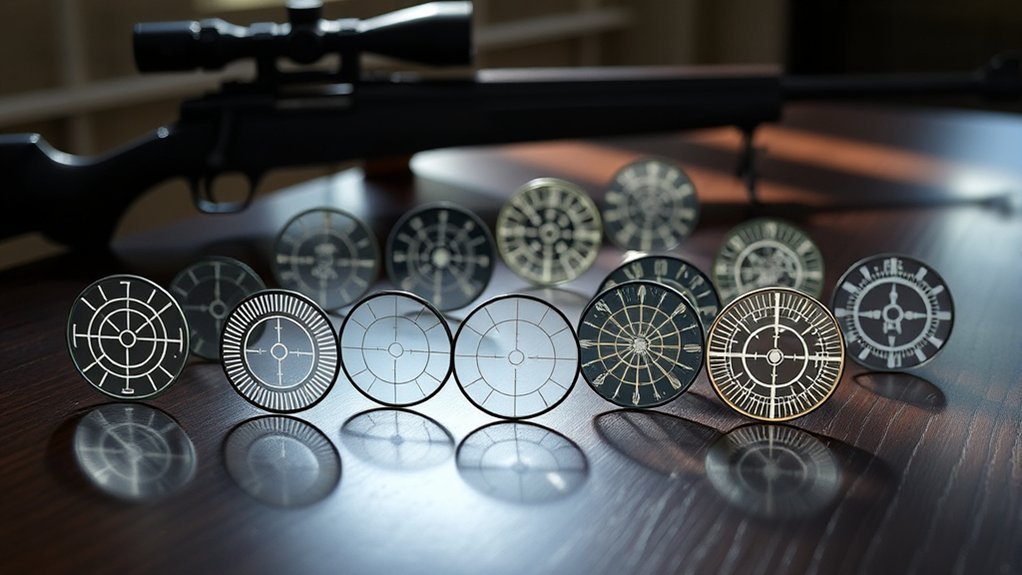
Choosing the right reticle type starts with three questions: how simple you want the sight picture to be, whether you need extra reference marks, and how easy the reticle is to see in your normal lighting conditions. Duplex and traditional crosshair reticles keep the view clean. BDC reticles add pre-marked references that depend on the specific design. MOA and MIL/MRAD reticles use measured angular references, while illuminated reticles improve contrast without changing the basic reticle system. Also check whether the scope uses a first focal plane or second focal plane design, because that affects how measurement-based markings behave as magnification changes.
Quick Answer
For a simple, uncluttered sight picture, a duplex or traditional crosshair reticle is usually the easiest type to understand. BDC reticles add pre-marked references, while MOA and MIL/MRAD reticles use measured angular markings and require more familiarity with the system. An illuminated reticle can improve contrast against dark backgrounds. On variable-power scopes, also check whether the reticle is first focal plane or second focal plane, because focal-plane design affects measurement-based markings as magnification changes.
Key Takeaways
- Traditional crosshair and duplex reticles work well when you want a simple, uncluttered sight picture.
- BDC reticles use additional reference marks, but their meaning varies by reticle and manufacturer.
- MIL/MRAD and MOA reticles use angular reference systems rather than universal distance markings.
- Illuminated reticles improve contrast in difficult lighting, but illumination does not replace clear target identification.
- Focal-plane design, reticle complexity, lighting conditions, and your comfort with the markings should all influence your choice.
Reticle Types at a Glance
| Reticle Type | Main Characteristic | Learning Curve |
|---|---|---|
| Traditional Crosshair / Duplex | Simple center reference with little visual clutter | Low |
| Illuminated | Adds illuminated contrast to a reticle design | Low |
| BDC | Uses additional references defined by the reticle maker | Moderate |
| MOA | Uses minute-of-angle reference markings | Moderate |
| MIL / MRAD | Uses milliradian-based reference markings | Moderate |
| Christmas-Tree / Grid | Uses a dense field of reference marks | Higher |
Understanding Reticle Types
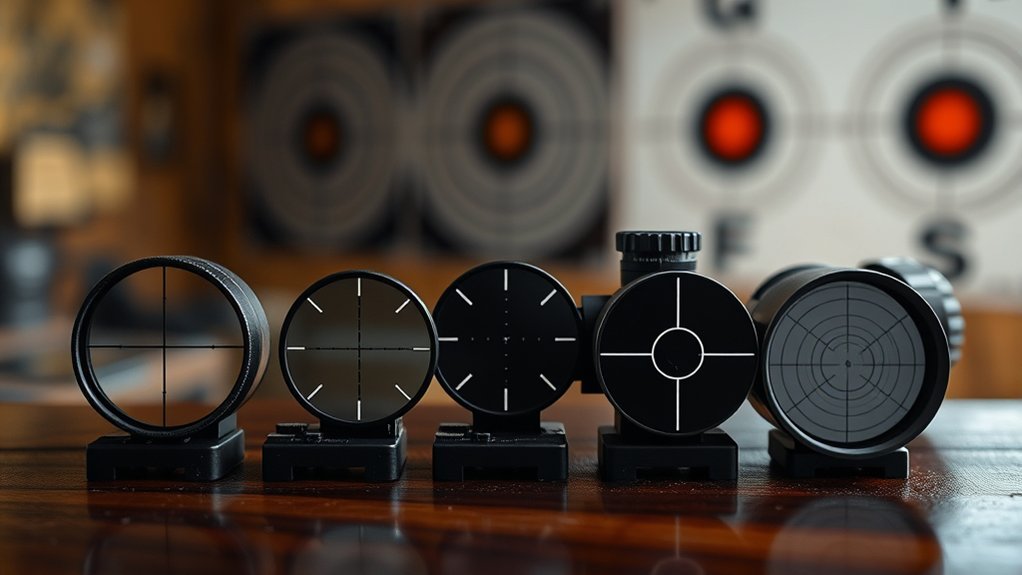
A reticle is the aiming pattern visible inside an optic. It may consist of two simple crossing lines or include dots, hash marks, circles, grids, illumination, or other reference features.
Each design presents information differently. BDC reticles use additional references whose intended meaning is defined by the manufacturer. MOA reticles use Minute of Angle markings, while MIL or MRAD reticles use milliradian-based markings. Illuminated designs add visible contrast to part or all of the reticle. More complex grid-style designs provide many references but also create a busier sight picture.
The best design is therefore not automatically the one with the most markings. A simple duplex can be easier to see and understand, while a measurement-based reticle may suit someone who specifically wants an angular reference system. Before buying, compare the reticle diagram, focal-plane type, turret units, illumination controls, and the manufacturer’s documentation.
For manufacturer explanations of common terminology, see the Vortex Optics FAQ and Leupold FAQ.
Note: A reticle does not replace safe firearm handling, correct optic installation, manufacturer instructions, or clear target identification. Use firearms only in lawful, controlled settings and follow all applicable safety rules.
Traditional Crosshair Reticles
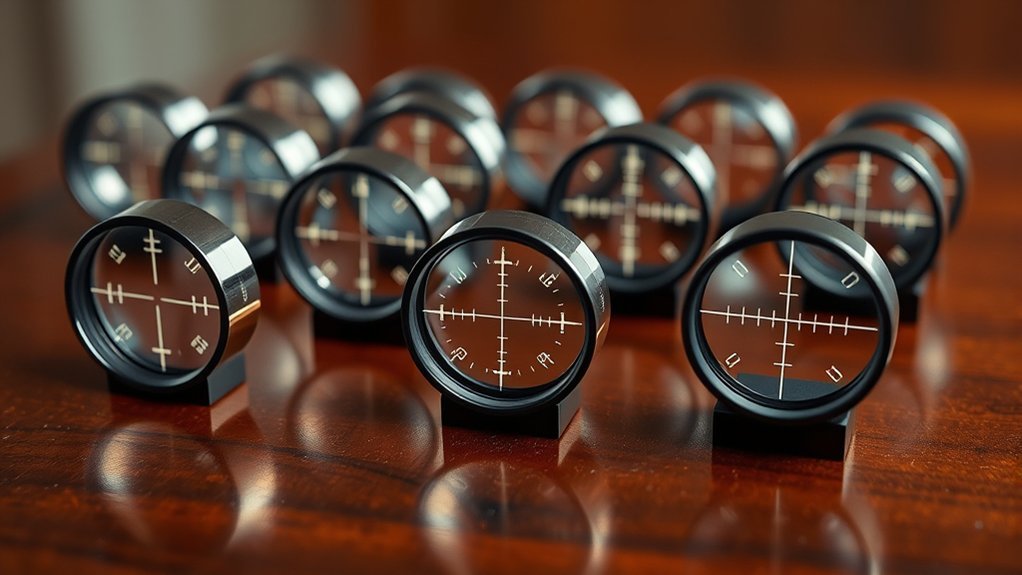
Traditional crosshair reticles remain popular because they are simple, clean, and easy to understand. They normally use horizontal and vertical lines that meet at the center, without a large number of additional markings competing for attention.
The main advantage is a clear sight picture. Thin center lines cover less of the viewed object, while thicker outer portions can make the reticle easier to locate against visually busy backgrounds.
A common variation is the duplex reticle. It combines heavier outer posts with finer lines toward the center. Leupold describes its Duplex design in the same general way: heavy outer lines guide the eye toward a finer central crosshair.
A traditional crosshair or duplex design is a practical choice when low visual clutter and a short learning curve matter more than having numerous reference marks.
Illuminated Reticles
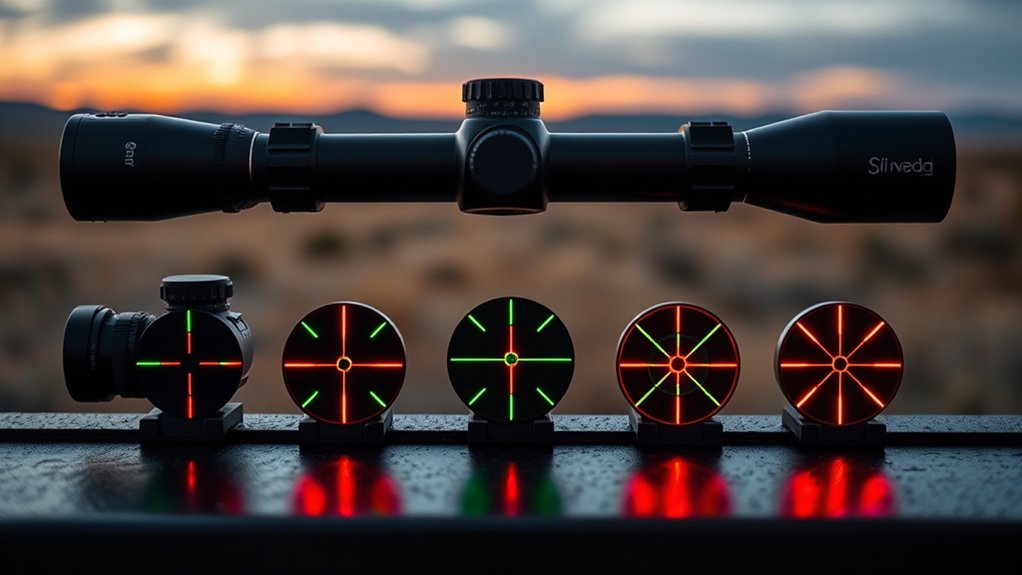
Illuminated reticles add a lighted element to the aiming pattern. Depending on the optic, that may be a center dot, part of the crosshair, or a larger portion of the reticle.
The main benefit is contrast. A black reticle can become difficult to distinguish against a dark or cluttered background, while illumination can make the center reference easier to locate. Many optics provide multiple brightness settings so the illuminated portion can be adjusted for surrounding light.
Color options vary by product. Red and green are common, but the available color and control system depend on the optic.
Illumination should remain a supporting feature rather than overwhelm the sight picture. Excessive brightness can create glare or obscure fine visual detail, so users should follow the optic manufacturer’s instructions for the lighting conditions in which the product is used.
Warning: An illuminated reticle does not make poor visibility safe. You still need to clearly identify what you are viewing and what is around and beyond it before handling or using any firearm.
BDC (Bullet Drop Compensation) Reticles
BDC reticles add extra reference marks to the main reticle. Those markings are arranged according to the particular reticle design rather than a single universal BDC standard.
Treat the manual for the exact optic and reticle as the controlling reference for what each BDC mark represents.
BDC is short for Bullet Drop Compensation, but that name should not be interpreted as meaning every BDC reticle behaves the same way. Layout, spacing, intended setup, and labeling can differ among manufacturers and products.
When comparing BDC designs, focus on these characteristics:
- Reticle Documentation: Check whether the manufacturer clearly explains each reference mark.
- Visual Clutter: More marks provide more visual information but can make the sight picture busier.
- Focal Plane: Confirm whether the scope is first focal plane or second focal plane.
- Compatibility Information: Follow the manufacturer’s documentation for the exact optic rather than assuming markings are interchangeable between scopes.
A BDC reticle is therefore best viewed as a manufacturer-defined reference system. Before relying on any markings, read the manual for the exact optic and reticle combination.
Mil-Dot Reticles
Mil-Dot reticles use references based on milliradians, commonly written as mil or MRAD. A milliradian is an angular unit rather than a fixed distance measurement.
Modern mil-based reticles may use dots, hash marks, or more complex grids. The exact spacing, labeling, and appearance vary, so the manufacturer’s reticle diagram is more useful than assuming every product follows the same visual pattern.
The table below summarizes what should be checked when comparing a mil-based optic:
| Feature | What It Means | What to Confirm |
|---|---|---|
| MIL / MRAD markings | Angular reference system | Exact subtensions in the optic manual |
| Focal plane | How the reticle appears as magnification changes | FFP or SFP specification |
| Turret units | Measurement system used by the optic controls | MIL/MRAD or another unit |
Focal-plane design is particularly important with measurement-based reticles. In a first focal plane scope, the reticle and viewed image scale together. In a second focal plane scope, the reticle appears to remain the same visual size as magnification changes. Always check the manufacturer’s stated subtension behavior for the specific model.
Pro Tip: Keeping the reticle and turret measurement systems consistent can make the optic easier to understand because you do not have to switch between two different angular units.
MOA (Minute of Angle) Reticles
An MOA reticle uses Minute of Angle as its angular reference system. MOA is an angular measurement used on many optics for reticle markings and turret adjustments.
One MOA is approximately 1.047 inches at 100 yards. It is often rounded to about one inch at 100 yards for a simple mental reference. The Vortex Optics FAQ likewise describes MOA and MRAD as angular units of measurement.
Understanding MOA Measurements
The key point is that MOA describes an angle, not one fixed physical distance. The physical span represented by that angle changes with distance.
- Angular Reference: MOA markings provide a repeatable angular scale.
- Reticle Marks: Hash marks or other references may be labeled in MOA increments.
- Turret Units: Some optics also use MOA-based turret adjustments.
- Manufacturer Specifications: Exact reticle spacing and control increments should be confirmed in the manual for the specific scope.
This is why the scope manual matters. Reticle patterns and turret increments are product specifications, not assumptions that should be carried from one optic to another.
Benefits of MOA Reticles
One benefit of an MOA reticle is that it gives the user a consistent angular measurement system instead of an unmarked sight picture.
MOA reticles commonly use hash marks or other repeated references. How dense those markings are depends on the design: some stay relatively simple, while others contain much more information.
If the scope’s turrets also use MOA, the reticle and controls share the same measurement language. That can make the optic easier to learn than a setup that combines different systems.
Christmas-Tree and Grid Reticles
Christmas-tree or grid reticles place a larger pattern of horizontal and vertical references below the center of the sight picture. Their shape can resemble a widening tree or grid, which is where the informal name comes from.
The main trade-off is information versus visual simplicity. A grid offers more reference points than a duplex or basic hash-mark reticle, but it also places more lines and markings in the field of view. That can be useful to a user who understands the system and distracting to someone who prefers a minimal sight picture.
If you are considering a tree-style reticle, inspect the manufacturer’s diagram at both low and high magnification and confirm the focal-plane type. Do not choose one simply because it appears more advanced; choose it only if you understand what the markings represent.
Selecting the Right Reticle for Your Needs
Select a reticle by matching its complexity and visibility to your intended environment and your familiarity with the system. The most complicated design is not automatically the most useful one.
Before choosing, compare the distances and environments in which the optic will legally be used, the amount of visual clutter you are comfortable with, whether illumination matters to you, and how much time you want to spend learning the markings.
Purpose of Reticle Type
The reticle affects how quickly you can recognize the center reference and how much additional visual information appears around it. Use these five questions as a simple selection framework:
- How much visual information do you want? A duplex is minimal, while grid-style designs are much denser.
- Will the reticle be viewed against dark or cluttered backgrounds? Bold lines or illumination may be easier to distinguish.
- Do you want a measured angular system? MOA and MIL/MRAD are measurement-based reticle families.
- What focal plane does the scope use? This affects how measurement-based markings behave as magnification changes.
- Does the manufacturer clearly document the reticle? A detailed manual or reticle diagram reduces guesswork.
Reticle Style Preferences
Different reticle styles emphasize different priorities. The best choice is the design you can understand quickly without unnecessary visual clutter.
| Reticle Style | Main Strength | Main Trade-Off |
|---|---|---|
| Duplex | Simple sight picture | Few additional references |
| MIL / MRAD | Measured angular references | Requires familiarity with the system |
| BDC (Bullet Drop Compensation) | Manufacturer-defined additional references | Meaning varies by reticle and setup |
| MOA | Measured angular references | Requires familiarity with the system |
| Christmas-Tree / Grid | Large number of reference marks | Busy sight picture and higher learning curve |
Compare the actual reticle diagram rather than choosing only by category name. Two reticles in the same general family can still look and behave differently.
First Focal Plane vs. Second Focal Plane Reticles
Reticle placement inside a variable-power scope also matters. Most such scopes use either a first focal plane reticle or a second focal plane reticle.
In a first focal plane scope, the reticle appears to grow and shrink with the viewed image as magnification changes. Because the image and reticle scale together, their proportional relationship remains consistent.
In a second focal plane scope, the reticle appears to remain the same visual size while the viewed image changes with magnification. Measurement-based subtensions therefore depend on the magnification specified by the manufacturer.
Neither design is automatically better for every person. First focal plane designs keep the reticle proportional to the image, while second focal plane designs maintain a visually consistent reticle size. Leupold and Vortex both describe this fundamental FFP/SFP distinction in their manufacturer FAQs.
Matching Reticle and Turret Adjustments
Another specification worth checking is whether the reticle and turret controls use the same measurement system. For example, some optics use MIL/MRAD for both, while others use MOA for both.
A matching system is generally easier to understand because the markings and controls use the same units. A mixed system may still be a legitimate product design, but it requires the user to understand two measurement languages.
Before buying or configuring an optic, read the specification sheet and manual for the exact model rather than assuming the reticle and turret units match.
Common Reticle Selection Mistakes
A reticle can look impressive on a product page and still be a poor fit for the person using it. More markings do not automatically make an optic easier to understand.
Watch for these common mistakes:
- Choosing too much clutter: Extra dots, lines, and hashes have little value if you do not understand what they represent.
- Ignoring visibility: A very fine black reticle can be harder to distinguish against dark or visually busy backgrounds.
- Assuming all BDC reticles are the same: Their markings and intended use vary by manufacturer and design.
- Mixing measurement systems without realizing it: Check both reticle and turret units before buying.
- Forgetting focal-plane behavior: FFP and SFP reticles behave differently as magnification changes.
- Skipping the manual: The manufacturer’s reticle diagram and specifications should be your primary reference for the exact optic.
Reticle Care and Practice Tips
A reticle is part of an optical system, so visibility can also be affected by mounting condition, lens cleanliness, focus, lighting, and the optic’s adjustment settings.
Follow the manufacturer’s installation and inspection instructions for the exact model. If the reticle appears tilted, shifts unexpectedly, becomes difficult to focus, or otherwise behaves abnormally, stop using the optic and inspect the mounting system or seek qualified assistance.
For illuminated reticles, check the battery and controls according to the product manual. Keep the lenses clean with materials intended for optical surfaces, because fingerprints, moisture, dust, and glare can reduce image clarity and reticle contrast.
Frequently Asked Questions
What is the easiest reticle type to understand?
A traditional crosshair or duplex reticle is generally the easiest to understand because it keeps the sight picture simple and uses relatively few markings. A more complex reticle can provide more information, but it also takes more time to learn.
Is an illuminated reticle a different reticle system?
Not necessarily. Illumination is usually a visibility feature added to another reticle design. For example, a relatively simple reticle can have an illuminated center point, while a more complex reticle can also include illumination.
What is the difference between MOA and MIL reticles?
MOA and MIL/MRAD are two different angular measurement systems. Neither label alone makes a reticle universally better. The important points are understanding the system and checking whether the reticle and turret controls use matching units.
What is the difference between FFP and SFP reticles?
In a first focal plane scope, the reticle appears to scale with the viewed image as magnification changes. In a second focal plane scope, the reticle appears to remain the same visual size while the image changes. Check the manufacturer’s instructions for how measurement-based markings are specified on the exact scope.
Are BDC reticle marks universal?
No. BDC designs vary among manufacturers and products. The number, spacing, labeling, and intended interpretation of the marks should be confirmed in the documentation for the exact optic.
Conclusion
The main reticle types differ in how much information they place in the sight picture. A traditional crosshair or duplex emphasizes simplicity. An illuminated reticle adds contrast. A BDC reticle adds manufacturer-defined references. MOA and MIL/MRAD reticles use angular measurement systems, while Christmas-tree or grid reticles provide a denser field of markings.
The best reticle is not automatically the most complex one. Compare the reticle diagram, focal-plane design, measurement units, visibility, and manufacturer documentation before choosing. Above all, use the optic only with proper firearm-safety practices and follow the instructions for the exact model you own.