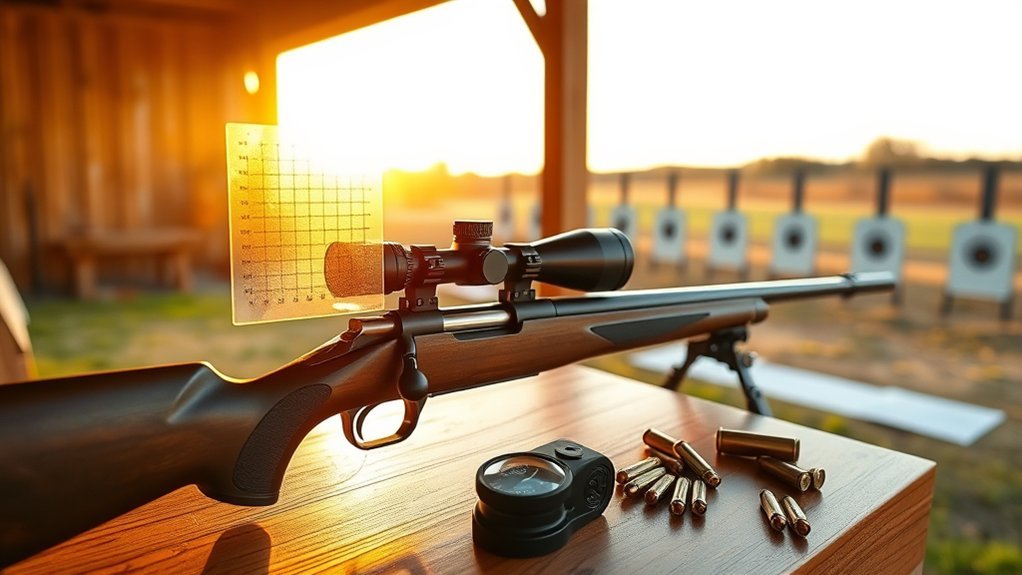
MOA and mils are both angular systems for scope adjustment, but they affect use differently. MOA equals about 1.047 inches at 100 yards and usually adjusts in 1/4 MOA clicks for finer corrections. A mil equals about 3.6 inches at 100 yards and commonly adjusts in 0.1 mil steps for faster corrections. Neither system is inherently more accurate. Accuracy depends on consistent application, matched reticles and turrets, and shooter familiarity. The sections ahead clarify practical tradeoffs.
MOA vs Mils: Key Differences
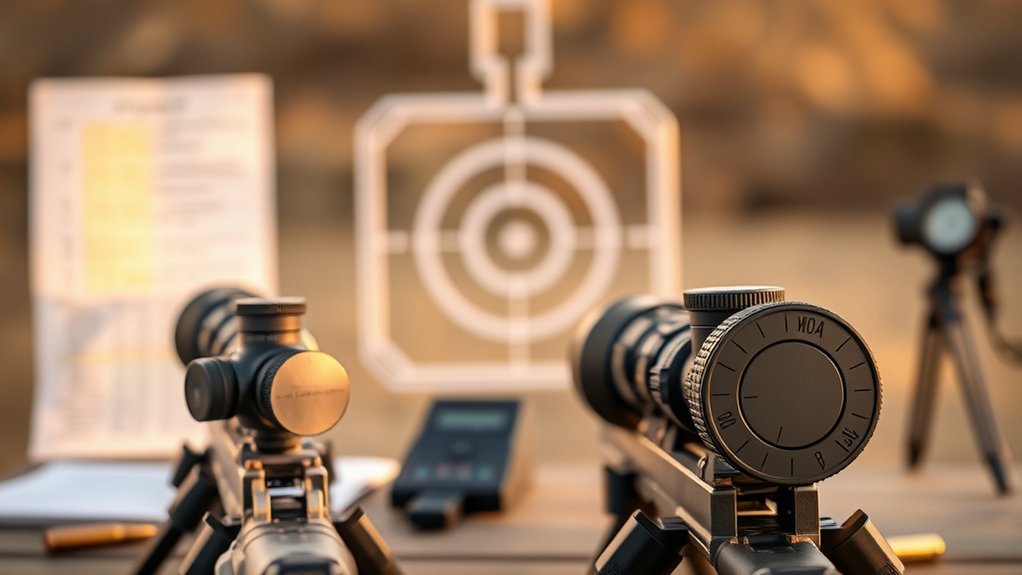
Precision defines the distinction between MOA and Mils. MOA represents one-sixtieth of a degree, an angular measurement yielding about 1.047 inches at 100 yards. Mil represents one-thousandth of a radian, covering about 3.6 inches at the same range. This difference shapes how a shooter interprets the reticle and applies corrections with disciplined independence.
MOA adjustments commonly move in 1/4 MOA clicks, allowing fine correction control valued in competition and target work. Mil adjustments usually move in 0.1 Mil increments, enabling faster dialing in tactical environments.
MOA favors fine-tuned precision, while Mil promotes quicker adjustment under tactical pressure and changing field conditions.
At 200 yards, MOA corresponds to roughly 2.094 inches, while a Mil spans about 7.2 inches. Because both systems govern sight correction through angular measurement, conversion knowledge strengthens autonomy; 1 Mil equals about 3.438 MOA.
A shooter choosing between them should assess preferred reticle format, correction speed, and application context rather than assume one system grants universal superiority in all conditions.
How MOA and Mils Scale
The practical difference becomes clearer when each system is viewed across distance. MOA and Mil are angular measurements, so their linear value expands as range increases. One MOA equals 1/60th of a degree and moves impact about 1.047 inches at 100 yards. At 200 yards, that same MOA spans about 2.094 inches. This scaling requires shooters to understand how adjustments translate as distance changes.
A Mil follows the same angular principle but uses a decimal-friendly relationship. At 100 meters, 1 Mil equals 10 centimeters, and at 100 yards it measures roughly 3.6 inches.
Because the Mil system maintains a consistent metric scale, calculations often feel more direct during long-range shooting. Conversion also matters: 1 Mil is about 3.438 MOA.
That relationship helps a shooter move between systems without dependence on guesswork. Mastery of either scale supports clearer corrections, more deliberate adjustments, and greater freedom from confusion under changing field conditions.
Do MOA or Mils Improve Accuracy?
Accuracy does not come from MOA or Mil alone; it comes from how precisely a shooter applies the chosen adjustment system. Both systems can support high accuracy because each provides repeatable angular corrections for bullet impact.
MOA is often favored in precision target work because its finer adjustments can permit smaller point-of-impact changes at 100 yards. Mil, by contrast, shifts impact about 3.6 inches at 100 yards and uses a consistent angular scale that can simplify ranging and corrections across changing distances.
The practical advantage appears when the shooter understands the reticle, memorizes the unit logic, and executes adjustments without hesitation. Familiarity liberates performance from confusion, wasted motion, and calculation errors.
A disciplined shooter using MOA can achieve excellent accuracy, while an equally trained shooter using Mil can do the same. The decisive factor is not the label on the turret or reticle, but proficiency, consistency, and rapid application under real shooting conditions and stress.
MOA vs Mils: Scope Clicks Compared
MOA and mil scope clicks differ first in click value: MOA turrets commonly adjust in 1/4 MOA increments, while mil turrets typically adjust in 0.1 mil increments.
This produces different movement per click, with MOA generally offering finer correction and mils often covering more distance per adjustment, especially as range increases.
A clear comparison of click size and conversion values helps determine adjustment speed and supports consistent, error-free use of one system.
Click Value Differences
When comparing click values, turret increment size determines how much correction each adjustment produces. MOA turrets commonly use 1/4 MOA per click value, shifting the reticle about 0.25 inches at 100 yards. MIL turrets usually use 0.1 mil per adjustment, moving impact about 1 cm at 100 meters or 0.36 inches at 100 yards.
| System | Typical Click | Shift at 100 |
|---|---|---|
| MOA | 1/4 MOA | 0.25 in |
| MIL | 0.1 mil | 0.36 in |
| 1 MOA | full unit | 1.047 in |
| 1 mil | full unit | 3.6 in |
Because 1 mil equals about 3.438 MOA, MIL corrections are inherently larger per unit. Mixed MOA reticle and MIL turrets impose extra conversion steps, limiting liberated, error-resistant adjustment discipline in field use.
Adjustment Speed Comparison
For many shooters, adjustment speed depends less on mechanical click rate than on how quickly the correction can be calculated and dialed.
In MOA vs mil systems, MOA adjustments usually move impact 1/4 MOA per click, about 0.25 inch at 100 yards. Mil adjustments commonly shift 0.1 mil per click, about 1 centimeter at 100 meters or 0.36 inch at 100 yards.
At 500 yards, 1 MOA equals about 5.235 inches, while 0.1 mil tracks near 5 inches. This affects adjustment speed under pressure.
Shooters working in inches may process MOA adjustments faster, while users of mil-based scopes often benefit from decimal math and consistent metric scaling.
Mixed systems, especially mil reticles with MOA turrets, can delay corrections and reduce precision when immediate, self-directed action is required in competition.
Should Reticles and Turrets Match?
Reticles and turrets function most efficiently when both use the same measurement system, such as MOA with MOA or Mil with Mil.
This alignment allows direct corrections through the reticle and turrets without conversion, which improves speed and reduces adjustment errors, especially since MOA turrets commonly move in 1/4 MOA and Mil turrets in 0.1 Mil increments.
A mixed configuration can still be used, but it introduces unnecessary complexity and increases the likelihood of confusion under time pressure.
Matching System Benefits
Because consistency is critical in precision shooting, matching the reticle and turret system—either MOA/MOA or Mil/Mil—provides a direct and coherent method for observing, calculating, and correcting impacts. This matching system streamlines adjustments, preserves focus, and supports disciplined shot execution under field pressure.
- MOA reticle with MOA turret uses one angular language throughout.
- Mil reticle with Mil turret simplifies ranging and dialing.
- Consistent adjustments reduce hesitation and cognitive load.
- Seamless integration improves speed, confidence, and repeatability.
A shooter using MOA across optic and turret can measure miss distance and dial corrections without translation. Likewise, a Mil-based setup offers the same efficiency, often favored for long-range or military use.
For those seeking operational freedom, a unified reticle-turret pairing delivers clarity, control, and cleaner decision-making behind the rifle.
Risks Of Mixing
Even a modest mismatch between reticle and turret units can introduce unnecessary complexity into the firing process. A matched MOA reticle with MOA turrets forms a coherent system, enabling direct observations and immediate adjustments without secondary math.
By contrast, a MIL reticle paired with MOA turrets forces constant conversion during engagement. That added step creates measurable risks. Because 1 MIL equals about 3.438 MOA, small conversion errors can compound into substantial point-of-impact deviations at extended range.
In practical use, mixed systems often slow correction speed, reduce confidence, and increase confusion under pressure. Long-range accuracy depends on consistency, especially when rapid follow-up adjustments are required.
For shooters seeking operational independence and cleaner decision-making, matching reticle and turret units remains the disciplined choice, minimizing avoidable errors and preserving precision.
Why Many Shooters Choose Mils
Many shooters choose MILs for their consistent scaling across distances and their faster, more intuitive adjustment system. For those seeking liberation from cumbersome math, MILs offer a cleaner framework than MOA adjustments. Because one mil equals about 3.6 inches at 100 yards, shooters can apply consistent adjustments with less hesitation during long-range work.
MILs free shooters from cumbersome math, offering cleaner adjustments and more confident long-range corrections with intuitive, consistent scaling.
A MIL reticle paired with decimal turrets also streamlines mental calculations, which supports quicker corrections under pressure.
- Decimal-based clicks simplify holds and turret dialing.
- Range estimation with mil markings improves field autonomy.
- Wind calls become faster and more repeatable.
- Team communication benefits from metric standardization.
In tactical, competition, and hunting contexts, this structure often increases speed and confidence. Precision shooters frequently value how MIL systems unify ranging, holding, and dialing within one method.
Many who undergo this change report fewer conversion errors, better rhythm on target, and a more efficient path to accurate impacts in dynamic shooting environments overall.
When MOA Makes More Sense
When MOA makes more sense is typically in short- to mid-range target shooting, where its angular value maps cleanly to familiar imperial measurements. For shooters seeking practical independence from cumbersome conversions, MOA lets them adjust scopes with fast, exact corrections per 100 yards. Its inch-based logic simplifies elevation and windage changes, especially when targets and score rings demand disciplined precision.
| Distance | 1 MOA value | Practical use |
|---|---|---|
| 100 yards | ~1.0 inch | Fine zero and group tuning |
| 200 yards | ~2.1 inches | Rapid visual correction |
In formats such as Fullbore, MOA often feels immediately usable because many competitors already think in inches. That familiarity reduces hesitation and supports liberated, self-directed shot correction. A 1/4 MOA click moves impact about 0.25 inches per 100 yards, which helps tighten groups without overcorrection. For short-range precision work, MOA consequently offers a highly intuitive, methodical adjustment framework for many shooters today.
How to Choose MOA or Mils
Choice between MOA and Mils should be based on the shooter’s measurement system, application, and speed of correction. MOA adjustments measure 1/60th of a degree, equaling about 1.047 inches at 100 yards, while Mil-based reticles divide space into thousandths of a radian, or about 3.6 inches at 100 yards. This distinction shapes choosing between MOA for imperial familiarity or Mils for decimal efficiency.
- Use MOA for precision target disciplines demanding fine angular correction.
- Use Mils for tactical or military contexts requiring fast decimal holds.
- Match turret and reticle systems to prevent conversion errors.
- Retain an existing system when continuity outweighs retraining.
Preference based on application remains the most practical filter. MOA often suits competition shooters working in yards and inches. Mils offer greater ease of use for shooters thinking in metric terms or making rapid field corrections.
If starting fresh, a Mil system often provides a more streamlined path to independent, efficient engagement.
Frequently Asked Questions
What Is More Accurate, MOA or MILS?
Neither is inherently more accurate; precision depends on shooter proficiency. In Precision shooting, MOA favors finer Scope adjustments, while MILs streamline Range estimation, Reticle types, and Ballistic calculations, enabling informed, self-directed correction and freedom.
How Many Mils Equal 1 MOA?
1 MOA equals approximately 0.291 mils. For liberated precision shooting, one applies this ratio in Moa adjustments, Mils measurements, Scope calibration, and Ballistic calculations, ensuring methodical, technically consistent corrections across distances and systems.
Do MILitary Snipers Use MIL or MOA?
Like a neon chronometer, military snipers generally use MIL, not MOA. This standard supports sniper training techniques, ballistic calculations, reticle types, range estimation, and windage adjustments, granting operators faster, freer, more consistent tactical precision.
How to Tell if a Scope Is MOA or MIL?
One determines whether a scope uses MOA or MIL by checking scope calibration, adjustment increments, and reticle types. Manufacturer specifications and reticle subtensions confirm range estimation standards, enabling liberated, methodical verification for optimized shooting precision.
Conclusion
Choosing between MOA and mils depends on application, training, and preferred workflow. Neither system increases inherent rifle accuracy; each provides an angular method for measuring correction and holdover. Matching reticles and turrets simplifies adjustment, while familiarity drives speed and consistency. Mils often suit tactical and practical shooting, whereas MOA may appeal to shooters wanting finer click granularity. In practice, selecting one system and mastering it is like calibrating a precise instrument for repeatable, efficient performance.
