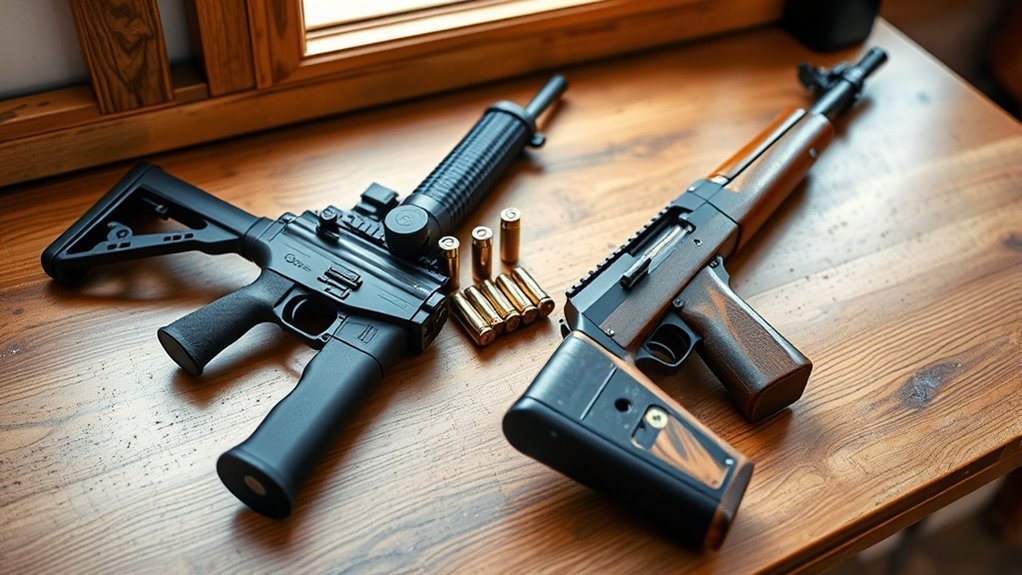
Assault rifles and battle rifles differ primarily in caliber, design, and tactical applications. Assault rifles use intermediate cartridges for mobility and rapid fire, with effective ranges of 300-500 meters. In contrast, battle rifles utilize full-powered cartridges, excelling in long-range accuracy and stopping power, effective up to 800 meters. While assault rifles are generally lighter and maneuverable, battle rifles are bulkier, providing greater lethality against hardened targets. Understanding these distinctions can enhance one’s knowledge of firearm capabilities and uses.
What’s the Difference: Assault Rifle vs. Battle Rifle?
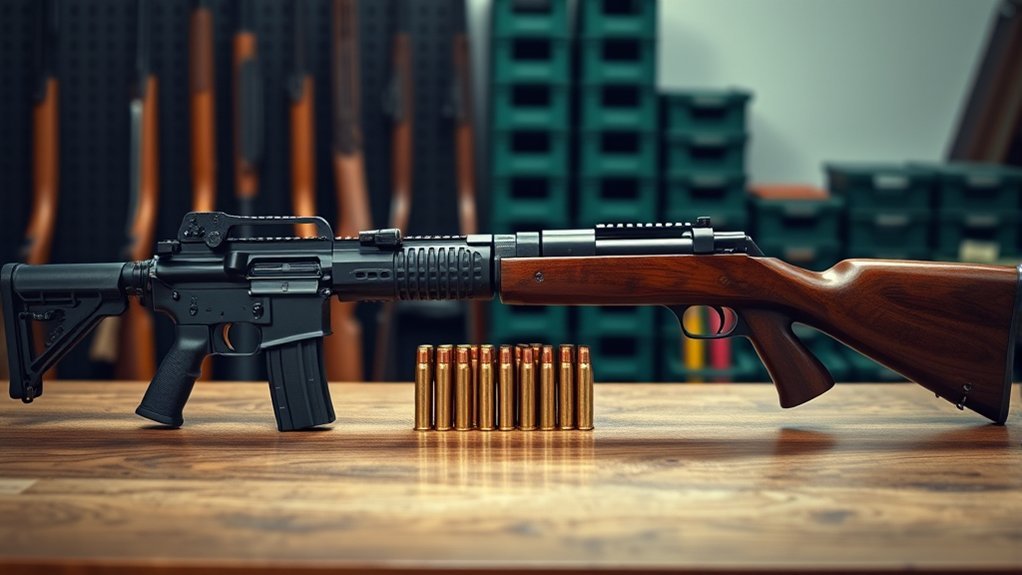
While both assault rifles and battle rifles serve critical roles in modern military arsenals, their fundamental differences lie in design, ammunition, and intended use.
Assault rifles, exemplified by models like the AK-47 and M16, utilize intermediate cartridges such as the 5.56×45mm NATO, offering a balance between recoil and rate of fire. Their effective range typically spans 300 to 500 meters, making them ideal for close to mid-range combat.
Assault rifles like the AK-47 and M16 balance recoil and fire rate, excelling in close to mid-range combat at 300 to 500 meters.
Conversely, battle rifles, like the FN FAL and M14, employ full-powered cartridges, such as the 7.62×51mm NATO, delivering superior stopping power and an effective range of 500 to 800 meters, suitable for long-distance engagements.
The weight and size of battle rifles can hinder mobility, whereas assault rifles are designed for maneuverability.
Both types often feature selective fire, enhancing combat effectiveness, but the evolution from battle rifles, standard during World War II, to assault rifles reflects changing military needs.
Historical Evolution: Assault vs. Battle Rifles
The evolution of firearms from battle rifles to assault rifles highlights significant advancements in military technology and tactics.
Battle rifles, such as the M1 Garand and SVT-40, emerged during World War I and II, utilizing full-power cartridges for long-range engagements.
The historical evolution began to change with the introduction of the StG 44 in 1944, recognized as the first successful assault rifle, employing the 7.92×33mm Kurz cartridge.
This paradigm shift continued post-World War II, as NATO shifted from battle rifles like the FN FAL to lighter designs, particularly the M16, which utilized the smaller 5.56×45mm NATO cartridge.
The AK-47, adopted by the Soviet Army in 1949, epitomized the global embrace of assault rifles, focusing on versatility and ease of production.
Tactical Applications: Range and Use Cases
Tactical applications of assault and battle rifles are defined by their unique characteristics and intended use cases in various combat scenarios.
Assault rifles, such as the AK-47 and M16, are engineered for effective engagements within 300-500 meters, making them suitable for urban combat where maneuverability and rapid response are essential.
Assault rifles like the AK-47 and M16 are designed for urban combat, excelling in rapid response and engagements within 300-500 meters.
In contrast, battle rifles like the FN FAL and M14 excel in long-range engagements, reaching effective shooting distances of 500-800 meters, providing greater precision and stopping power.
Key distinctions in tactical applications include:
- Engagement Range: Assault rifles operate effectively at shorter distances, while battle rifles dominate longer ranges.
- Stopping Power: Battle rifles deliver higher lethality against hardened targets.
- Maneuverability: Assault rifles are lighter, enhancing mobility.
- Sustained Fire: Assault rifles allow soldiers to carry more ammunition for continuous fire.
- Precision: Battle rifles offer superior accuracy for infantry operations.
Power and Precision of Assault and Battle Rifles
Assault rifles and battle rifles differ fundamentally in their power and precision, characteristics that greatly influence their operational effectiveness.
Battle rifles, such as the FN FAL and M14, fire full-power cartridges like the 7.62×51mm NATO, providing considerable stopping power and accuracy at ranges of 500 to 800 meters.
In contrast, assault rifles, exemplified by the AK-47 and M16, utilize intermediate cartridges like the 5.56×45mm NATO, allowing for rapid follow-up shots and lighter recoil. This design promotes adaptability in dynamic combat environments, enhancing maneuverability and enabling quicker target acquisition.
While the heavier rounds of battle rifles excel in penetrating tough materials for long-range engagements, assault rifles often necessitate multiple rounds for similar effectiveness against cover.
Ultimately, battle rifles are optimized for power and long-range precision, while assault rifles prioritize speed and tactical advantage in close to mid-range scenarios.
Design Features and Weight Considerations
Design features and weight considerations play an essential role in the operational effectiveness of assault and battle rifles. Assault rifles are engineered for mobility, being lighter and more compact, which facilitates quick maneuvering in various environments.
In contrast, battle rifles are larger and heavier, impacting overall agility in dynamic combat situations.
Key distinctions include:
- Modular Design: Battle rifles often allow customization but tend to retain weight due to full-power cartridge compatibility.
- Recoil Management: Assault rifles feature reduced recoil, enhancing target acquisition in close-quarters combat.
- Ammunition Capacity: Assault rifles permit soldiers to carry a greater quantity of lighter ammunition.
- Performance Impact: The bulkiness of battle rifles can hinder effectiveness during chaotic firefights.
- Combat Suitability: Streamlined assault rifle designs are advantageous in urban or unpredictable settings.
Choosing the Right Rifle for Your Needs?
Selecting the appropriate rifle requires careful consideration of purpose and functionality, as well as weight and maneuverability.
For operations in confined spaces or urban environments, an assault rifle offers advantages in rapid response and ease of handling.
Conversely, a battle rifle is better suited for long-range precision needs, albeit at the cost of increased weight and bulk.
Purpose and Functionality
When evaluating the purpose and functionality of rifles, one must consider the specific operational requirements and engagement scenarios. The choice between assault and battle rifles greatly impacts combat effectiveness.
- Assault rifles utilize intermediate cartridges, like the 5.56×45mm NATO, for rapid fire and lighter recoil.
- Designed for close-quarters combat, they excel in urban and dynamic environments.
- Battle rifles, such as the FN FAL, fire full-power cartridges like the 7.62×51mm NATO, offering greater stopping power.
- They are effective for engagements at distances between 500 to 800 meters.
Understanding mission requirements is vital, as assault rifles are better suited for tactical mobility, while battle rifles remain essential for long-range precision.
Selecting the appropriate rifle type guarantees ideal functionality in diverse combat situations.
Weight and Maneuverability
Weight and maneuverability are critical factors in determining the suitability of a rifle for specific combat scenarios. Assault rifles, like the M4 Carbine, typically weigh between 6 to 9 pounds, offering enhanced mobility for soldiers, especially in urban warfare. In contrast, battle rifles, such as the FN FAL, generally exceed 10 pounds, providing greater stopping power and range but sacrificing maneuverability.
| Rifle Type | Weight Range |
|---|---|
| Assault Rifles | 6 – 9 pounds |
| Battle Rifles | 10+ pounds |
The lightweight design of assault rifles facilitates quicker target acquisition and follow-up shots due to reduced recoil, making them highly effective in close-quarters combat. Ultimately, the choice between these rifles hinges on operational needs and engagement scenarios.
Frequently Asked Questions
Is an AR-15 Considered a Battle Rifle?
The AR-15 is not classified as a battle rifle due to its semi-automatic function, lightweight design, and intermediate cartridge. Misconceptions persist regarding its military applications, yet it primarily serves civilian purposes, emphasizing customization and performance metrics.
Is the AK-47 a Battle Rifle?
The AK-47 is not a battle rifle; it utilizes intermediate ammunition and features a design focused on rapid fire and reliability. Its variants and modifications enhance effectiveness, contributing to its global popularity in combat scenarios.
Is the AR-10 a Battle Rifle?
Indeed, the AR-10 qualifies as a battle rifle, characterized by its powerful 7.62×51mm NATO caliber, modular design, and military applications, offering notable accuracy and versatility through various modifications, accessories, and specifications tailored for diverse combat scenarios.
Is a Battle Rifle an Assault Rifle?
A battle rifle is not classified as an assault rifle. Variances in military firearm definitions, caliber differences, and design features emphasize their distinct roles in tactical rifle usage and modern warfare, influencing civilian firearm regulations and legislation.
Conclusion
In conclusion, while assault rifles and battle rifles serve distinct roles in modern warfare, their unique characteristics cater to different tactical needs. Consider them akin to a Swiss Army knife and a dedicated chef’s knife; the former is versatile and adaptable for various tasks, while the latter excels in precision and strength for specific culinary applications. Understanding these differences guarantees informed decisions in selecting the appropriate firearm for varied operational contexts.
