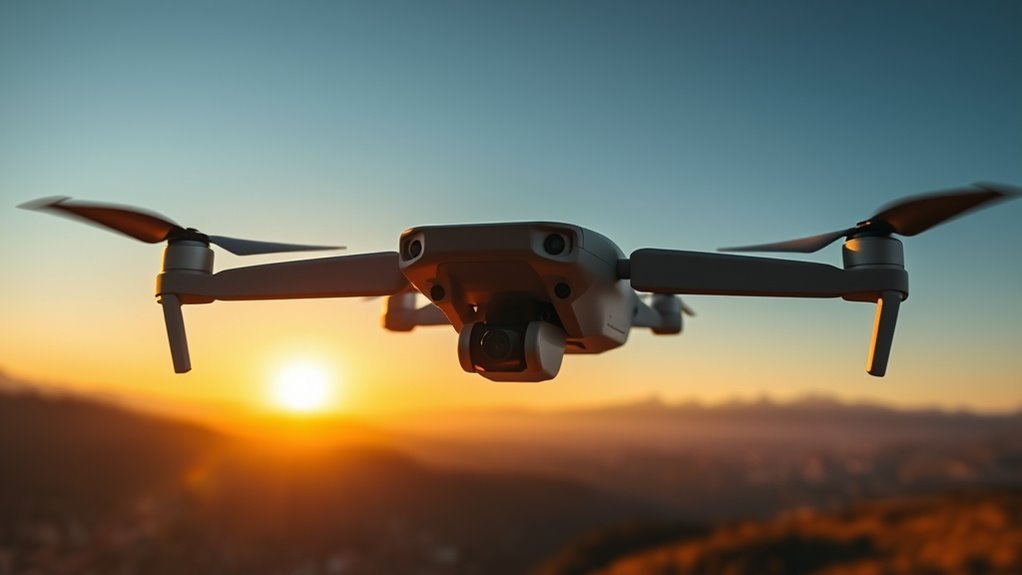
In 2026, the DJI Mini 4 Pro still stands out for its 1/1.3-inch CMOS sensor, 48 MP output, and compact design. Its practical flight time remains around 28 to 31 minutes, while the 20 km rated range and stable signal support dependable use in varied conditions. Yet low-light performance and limited room for upgrades continue to define its place. The key question is whether those tradeoffs still make it a smart purchase today.
DJI Mini 4 Pro Specs and Price in 2026
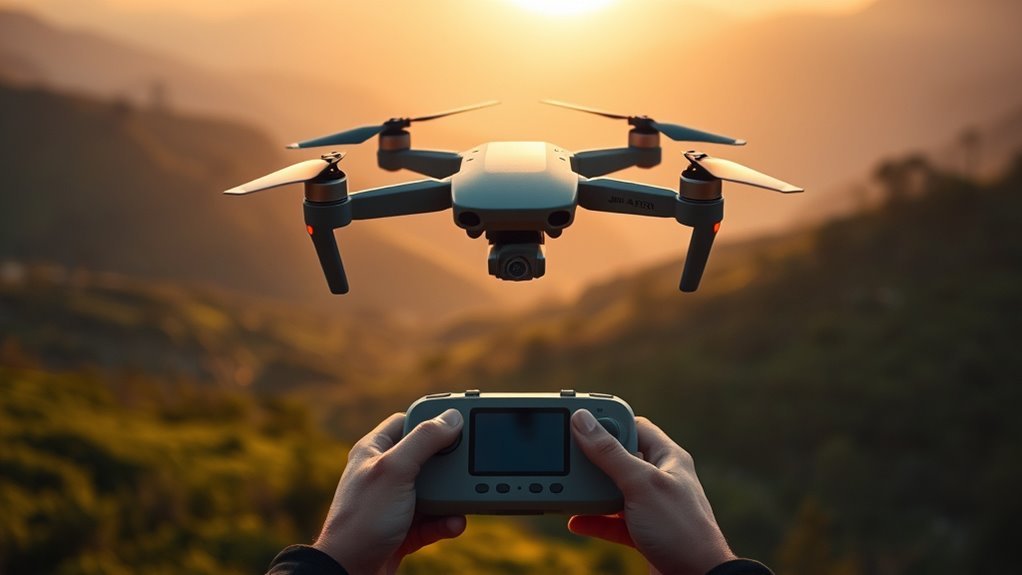
The DJI Mini 4 Pro remains a compact sub-250 g drone in 2026, weighing just 249 grams and staying under the FAA registration threshold for added travel convenience.
The DJI Mini 4 Pro stays a 249 g travel-friendly drone, keeping pilots under FAA registration requirements.
Its Mini 4 Pro specs center on a 1/1.3-inch CMOS sensor with 48 megapixels, plus 4K recording at 60fps and 100fps in HDR mode. The battery delivers up to 34 minutes of flight time, though real-world use is typically 28 to 31 minutes.
For control, the O4 system provides a transmission range of up to 20 km, with stable signal behavior in open conditions.
On price, used units are commonly listed near €599, while new Fly More Combo packages sit around €799 in 2026.
For pilots seeking portability, regulatory simplicity, and measurable capability, the balance of specs and price remains competitive.
Those comparing options can buy with a clear view of its technical position.
DJI Mini 4 Pro Image Quality: Daylight Vs Low Light
The DJI Mini 4 Pro’s 1/1.3-inch sensor delivers strong daylight sharpness, with 48 MP stills that retain fine detail and support substantial cropping.
In well-lit conditions, its 4K/60fps footage is similarly crisp, though the fixed f/1.7 aperture may require ND filters to prevent overexposure.
In low light, image noise becomes visible around ISO 800 and increasingly degrades quality at ISO 1600, limiting its effectiveness for darker scenes.
Daylight Sharpness
In bright conditions, the DJI Mini 4 Pro delivers particularly sharp results, with its 48 MP stills showing fine detail that can rival more advanced drones such as the Mavic 3.
Its daylight sharpness benefits from the 1/1.3-inch sensor, which preserves texture and supports substantial cropping for photography enthusiasts seeking freedom in post-processing.
The drone also records video recorded at 4K/60fps with clean edges and stable motion.
- Fine detail remains intact across the frame
- Color and contrast appear well controlled
- The 3-axis gimbal aids smooth capture
- Bright-scene flexibility strengthens creative use
Low Light Noise
While the DJI Mini 4 Pro performs strongly in bright scenes, its image quality becomes more limited as illumination drops. The 1/1.3-inch sensor maintains respectable detail in low light, but noise becomes visible at ISO 800 and rises sharply by ISO 1600.
As a result, shadows lose texture, fine edges soften, and nighttime photography is constrained. The drone can still record sharp 4K/60fps video in daylight, yet dim scenes show similar noise patterns, reducing overall image quality.
The D-Log M color profile can preserve grading latitude, but it cannot recover detail that sensor data never captured. For operators seeking visual freedom in difficult lighting, the Mini 4 Pro is best regarded as a daylight-first tool rather than a reliable low light platform.
DJI Mini 4 Pro Flight Time and Battery Life
The DJI Mini 4 Pro is rated for up to 34 minutes of flight time, although typical real-world operation more often falls in the 28 to 31 minute range depending on wind, maneuvering, and sensor usage.
The optional Battery Plus extends endurance toward 45 minutes, but it also adds weight and changes the aircraft’s regulatory profile in some regions, making the tradeoff operational rather than purely performance-based.
In colder conditions below 5°C, usable flight time can drop by 20-30%, so battery planning remains a significant factor in practical session length.
Real-World Flight Time
Real-world endurance from the DJI Mini 4 Pro is strong for a sub-250 g drone, with its standard Intelligent Flight Battery delivering a maximum rated 34 minutes and typical practical flights falling around 28 to 31 minutes under favorable conditions.
In real-world conditions, the Mini 4 Pro maintains usable battery life for measured flight sessions, while the O4 transmission system supports confident control at distance.
- Standard battery: 2,590 mAh
- Rated endurance: 34 minutes
- Practical endurance: 28–31 minutes
- Cold-weather loss: 20–30% below 5°C
Charging the Intelligent Flight Battery takes about 70 minutes, so turnaround remains efficient.
Wind, aggressive maneuvers, and repeated ascent reduce endurance, yet the platform still supports disciplined aerial work with predictable power management and limited interruption.
Battery Plus Tradeoffs
Battery performance on the DJI Mini 4 Pro becomes more flexible with the Battery Plus, which increases capacity from 2,590 mAh to 3,850 mAh and raises maximum flight time from 34 minutes to up to 45 minutes.
In practice, the Pro Battery can extend operational freedom, though added mass may trigger FAA registration requirements and slightly alter handling.
The standard battery typically delivers 28-31 minutes, while colder conditions below 5°C can cut battery life by 20-30%, reducing performance.
Charging is also slower: about 70 minutes for the Intelligent Flight Battery and 101 minutes for the Battery Plus when mounted on the aircraft.
A charging hub can streamline rotation between packs, but actual flight time still depends on wind, payload, and cell condition.
The Mini 4 Pro’s O4 link remains strong.
DJI Mini 4 Pro Range, Signal, and Wind Test
With the O4 transmission system, the DJI Mini 4 Pro is rated for a maximum range of up to 20 km, and in practice it maintains a strong, stable signal across long distances. The DJI Mini 4 Pro combines this transmission range with reliable signal quality, while omnidirectional obstacle avoidance helps preserve control in changing environments.
In real-world testing, video link interruptions remain brief, though dense mobile network zones may introduce minor picture artifacts.
- Strong signal retention across extended flights
- Clear control feedback at range
- Omnidirectional obstacle avoidance supports safer routing
- Wind conditions shape handling more than raw distance
Wind performance is most consistent up to force 4; at force 5, stability declines and flight precision becomes less assured.
Flight time typically averages 28-31 minutes, though temperature and wind can shorten it. Overall, the system favors disciplined, liberated aerial use where range, responsiveness, and environmental awareness matter.
DJI Mini 4 Pro Weaknesses You Should Know
Despite its strong overall capability, the DJI Mini 4 Pro has several clear limitations.
The Mini 4 Pro shows modest low-light performance; noise becomes visible from ISO 800 and turns intrusive at ISO 1600, reducing detail and tonal freedom in darker scenes.
Its advertised 4K/100fps option is not fully open, because 100fps is only available in HDR mode, which constrains grading latitude and workflow flexibility.
In bright sunlight, the fixed f/1.7 aperture often requires ND filters to maintain proper exposure and avoid clipping.
Wind conditions also expose a weakness: stability declines in force 5, while force 4 or lower is the practical operating range.
Some users have reported brief picture interruptions in dense mobile-network environments such as Barcelona and Tokyo, suggesting occasional transmission disruption.
These limits do not negate the aircraft’s competence, but they define where performance is reduced and where careful operation remains necessary.
Is the DJI Mini 4 Pro Still Worth Buying?
Yes—DJI’s Mini 4 Pro remains a compelling purchase in 2026, particularly for travelers and price-sensitive buyers. The Mini 4 Pro still delivers a strong balance of capability and portability, and the price difference between used units and new Fly More Combos keeps it attractive. Its 28–31 minute flight time and up to 20 km transmission range remain competitive, while the 1/1.3-inch 48 MP sensor produces sharp 4K/60fps footage in daylight.
- Omnidirectional obstacle detection improves operational safety.
- Advanced flight modes expand creative autonomy.
- Low-light situations reveal noise at ISO 800.
- Newer models may suit advanced professionals better.
For users prioritizing freedom of travel, efficient deployment, and reliable image quality, it is still worth buying.
However, those centered on nighttime work or the latest professional feature set may prefer a newer platform, since the Mini 4 Pro is strongest as a versatile, efficient, mid-tier aerial tool rather than a maximalist flagship.
Frequently Asked Questions
Which DJI Drone to Buy in 2026?
The best DJI drone to buy in 2026 depends on purpose, budget, and flight regulations.
For balanced drone technology, strong aerial photography, and efficient battery efficiency, the Mini 4 Pro remains a practical choice.
For lower cost, the Mini 2 SE suits beginners; for superior image quality, the Mini 5 Pro or Air 3S are stronger competitive models.
User reviews generally favor the Mini 4 Pro for portability, value, and freedom in everyday flight.
Is the DJI Mini 4 Pro Worth Buying?
Yes—the DJI Mini 4 Pro remains worth buying, almost absurdly so for its size.
Its performance comparison against newer rivals still favors portability, battery longevity, and strong camera quality in daylight.
The user experience is refined, with reliable software updates and stable O4 transmission.
Price trends in 2026 keep it attractive for independent creators seeking liberation from heavier gear.
Low-light limits persist, but its overall technical value is still compelling.
Can FAA Know You Flew a DJI Drone?
Yes, the FAA can often determine that a DJI drone was flown through drone regulations, registration records, remote identification, and flight logging data.
GPS-enabled aircraft may store flight history, and investigators can review logs after incidents or complaints.
FAA enforcement may follow unauthorized operations in controlled airspace or commercial misuse. This raises privacy concerns, so user responsibility remains essential: pilots must follow Part 107 rules and all applicable airspace requirements.
Will DJI Drones Work in 2026?
Yes, DJI drones will likely work in 2026, and it happens almost by coincidence that support extends through firmware maintenance and software updates.
Future drone technology, battery advancements, and a competitive market should keep many models functional.
Regulatory changes may affect some flight modes or regions, yet user expectations for reliability, range, and control remain high.
In practical terms, continued compatibility appears technically sound, though local compliance will determine usability.
Conclusion
In 2026, the DJI Mini 4 Pro remains a strong mid-tier option for aerial imaging, especially for travelers and hobbyists. Its 1/1.3-inch sensor and 48 MP output still produce competitive daylight footage, while the practical 28–31 minute flight time supports efficient shooting sessions. One notable figure is its 20 km rated range, which reflects strong transmission performance, though real-world conditions vary. Low-light limitations persist, but overall value remains compelling.
