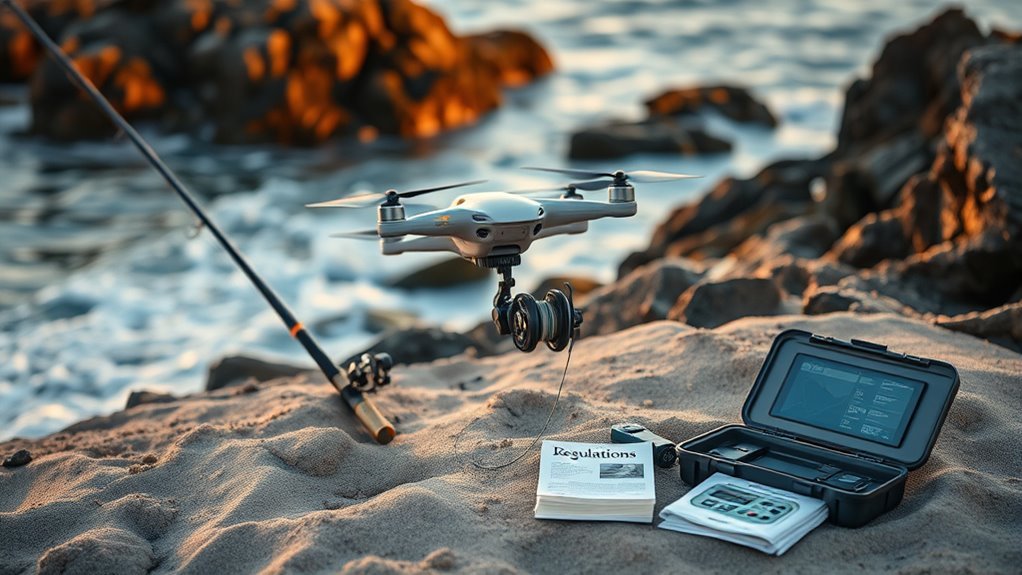
Drone fishing pairs a rod with light drag and a drone fitted with a bait release, letting the line pay out as the payload flies to a target zone. Success depends on matching bait weight, line strength, and drone capacity, often staying near 60–70% of the payload limit. Legal rules also vary by location, and a poor setup can end the outing before the bait ever hits the water.
What Is Drone Fishing?
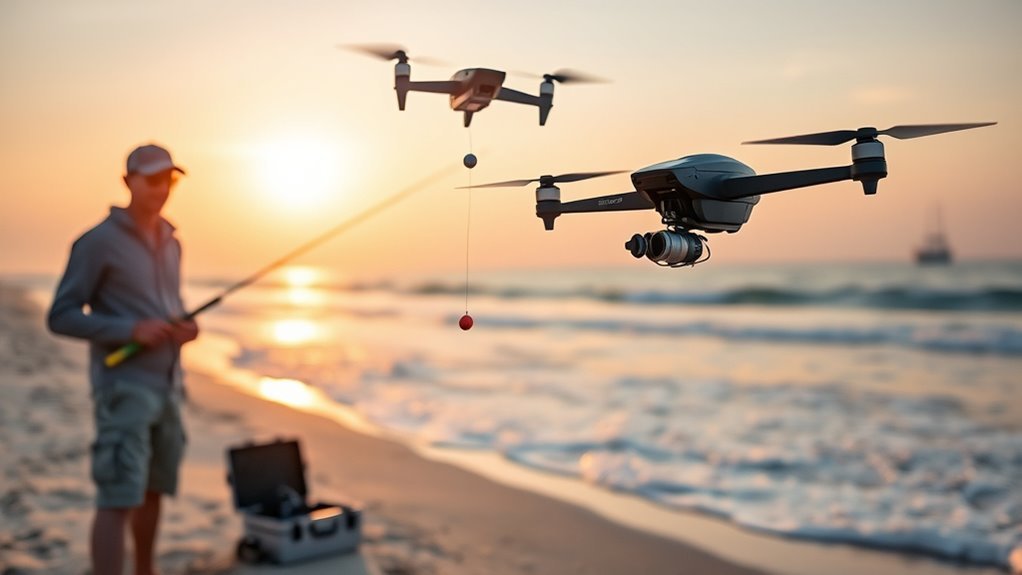
Drone fishing is a method in which a drone, equipped with a camera and a bait release mechanism, carries fishing tackle to a targeted location beyond normal casting range.
In practice, the craft lifts a rod line from a holder, flies outward, and pays off line until the operator reaches the intended point for bait release. This approach allows precise placement over structure, surf breaks, or other distant water features.
Typical drones used for drone fishing manage a payload capacity of about 1 to 4.5 lbs, although operation at 60 to 70 percent of maximum load is preferred for stability and safety.
Purpose-built fishing drones add waterproofing and improved control, while adapted consumer models may need modifications.
Legal regulations remain location dependent, so users must still align their activity with local fishing rules and aviation requirements before deployment.
Is Drone Fishing Legal Where You Live?
Whether drone fishing is legal depends entirely on local rules, because regulations vary widely by jurisdiction and some areas explicitly prohibit using drones for fishing.
Drone fishing regulations must be checked at the state, county, and site level before any flight. In the United States, compliance with FAA rules is required, including registration for drones over 250 grams and observance of airspace limits.
Drone fishing rules must be checked at every level, and FAA requirements still apply.
Local fishing laws may also restrict launch sites, line handling, or device use in parks and reserves, where drone takeoff is often banned. Some jurisdictions permit reconnaissance use for locating fish, while others allow release clips under narrow conditions.
Because these differences can determine whether a flight is lawful or penalized, users should verify each destination separately. Fines, confiscation, and other penalties can follow violations.
Careful review of official guidance preserves access, reduces risk, and supports lawful use.
How Drone Fishing Works
Once local rules have been confirmed, the basic workflow is straightforward: a fishing rod is secured with a light drag, and a drone carries a release mechanism that drops the bait at the target location. In drone fishing, the line is paid out during flight, then the bait release occurs, and the angler resumes normal fishing from shore or boat. Performance depends on payload limits, since wind, battery age, and distance reduce effective lift. Purpose-built platforms typically handle 1 to 4.5 lbs.
| Step | Function |
|---|---|
| Load | Attach bait and line |
| Fly | Move to the target zone |
| Release | Drop payload cleanly |
| Recover | Return and fish normally |
Legal regulations remain decisive; some jurisdictions prohibit drone use entirely. Operation should stay within visual line of sight and comply with FAA rules where applicable. This method extends reach while preserving control.
Choose the Right Drone Fishing Gear
Choosing drone fishing gear begins with matching payload capacity and a dependable release system to the intended bait load, since accurate drops depend on both.
A waterproof, saltwater-rated frame with sufficient flight range and battery life improves reliability during extended use, especially in harsh marine conditions.
Legal gear compatibility must also be verified, because local rules may restrict payloads, launch areas, and drone configurations.
Payload And Release Systems
Payload and release systems determine how reliably a fishing drone can carry and drop bait. For fishing drones, a suitable payload release capacity usually falls between 1 and 4.5 lbs, enough for bait, lead, and hook without exceeding operational limits.
A precise release mechanism matters more than crude suspension; mechanical bait release units outperform gravity clips by controlling drop timing and reducing premature discharge. Operators should keep loads at 60-70% of rated capacity to preserve lift margin against wind and aging batteries.
Purpose-built platforms generally integrate the release hardware cleanly, while adapted drones may need add-on parts. Routine maintenance, including rinsing after saltwater exposure and lubricating servo components, helps sustain dependable operation and keeps the system ready for independent use.
Waterproof Build And Range
A durable waterproof build is a primary requirement in drone fishing gear, with IPX7 or higher offering the protection needed against saltwater exposure and repeated launch-and-recovery cycles. A waterproof drone preserves function where ordinary craft fail, supporting reliable bait transport and retrieval.
| Spec | Target | Effect |
|---|---|---|
| Waterproof rating | IPX7+ | Saltwater resistance |
| Payload capacity | 1-4.5 lbs | Bait and tackle lift |
| Range | Up to 500 yards | Extended casting distance |
Integrated release systems improve bait placement without destabilizing flight. Range near 500 yards expands access to offshore structure and surf breaks, beyond conventional casting distance. Selection should also consider local regulations, since permitted use varies by location. The result is practical, mobile, and less constrained.
Legal Gear Compatibility
Beyond waterproof construction and range, gear selection must also satisfy legal and operational constraints. For drone fishing, the platform should match bait mass and tackle weight with adequate payload capacity, usually 400–800 grams, to avoid strain and unstable flight.
Purpose-built fishing drones are preferable because they combine IPX7-plus water resistance with integrated release systems, reducing failure risk over open water. External release systems should be mechanically timed rather than gravity based when precision matters.
Local regulations must be verified before deployment, because some jurisdictions require registration or restrict specific drone functions by weight. Battery endurance also matters; 10–30 minutes of usable flight time supports scouting, delivery, and return.
Proper matching keeps the setup lawful, efficient, and operationally free.
Understand Payload, Line, and Drag Limits
Drone fishing performance depends on staying within the aircraft’s payload limit, typically using only 60–70% of the rated capacity to preserve stability in wind and battery aging.
The line must be tensioned within the reel and release system’s working range, since excessive resistance can delay bait drop and reduce placement accuracy.
Drag settings should be matched to the deployment load so the drone can release bait reliably without overstraining the gear or risking equipment loss.
Payload Capacity Limits
Payload limits set the practical ceiling for drone fishing, with purpose-built models typically carrying about 1 to 4.5 lbs depending on wind, temperature, and battery condition. The payload capacity defines the maximum weight a craft can lift while preserving control, battery life, and wind resistance.
Practical use stays near 60-70% of rating to preserve margin and reduce strain.
- Match bait, lead, hook, and release gear to the drone’s rated lift.
- Reduce load further when temperatures drop or batteries age.
- Treat 15 mph winds as a significant performance penalty.
- Verify stable ascent before committing to a cast offshore.
This measured approach supports reliable operation and gives anglers greater freedom to deploy gear confidently without overloading the system.
Line Drag And Resistance
Once the lift limit is understood, the next constraint is line drag and resistance, which determine how smoothly bait can be carried offshore and how safely a fish can be fought on retrieval.
Line drag grows with distance, swell, and reel setting, so the system must be tuned to avoid overload. A drone’s payload capacity is only part of the equation; a light rig can still fail if line resistance is excessive.
Reel drag should be set to slip before the line reaches breaking strain, especially during sudden runs. Terminal tackle must also be matched to the drone’s carry limit, keeping bait, lead, and hook compact and balanced.
In regulated waters, line limits and payload rules can further define what is lawful and practical.
Set Up the Release and Bait
To set up the release and bait, the fishing rod should be secured in a holder with light drag, and the reel’s clicker engaged to allow controlled line payout.
The release mechanism is then attached beneath the drone, with bait, lead, and hook fixed to hardware rated for the load. This fishing gear should match the drone’s payload capacity, commonly 1 to 4.5 lbs, to prevent instability during bait dropping.
Before launch, line is paid out as the drone moves to the target area, while the camera helps identify fish schools and open water. At the strike point, the mechanism is triggered, and the line is tightened for the fight.
- Verify the release mechanism locks securely.
- Confirm the bait and sinker balance the load.
- Monitor line tension during transit.
- Check local regulations for payload release rules.
Fly Safely Over Salt Water
Saltwater drone fishing requires a platform rated for harsh exposure, ideally with an IPX7 water resistance rating to reduce corrosion risk. In drone-assisted fishing, the aircraft should remain in visual line of sight at all times, preserving control and satisfying safety rules over open water. A dependable release mechanism lets the operator place bait accurately in current seams, reefs, or drop-offs while avoiding line interference.
| Control point | Operational need |
|---|---|
| Salt water exposure | IPX7 protection |
| Flight discipline | Visual line of sight |
| Payload delivery | Reliable release mechanism |
Wind matters. Over salt water, gusts can intensify, so flights above 15 mph are poor choices because stability degrades quickly. Local restrictions also shape access; parks and wildlife reserves may prohibit this use entirely. Careful compliance keeps the process safe, precise, and free from unnecessary constraints.
Avoid Common Drone Fishing Mistakes
Common drone fishing errors often begin with poor preparation: line drag should be set correctly before flight to avoid snags and guarantee a smooth bait drop at the target point. The drone’s payload should stay well below its maximum capacity—ideally around 60–70%—and the release mechanism should be inspected regularly to prevent jams after repeated use.
A disciplined operator avoids common mistakes by treating each drone as a constrained tool, not an all-purpose carrier. Knowledge of regulations is equally critical, since local restrictions on drone fishing may limit where bait release is permitted or prohibit the practice entirely.
- Verify line tension before takeoff.
- Match payload to the drone’s rated limit.
- Test the bait release repeatedly on land.
- Review regulations before every outing.
Practice in open areas sharpens control, helping maintain accurate placement and reducing avoidable failures.
Is Drone Fishing Worth It?
Drone fishing can be worth the investment for anglers who need to place bait in hard-to-reach areas, since it can improve catch rates by up to three times compared with traditional casting.
A waterproof drone with 1 to 4.5 lbs of payload can carry bait, hooks, and sinkers, while a reliable bait release system improves placement accuracy and reduces wasted effort.
Real-time video scouting adds tactical value by revealing structure, surf breaks, and fish movement before deployment.
However, drone fishing is not universally practical. Equipment costs are higher than standard rigs, and legality varies by jurisdiction; some locations restrict drone use or require FAA compliance.
The best drones balance stability, payload, and release precision, making them more than a novelty.
For anglers seeking access, efficiency, and greater control over where bait is delivered, drone fishing can justify the expense when regulations allow.
Frequently Asked Questions
Which Drones Have Bait Release Mechanisms?
Fishing drones such as the SwellPro Splash Drone 3 and FD1 include built-in bait mechanisms for controlled drops.
Purpose-built drone types often integrate these fishing accessories, while add-on units like the Gannet X-Release convert camera drones into bait carriers.
These systems pair with line attachments and are selected for payload capacity, release precision, and compatibility.
Mechanical release designs usually outperform gravity clips in reliable delivery and operational freedom.
Can I Shoot Down a Drone Spying on My Property?
No; shooting down a drone over property boundaries is generally unlawful.
Drone regulations usually treat drones as aircraft, and damaging one can trigger criminal charges or civil liability. Privacy rights concerns do not create a blanket right to destroy equipment.
Self defense laws rarely justify force against an unmanned aircraft. The proper response is documentation, reporting, and legal complaint through local law enforcement or aviation authorities, preserving autonomy through lawful means.
Is It Legal to Drop Things From a Drone?
Usually not without limits; like rain from a cloud, a drone’s dropped object can cross into regulated airspace and law.
Drone regulations vary by jurisdiction, and aerial delivery of any payload may be restricted or banned. In some places, fishing laws and wildlife protection rules further prohibit bait drops.
Operators must check local statutes, FAA registration rules, park bans, and permit requirements before releasing anything from above.
How Does a Fishing Drone Work?
A fishing drone works by combining drone technology with a bait-release mechanism, enabling precise placement of bait far beyond shore casting.
It lifts a light rig, flies to a target, and drops the bait when commanded, often using waterproof hardware and remote control.
These fishing techniques offer aerial advantages in surf, reefs, and open water, while also supporting ocean conservation by reducing repeated casts, disturbance, and wasted effort.
Conclusion
Drone fishing works when the system is balanced: the drone must carry the bait, the line must pay out cleanly, and the drag must remain light enough to prevent breakage. It is effective when the setup is correct, legal where used, and operated with care over water. It is risky when payload limits are ignored, line tension is excessive, or local rules are overlooked. In short, it rewards preparation, precision, and compliance.
