
The 2025 Toyota RAV4 can be a good tow vehicle for small trailers, personal watercraft, and some lightweight campers. Its suitability depends on the powertrain, the trailer’s fully loaded weight, and the vehicle’s remaining payload. It is built for light-duty towing rather than large travel trailers or heavy equipment.
Quick Answer
Yes. A 2025 Toyota RAV4 is good for light towing when the trailer’s fully loaded weight stays within the vehicle, hitch, tire, and payload limits. U.S. gas models tow up to 1,500 pounds, Hybrids up to 1,750 pounds, and Plug-in Hybrids up to 2,500 pounds.
Key Takeaways
- The 2025 gas RAV4 has a maximum trailer rating of 1,500 pounds.
- The 2025 RAV4 Hybrid is rated for up to 1,750 pounds.
- The 2025 RAV4 Plug-in Hybrid is rated for up to 2,500 pounds.
- Use the trailer’s loaded weight, not its advertised dry weight, when checking compatibility.
- Towing capacity does not replace payload, axle, hitch, tongue-load, or tire limits.
- Check the owner’s manual for your exact model year, market, trim, and equipment before towing.
2025 Toyota RAV4 Towing Capacity by Powertrain
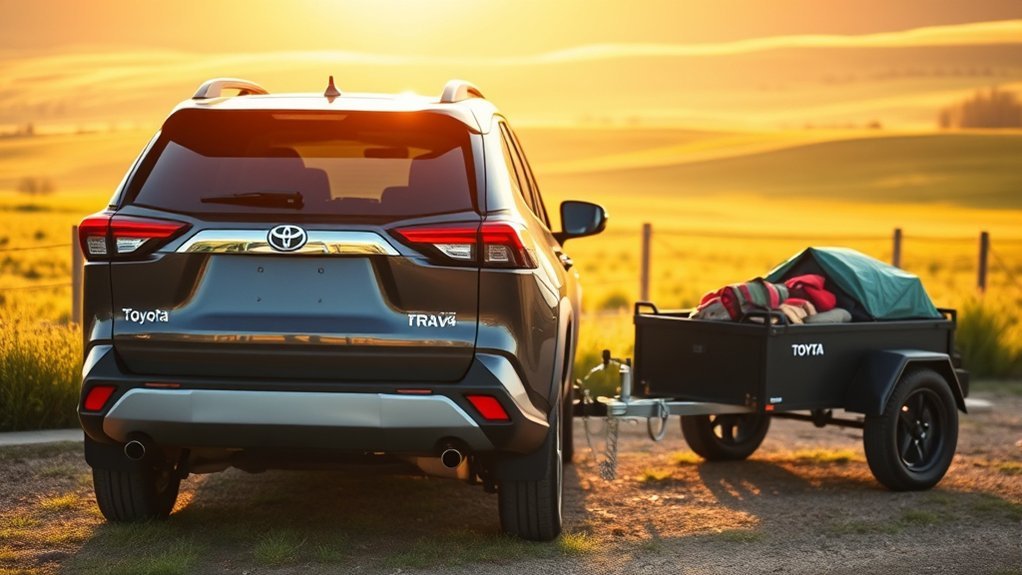
Toyota gives the three 2025 U.S.-market RAV4 powertrains different maximum trailer ratings. The following table provides a quick comparison.
| 2025 RAV4 model | Maximum trailer weight | Possible light-duty uses |
|---|---|---|
| Gas RAV4 | 1,500 pounds | Small utility trailers, a light sport trailer, or some personal-watercraft setups |
| RAV4 Hybrid | 1,750 pounds | Small cargo trailers and selected micro, teardrop, or compact pop-up campers |
| RAV4 Plug-in Hybrid | 2,500 pounds | Some larger teardrop campers, compact pop-ups, utility trailers, or small boats |
These are maximum ratings, not recommended trailer targets for every trip. Your safe limit can be lower because of passengers, cargo, accessories, hitch components, tire ratings, road conditions, or the trailer’s shape.
Note: These figures apply to the 2025 U.S.-market RAV4 lineup. Toyota redesigned the RAV4 for 2026 and changed its powertrain lineup. Do not use a 2025 rating for a different model year without checking that vehicle’s manual.
What the RAV4 Towing Rating Really Means
The maximum trailer rating is only one part of a safe towing calculation. You also need to check how much the trailer weighs after it is packed and how much weight the vehicle is carrying.
Use Loaded Trailer Weight, Not Dry Weight
A manufacturer or seller may advertise a camper using its dry or empty weight. That figure may not include camping gear, water, batteries, propane, food, tools, or dealer-installed equipment.
You can estimate the actual trailer weight with this calculation:
Loaded trailer weight = empty trailer weight + cargo + fluids + batteries + propane + accessories
Warning: A trailer that appears suitable by dry weight can exceed the RAV4’s limit after you pack it. Use a certified public scale when possible instead of relying only on an advertised estimate.
Check Payload and Vehicle Weight Limits
Trailer tongue load presses down on the RAV4 and uses part of its available payload. Passengers, luggage, aftermarket accessories, cargo-area equipment, and roof-mounted gear use payload as well.
Your combined vehicle load includes:
- Every passenger
- Cabin and cargo-area luggage
- Installed accessories not included in the original curb weight
- Roof-rack cargo
- The trailer’s tongue load
Check the certification and tire-information labels on your vehicle for its weight and loading limits. Do not exceed the vehicle’s gross vehicle weight rating, axle ratings, tire ratings, or available cargo capacity.
The Lowest-Rated Component Controls
Your towing setup is limited by its lowest-rated part. That may be the vehicle, hitch receiver, ball mount, hitch ball, trailer coupler, tires, or another component.
A hitch labeled for more than 1,500 or 2,500 pounds does not increase the RAV4’s factory towing capacity. It only shows the hitch component’s own rating.
Suitable Trailers for Each 2025 RAV4 Model
Trailer names alone do not prove that a setup is safe. Two similar campers can have very different weights, cargo capacities, and frontal areas. Compare the actual loaded specifications before buying or renting one.
Trailer Options for the Gas RAV4
With a maximum rating of 1,500 pounds, a gas RAV4 may suit a small open utility trailer, a lightweight motorcycle or dirt-bike trailer, or some single personal-watercraft combinations.
Many enclosed cargo trailers and campers become too heavy after loading. Their tall, boxy shape can also create substantial aerodynamic drag even when their scale weight is within the numerical limit.
Trailer Options for the RAV4 Hybrid
The Hybrid’s 1,750-pound maximum provides slightly more room for cargo. It may work with selected micro campers, compact teardrops, very light pop-up campers, or small utility trailers.
Check the camper’s battery, propane, water, food, bedding, and equipment weight. A model advertised near the limit may have little or no usable allowance left once packed.
Trailer Options for the RAV4 Plug-in Hybrid
The Plug-in Hybrid’s 2,500-pound maximum expands the range of possible lightweight trailers. Some compact pop-up campers, larger teardrops, small boats, and utility trailers may fit when fully loaded.
It still is not a replacement for a truck or larger SUV when you need to tow a full-size travel trailer, heavy boat, car hauler, or equipment trailer.
Choose a trailer by its measured loaded weight and the RAV4’s remaining payload, not by labels such as “micro,” “compact,” or “lightweight.”
How to Set Up a RAV4 for Towing
A complete setup needs more than a receiver hitch. Use components designed for your exact model year and powertrain, and have them installed correctly.
Hitch and Coupling Equipment
- Use a receiver hitch approved for your exact RAV4 configuration.
- Confirm the receiver, ball mount, hitch ball, and coupler ratings.
- Match the hitch-ball size to the trailer coupler.
- Insert and secure the hitch pin or locking pin correctly.
- Latch the coupler and verify that it cannot lift off the ball.
- Attach the safety chains without allowing them to drag.
Wiring, Lights, and Trailer Brakes
Install a compatible wiring harness so the trailer’s brake lights, turn signals, and running lights work with the RAV4. Test every light before leaving.
Some trailers require brakes, a breakaway system, or a compatible brake controller. Requirements depend on trailer design, equipment, and local law. Follow the vehicle manual, trailer instructions, component documentation, and the rules where you drive.
Mirrors and Visibility
You need a clear view along both sides of the trailer. If the trailer blocks the factory mirrors, use legal towing mirrors that provide the required field of view.
Pro Tip: After hitching the trailer, weigh the loaded combination at a public scale. A measured weight is more useful than estimates from product listings or empty-trailer specifications.
Tips for Safe and Efficient Towing With Your RAV4
Towing changes acceleration, braking, turning, fuel use, and stability. Give yourself more time and space than you would while driving without a trailer.
Complete a Pre-Trip Check
Before each trip, inspect the following items:
- Vehicle and trailer tire pressures while the tires are cold
- Tire condition, load ratings, and visible damage
- Hitch pin, ball mount, coupler, and latch
- Safety chains and any required breakaway cable
- Brake lights, turn signals, and running lights
- Trailer brakes, if equipped
- Doors, hatches, cargo straps, and loose equipment
- Mirrors and rearward visibility
- Engine coolant, oil, and other service items due for inspection
Adjust Your Driving
- Accelerate gradually and avoid abrupt steering inputs.
- Leave more following distance because the combination takes longer to stop.
- Slow down before curves instead of braking hard during the turn.
- Allow extra room when passing, merging, and changing lanes.
- Watch for crosswinds and air movement from large vehicles.
- Use extra caution on steep grades, rough roads, and wet surfaces.
- Practice turning, stopping, and reversing in an open area before a longer trip.
Towing normally reduces fuel economy, but no single percentage applies to every setup. Trailer weight, frontal area, speed, hills, wind, temperature, and driving style all affect energy use.
Watch for Heat and Warning Lights
Climbing grades, driving in hot weather, and pulling a high-drag trailer place additional demand on the powertrain. If a temperature or warning indicator appears, move to a safe location and follow the owner’s manual rather than continuing under load.
Ensuring Towing Safety With Your RAV4
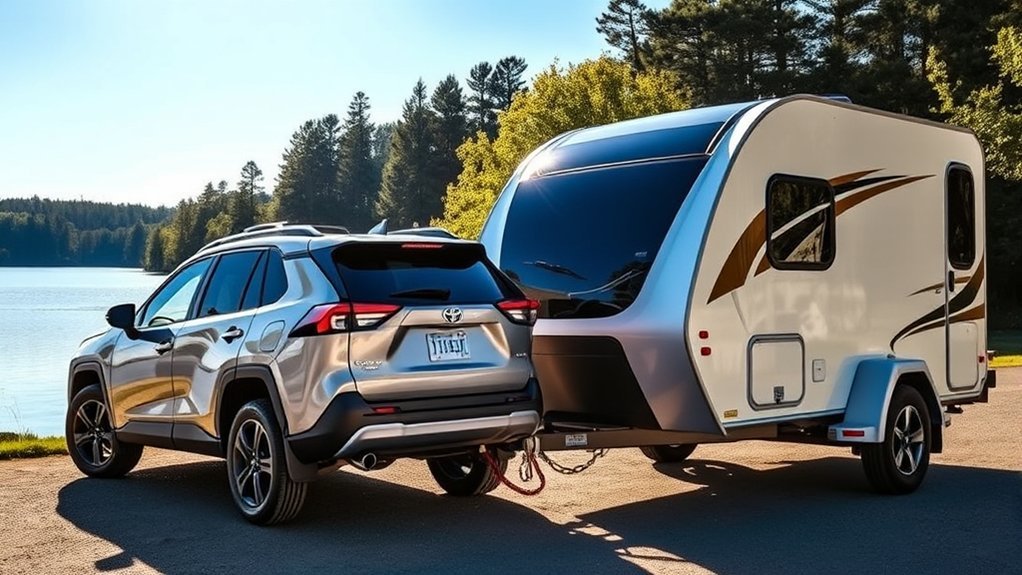
Good trailer balance helps the RAV4 remain stable, but the correct tongue-load range depends on the vehicle and trailer instructions. Do not use one general percentage as a substitute for those specifications.
Measure the tongue load with suitable equipment and adjust cargo placement without exceeding the trailer’s axle or cargo limits. Secure the cargo so it cannot shift while you drive.
What to Do if Trailer Sway Begins
If the trailer starts moving from side to side:
- Hold the steering wheel steadily.
- Ease off the accelerator.
- Avoid sudden steering or hard braking.
- If your properly installed trailer-brake system allows safe manual correction, follow its manufacturer’s instructions.
- Reduce speed gradually and pull over when it is safe.
- Check cargo distribution, tongue load, tire condition, hitch connections, and wind conditions before continuing.
Warning: Do not try to correct sway by making a sharp steering movement or accelerating aggressively. Stop and correct the cause instead of continuing at the same speed.
What Owners Should Expect From a RAV4 Tow Vehicle
A properly loaded light trailer can work well with a RAV4, but towing performance will not feel the same as normal driving. Acceleration will be slower, stopping distances will increase, and the vehicle may respond more strongly to hills and crosswinds.
A low-profile utility trailer may feel easier to pull than a tall enclosed trailer of similar weight because the taller trailer creates more aerodynamic resistance. A heavier load can also increase fuel use and reduce the vehicle’s performance on long grades.
The RAV4 makes the most sense when your trailer remains comfortably within every rating and you tow occasionally or for light recreational use. A larger tow vehicle is the better choice when the trailer is near the limit before loading, has a large frontal area, or must carry substantial cargo.
Warranty and Maintenance When Towing
Toyota’s 2025 RAV4 Warranty and Maintenance Guide describes a 36-month or 36,000-mile basic warranty and a 60-month or 60,000-mile powertrain warranty for qualifying defects. It does not provide a separate blanket warranty for every towing-related problem.
Damage caused by overloading, misuse, improper maintenance, or some alterations may not be covered. The guide’s roadside towing provision refers to transporting an inoperable vehicle to a Toyota dealership when a warranted part caused the problem.
When you tow regularly:
- Follow the maintenance schedule for your driving conditions.
- Inspect the engine oil, coolant, brakes, tires, and wheel condition.
- Check the hitch and wiring for looseness, wear, corrosion, or damage.
- Service the trailer’s tires, bearings, brakes, coupler, and lights according to its manufacturer’s schedule.
- Keep records of inspections, maintenance, and equipment installation.
Frequently Asked Questions
What warranty applies to towing-related problems on a RAV4?
The RAV4 does not have a separate blanket towing warranty. Toyota’s basic warranty covers qualifying defects for 36 months or 36,000 miles, while the powertrain warranty lasts 60 months or 60,000 miles. Damage caused by overloading, misuse, improper maintenance, or unsuitable modifications may be excluded.
Can I install a towing hitch on any RAV4 model?
Compatible hitches are available for many RAV4 configurations, but the hitch must match the exact model year, powertrain, and vehicle design. Installation does not increase the vehicle’s factory towing capacity. Use correctly rated components and follow Toyota’s and the hitch manufacturer’s instructions.
How does towing affect RAV4 fuel efficiency?
Towing generally reduces fuel or electric efficiency, but the amount varies. Trailer weight, frontal area, speed, wind, hills, temperature, traffic, and driving style all affect consumption. A tall enclosed trailer may create more drag than a lower-profile trailer with a similar weight.
Which aftermarket towing accessories may be needed?
A setup may require a compatible receiver hitch, ball mount, hitch ball, wiring harness, safety chains, towing mirrors, and legally required trailer-brake equipment. Every component must be approved for the specific vehicle and rated for the actual load.
What maintenance does a RAV4 used for towing need?
Follow Toyota’s maintenance schedule and inspect the oil, coolant, brakes, tires, hitch, and wiring regularly. Maintain the trailer as well, including its tires, bearings, brakes, coupler, lights, and breakaway equipment when fitted.
Can a Toyota RAV4 tow a camper?
Some lightweight teardrop, micro, or compact pop-up campers may fit within a 2025 RAV4’s limits. Check the camper’s fully loaded weight, tongue load, frontal area, and equipment instead of relying on its dry weight or “lightweight” label.
Conclusion
The 2025 Toyota RAV4 is a practical choice for light towing when you match the powertrain to a properly loaded trailer. Gas models handle up to 1,500 pounds, Hybrids up to 1,750 pounds, and Plug-in Hybrids up to 2,500 pounds.
Before you hitch up, verify the trailer’s loaded weight, the vehicle’s remaining payload, and every component rating. Use compatible equipment, inspect the complete setup, and adjust your driving for longer stopping distances and reduced stability. Choose a larger tow vehicle when the trailer approaches the RAV4’s limits or creates substantial aerodynamic drag.
Sources
- Toyota: 2025 RAV4 — official gas-model information and specifications.
- Toyota: 2025 RAV4 Hybrid — official Hybrid model information and specifications.
- Toyota: 2025 RAV4 Plug-in Hybrid — official Plug-in Hybrid information and specifications.
- Toyota: 2025 RAV4 Warranty and Maintenance Guide — warranty coverage, exclusions, roadside towing, and maintenance information.
- Toyota: 2026 RAV4 — current-generation information supporting the model-year warning.
