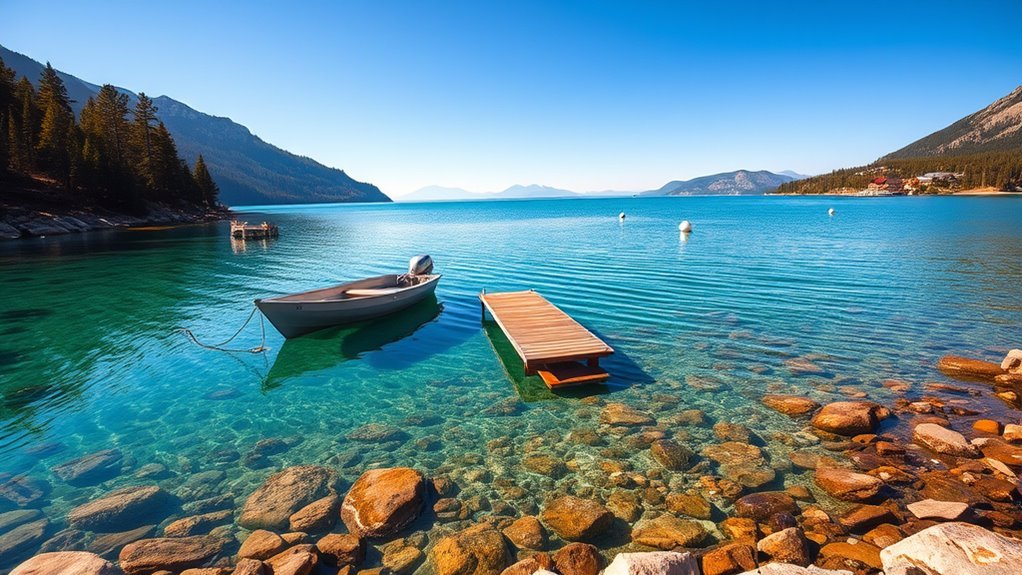
Buying lake property requires more than finding a beautiful waterfront view. Shoreline rights, flood exposure, dock permits, and lake conditions can determine how you use the property and what it costs to maintain. Before making an offer, examine both the house and the water around it.
Quick Answer
Before buying lake property, confirm legal waterfront access, shoreline boundaries, dock permissions, flood risk, and seasonal water levels. Inspect the house, shoreline, septic system, and water supply. Review lake water quality, local zoning, rental restrictions, insurance, and ongoing maintenance costs. Verify these details during your inspection period, before the purchase becomes final.
Last checked: September 26, 2026. Dates and figures were verified against official sources.
Key Takeaways
- A waterfront listing does not automatically establish ownership of the shoreline or permission to install a dock.
- Flood maps, historical water levels, and insurance quotes provide different pieces of the property’s risk picture.
- Septic systems, private wells, retaining walls, and docks may need separate professional inspections.
- Lake depth, seasonal mixing, nutrients, and algae affect fishing, swimming, and boating.
- Recorded restrictions and local regulations can affect rentals, additions, shoreline work, and future maintenance costs.
What to Check When Buying Lake Property?
Start with the property’s legal boundaries, physical condition, and permitted uses. Then examine the practical details of daily living, including water access, utilities, nearby services, and seasonal activity.
Confirm Shoreline Frontage and Waterfront Rights
Shoreline frontage is the length of the lot along the water. It affects access, privacy, recreational space, and the room available for docks or other waterfront structures.
However, frontage alone does not guarantee permission to build a dock. Actual requirements depend on the lake, the managing authority, recorded property rights, and local rules.
For example, Entergy’s dock guidelines for Lakes Hamilton and Catherine specify the following frontage requirements for qualifying developments recorded in 2006 or later:
- At least 75 feet of frontage for eligibility for a single-slip dock.
- At least 100 feet for eligibility for a two-slip dock.
These are location-specific requirements, not nationwide standards. Other lakes may use different measurements or prohibit new private docks altogether.
Request a current survey showing the lot boundaries and their relationship to the shoreline. Ask whether the property includes direct waterfront ownership, deeded access, or shared community access.
Also review easements, which give another party a defined right to use part of the property. They may affect shoreline paths, shared driveways, utilities, and access to the water.
Inspect the Dock and Confirm Its Permit
An existing dock needs both a physical inspection and a permit review. Its presence does not prove that it can legally remain, be expanded, or transfer to a new owner.
Inspect the decking, supports, flotation, anchors, fasteners, gangway, and boat lift. A qualified electrician should assess any dock electrical system.
Ask for the original permits, approved plans, inspection records, and documentation of later modifications. Confirm that the dock’s actual size and location match the approved plans.
Rules vary by managing authority. For example, TVA’s Section 26a regulations require a new property owner to notify TVA within 60 days of acquiring property associated with an approved shoreline facility.
On a different lake, a state agency, local government, utility, or the U.S. Army Corps of Engineers may have jurisdiction.
Review Flood History and Insurance
Flood exposure can affect the home’s safety, insurance costs, and future improvements. A property outside a mapped high-risk flood zone can still experience flooding.
Enter the property’s address in the FEMA Flood Map Service Center to identify its mapped flood zone and available flood hazard information.
Pay particular attention to:
- Past flooding reported by the seller or documented in available records.
- The elevation of the house compared with the surrounding land and shoreline.
- Drainage patterns during heavy rainfall.
- Water intrusion in the basement, crawl space, or foundation.
- Existing flood protection measures and previous repairs.
An elevation certificate, when available, can help document the building’s elevation. A surveyor can advise whether updated elevation information is needed.
Under National Flood Insurance Program requirements, flood insurance is generally required for buildings in a Special Flood Hazard Area when the mortgage is federally backed. A lender may also require coverage outside these areas.
Most standard homeowners insurance policies do not cover flood damage. Obtain actual property-specific quotes before closing rather than estimating premiums from the listing.
Inspect the House, Shoreline, and Utilities
A standard home inspection should cover the roof, foundation, electrical system, plumbing, heating, cooling, and visible moisture problems. Waterfront features may need additional specialists.
Look for shoreline erosion, exposed roots, damaged retaining walls, shifting stones, and signs that waves have removed soil beneath existing structures.
If the property uses a septic system, arrange a dedicated inspection. The EPA’s homebuyer’s septic guide recommends inspecting the system before purchase.
Request its permit, installation records, pumping history, and information about the drain field. Confirm that the system can support the intended use of the home.
If drinking water comes from a private well, arrange laboratory testing. The EPA recommends annual testing for total coliform bacteria, nitrates, total dissolved solids, and pH.
Additional tests may be appropriate based on nearby agricultural activity, industry, geology, or previous contamination.
Check Access, Restrictions, and Daily Living
A lake house can feel very different during a crowded summer weekend than during a quiet weekday. Visit at different times when possible and consider how you intend to use the property.
Check road access, driveway conditions, grocery stores, healthcare, emergency services, internet availability, and utility reliability.
Review zoning rules, deed restrictions, and homeowners association documents for limits on:
- Short-term and seasonal rentals.
- Additional buildings, decks, garages, and guest accommodations.
- Boat storage and shoreline construction.
- Tree removal and vegetation management.
- Parking, noise, and shared recreational facilities.
If you plan to rent the home, verify that both local regulations and recorded community rules allow your intended rental arrangement.
Understand the Full Ownership Cost
The purchase price is only one part of lakefront ownership. The total budget may also include maintenance that an ordinary residential property does not require.
- Homeowners and flood insurance.
- Property taxes and association assessments.
- Dock installation, removal, repair, or replacement.
- Shoreline stabilization and erosion control.
- Septic pumping and system maintenance.
- Private-well testing and treatment.
- Road, driveway, and shared-access maintenance.
- Seasonal landscaping and storm cleanup.
Request available maintenance records and written estimates for major repairs. Include likely work in the ownership budget before deciding whether the property is affordable.
Note: A qualified surveyor, real estate attorney, insurer, and appropriate inspection specialists can help resolve property-specific questions. Confirm legal rights and major repair obligations before your inspection or financing contingencies expire.
Lake Conditions That Affect Ownership
The lake itself can change how useful and enjoyable a waterfront property is. Its depth, shoreline shape, water quality, and seasonal activity influence access, recreation, and maintenance.
Consider the following conditions before buying:
- Seasonal water levels: Falling water can leave a dock inaccessible, while unusually high water may affect shoreline structures.
- Shoreline shape: Steep banks, rocky edges, and soft sediment change how easily people reach the water.
- Lake depth: Water depth near the property determines which boats can safely approach and whether access remains practical during low-water periods.
- Water clarity: Cloudiness, sediment, and algae can affect the experience of swimming and boating.
- Aquatic plants: Native vegetation supports habitat, while dense growth or invasive species may interfere with recreation.
- Seasonal activity: Boat traffic, fishing, swimming, and holiday crowds may produce noise, wake, and additional shoreline wear.
Ask the lake manager or local lake association about water-level management, aquatic-plant control, fishing conditions, and recurring maintenance projects.
Fish populations and native plants can make a lake attractive for anglers and wildlife observers. However, a large fish population does not automatically mean the water is suitable for swimming.
Evaluate the lake according to your intended use rather than appearance alone.
How Water Levels and Mixing Affect You
Water levels determine how easily you can reach the lake, while mixing affects its temperature, nutrients, and dissolved oxygen. Both influence boating, fishing, and the overall condition of the water.
How Seasonal Water Levels Change Access
Lakes rise and fall as rainfall, evaporation, inflows, and water releases change. Reservoir operators may also manage levels for flood control, water supply, or other purposes.
At low water, a shallow cove may expose sediment or leave a dock away from usable boating depth. At high water, waves may reach areas that usually remain dry.
For monitored US lakes, USGS Water Data for the Nation provides current and historical observations, including lake and reservoir levels where monitoring stations are available.
Compare the lake’s historical range with the actual water depth at the property. A deep main channel does not guarantee adequate depth beside a particular dock.
If you own a boat, consider its draft, which is the depth of water it needs to float safely. Check the approach channel as well as the water at the dock.
What Is Lake Mixing?
Lake mixing occurs when wind, cooling, or other forces move water between different depths. This movement can redistribute heat, oxygen, and nutrients throughout the lake.
During warm weather, some deeper lakes develop thermal stratification. Warm surface water forms an upper layer, while colder, denser water remains below.
These layers may mix only weakly until seasonal conditions change.
Surface water often contains more oxygen because it contacts the air and receives sunlight for photosynthesis. Deeper water can lose oxygen as organisms consume it and organic material decomposes.
Low oxygen may reduce the habitat available to fish that require cooler, oxygen-rich water.
When the lake mixes again, oxygen and nutrients can move between layers. The timing and extent depend on lake depth, climate, wind, and other physical conditions.
Why Flushing Rate Matters
Flushing describes how quickly incoming water replaces water already in the lake. Residence time describes how long water remains in the lake on average.
A lake with slow renewal may retain nutrients and pollutants for longer. However, its actual response also depends on the amount of incoming pollution, temperature, depth, and biological activity.
Mixing and flushing are different processes. A lake can mix vertically without exchanging much water with its surroundings.
For property buyers, long-term monitoring is more informative than judging conditions from a single visit.
What Lake Nutrients and Algae Mean for Buyers
Nutrients support aquatic plants and algae, but excessive amounts can create water-quality problems. Nitrogen and phosphorus are especially important because runoff and wastewater can increase their concentrations.
High nutrient levels may encourage dense plant growth, cloudy water, unpleasant odors, and harmful algal blooms.
Understanding Lake Trophic Classes
A lake’s trophic state describes its biological productivity, often estimated from algae levels. It helps explain the lake’s general condition but does not establish whether swimming is safe.
The EPA National Lakes Assessment uses chlorophyll a, a pigment found in algae, to classify lake productivity.
| Trophic Class | Chlorophyll a | Typical Characteristics |
|---|---|---|
| Oligotrophic | 2 µg/L or less | Low productivity, generally clear water, and relatively little algae. |
| Mesotrophic | Above 2 to 7 µg/L | Moderate biological productivity. |
| Eutrophic | Above 7 to 30 µg/L | High productivity, with greater potential for substantial algae and plant growth. |
| Hypereutrophic | Above 30 µg/L | Very high productivity, often associated with excessive algae growth. |
These are EPA assessment benchmarks, not drinking-water standards or tests for algal toxins.
A productive lake may support abundant fish and aquatic plants. However, excessive nutrient enrichment can reduce oxygen, produce nuisance growth, and interfere with recreation.
How to Recognize Possible Harmful Algal Blooms
Blue-green algae are cyanobacteria. Some cyanobacterial blooms produce toxins that can harm people, pets, and wildlife.
The CDC recommends following local water advisories and avoiding water that appears discolored, scummy, or unusually foul-smelling.
Warning: Do not swim, fish, or allow pets into water with signs of a harmful algal bloom. Some toxins may be present even when a bloom is not visible. Follow local health advisories and keep children and animals away from suspicious water.
Ask for historical monitoring results, reported blooms, swimming closures, and available toxin testing.
Also review nutrient measurements, water clarity, and dissolved oxygen trends. These records provide more useful evidence than a single photograph taken on a clear day.
How Your Watershed Shapes Lake Life
A watershed is the land area that drains into a shared water body. What happens beyond the shoreline can therefore affect the lake beside your property.
According to NOAA’s watershed explanation, rainfall and snowmelt travel through connected streams, rivers, and drainage areas toward larger water bodies.
As water moves across the land, it can carry soil, nutrients, and other pollutants into the lake.
How Nearby Land Use Affects Water Quality
Agricultural land, roads, construction, and expanding communities can change the amount and type of runoff entering a watershed.
Potential sources include:
- Fertilizer and manure from farms or landscaped areas.
- Sediment from exposed soil and construction sites.
- Wastewater from poorly maintained septic systems.
- Oil, chemicals, and other pollutants carried by stormwater.
Vegetated shorelines and natural drainage areas can help slow runoff and retain sediment before it enters the lake.
Changes elsewhere in the watershed may still affect the property, even when its immediate shoreline appears well maintained.
How to Research a Lake’s Environmental Condition
Start with the EPA’s How’s My Waterway resource.
It brings together reported information about local watersheds, identified water-quality problems, swimming, aquatic life, and restoration activities.
EPA notes that newer or more detailed information may exist outside its database. State environmental agencies and local lake associations may hold additional monitoring records.
Ask whether the watershed has an active management plan, recurring algal blooms, invasive species, or known pollution problems.
These details help you understand whether lake conditions are stable, improving, or becoming more difficult to manage.
Documents to Request Before Buying a Lake House
Written records are more dependable than assumptions based on a listing or a conversation. Collect the documents relevant to the property while inspection and financing contingencies remain available.
- Survey and title records: Confirm lot boundaries, shoreline ownership, easements, and recorded access rights.
- Dock documentation: Obtain permits, approved plans, maintenance records, and information about ownership transfer.
- Flood information: Review the flood map, available elevation records, known flood history, and insurance quotes.
- Inspection reports: Include the house, dock, shoreline structures, and any other features requiring specialist evaluation.
- Utility records: Obtain septic permits, service history, well information, and drinking-water test results where applicable.
- Community documents: Review zoning, deed restrictions, association rules, assessments, and shared maintenance duties.
- Lake records: Request available water-level history, water-quality results, fishing information, and reports of algal blooms.
- Ownership expenses: Collect tax information, utility costs, insurance quotes, and written estimates for major repairs.
Compare these records with what you observed during the property visit. Resolve material differences before closing, especially those involving legal access, insurance, unsafe structures, or major repairs.
Frequently Asked Questions
What are the key things to consider when buying a lake house?
Check legal waterfront access, dock permissions, flood exposure, the condition of the house and shoreline, utilities, and local rules. Confirm ownership and maintenance duties in the recorded documents before buying.
What are the must-haves for a lake trip?
Pack drinking water, snacks, sun protection, a first aid kit, and a suitable life jacket for each person. Add a chair, fishing rod, and tackle if you plan to fish, and check local license rules first.
What do I need for a day at the lake?
Bring water, food, a cooler, sun protection, comfortable seating, and basic first aid supplies. For water activities, use suitable life jackets and follow posted swimming and boating advisories.
How can beginners fish in a lake?
Start with a simple rod and reel, a hook, and bait suited to the target fish. Try areas near rocks or vegetation, often around dawn or dusk, and confirm local fishing license, season, and catch rules.
Does owning lakefront land guarantee dock rights?
No. Property boundaries, recorded access rights, lake ownership, and shoreline rules can limit or prohibit a private dock. Confirm the specific parcel’s permissions and the status of any existing permit.
Can a clear-looking lake still have unsafe water?
Yes. Some harmful algal blooms and other contaminants are not visible. Review local advisories and available tests rather than treating clear water as proof that swimming is safe.
Conclusion
Buying lake property means evaluating the home, shoreline, legal rights, and lake as one connected investment. A beautiful view cannot replace reliable access, sound structures, safe water, or manageable ownership costs.
Before making a final commitment, compare the property’s records with professional inspection findings and the way you intend to use the lake. That preparation can help you identify costly restrictions and maintenance needs before they become your responsibility.
Sources
- Entergy Arkansas, Single-Family Dock Application Packet: Lake-specific frontage and dock eligibility requirements.
- Tennessee Valley Authority, Section 26a Regulations: Shoreline construction, permits, and ownership transfer requirements.
- FEMA Flood Map Service Center: Official flood hazard maps and related property information.
- National Flood Insurance Program, Eligibility: Flood insurance requirements and coverage considerations.
- EPA, New Homebuyer’s Guide to Septic Systems: Septic inspections and purchasing considerations.
- EPA, Protect Your Home’s Water: Private-well testing recommendations.
- USGS, Water Data for the Nation: Historical and current water-level observations.
- EPA, National Lakes Assessment: Trophic state, chlorophyll a, nutrients, and lake condition.
- CDC, Preventing Illnesses Caused by Harmful Algal Blooms: Recreational water safety and exposure prevention.
- NOAA, What Is a Watershed?: Watershed boundaries and drainage processes.
- EPA, How’s My Waterway: Local water-quality assessments and environmental information.
