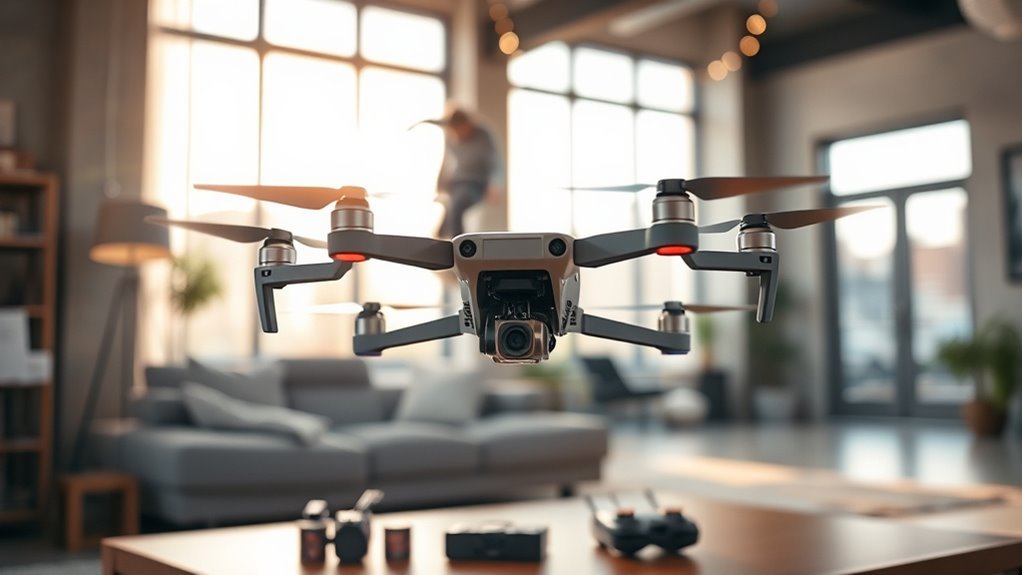
Cinewhoop drones are small, ducted quadcopters built for controlled cinematic flight rather than speed. Their prop guards improve safety and help stabilize footage in tight spaces, which makes them useful indoors and around obstacles. Sizes and setups vary enough to change performance considerably. The key question is not just what a cinewhoop can do, but which configuration suits a specific flight environment best.
What Makes a Cinewhoop Different?
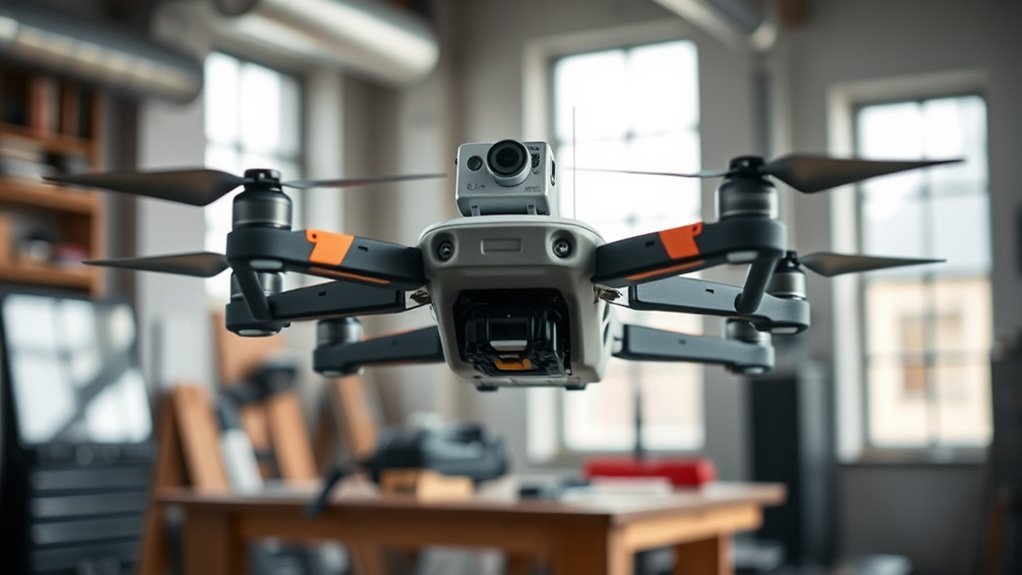
Cinewhoops are a distinct class of FPV drones built around ducted propellers, a design that improves safety during indoor flight and enables close-proximity shooting with reduced risk of injury or damage.
A Cinewhoop usually carries 2- to 3.5-inch propellers, making it compact and agile enough to move through narrow corridors, rooms, and other indoor environments with control. The propeller guards, or ducts, protect people and objects while also supporting stable low-altitude flight.
Compact and agile, a Cinewhoop’s ducted props help it slip through tight spaces while keeping flight stable and safe.
As a result, the platform is suited to filming where precision matters and where freedom from large, exposed rotors is essential. Its focus is not raw speed, but smooth cinematic footage supported by stabilization and predictable handling.
This emphasis changes flight performance: added weight can shorten flight time, yet the tradeoff is practical usability in confined spaces. For operators seeking liberated movement inside restricted settings, the Cinewhoop offers a controlled, specialized FPV tool.
Cinewhoops vs. Freestyle Drones
Unlike freestyle drones, cinewhoops are built for controlled cinematic flight rather than aggressive maneuvering, with ducted propellers that improve safety in tight spaces and support smooth, low-speed shots. For indoor flying, cinewhoop drones prioritize stable flight characteristics and camera compatibility for lightweight action cameras, making cinematic footage more accessible in confined environments. Freestyle drones, by contrast, emphasize speed, torque, and rapid attitude changes, enabling acrobatic lines but reducing suitability for tight, protected spaces. Skill requirements also diverge: cinewhoops are generally less demanding, allowing newer pilots to operate with more confidence, while freestyle drones reward advanced stick control and higher risk tolerance.
| Aspect | Cinewhoops | Freestyle drones |
|---|---|---|
| Primary use | Cinematic footage | Tricks and racing |
| Flight characteristics | Slow, smooth | Fast, agile |
| Skill requirements | Lower | Higher |
Cinewhoop Sizes and What They’re Best For
Size is a major factor in cinewhoop performance, with frames typically ranging from 1.6 inches to 3.5 inches and each class suited to different filming conditions.
A Cinewhoop drone in the 1.6-inch or 2-inch range favors indoor flying, where low mass, reduced noise, and high agility support precise work in confined spaces.
Mid-size 2.5-inch and 3-inch models offer a practical balance, often staying under 250g for regulatory compliance while preserving maneuverability for mixed routes.
At the upper end, 3.5-inch cinewhoops deliver greater stability, stronger thrust, and higher payload capacity, which improves handling in outdoor environments and windy conditions.
At the upper end, 3.5-inch cinewhoops offer greater stability, stronger thrust, and better performance in windy outdoor conditions.
Larger frames typically produce smoother footage, though they sacrifice some responsiveness. Smaller frames react faster, but battery life and load limits constrain them.
Selecting size consequently determines not only flight behavior but also mission range, safety margin, and the degree of creative freedom available to the pilot.
Best Cinewhoops for Indoor Flying
For indoor flying, top cinewhoop picks typically fall in the 2-inch to 3-inch class, where compact dimensions improve control in confined spaces.
Models such as the BetaFPV Pavo Pico V2 and GEPRC Cinebot25 V2, both under 250g, combine agility with regulatory practicality.
Ducted propellers further improve safety while still supporting short 5- to 8-minute flights and lightweight camera payloads.
Top Indoor Picks
Indoor flying places a premium on compact frames, stable handling, and low collision risk, and the best cinewhoops in this category balance all three.
The Cinewhoop class gives FPV pilots controlled indoor flying with a compact design suited to tight rooms and corridors.
The BetaFPV Pavo20 Pro favors agile response and is well suited to cinematic shots, though it requires DIY installation.
For a lighter alternative, the BetaFPV Pavo Pico V2 weighs 84 g and works with the DJI O4 Lite system.
The Speedybee Bee25 adds 7-8 minutes of flight time, while the GEPRC Cinebot25 V2 emphasizes stable flight in varied interiors.
The DJI Avata 2 remains the most turnkey option, pairing GPS, video transmission, and ready-to-fly bundles for liberated, immersive operation.
Small Size Advantages
Compact cinewhoops gain their advantage from a tight physical footprint, with most models measuring roughly 1.6 to 3.5 inches, which makes them well suited to confined indoor spaces.
This Cinewhoop small size improves indoor flying by reducing collision risk and simplifying control in hallways, rooms, and stairwells. The compact design also supports traversing tight spaces where larger aircraft cannot operate safely.
Protective ducts surround the propellers, adding a safety margin during proximity flying and limiting damage to walls, furniture, and people.
Lightweight examples such as the BetaFPV Pavo Pico V2 and GEPRC Cinebot25 V2 preserve maneuverability while still supporting stable aerial videography.
With flight times of 4 to 8 minutes, operators gain enough freedom to capture precise, cinematic motion indoors without sacrificing control or safety.
Best Cinewhoops for Outdoor Shots
Outdoor cinewhoops are generally best chosen around the 3.5-inch class, where power, agility, and stability are balanced well enough to produce smooth footage in changing conditions. For Cinewhoop outdoor shots, this size gives operators more freedom without sacrificing control. The GEPRC Cinebot35 is a strong reference point for wind-resistant cinematic footage, while the BetaFPV Pavo20 Pro favors lighter builds and precise handling. DJI’s Avata 2 adds a mature ecosystem and reliable transmission for versatile field work.
| Model | Strength | Outdoor Use |
|---|---|---|
| GEPRC Cinebot35 | Payload and stability | Windy scenes |
| BetaFPV Pavo20 Pro | Lightweight handling | Tight environments |
| DJI Avata 2 | GPS and link quality | Broad coverage |
Speedybee Bee25 also merits attention for longer sessions, with 7-8 minute flight times supporting extended coverage. The best Cinewhoop for outdoor shots is the one that preserves stability, delivers responsive control, and keeps the camera liberated from harsh motion.
Pick the Right Battery and Props
With the frame and camera platform chosen, performance now depends on matching the battery and props to the drone’s build. For a Cinewhoop, battery selection should account for motor KV, propeller size, drone weight, and target flight time. Common packs are 850mAh, 1100mAh, and 1500mAh, each shifting the balance between duration and agility.
Connector compatibility matters as well; XT30 and XT60 must match the airframe to prevent power loss and wiring issues. Propeller size directly changes handling: 1.6-inch and 2-inch props suit indoor flying, where compact response and control are essential, while 3.5-inch props offer greater outdoor stability.
Added prop guards increase drag and reduce flight time, so battery capacity must be weighed against drone weight. Regular testing confirms whether the chosen battery and props deliver the needed efficiency, freedom, and maneuverability without sacrificing reliable performance.
Tune Your Cinewhoop for Smooth Video
Smooth Cinewhoop footage depends on careful tuning of the flight controller and pilot inputs.
- PID Tuning: adjust Proportional, Integral, and Derivative values until wobble is reduced and frame stability improves.
- Sensitivity settings: refine rates and expo so stick movement yields restrained, accurate response for smoother lines.
- Throttle control: hold a steady throttle to preserve altitude, limit bumps, and support clean cinematic footage.
- Flight modes: use manual or acro for direct authority, enabling controlled, expressive FPV flying without excess correction.
Each Cinewhoop behaves differently, so tuning is rarely immediate.
Trial and error remains essential: test one change at a time, review the result, and iterate until motion feels liberated yet disciplined.
When the airframe responds predictably, the pilot can shape shots with precision, turning raw movement into smooth cinematic footage that serves the scene.
How to Fly a Cinewhoop Safely
Safe Cinewhoop operation begins with a pre-flight inspection that confirms propeller guards, batteries, and all critical components are secured and functioning correctly.
For indoor flight, the pilot should use slow, smooth control inputs and maintain constant awareness of nearby obstacles, people, and property.
Practice in open spaces or simulators can improve control precision before attempting confined environments, while local regulations and line-of-sight requirements should always be observed.
Preflight Safety Checks
Before each flight, a cinewhoop should be inspected for visible damage, with special attention to the propeller guards, which must be securely attached and free of cracks. This preflight routine supports drone safety and preserves controlled flight in indoor environments where obstacles constrain movement.
- Verify the battery is charged to at least 80% and connections are firm.
- Test throttle, yaw, pitch, and roll for immediate response and calibration.
- Survey the area for obstacles, people, and pets, clearing the flight path.
- Confirm adequate clearance from walls and fixed surfaces before takeoff.
A disciplined preflight process reduces avoidable risk and grants the operator the freedom to focus on precision rather than correction.
Indoor Flight Techniques
With the drone inspected and the flight area cleared, indoor operation depends on controlled inputs and disciplined spacing. A Cinewhoop’s ducts improve safety, yet the pilot still must avoid walls, ceilings, and furniture. Smooth throttle control and a steady altitude reduce drift and preserve indoor flight freedom.
| Technique | Purpose | Effect |
|---|---|---|
| Smooth throttle control | Stabilize motion | Fewer corrections |
| Acro mode, low rates | Refine handling | Better cinematic footage |
| Distance from obstacles | Preserve safety | Lower collision risk |
Beginners should first fly in acro mode at conservative rates, then expand speed only after precision improves. Battery levels require regular monitoring, because voltage drop reduces responsiveness. Keeping the drone under 250g also supports maneuverability, enabling cleaner lines, safer shifts, and more liberated movement through confined interiors.
Frequently Asked Questions
Is a Cinewhoop Good for Beginners?
Yes, a cinewhoop is generally good for beginners. Its Cinewhoop features include propeller guards, compact size, and flight stability, which reduce crash risk and ease control.
Beginner tips include starting in open indoor spaces, checking battery life, and using low-speed modes. Camera options remain useful for learning footage capture. Safety precautions are essential around people.
Popular brands such as BetaFPV and GEPRC offer ready-to-fly models that support a smoother start.
What Is a Cinewhoop Drone Used For?
A Cinewhoop drone is used to turn cramped spaces into grand cinematic stages, because apparently hallways deserve blockbuster treatment.
Its Cinewhoop features support Flight stability, making Indoor flying practical for real estate, events, and tight-location filmmaking.
Camera options vary for different Filmmaking techniques, while Battery life limits each sortie.
Propeller guards and Safety precautions reduce risk, enabling precise, liberated visual storytelling in museums, homes, forests, and urban environments with minimal disturbance.
Do You Need a License to Fly a Cinewhoop?
A license is not always required to fly a cinewhoop. Under FAA Cinewhoop regulations, recreational flights with drones under 250 grams generally need no pilot certificate, though drone safety rules still apply.
Commercial operations usually require Part 107, registration, and attention to flying locations, battery management, equipment setup, and insurance requirements.
Operators should consult community resources and verify local laws, since permissions and limits vary by airspace and region.
What Is the 1:1 Rule for Drones?
The 1:1 rule for drones keeps altitude and horizontal distance equal, such as 100 feet up and 100 feet away, improving drone safety.
Studies often note that many incidents occur within the first minute of poor orientation, making this ratio valuable. It supports flight regulations, camera stabilization, battery life planning, aerial photography, and even racing drones.
Observing it, along with maintenance tips, helps pilots fly freely yet precisely.
Conclusion
In the end, the cinewhoop’s greatest irony is that the drone built for safety often becomes the tool that reveals the most daring shots. Its ducts, modest speed, and stable handling may seem unremarkable, yet they enable smooth flight through spaces where larger drones would fail. For pilots who value control over spectacle, the cinewhoop proves that precision, not aggression, is what makes cinematic footage possible.