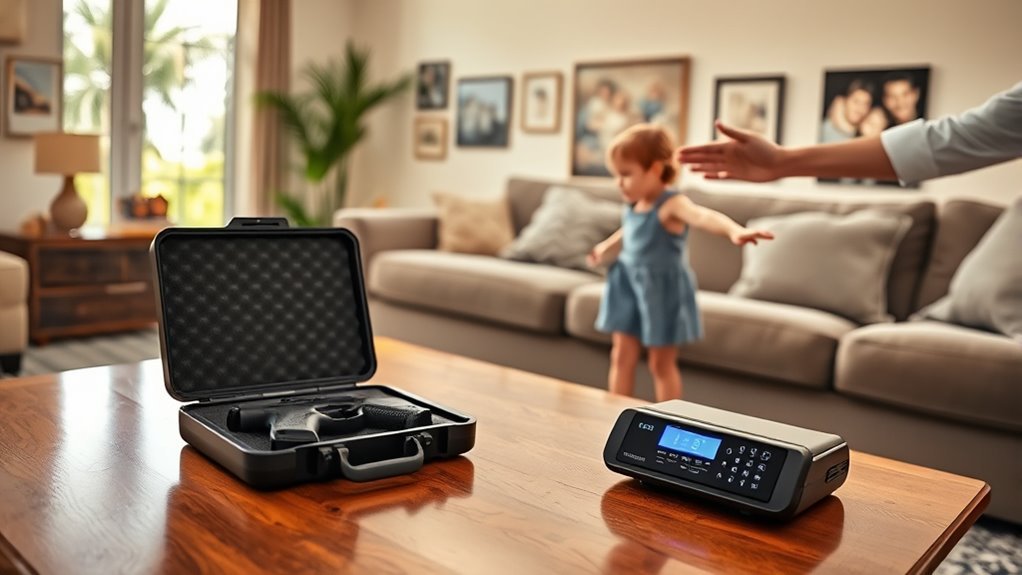
Florida’s safe storage gun law sets rules for keeping firearms away from children and carrying handguns in private vehicles. However, the widely reported October 1, 2026 vehicle-storage mandate did not become law. Understanding the difference between the failed proposal and existing Florida statutes can help you store firearms safely while following the rules that actually apply.
Quick Answer
Florida did not enact the proposed October 1, 2026 vehicle-storage mandate. Existing law allows eligible adults to keep handguns securely encased or otherwise not readily accessible in private vehicles. Separate rules require secure storage of loaded firearms when children under 16 may gain unauthorized access. Criminal penalties depend on specific statutory conditions.
Last checked: September 28, 2026. Dates and figures were verified against official sources.
Key Takeaways
- Florida SB 256 and its companion HB 159 failed during the 2026 legislative session.
- A glove compartment does not have to be locked to qualify as securely encased under the existing vehicle-possession definition.
- A locked firearm container is still a safer option when leaving a vehicle unattended.
- Florida’s child-access storage statute specifically defines a minor as someone under 16.
- The law’s criminal-storage provision requires more than simply finding an unlocked firearm.
What Florida’s Safe Storage Gun Law Requires
)
Florida has existing firearm-storage and vehicle-possession laws. The separate proposal to require additional locking and concealment in certain unattended vehicles and vessels did not pass.
The official legislative history of SB 256 confirms that the bill died in the Senate Criminal Justice Committee on March 13, 2026. Its companion measure, HB 159, also failed.
SB 256 proposed an October 1, 2026 effective date for new storage requirements affecting handguns in unoccupied, unsecured private vehicles and vessels.
The proposal would have required handguns to remain hidden from ordinary observation and secured through an attached locking mechanism or inside a locked compartment or container.
However, a proposed effective date does not make legislation enforceable. Because the bill never became law, its vehicle-storage amendment does not take effect on October 1, 2026.
Instead, the existing Florida Statute 790.25(4) governs possession of handguns and other weapons in private conveyances.
Under this provision, a person aged 18 or older who lawfully possesses a handgun may keep it inside a private conveyance if it is securely encased or otherwise not readily accessible for immediate use.
Authorized concealed carry on the person’s body is addressed separately under Florida law.
Florida also maintains child-access prevention requirements under Statute 790.174. These rules apply to loaded firearms when the owner knows, or reasonably should know, that a qualifying minor is likely to gain unauthorized access.
The two provisions address different circumstances. A lawful vehicle-storage arrangement does not automatically resolve every child-access or firearm-carrying question.
Who Must Comply With Florida’s Storage Rules?
Florida’s existing storage and possession rules apply according to the firearm, the owner’s circumstances, and the location involved. The failed 2026 proposal did not create a new locking obligation for every firearm owner.
For private vehicles, Statute 790.25(4) addresses adults aged 18 or older who are otherwise legally permitted to possess the handgun or weapon.
For child-access prevention, Statute 790.174 addresses people who store or leave loaded firearms on premises under their control when they know, or reasonably should know, that a child covered by the statute is likely to gain access without lawful permission or required supervision.
Florida’s vehicle-possession and child-access rules have different requirements. Compliance with one provision does not automatically establish compliance with another.
The location and manner of possession matter. For example, keeping a handgun inside a glove compartment raises different legal questions from carrying it on your person.
Similarly, leaving a loaded firearm where a young child may access it raises issues under the child-access prevention statute.
Gun owners should also distinguish legal minimums from additional safety precautions. A storage method may satisfy a specific statutory definition while offering less protection against theft than a dedicated firearm safe.
How to Store Handguns in Cars and Boats
For vehicle possession under Florida Statute 790.25(4), a handgun must be securely encased or otherwise not readily accessible for immediate use unless another lawful carrying provision applies.
The failed 2026 legislation does not impose its proposed additional locking and concealment requirements on unattended vehicles or vessels.
Nevertheless, using a properly secured firearm lockbox remains a practical way to reduce theft and unauthorized access.
Locked Vehicle Storage
Florida law defines the term securely encased more broadly than a locked gun safe.
Under Florida Statute 790.001(15), the definition includes several storage arrangements.
- A glove compartment, whether locked or unlocked.
- A snapped holster.
- A gun case, whether locked or unlocked.
- A zippered gun case.
- A closed box or container that requires opening a lid or cover to access its contents.
This definition is important because a locked container is not the only way a handgun can qualify as securely encased under the existing vehicle-possession law.
The statute also recognizes a handgun that is otherwise not readily accessible for immediate use.
That means the firearm cannot be positioned so that it can be retrieved and used as easily and quickly as though it were carried on the person.
However, the legal definition of securely encased should not be confused with a recommendation for theft-resistant storage.
A glove compartment may qualify under the statute without providing the protection of a dedicated locked firearm container.
The Bureau of Alcohol, Tobacco, Firearms and Explosives (ATF) vehicle-storage guidance recommends using a lockable case or lockbox, preferably secured to the vehicle.
For practical storage when leaving your vehicle unattended:
- Confirm the firearm is unloaded before placing it in storage, following safe handling procedures.
- Place the firearm inside a suitable locked firearm container.
- Secure the container to the vehicle where the design permits.
- Keep the container out of ordinary view.
- Lock the vehicle and retain control of the storage key or combination.
- Return the firearm to secure home storage when practical.
These steps provide additional protection beyond relying solely on a glove compartment or vehicle door lock.
Warning: A locked vehicle door does not make an unsecured firearm safe from theft or unauthorized access. Never leave a firearm where a child can reach it.
Boat Transport Rules
The proposed October 2026 storage amendment expressly covered private vessels, but it did not become law.
Therefore, the bill’s requirement for a handgun in an unoccupied, unsecured vessel to be hidden and secured in a specified manner is not an enacted requirement under that proposal.
Boat owners must still follow applicable firearm possession, carrying, and child-access laws.
For unattended storage, a locked container that is appropriate for the marine environment provides an additional safety measure.
Keep the firearm protected from unauthorized handling, retain control of the key or combination, and avoid leaving it exposed in an open compartment.
A vessel’s storage arrangement may differ from a car’s trunk or glove box. Do not assume that a compartment is legally or physically secure simply because it has a cover.
Owners should consider the firearm’s location, the people who may enter the vessel, and whether a child could gain access.
These precautions address the theft and juvenile-access concerns raised in the proposed legislation without presenting its failed requirements as current law.
Florida Home Storage Rules for Minors
Florida’s existing home-storage law focuses on preventing unauthorized access to loaded firearms by children covered by the statute.
It does not establish a blanket requirement that every firearm in every home must always be locked, regardless of the circumstances.
Instead, the duty depends on the conditions established in Statute 790.174.
Minors’ Access Limits
Florida uses different age thresholds for different firearm laws. This distinction is especially important when discussing storage and possession.
Under Florida Statute 790.174, the term minor specifically means a person under 16.
The provision applies when someone stores or leaves a loaded firearm on premises under their control and knows, or reasonably should know, that such a minor is likely to gain access without lawful permission or legally required supervision.
Other Florida laws address individuals under 18.
For example, Statute 790.22 generally prohibits firearm possession by people under 18 while recognizing specific exceptions.
Purchasing restrictions are another separate issue. Florida generally prohibits firearm purchases by people younger than 21, subject to statutory exceptions.
These age limits should not be treated as interchangeable. A storage requirement, possession restriction, and purchase prohibition may apply to different groups.
Locked Storage Requirements
When Florida’s child-access storage provision applies, the owner must secure the loaded firearm in one of the ways recognized by the statute.
The permitted arrangements include:
- A securely locked box or container.
- A location that a reasonable person would believe to be secure.
- A trigger lock that secures the firearm.
The statute provides an exception when the firearm is carried on the person’s body or kept close enough to be retrieved and used as easily and quickly as if carried.
This exception is part of the legal language. It is not a reason to leave a firearm accessible to children.
For households, storing firearms unloaded in locked containers and securing ammunition separately provides additional protection.
Keep keys and combinations away from children and other unauthorized users.
Simply placing a firearm on a high shelf or hiding it in a drawer is not equivalent to secure storage.
A dedicated firearm safe can also help households maintain a consistent storage arrangement when visitors or children are present.
Supervised Home Use
Florida permits certain firearm activities involving minors, but the applicable exceptions depend on age, activity, and supervision.
Under Florida Statute 790.22(3), a person under 18 generally may not possess a firearm except in circumstances specified by law.
The statute recognizes an unloaded firearm at the minor’s home and certain lawful hunting, marksmanship, and recreational shooting activities.
For qualifying hunting and shooting activities, supervision requirements depend on whether the minor is under 16 or at least 16.
The statute also recognizes direct transportation of an unloaded firearm to or from specified lawful activities.
Separately, subsection (1) addresses the use of BB guns, air or gas-operated guns, and electric weapons or devices by minors under 16.
These provisions should not be collapsed into a general statement that every minor may possess or use a firearm whenever an adult is present.
Parents and guardians should maintain direct control over firearm access and understand the legal conditions that apply to the particular activity.
Penalties for Unsafe Gun Storage
Florida’s existing safe-storage law provides criminal penalties when specified conditions are met. It does not automatically impose the same penalty for every instance of an unlocked firearm.
Under Statute 790.174(2), a person commits a second-degree misdemeanor when the statutory storage duty is violated and the minor subsequently gains access and possesses or exhibits the firearm in the circumstances described by the law.
Those circumstances include possession or exhibition in a public place, or exhibition in a rude, careless, angry, or threatening manner in violation of Statute 790.10.
The provision also contains an exception when a minor obtains the firearm through an unlawful entry by any person.
The general sentencing limits for a second-degree misdemeanor are:
- Up to 60 days of imprisonment under Florida Statute 775.082.
- A fine of up to $500 under Florida Statute 775.083, subject to applicable statutory provisions.
Other firearm-related conduct may fall under separate criminal laws and carry different penalties.
The failed 2026 vehicle-storage proposal does not create an additional misdemeanor for violating its proposed locking requirements.
Note: This guide explains general Florida law and does not replace legal advice. If a specific storage, possession, or criminal-liability question affects you, consult a qualified Florida firearms attorney.
What’s New in Florida’s 2026 Safe Storage Law?
The central 2026 development was proposed legislation rather than a new statewide vehicle-storage mandate.
SB 256 proposed additional handgun-storage requirements for unoccupied, unsecured private vehicles and vessels. The bill was not enacted.
Its original legislative text included provisions concerning concealment, locking mechanisms, public education, firearms-training curricula, and updated warnings during firearm sales and transfers.
The proposal also cited national firearm-theft figures. Its preamble stated that thefts from cars had tripled over the preceding decade and that more than half of gun thefts occurred from cars in 2022.
These were historical figures used to explain the proposal. They should not be presented as current Florida-specific theft statistics.
The table below separates the proposed changes from the provisions that actually apply.
| Provision | Legal Status | What It Means |
|---|---|---|
| Proposed vehicle and vessel locking requirement | SB 256 failed in 2026 | No new mandate under that proposal |
| Existing private-vehicle possession rules | Florida Statute 790.25(4) | Securely encased or otherwise not readily accessible, subject to applicable exceptions |
| Existing child-access storage requirements | Florida Statute 790.174 | Applies to loaded firearms under specified circumstances involving minors under 16 |
Another important distinction concerns firearm-sale warnings.
Under existing Florida Statute 790.175, retailers must provide written warnings and display required notices about firearm access by minors and unlawful transfers.
Those warnings refer to minors under 18. However, the separate safe-storage offense in Statute 790.174 specifically defines a minor as someone under 16.
The failed bill proposed expanding the warning language to include its vehicle-storage requirements. Those proposed additions did not become part of the statute through SB 256.
The practical distinction is straightforward: existing laws remain enforceable, while provisions contained only in an unsuccessful bill do not create new legal duties.
Frequently Asked Questions
What Are the Legal Requirements for Storing Guns in Florida?
Florida requires secure storage of loaded firearms when the conditions in Statute 790.174 apply, particularly when children under 16 may gain unauthorized access. Vehicle possession is governed separately under Statute 790.25(4). The proposed additional vehicle-locking requirements for October 2026 did not become law.
What Is the 333 Rule for Guns?
The 333 rule is not a recognized storage standard in Florida’s firearm statutes. Some informal safety advice combines locked containers, firearm locks, and restricted access, but these practices should not be mistaken for a legal formula. Florida’s actual storage requirements are established by its statutes.
What Are the Changes in Florida’s Gun Laws in 2026?
The proposed October 1, 2026 vehicle-storage amendment was not enacted. SB 256 and its companion HB 159 failed during the legislative session. Existing firearm-storage, vehicle-possession, and child-access provisions remain the applicable starting points for the issues covered in this guide.
Can I Keep a Loaded Gun in My Glove Box in Florida?
Florida’s securely encased definition includes a glove compartment, whether locked or unlocked. A lawfully possessed handgun may qualify under the private-vehicle possession provision without the proposed 2026 locking mandate. Other applicable possession and child-access rules still matter, and a dedicated lockbox provides additional protection.
Does Florida Require Every Gun to Be Locked at Home?
No blanket locking requirement applies to every firearm in every circumstance under Statute 790.174. The statute specifically addresses loaded firearms when the owner knows, or reasonably should know, that a minor under 16 is likely to gain unauthorized access. Locked storage remains a recommended safety precaution.
Can You Be Charged for Leaving an Unlocked Gun in a Car?
The failed 2026 proposal does not create a criminal offense for violating its proposed vehicle-storage requirement. However, existing firearm-possession and child-access laws can still apply depending on the circumstances. Whether conduct violates Florida law depends on the relevant statute and the facts involved.
Conclusion
Florida’s safe storage gun law remains important for preventing unauthorized firearm access, but the proposed October 1, 2026 vehicle-storage mandate was not enacted.
For legal compliance, distinguish the existing private-vehicle possession rules from the child-access storage requirements. For additional safety, use a locked firearm container, control access to keys and combinations, and avoid leaving firearms unsecured in unattended vehicles or homes.
Sources
- Florida Senate: SB 256 legislative history: Confirms the bill’s status, proposed effective date, and failure during the 2026 legislative session.
- Florida Senate: SB 256 original bill text: Documents the proposed vehicle-storage requirements, public education provisions, warning changes, and historical theft figures.
- Florida Statute 790.25: Establishes existing private-conveyance firearm-possession requirements.
- Florida Statute 790.001: Defines securely encased and readily accessible for immediate use.
- Florida Statute 790.174: Establishes safe-storage duties involving minors and the conditions for criminal liability.
- Florida Statute 790.22: Addresses firearm possession by minors and specified exceptions.
- Florida Statute 790.175: Establishes firearm-sale and transfer warning requirements.
- Florida Statute 775.082: Establishes applicable imprisonment limits for criminal offenses.
- Florida Statute 775.083: Establishes applicable criminal fine limits.
- Bureau of Alcohol, Tobacco, Firearms and Explosives: Provides practical guidance on preventing firearm theft from vehicles.
