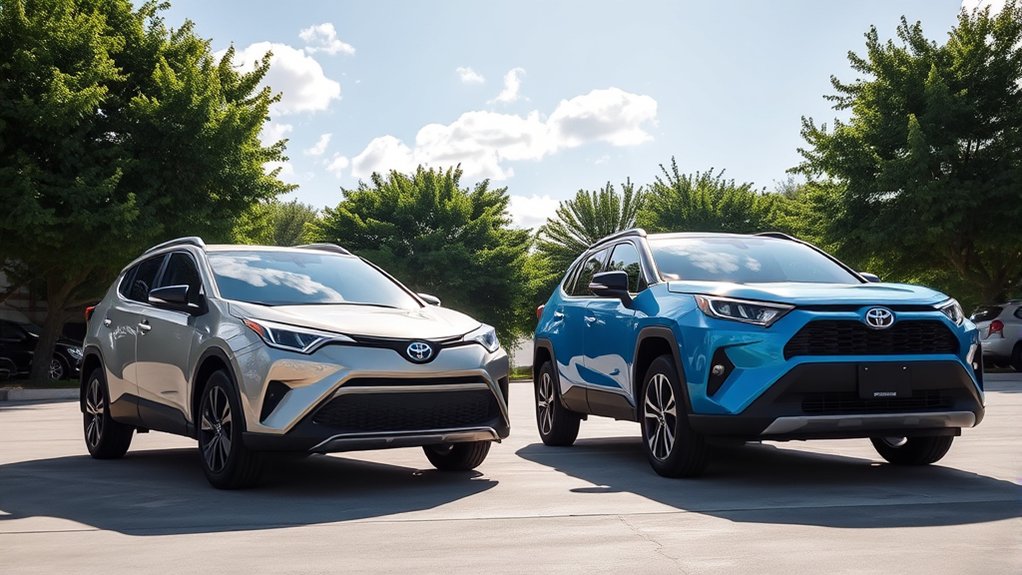
No Toyota RAV4 acquired in 2026 qualifies for the federal clean vehicle tax credit. The standard Toyota RAV4 Hybrid is a conventional hybrid that cannot be charged from an external power source, so it did not qualify under the former New Clean Vehicle Credit. The RAV4 Plug-in Hybrid can be charged externally, but federal new, used, and commercial clean-vehicle credits are unavailable for vehicles acquired after September 30, 2025.
A different federal tax benefit may still matter to some RAV4 buyers. For tax years 2025 through 2028, qualifying taxpayers may deduct certain interest paid on a loan for a new personal-use vehicle that completed final assembly in the United States. This is a car-loan-interest deduction, not an EV or hybrid tax credit.
Last updated: September 11, 2026
Quick Answer
No. A Toyota RAV4 Hybrid acquired in 2026 does not qualify for the federal clean vehicle tax credit. The conventional Hybrid never qualified under the plug-in clean-vehicle rules, and the federal new, used, and commercial clean-vehicle credits ended for vehicles acquired after September 30, 2025. However, some new U.S.-assembled RAV4 Hybrids financed for personal use may qualify for the separate federal car-loan-interest deduction.
Key Takeaways
- The RAV4 Hybrid is a conventional, non-plug-in hybrid and does not qualify for the federal clean vehicle credit.
- Federal new, previously owned, and commercial clean-vehicle credits are unavailable for vehicles acquired after September 30, 2025.
- Older RAV4 Prime eligibility depended on the transaction date and the federal rules then in effect; plug-in capability alone did not guarantee a credit.
- A separate 2025–2028 deduction may apply to interest on a qualifying loan for a new U.S.-assembled personal vehicle.
- Toyota says 2026 RAV4 Hybrid production occurs in Kentucky and Ontario, Canada, so the exact assembly location must be checked. The 2026 RAV4 Plug-in Hybrid is assembled in Japan.
- Arizona does not provide a blanket current RAV4 purchase credit or solo-HOV exemption, although some utilities offer EV charging rebates or time-of-use rates.
Does the Toyota RAV4 Hybrid Qualify for a Federal Tax Credit in 2026?

No. The standard RAV4 Hybrid does not qualify for the federal New Clean Vehicle Credit because its traction battery cannot be recharged from an external electricity source. It is a conventional hybrid that charges through the gasoline engine and regenerative braking.
The timing rule now makes the answer broader for current shoppers. According to the Internal Revenue Service, the New Clean Vehicle Credit, Previously-Owned Clean Vehicle Credit, and Qualified Commercial Clean Vehicle Credit are unavailable for vehicles acquired after September 30, 2025.
For a RAV4 acquired after September 30, 2025, the federal clean-vehicle credit is $0. That rule applies even to a plug-in hybrid or electric vehicle that otherwise would have met the former technical requirements.
A limited transition rule remains relevant to some earlier transactions. The IRS treats a vehicle as acquired when the buyer entered a binding written contract and made a payment. A qualifying vehicle acquired by September 30, 2025 could be placed in service later, but every other applicable vehicle, buyer, seller-reporting, and documentation requirement still had to be satisfied.
Important: “Acquired” and “placed in service” are not always the same date. The IRS generally treats a vehicle as placed in service when the buyer takes possession.
Why Does the Standard RAV4 Hybrid Not Qualify?
The RAV4 Hybrid combines a gasoline engine, electric motor-generators, and a traction battery to reduce fuel use. It has no external charging port. If you want a deeper explanation of that system, see how the Toyota RAV4 Hybrid engine and electric system work.
The former federal clean vehicle program covered qualifying plug-in electric and fuel-cell vehicles. Using an electric motor by itself was not enough.
| Vehicle | External Charging | Federal Clean-Vehicle Credit for 2026 Acquisition | Potential Car-Loan-Interest Deduction |
|---|---|---|---|
| RAV4 Hybrid | No | No | Possible if the exact vehicle was finally assembled in the United States and all financing and taxpayer rules are met |
| RAV4 Plug-in Hybrid / former RAV4 Prime | Yes | No | 2026 model is assembled in Japan, so it does not meet the U.S.-final-assembly requirement |
Regenerative braking does not make a conventional hybrid a plug-in vehicle. It recovers some energy while the vehicle slows, but it does not allow the owner to recharge the traction battery from the electrical grid.
Can a 2026 RAV4 Qualify for the Car-Loan-Interest Deduction?
Possibly. This deduction is separate from the former clean-vehicle credit. For tax years 2025 through 2028, the IRS allows eligible individuals to deduct up to $10,000 per year of qualified interest paid on a loan for a new personal-use vehicle, subject to the program’s requirements.
According to the IRS guidance for individuals and workers, the vehicle must have completed final assembly in the United States. The loan generally must have originated after December 31, 2024, be secured by a lien on the vehicle, and finance a new personal-use vehicle whose original use begins with the taxpayer. Lease payments do not qualify.
The maximum deduction phases out for taxpayers with modified adjusted gross income above $100,000, or $200,000 for married couples filing jointly. The taxpayer must also report the vehicle identification number on the tax return.
2026 RAV4 assembly check: Toyota states that 2026 RAV4 Hybrid models are assembled in Lexington, Kentucky and in Ontario, Canada. Only an otherwise qualifying U.S.-assembled vehicle can meet the car-loan-interest deduction’s final-assembly requirement. Check the exact VIN or dealer window label instead of assuming every RAV4 Hybrid qualifies.
Toyota states that the 2026 RAV4 Plug-in Hybrid is assembled in Japan. Therefore, that model does not meet the U.S.-final-assembly requirement for this particular loan-interest deduction.
RAV4 Prime and RAV4 Plug-in Hybrid Tax Credit History
Earlier model years of Toyota’s plug-in RAV4 were sold as the RAV4 Prime. Toyota now markets the current model as the RAV4 Plug-in Hybrid. The name change does not restore a federal clean-vehicle credit.
Older articles can be confusing because the rules changed several times. The major dates are:
| Period | What Changed |
|---|---|
| Before August 16, 2022 | The RAV4 Prime could qualify under the older plug-in vehicle credit rules, subject to the requirements then in effect and Toyota’s manufacturer phaseout. |
| August 16, 2022 onward | A North American final-assembly requirement took effect for new clean vehicles, with a transition rule for certain binding contracts entered before August 16, 2022. |
| 2023 through September 30, 2025 | Section 30D also applied income, MSRP, seller-reporting, assembly, battery, and other requirements. Plug-in capability alone did not establish eligibility. |
| After September 30, 2025 | New, used, and commercial federal clean-vehicle credits are unavailable for later acquisitions. |
The IRS historical manufacturer table lists the 2021–2022 RAV4 Prime among Toyota vehicles that could receive the former plug-in credit before the post-2022 rules took over. However, the applicable purchase date, delivery date, transition rules, assembly requirements, and Toyota phaseout rules still matter for an individual transaction.
For 2025, Toyota lists the RAV4 Plug-in Hybrid as assembled in Aichi, Japan. A normal consumer purchase therefore did not satisfy the North American final-assembly requirement of Section 30D. Leasing and commercial-credit treatment followed different historical rules because the leasing company, not the lessee, owned the vehicle.
For a deeper model-specific explanation, see our guide to RAV4 Plug-in Hybrid tax-credit eligibility.
Warning: Do not use an old dealer advertisement, window sticker, model name, or archived “up to $7,500” claim as proof that a particular historical transaction qualified. Eligibility depended on the law and vehicle information in effect at the time.
What Historical Requirements Could Affect a RAV4 Prime Claim?

If you are reviewing an older transaction, the exact rules depend on the acquisition and placed-in-service dates. Depending on the year, relevant factors could include:
- The exact model year, trim, VIN, and final-assembly location
- The acquisition date and the date you took possession
- Whether a binding contract qualified for a transition rule
- The buyer’s modified adjusted gross income
- The applicable MSRP limit
- Battery and critical-mineral rules in effect on the relevant date
- A valid seller or time-of-sale report when required
- Whether the taxpayer bought and owned the vehicle or leased it
- Whether the vehicle was acquired for use rather than resale
Under the later version of the former New Clean Vehicle Credit, modified adjusted gross income generally could not exceed $150,000 for most individual filers, $225,000 for heads of household, or $300,000 for married couples filing jointly and qualifying surviving spouses. The SUV MSRP limit was $80,000. These figures should be applied only to a transaction for which those rules were actually in effect.
Historical-rule caution: Do not apply the 2023–2025 income, battery, and MSRP rules automatically to a 2021 or early-2022 RAV4 Prime purchase. Earlier transactions were governed by different versions of the credit.
Are There Arizona Incentives for RAV4 Hybrid or Plug-in Hybrid Owners?
Arizona does not provide a blanket current purchase credit for every hybrid or plug-in hybrid. Current benefits depend on the vehicle, utility territory, charging equipment, purchase date, and program rules.
| Program or Benefit | Current Practical Guidance |
|---|---|
| State vehicle-purchase tax credit | No blanket current Arizona purchase credit is listed for a new RAV4 Hybrid or RAV4 Plug-in Hybrid. Verify current state programs before purchase. |
| Reduced alternative-fuel vehicle license tax | The former reduced rate is not a current benefit for a newly purchased RAV4. The old program applied to qualifying alternative-fuel vehicles purchased under earlier rules. |
| Utility Level 2 charger rebate | Some Arizona utilities currently list residential Level 2 charging incentives. These can be relevant to a plug-in vehicle but not to a conventional RAV4 Hybrid that cannot plug in. |
| EV time-of-use electricity rate | Arizona Public Service, Salt River Project, Tucson Electric Power, and other providers may offer EV-related rates or programs. Eligibility depends on the customer’s utility and plan. |
| Solo HOV-lane access | No current hybrid or alternative-fuel solo-HOV exemption applies under the former program. Arizona DOT states that, beginning September 30, 2025, qualifying vehicles no longer receive the old exemption from occupancy requirements. |
| Emissions-testing exemption | Arizona’s zero-emission vehicle exemption applies to electric vehicles. Do not assume a gasoline-powered conventional or plug-in hybrid receives the same exemption. |
Use the U.S. Department of Energy Arizona Laws and Incentives directory and your utility’s current terms before buying charging equipment or choosing an EV rate. Program funding, equipment requirements, and eligibility can change.
Federal charger-credit update: The former Alternative Fuel Vehicle Refueling Property Credit is unavailable for property placed in service after June 30, 2026. A current utility rebate is separate from that expired federal credit.
How Do You Verify an Older RAV4 Prime Tax-Credit Claim?

If you are reviewing an older RAV4 Prime transaction, use the following checklist rather than relying on a current model-level statement:
- Identify the acquisition date. Find the signed purchase agreement, payment record, and any binding contract.
- Identify the placed-in-service date. Record when you took possession of the vehicle.
- Check which version of the law applied. Rules changed significantly on August 16, 2022, January 1, 2023, and September 30, 2025.
- Confirm ownership. Determine whether you purchased or leased the vehicle.
- Verify the exact vehicle. Use the VIN, model year, trim, final-assembly location, and applicable qualified-vehicle records.
- Locate the seller report if one was required. For later transactions, seller reporting was an eligibility requirement.
- Check the applicable income, MSRP, battery, and assembly rules. Use only the requirements that applied to that transaction date.
- Keep the records with your tax files. Retain the contract, payment evidence, VIN, registration, seller report, and tax forms.
Tax Information Notice: This article provides general information, not individualized tax advice. Historical eligibility can depend on transaction documents, tax circumstances, and the law in effect at the time. Consult the IRS instructions or a qualified tax professional before filing or amending a return.
RAV4 Plug-in Hybrid vs. RAV4 Hybrid: Which Tax and Cost Factors Matter Now?
Neither model receives the former federal clean-vehicle credit when newly acquired after September 30, 2025. A useful 2026 comparison therefore starts with the actual purchase or lease price, financing, assembly location, charging access, and operating costs.
| Factor | RAV4 Hybrid | RAV4 Plug-in Hybrid |
|---|---|---|
| Federal clean-vehicle credit for current acquisition | None | None |
| Potential car-loan-interest deduction | Possible on an otherwise qualifying U.S.-assembled vehicle | 2026 model’s Japan assembly does not satisfy the U.S.-assembly requirement |
| External charging | Not available | Available |
| Electric-only local driving | No | Yes, when the battery is charged and operating conditions allow |
| Home-charging equipment | Not needed | Optional cost; utility rebates or special electricity rates may be available |
| Operating-cost calculation | Based mainly on gasoline price and fuel economy | Depends on electricity price, charging frequency, gasoline price, and travel pattern |
A plug-in model can still be attractive for a driver who charges regularly and completes many local trips on electricity. A conventional RAV4 Hybrid may be simpler for someone without dependable charging or whose expected electricity savings would not offset the higher transaction price.
Pro Tip: Compare the final written vehicle price, financing cost, insurance, gasoline use, electricity use, charger cost, and confirmed incentives. Do not subtract an advertised tax benefit until you have verified that your exact vehicle and transaction qualify.
Common RAV4 Tax-Credit Myths
- Myth: Every hybrid qualifies for a federal tax credit.
Fact: Conventional hybrids such as the RAV4 Hybrid did not qualify under the federal plug-in clean-vehicle program. - Myth: Every plug-in hybrid qualified before September 30, 2025.
Fact: Eligibility depended on the exact vehicle, transaction date, assembly location, buyer requirements, seller reporting, battery rules, and other conditions. - Myth: A new RAV4 Plug-in Hybrid bought in 2026 receives up to $7,500.
Fact: The federal new clean vehicle credit is unavailable for vehicles acquired after September 30, 2025. - Myth: The new car-loan-interest deduction is an EV tax credit.
Fact: It is a separate deduction tied to qualifying loan interest, taxpayer limits, vehicle use, and U.S. final assembly. - Myth: Every 2026 RAV4 Hybrid qualifies for the car-loan-interest deduction.
Fact: Toyota assembles 2026 hybrids in both Kentucky and Canada, so the exact vehicle’s final-assembly location must be verified. - Myth: A lessee personally claims the same consumer clean-vehicle credit as a buyer.
Fact: The leasing company owns the vehicle. Any historical incentive passed through to a customer depended on the lessor and lease contract. - Myth: Filing Form 8936 makes an old vehicle eligible.
Fact: A tax form cannot cure a vehicle or transaction that failed the applicable eligibility requirements. - Myth: Arizona hybrids still receive automatic solo HOV access.
Fact: Arizona DOT says the former alternative-fuel and energy-efficient vehicle exemption ended September 30, 2025.
How Do You File a Valid Historical Clean-Vehicle Credit Claim?
This section applies only to an older transaction that actually satisfied the rules in effect when the vehicle was acquired and placed in service.
| Document | What It Helps Establish |
|---|---|
| Signed purchase contract | Transaction terms and acquisition timing |
| Payment record | Payment connected with the transaction or an applicable transition rule |
| Seller or time-of-sale report | Required vehicle qualification information for later versions of the program |
| VIN and vehicle records | Exact model, model year, assembly location, and vehicle identity |
| Delivery or possession record | Placed-in-service date |
| Income records | Compliance with income limits when those limits applied |
| Form 8936 and related schedule, when required | Vehicle information and credit calculation reported with the return |
- Determine which federal rules applied to your acquisition and delivery dates.
- Verify the exact VIN, assembly location, and vehicle eligibility under those rules.
- Confirm any applicable seller-reporting, income, MSRP, battery, or use requirements.
- Review the IRS historical new clean vehicle guidance when the transaction falls under the post-2022 rules.
- Use the appropriate version of IRS Form 8936 for the tax year involved.
- Retain supporting records with the original or amended return.
A lease customer should review the lease contract rather than file a consumer clean-vehicle credit claim for a vehicle owned by a leasing company.
Frequently Asked Questions
Does a Toyota RAV4 Hybrid qualify for a federal tax credit in 2026?
No. The conventional RAV4 Hybrid does not qualify for the federal clean vehicle credit, and the federal new, used, and commercial clean-vehicle credits are unavailable for vehicles acquired after September 30, 2025.
Can a 2026 RAV4 Hybrid qualify for the car-loan-interest deduction?
Possibly. The federal deduction applies to qualifying interest on certain new personal-use vehicles that completed final assembly in the United States. Toyota assembles 2026 RAV4 Hybrids in both Kentucky and Canada, so you must verify the exact vehicle’s assembly location and satisfy the loan and taxpayer requirements.
Does a 2026 RAV4 Plug-in Hybrid qualify for the federal clean vehicle credit?
No. Federal clean-vehicle credits ended for vehicles acquired after September 30, 2025. Toyota also states that the 2026 RAV4 Plug-in Hybrid is assembled in Japan.
Did older RAV4 Prime models qualify for a federal tax credit?
Some older transactions did. The RAV4 Prime appeared under the former pre-2023 plug-in credit program, but eligibility changed after the North American final-assembly rule took effect on August 16, 2022. The exact purchase date, delivery date, VIN, assembly location, transition rules, and other requirements must be checked.
Can I get an Arizona state tax credit for a RAV4 Hybrid?
Arizona does not currently list a blanket purchase tax credit for every new RAV4 Hybrid. Utility, charging, or local programs can differ, so verify the current Arizona Department of Energy directory and your utility’s rules.
Can a RAV4 Hybrid use Arizona HOV lanes with one occupant?
Not under the former hybrid or alternative-fuel exemption. Arizona DOT states that the exemption ended September 30, 2025, so ordinary occupancy requirements now apply during restricted HOV hours unless another vehicle-specific exception applies.
Are Arizona charger rebates available for a RAV4 Plug-in Hybrid?
Some Arizona utilities list Level 2 charger rebates, EV programs, or time-of-use electricity rates. Eligibility depends on the utility territory and current program terms. These utility incentives are separate from the former federal charger tax credit.
Can I personally claim a clean-vehicle credit when I lease the RAV4?
Generally, no. The leasing company owns the vehicle. Under the former commercial clean-vehicle program, a lessor might have qualified and chosen to reflect some value in the lease, but the lessee did not personally claim the consumer credit.
Conclusion
A Toyota RAV4 Hybrid acquired in 2026 does not qualify for the federal clean vehicle tax credit. It is a conventional non-plug-in hybrid, and the federal clean-vehicle credit programs have also ended for vehicles acquired after September 30, 2025.
The more useful 2026 tax question is whether a financed RAV4 qualifies for the separate car-loan-interest deduction. Some U.S.-assembled RAV4 Hybrids may qualify if the vehicle, loan, use, and taxpayer requirements are satisfied. Check the exact VIN and final-assembly location before relying on the deduction.
For Arizona buyers, verify current utility charging programs rather than assuming a state purchase credit, reduced registration tax, or solo-HOV benefit. For an older RAV4 Prime transaction, use the exact acquisition date, delivery date, VIN, assembly location, seller records, and tax-year rules before filing a claim.
Sources
- IRS — Clean Vehicle Tax Credits — current September 30, 2025 termination and acquisition/placed-in-service rules
- IRS — Clean Energy Credit Modification FAQs — statutory termination dates and acquisition definition
- IRS — Qualified Vehicles Purchased in 2022 and Before — historical RAV4 Prime credit and Toyota phaseout information
- IRS — When New Clean Vehicle Requirements Apply — August 16, 2022 final-assembly change and transition rule
- IRS — New Clean Vehicles Purchased in 2023 or After — historical buyer, MSRP, assembly, battery, and seller-reporting requirements
- IRS — Car Loan Interest Deduction — 2025–2028 deduction, income limits, loan rules, and U.S. final-assembly requirement
- IRS — Form 8936, Clean Vehicle Credits — federal filing form and instructions
- U.S. Department of Energy — Arizona Laws and Incentives — current Arizona state and utility programs
- Arizona Department of Transportation — HOV Rules — current occupancy requirements and end of the former alternative-fuel exemption
- Toyota USA Newsroom — 2026 RAV4 — 2026 Hybrid and Plug-in Hybrid assembly locations
- Toyota Fleet Guide — 2025 RAV4 Plug-in Hybrid assembly in Aichi, Japan
- Toyota — RAV4 Plug-in Hybrid — current model name and manufacturer information
