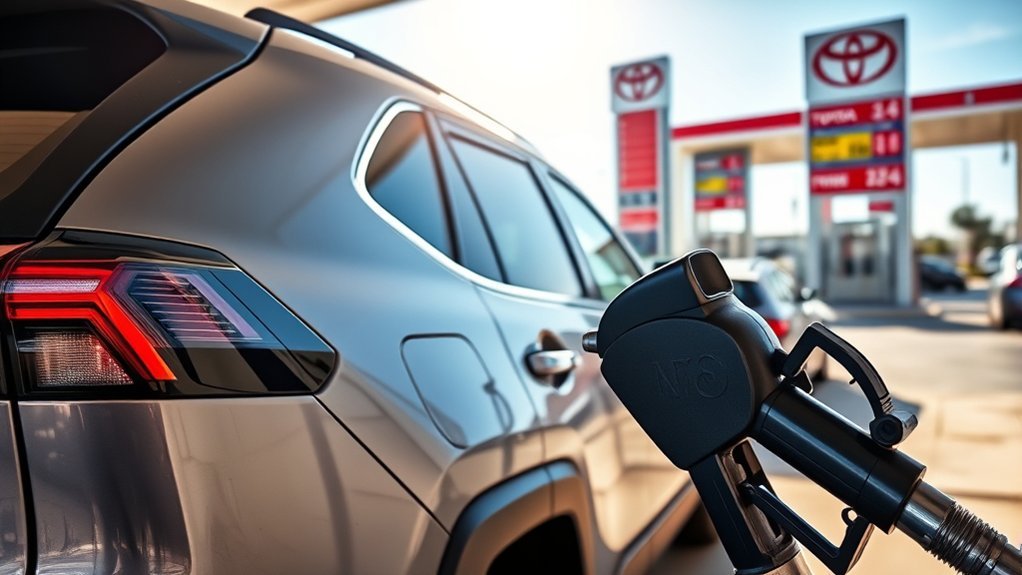
No—if your U.S.-market Toyota RAV4 owner’s manual specifies 87 AKI, regular unleaded gasoline is the correct choice, not premium. Toyota manuals for many recent RAV4 gasoline and hybrid models list 87 AKI (91 RON) or higher. Premium is safe to use when 87 is specified, but under normal driving it usually offers little to no meaningful benefit. Fuel requirements can vary by model year and market, so confirm the owner’s manual for your exact RAV4 and follow any fuel label inside the filler door.
Last updated: September 19, 2026. This revision rechecked octane guidance, the 2026 U.S. RAV4 powertrain lineup, ethanol limits, 85-octane guidance, and current TOP TIER™ information.
Quick Answer
A Toyota RAV4 generally does not need premium gas. If the owner’s manual lists 87 AKI (91 RON) or higher, regular 87-octane unleaded is the correct everyday choice. Higher-octane fuel may offer a small benefit under severe-duty conditions in some vehicles, but normal driving usually brings little to no gain when premium is not required. Check the manual for your exact model year and market.
Key Takeaways
- Use the octane grade listed in your RAV4 owner’s manual or on the fuel-door label; for many U.S. models, that is 87 AKI regular unleaded.
- Premium gasoline has greater knock resistance, but it is not automatically cleaner or better for an engine designed for regular.
- Do not use 85-octane fuel merely because it is sold at high elevation unless your manual specifically permits it.
- Choose a reputable station and, when available, TOP TIER™ Approved Gasoline in the required octane grade; the standard applies across the octane grades sold by an approved retailer.
- Persistent knocking, power loss, or a warning light calls for diagnosis—not an automatic switch to premium.
Does the 2026 Toyota RAV4 Need Premium Gas?
Toyota changed the U.S. RAV4 lineup for 2026: every model is now either a Hybrid or a Plug-in Hybrid rather than a conventional gas-only RAV4. That lineup change does not make “premium” a safe assumption. Use the octane requirement in the owner’s manual for the exact vehicle. Toyota’s current guidance for RAV4 fuel selection continues to center on the specified minimum octane, not on buying the highest grade available.
If you are moving from a 2025 gas-only RAV4 to a 2026 model, pay attention to the powertrain change as well as the fuel label. The standard Hybrid does not plug in; the Plug-in Hybrid can drive on external battery power before operating as a gasoline-electric hybrid. In both cases, the gasoline engine still has a model-specific fuel requirement that should be checked in the manual.
2026 update: Toyota says the U.S. RAV4 lineup is now 100% electrified, with Hybrid and Plug-in Hybrid powertrains. This is a genuine model-year change, not a cosmetic “2026” refresh to an older fuel article.
Understanding Fuel Grades: Regular vs. Premium
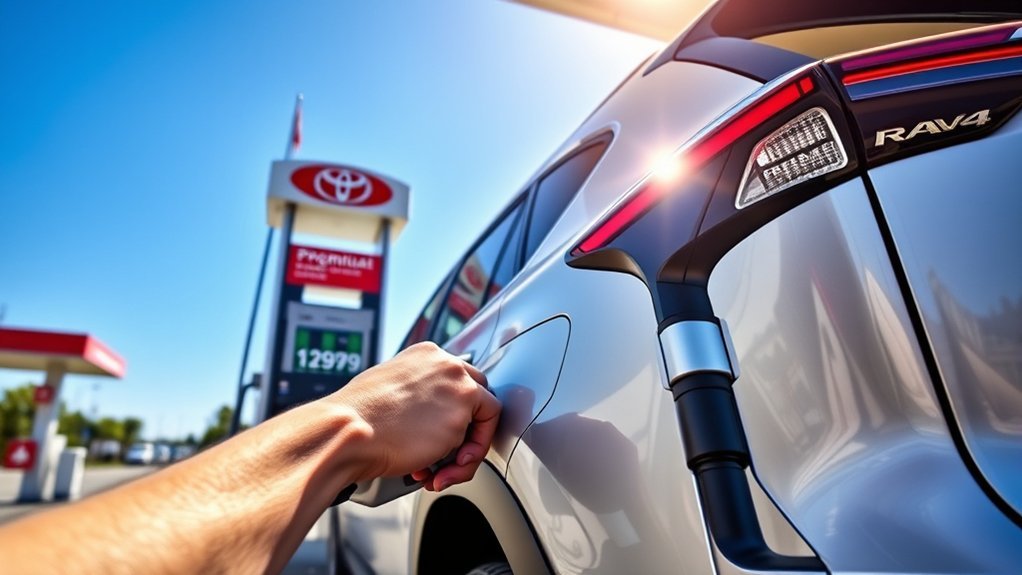
Gasoline grades are separated mainly by octane rating, which measures resistance to abnormal combustion known as knock or ping. In the United States, the number shown at the pump is AKI, calculated as (R+M)/2. Regular is usually 87 AKI, mid-grade is commonly 88–90 AKI, and premium is typically 91–94 AKI.
For many U.S.-market RAV4 model years, regular 87-octane unleaded gasoline meets the manufacturer’s requirement. The exact wording and permitted ethanol content can differ by year and market, so use Toyota’s official manual finder to verify your vehicle rather than relying only on a general article.
| Feature | Regular Gasoline | Premium Gasoline |
|---|---|---|
| Typical U.S. octane | 87 AKI | 91–94 AKI |
| Main purpose | Meets the needs of engines designed for regular | Provides more knock resistance for engines that require or recommend it |
| Expected RAV4 benefit when 87 is specified | Normal designed performance and efficiency | Usually little to no noticeable benefit in normal driving |
| Typical price | Lower | Higher |
| Best choice | Use when the manual specifies 87 AKI | Use when the manual requires or recommends a higher grade |
“Premium” describes higher knock resistance, not a universal upgrade in fuel quality.
Why the Toyota RAV4 Is Designed for Regular Gas
An engine’s compression ratio, combustion strategy, ignition timing, and control software determine the octane it needs. When Toyota calibrates a RAV4 engine for regular gasoline, 87 AKI provides the knock resistance needed for its intended performance under normal operating conditions.
Using the specified regular gasoline is not “feeding the engine a lower-quality fuel.” Octane and detergent quality are different characteristics. A reputable 87-octane fuel can contain an effective detergent package, while a higher-octane fuel is not automatically necessary for your engine.
Note: Fuel labels differ internationally. Toyota commonly pairs a U.S. requirement of 87 AKI with 91 RON in its manuals. Do not compare pump numbers across countries until you confirm whether the station displays AKI or RON.
How Octane Ratings Impact Engine Performance
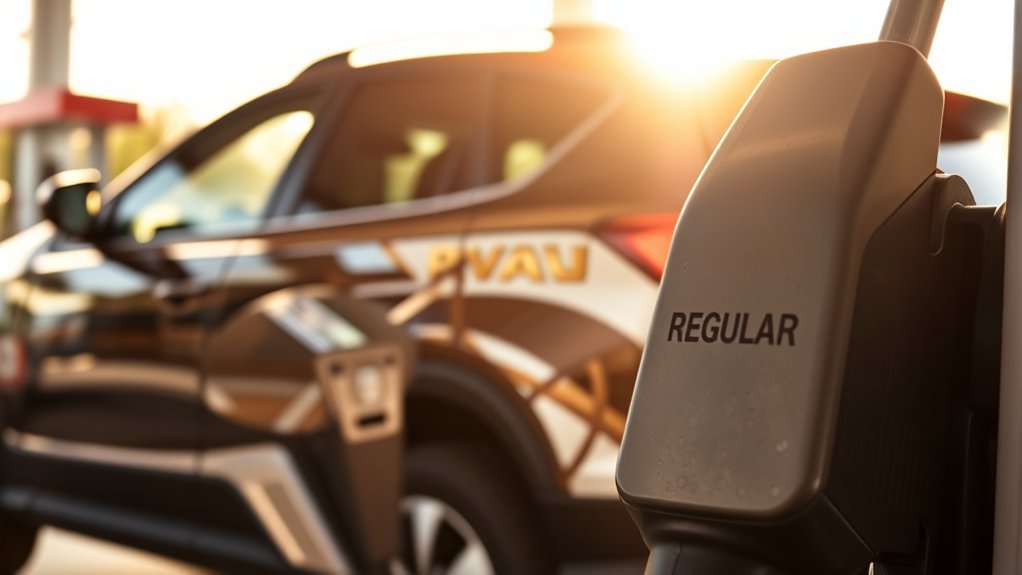
Octane rating does not measure the fuel’s energy content, cleaning ability, or overall “strength.” It measures how well gasoline resists premature combustion under pressure. The U.S. Department of Energy and EPA-backed FuelEconomy.gov guidance says to use the octane grade required by the vehicle manufacturer.
Octane Rating Explained
Higher-octane gasoline is useful in engines engineered for high cylinder pressure, such as some high-compression or turbocharged engines. In an engine calibrated for regular fuel, however, extra octane often goes unused during ordinary driving.
| Fuel Grade | Typical U.S. AKI | What It Means for a RAV4 Specified for 87 |
|---|---|---|
| Regular | 87 | Meets the intended requirement |
| Mid-grade | 88–90 | Normally unnecessary unless the manual says otherwise |
| Premium | 91–94 | More knock resistance, but usually no meaningful everyday advantage |
Engine Knock Resistance
Knock occurs when part of the air-fuel mixture burns abnormally instead of following the controlled flame front initiated by the spark plug. Modern engine controls can react to knock, but that protection is not permission to use fuel below the manufacturer’s minimum.
If your RAV4 specifies 87 AKI, choose 87 or higher. Avoid 85-octane gasoline—even at high elevation—unless the owner’s manual for your exact vehicle expressly allows it. Federal fuel-economy guidance notes that modern fuel-injected engines should continue to use the manufacturer-recommended octane at altitude.
Warning: Do not fill a gasoline RAV4 with diesel, and do not use E85 unless the vehicle is specifically identified as a flex-fuel vehicle. If the wrong fuel was added, do not start the engine; contact roadside assistance or a qualified repair facility.
Does Premium Gas Improve Performance in the RAV4?
When the owner’s manual requires only regular gasoline, premium generally does not produce a meaningful increase in horsepower, acceleration, or fuel economy during normal driving. Government guidance says some vehicles may show a small benefit from higher octane under severe-duty conditions, but the owner’s manual remains the deciding authority.
A single tank of premium will not harm a RAV4 designed for regular. It is simply likely to cost more without delivering enough benefit to offset the price difference.
| Situation | Likely Effect | Best Action |
|---|---|---|
| Normal driving; manual specifies 87 | Premium usually provides little to no noticeable gain | Use 87 AKI regular |
| Towing, heavy load, or extreme heat | A small benefit may occur in some vehicles, but it is not guaranteed | Follow the manual; do not exceed load limits |
| Premium added accidentally | No damage expected | Drive normally and return to the specified grade next fill |
| Fuel below the minimum octane | Possible knock, reduced performance, or long-term risk | Avoid it and consult the manual or a technician |
Debunking Myths About Regular and Premium Gas
- Myth: Premium gas is cleaner. Octane and detergent performance are separate. Look for a quality standard such as TOP TIER™, which applies across the octane grades sold by an approved brand.
- Myth: Premium always increases mileage. If the engine does not need the extra knock resistance, any change is usually too small or inconsistent to justify the higher price.
- Myth: Regular gas damages a RAV4. Fuel that meets the octane and formulation specified by Toyota is the correct fuel, not a compromise.
- Myth: 85 octane is fine at altitude. Modern engines should still receive the manufacturer’s recommended grade unless the manual says otherwise.
- Myth: Premium fixes engine problems. Persistent knock, hesitation, rough running, or a check-engine light needs diagnosis.
How to Tell if Your RAV4 Needs Better Fuel
Your RAV4 does not “learn” to require premium simply because it ages. If it begins knocking, losing power, or running roughly on the specified gasoline, first consider poor-quality or contaminated fuel, an ignition or sensor issue, carbon deposits, overheating, or another mechanical problem.
| Symptom | What It May Mean | Recommended Action |
|---|---|---|
| Knocking or pinging under load | Low-octane, poor-quality, or contaminated fuel; excessive heat; or an engine fault | Verify the fuel grade, avoid heavy load, and arrange inspection if it continues |
| Sudden power loss after refueling | Possible contaminated or incorrect fuel | Keep the receipt and contact the station and a qualified technician |
| Check-engine light | A stored diagnostic fault, not proof that premium is needed | Have the diagnostic codes read and the cause repaired |
| Lower fuel economy | Driving conditions, tire pressure, weather, maintenance, or fuel formulation | Track several tanks before drawing conclusions |
Pro Tip: If a problem begins immediately after a fill-up, save the receipt and note the station, pump number, fuel grade, and mileage. That information can help diagnose contaminated or misdelivered fuel.
Best Tips for Fueling Up Your RAV4
- Confirm the required grade: Check the fuel-door label and the owner’s manual for the exact model year, engine, and market.
- Use the correct rating system: U.S. and Canadian pumps generally display AKI; many other countries display RON.
- Choose quality fuel: TOP TIER™ Approved Gasoline uses a detergent-performance standard that applies across the octane grades sold by an approved retailer; choose the octane your RAV4 requires.
- Do not top off: Stop when the pump automatically clicks off. Continued filling can spill fuel and interfere with the evaporative-emissions system.
- Check ethanol labeling: EPA permits E15 in 2001-and-newer light-duty vehicles, but the vehicle manufacturer’s instructions should still govern your RAV4. Never use E85 unless the vehicle is designed for it.
- Skip routine additive dosing: Do not add fuel-system cleaner every 10,000 miles by default. Use an additive only when the owner’s manual allows it or a qualified technician recommends a suitable product for a specific need.
- Refuel safely: Turn off the vehicle, do not smoke or use an open flame, and clean up or report spills immediately.
Fuel-quality update: TOP TIER™ introduced its TOP TIER™+ standard in May 2026, and participating brands are transitioning over time. That change concerns fuel-performance and deposit-control standards; it does not mean a RAV4 that specifies 87 AKI suddenly needs premium.
Which Ethanol Blend Can a RAV4 Use?
Most gasoline sold in the United States contains up to 10% ethanol, commonly labeled E10. E15 contains 10.5% to 15% ethanol, while E85 contains far more ethanol and is intended only for flex-fuel vehicles.
The EPA allows E15 in model-year 2001 and newer passenger vehicles, including SUVs, but legal approval is not the same as a model-specific manufacturer recommendation. Check the fuel section of your Toyota manual for the maximum ethanol content permitted for your RAV4. This is especially important for older models and vehicles built for markets outside the United States.
What to Do if You Used the Wrong Fuel
If You Used Premium Instead of Regular
No special action is normally needed. Premium has higher octane than required and should not damage an engine designed for regular. Use the specified grade at the next fill-up.
If You Used 85 Octane or Another Grade Below the Minimum
FuelEconomy.gov warns that using octane below the manufacturer’s requirement can reduce performance and may damage the engine or emissions system over time. If you realize the mistake before driving, use the owner’s manual or Toyota guidance before starting the vehicle. If you have already driven and the engine knocks, loses power, or shows a warning light, avoid heavy load and contact Toyota or a qualified technician for model-specific advice.
If You Added Diesel or E85
Do not start the engine. Starting circulates the wrong fuel and can turn a tank-drain procedure into a much larger repair. Arrange towing to a qualified repair facility.
Cost of Premium Fuel for Your RAV4
Fuel prices vary by location, season, and station, so a fixed “average” quickly becomes stale. Use the price difference displayed at your station to calculate the extra cost accurately.
| Calculation | Formula | Example |
|---|---|---|
| Extra cost per fill | Gallons purchased × premium price gap | 12 gallons × $0.60 = $7.20 |
| Extra annual cost | Annual gallons × premium price gap | 500 gallons × $0.60 = $300 |
| Break-even MPG gain | Premium must reduce fuel use enough to offset its percentage price increase | A 15% higher price per gallon requires about a 15% MPG increase to break even over the same distance |
For example, if regular costs 15% less than premium, a RAV4 getting 30 mpg on regular would need about 34.5 mpg on premium to break even on fuel cost over the same distance. FuelEconomy.gov notes that when higher octane is not required, the price increase is typically greater than the fuel savings.
Because a RAV4 designed for 87 AKI is unlikely to gain enough efficiency from premium to cover a typical price gap, regular gasoline is usually the economical choice.
Strategies for Maintaining Optimal Fuel Efficiency in Your RAV4
Fuel grade is only one small part of operating cost. Tire pressure, driving style, speed, trip length, weather, cargo, and maintenance often have a larger effect on real-world mileage.
Monitor Tire Pressure Regularly
Check all tires when cold, ideally at least monthly and before a long trip. Use the pressure printed on the driver-side door-jamb label or listed in the owner’s manual—not the maximum pressure molded into the tire sidewall.
According to FuelEconomy.gov, properly inflated tires improve gas mileage by about 0.6% on average and up to 3% in some cases. It estimates that average underinflation across all tires can reduce mileage by about 0.2% for each 1 psi drop.
Optimize Driving Habits
Accelerate smoothly, look ahead so you can avoid unnecessary braking, maintain a steady legal speed, and limit excessive idling. On suitable open roads, cruise control may help maintain a consistent speed, but it is not ideal on slippery surfaces or rolling terrain where frequent speed changes are required.
| Driving Habit | Why It Helps | Practical Approach |
|---|---|---|
| Smooth acceleration | Reduces high-power fuel demand | Build speed progressively instead of flooring the accelerator |
| Anticipate stops | Preserves momentum and reduces unnecessary braking | Leave space and coast early when traffic slows |
| Limit idling | Avoids burning fuel while stationary | Turn the vehicle off during longer waits when safe and lawful |
| Remove unnecessary cargo | Reduces the energy needed to accelerate and climb | Take out heavy items and unused roof accessories |
Related Guides
Frequently Asked Questions
Can using premium gas harm my RAV4 engine?
No. Premium gasoline has greater knock resistance and should not harm a RAV4 designed for regular. It is usually an unnecessary expense unless your exact owner’s manual requires or recommends a higher octane.
Does a RAV4 Hybrid need premium gas?
Not when the owner’s manual specifies 87 AKI. Recent U.S.-market RAV4 Hybrid manuals list regular unleaded gasoline at 87 AKI (91 RON) or higher. Check the manual for your exact model year, especially if the vehicle was built for another market.
What happens if I accidentally use premium gas?
Nothing unusual should happen. Drive normally, and return to the grade specified in the owner’s manual at the next fill-up. There is no need to drain the tank.
Does using regular gas affect my warranty?
Using regular gasoline is appropriate when it meets Toyota’s fuel specification for your RAV4. Warranty coverage for a fuel-related repair depends on the cause and the terms of the warranty, so avoid blanket assumptions. Follow the owner’s manual, and keep the fuel receipt if a problem begins immediately after refueling.
Are there long-term effects from using regular gas?
Not when regular gasoline meets the octane and fuel-quality requirements listed for your RAV4. The engine is designed and calibrated around that specification. Problems arise from using fuel below the minimum requirement, contaminated fuel, or the wrong fuel type—not from correctly specified regular gasoline.
Should I use premium when towing or driving in extreme heat?
Follow the owner’s manual. Higher octane may provide a small benefit in some vehicles under severe load, but it does not increase the RAV4’s tow rating or replace proper cooling-system maintenance, correct tire pressure, and adherence to weight limits.
Can a RAV4 use 85-octane gas at high altitude?
Do not assume that it can. Modern fuel-injected engines should use the manufacturer-recommended octane even where 85 AKI is sold. If your manual specifies 87 AKI, use 87 or higher.
Is TOP TIER™ premium gas required?
No. TOP TIER™ is a fuel-performance standard, not an octane grade. Approved brands offer qualifying gasoline across all octane grades, so you can choose TOP TIER™ regular when your RAV4 specifies 87 AKI.
Conclusion
For most U.S.-market Toyota RAV4s, regular 87-octane unleaded gasoline is the right fuel, and premium is not a necessary upgrade. The most reliable rule is simple: use the minimum octane and fuel formulation listed for your exact model year and market. Choose quality gasoline, avoid fuel below the specified grade, and treat persistent knock or poor performance as a diagnostic issue rather than a reason to buy premium indefinitely.
Sources
- Toyota Manuals and Warranties — official source for model-year-specific RAV4 fuel requirements and warranty documents.
- Toyota USA Newsroom: 2026 RAV4 — confirms the 2026 U.S. lineup uses Hybrid and Plug-in Hybrid powertrains.
- FuelEconomy.gov: Selecting the Right Octane Fuel — explains octane, manufacturer requirements, higher-octane effects, and 85-octane guidance.
- TOP TIER™ Gasoline — explains the automaker-backed fuel-performance standard and approved brands.
- TOP TIER™+: 2026 Standard Update — explains the May 2026 rollout of TOP TIER™+.
- FuelEconomy.gov: Keeping Your Vehicle in Shape — supports tire-pressure and maintenance guidance.
- U.S. EPA: E15 Fuel Registration — defines E15 and lists federally permitted vehicle categories.
