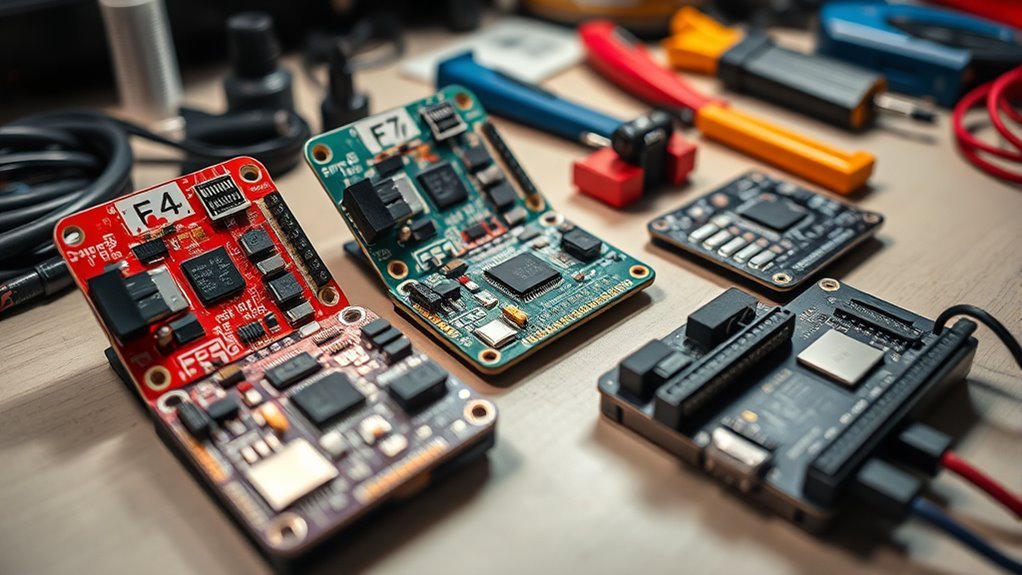
FPV stacks determine how cleanly a quad processes control input, drives motors, and survives crashes. F4 boards remain cheap and capable, but their headroom is limited. F7 brings faster processing and more serial flexibility, while H7 adds even more compute for high-rate filtering and modern firmware demands. Then there is the ESC side: 4-in-1 boards reduce wiring, yet single ESCs still matter in specific builds. The real tradeoffs start there.
FPV Stacks vs AIO Boards
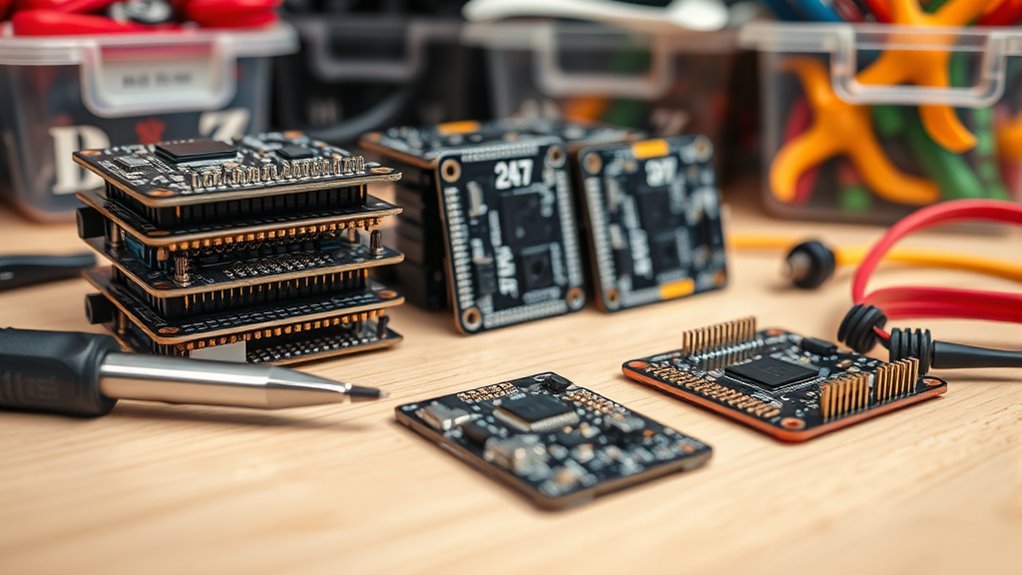
FPV stack architecture separates the flight controller and ESCs into discrete boards, improving serviceability, fault isolation, and upgrade flexibility compared with AIO boards, which consolidate multiple functions into a single compact unit.
In this modular format, the FPV flight controller and ESC and FC can be serviced independently, so a failed ESC does not condemn the entire system. Replacement ESCs on stacks typically cost less, and diagnosis of electrical noise, desyncs, or power irregularities is faster because each subsystem is accessible.
AIO boards, by contrast, minimize wiring and mass, making them efficient for sub-150g builds such as toothpicks and whoops, and for cinematic cruising where a clean layout matters.
Stacks are generally favored for larger frames and aggressive freestyle, where repair speed, upgrade latitude, and thermal headroom outweigh compactness. For pilots seeking autonomy from single-point failure, the stack remains the more liberating architecture.
F4 vs F7 vs H7 FCs?
At the processor level, F4, F7, and H7 flight controllers map directly to increasing compute headroom. F4 boards are built around a 32-bit ARM Cortex-M4, F7 boards step up to a Cortex-M7, and H7 units add dual-core performance for heavier workloads.
F4 FCs are the budget-tier option: adequate for basic Betaflight or INAV builds, but constrained by lower PWM ceilings, typically around 400Hz, and leaner telemetry and logging resources.
F4 FCs suit budget builds, but their lower PWM ceilings and limited logging keep ambitions modest.
F7 boards widen the control envelope, commonly supporting 1kHz PWM, faster loop execution, and more robust sensor integration. This makes them preferable for complex tuning and advanced flight freedom.
H7 controllers push further, pairing expanded throughput with superior Blackbox handling and firmware headroom for cutting-edge setups.
In practice, F4 suits entry-level builds, F7 balances cost and capability, and H7 targets pilots demanding maximal responsiveness, precision, and software latitude.
4-In-1 ESCS Vs Single ESCS
By design, 4-in-1 ESCs consolidate four motor controllers onto a single PCB, trading modularity for a tighter, lighter powertrain layout with cleaner wiring and reduced overall mass. This architecture suits 5-inch freestyle and racing frames where liberation from excess grams matters. single ESCs, by contrast, mount per arm, preserving channel isolation, improving airflow, and easing field replacement after a fault.
| Aspect | 4-in-1 ESCs vs single ESCs |
|---|---|
| Mass | 4-in-1 lighter |
| Wiring | 4-in-1 cleaner |
| Failure mode | 4-in-1 single-point |
| Cooling | single ESCs superior |
| Serviceability | single ESCs simpler |
For aggressive, high-power sorties, single ESCs often tolerate stronger thermal loads and higher amp envelopes, making them apt for X-Class or long-range platforms. Repair economics differ sharply: a 4-in-1 failure usually means swapping the entire unit, whereas a discrete ESC can be replaced independently. Both must still match motor current demands precisely.
How to Size an FPV ESC
After comparing 4-in-1 and single ESC layouts, the next sizing decision is current headroom: an FPV ESC should be selected so its continuous rating exceeds the motor’s maximum draw by at least 25%, while its burst rating can absorb short spikes roughly 20–30% above that continuous figure.
For example, a 35A motor load calls for an ESC at 44A or higher, with many 5-inch freestyle builds landing in the 55A to 60A class.
Flight Controllers merely command; ESCs must endure the electrical burden without saturation or thermal collapse. Motor Thrust Tables provide the current envelope, and that data should govern the selection.
Voltage system also matters: 4S setups commonly pair with 2300Kv to 2750Kv motors, while 6S builds favor 1700Kv to 1950Kv.
Higher-rated ESCs dissipate heat more effectively, preserving efficiency and enabling more liberated, aggressive flight.
Bluejay vs AM32 Firmware
Bluejay is typically deployed on 8-bit ESCs, where Bidirectional DShot and RPM telemetry provide tighter motor feedback, smoother low-throttle behavior, and improved propwash management.
AM32 targets 32-bit ESCs, leveraging higher PWM frequency support for faster throttle response, broader tuning latitude, and more granular motor control.
Firmware selection should match ESC architecture precisely, since version updates, protocol support, and calibration parameters directly affect reliability and performance.
Bluejay For 8-Bit ESCs
For 8-bit ESCs, Bluejay is the go-to firmware for enabling modern protocols such as Bidirectional DShot, which provides RPM feedback for better motor cooling and cleaner video by reducing noise in the powertrain.
Bluejay extends legacy hardware with precise commutation control, letting pilots access liberated throttle authority without replacing the stack.
- Bluejay, Bidirectional DShot, and RPM telemetry improve desync resistance and thermal headroom.
- Community-driven tuning supports motor, prop, and flight controller matching for sharper response.
- Frequent firmware updates preserve reliability, close bugs, and refine flight behavior.
Compared with obsolete stock firmware, Bluejay converts 8-bit ESCs into capable, configurable components for disciplined freestyle or race use, while maintaining a lean, accessible upgrade path.
AM32 For 32-Bit ESCs
AM32 is the firmware path for 32-bit ESCs, where its higher PWM frequency ceiling and tighter control logic deliver sharper throttle response and better exploitation of modern powertrain hardware.
In FPV builds, AM32 aligns with 32-bit ESC architecture, letting the stack extract the full dynamic range available from contemporary silicon.
Compared with Bluejay, which serves 8-bit controllers, AM32 is the correct liberation of capability when the hardware substrate can support it.
Configuration options remain extensive, enabling precise calibration of start behavior, timing, and braking characteristics to match frame mass, prop load, and pilot intent.
Ongoing firmware updates preserve compatibility, stabilize behavior, and track evolving drone standards.
The selection is architectural, not ideological: Bluejay for 8-bit systems, AM32 for 32-bit ESCs, maximizing performance potential.
DShot, RPM, And Tuning
DShot replaces legacy PWM signaling with a digital command path, reducing latency and sharpening ESC response across the FPV control loop. In this situation, DShot, RPM feedback, and tuning form the core of liberated throttle authority.
Bluejay firmware adds RPM telemetry, enabling real-time motor monitoring and dynamic filtering for tighter stability. AM32, built for 32-bit ESCs, supports higher PWM frequencies, improving throttle granularity and smoothing acceleration changes. Pilots can thus tune parameters to match aggressive racing, cinematic cruising, or freestyle snap.
- DShot: deterministic command delivery
- RPM: feedback for filtering and sync
- tuning: mission-specific ESC behavior
Both Bluejay and AM32 expose configurable settings, letting operators optimize response, efficiency, and feel without surrendering precision to legacy analog constraints.
FPV Stack Wiring and Capacitors
Clean signal integrity and power conditioning are central to FPV stack wiring, because the ESC-to-flight-controller harness must be pinned correctly to avoid component damage and operational failure. Precise connector pinout matching preserves stable Flight control and prevents smoke events.
| Item | Function | Spec |
|---|---|---|
| Harness | ESC-FC data/power link | Correct pinout |
| Wire gauge | Current transport | Match load |
| Capacitor | Spike suppression | Low ESR 1000µF+ |
| Placement | Noise reduction | Close to ESC |
High-quality connectors and adequate wire gauge reduce resistance, heating, and voltage drop under aggressive throttle transients. A Low ESR capacitor, preferably 50V and at least 1000µF, should be soldered across the main battery pads to absorb spikes that can stress MOSFETs and logic rails. Placement near the ESC tightens the power loop, lowering ripple and EMI. Compatibility checks must confirm DShot support and pin mapping before energizing the stack. Properly executed, the wiring harness becomes a disciplined conduit for liberated, reliable airframe performance.
How to Choose the Best FPV Stack
With wiring and power conditioning verified, the selection process shifts to stack architecture, where FC and ESC compatibility determines whether the system will communicate reliably under load. The decisive variables are protocol support, pin mapping, and current headroom.
For pilots seeking control without compromise, the stack must serve the airframe, not constrain it.
- MCU tier: In the F4 Vs F7 Vs H7 hierarchy, F4 suits economical baselines; F7 and H7 deliver stronger compute, faster PWM, and cleaner DShot execution.
- ESC type: A 4-in-1 ESC minimizes mass and wiring, but a single-channel fault can ground the craft; individual ESCs trade grams for serviceability and thermal separation.
- Ratings and modularity: ESC voltage and current limits should exceed peak draw by 25 percent.
Modular stacks favor aggressive flying and future upgrades, while AIO boards reward lighter, more restrained builds.
Frequently Asked Questions
What Are the Key Differences Between F4 and F7 Flight Controllers?
F7 flight controllers differ from F4 units primarily in processing headroom, firmware compatibility, and I/O density.
The F7’s faster MCU supports more UARTs, cleaner peripheral routing, and more advanced Betaflight builds, improving flight performance under aggressive maneuvers.
F4 boards remain cheaper and functional, but their controller features are more constrained, especially with newer firmware and multiple attached modules.
For pilots seeking liberation through precision, the F7 offers greater operational margin.
What Is the Best FPV Stack for My FPV Drone?
The best FPV stack is the one that coincidentally matches the airframe, motors, and flying intent.
FPV stack comparisons usually favor an F7 or H7 stack with a 4-in-1 ESC for pilots seeking higher loop rates, cleaner firmware integration, and liberated tuning headroom.
Performance benchmarks should confirm current headroom, thermal stability, and throttle linearity.
For lightweight builds, an AIO may prevail; for modularity and repairability, a full stack dominates.
How to Choose ESC for FPV Drone?
Choose an ESC by matching current headroom, motor compatibility, and voltage ratings first: target at least 25% above peak draw.
Evaluate ESC features, thermal performance, and firmware options such as Bluejay or AM32.
For liberated builds, 4-in-1 units maximize compactness, while singles ease repair.
Verify DShot support and pin mapping, then compare brand comparisons and user reviews.
Sound installation tips and conservative sizing preserve throttle authority and reliability.
What Is an F7 Flight Controller?
An F7 flight controller is a high-performance drone brain, where rapid computation meets near-silent precision.
Under the shell, its F7 features include a faster processor, up to 2MB flash, multiple UARTs, and advanced filtering, enabling dense peripherals and cleaner control loops.
Its F7 advantages include DShot compatibility, improved responsiveness, and expanded firmware headroom.
For pilots seeking liberation from bottlenecks, it delivers tighter tuning, richer telemetry, and more capable flight authority.
Conclusion
In sum, FPV stack selection hinges on mission profile, not marketing. F4 boards suit cost-constrained builds, while F7 and H7 FCs deliver greater I/O headroom, lower latency, and cleaner protocol support. 4-in-1 ESCs simplify wiring and reduce mass; single ESCs improve fault isolation and field serviceability. Proper current sizing, firmware choice, and capacitor placement remain critical. As the adage goes, “The right tool for the right job” keeps a build efficient, reliable, and race-ready.