
Last updated: September 11, 2026. We rechecked current NHTSA winter-driving and tire guidance, Honda AWD operation, and a current 2026 Toyota FWD-vs-AWD fuel-economy example.
Choosing between front-wheel drive (FWD) and all-wheel drive (AWD) comes down to where you drive, how often roads become slippery, and how much you value lower ownership costs. FWD is usually the practical choice for paved-road commuting, while AWD can provide useful acceleration traction in snow, on steep roads, and over loose surfaces.
Quick Answer
For most drivers who stay on paved roads and see mild weather, FWD is the better value because it usually costs less, uses less fuel, and has fewer drivetrain parts. Choose AWD when you regularly face snow, steep slippery roads, or loose surfaces. Tire grip remains critical because AWD does not inherently shorten stopping distances or prevent skids.
Key Takeaways
- FWD usually costs less to buy and maintain and often delivers better fuel economy.
- AWD can improve acceleration traction when starting on snow, climbing a slippery hill, or driving over loose surfaces.
- AWD does not cancel the laws of traction. It cannot guarantee shorter stopping distances on ice, snow, or wet pavement.
- Tires are critical because they control how well the vehicle accelerates, turns, and brakes.
- Compare exact trims. Fuel economy, price, maintenance requirements, and AWD behavior vary by model.
FWD vs. AWD: Choosing the Right Drivetrain for Your Needs
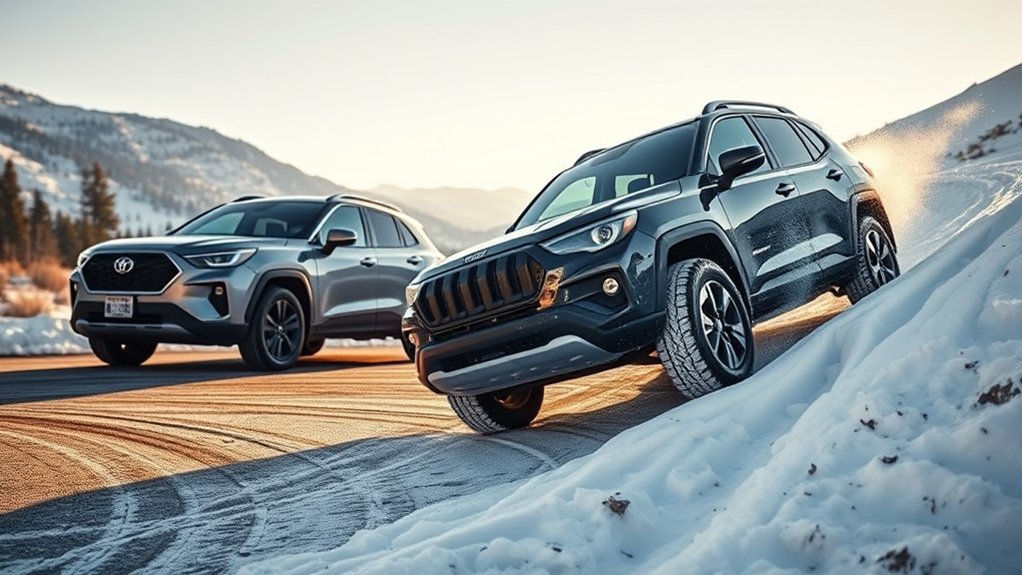
In a FWD vehicle, the engine or front electric motor sends driving force to the front wheels. Those wheels are responsible for both steering and moving the vehicle. Most FWD cars place the engine and transmission together at the front, which creates a compact and relatively simple drivetrain.
An AWD vehicle can send driving force to both the front and rear axles. However, not every AWD system works the same way:
- Full-time AWD continuously powers both axles, although the front-to-rear torque split may change.
- On-demand AWD operates mainly through one axle and sends more force to the second axle when the system expects or detects a need for additional traction.
- Electric AWD may use separate front and rear motors without a mechanical driveshaft connecting the axles.
- Torque-vectoring AWD can adjust force from side to side as well as between the front and rear axles.
For example, Honda explains that its Real Time AWD system continuously evaluates steering, throttle, wheel-speed, and other inputs. It changes the amount of driving force sent to the rear wheels based on the situation and can return to two-wheel-drive operation under certain conditions.
This variation is why you should judge the complete vehicle rather than choosing based only on an AWD badge.
FWD vs. AWD Comparison
| Factor | FWD | AWD |
| Driven wheels | Front wheels | Front and rear wheels when the system calls for them |
| Slippery-road acceleration | Usually adequate with suitable tires and careful throttle use | Usually stronger because driving force can be shared across both axles |
| Braking on snow or ice | Limited by tire grip, road conditions, speed, and brakes | Also limited by tire grip, road conditions, speed, and brakes |
| Fuel economy | Often better on comparable models | May be lower because of weight, friction, or additional motors |
| Purchase price | Usually lower | Usually higher when offered as an option |
| Maintenance | Fewer drivetrain components in most vehicles | May include a transfer unit, driveshaft, rear differential, clutches, or another motor |
| Best suited for | Commuting, mild climates, paved roads, and lower ownership costs | Frequent snow, slippery hills, rural roads, gravel, and drivers who need stronger launch traction |
A Current FWD vs. AWD Fuel-Economy Example
Current vehicles show why you should compare exact trims instead of assuming a fixed AWD fuel penalty. For the 2026 Toyota RAV4 LE and SE, Toyota lists FWD at 47 mpg city, 40 highway, and 43 combined. The corresponding LE and SE AWD versions are rated at 45 city, 39 highway, and 42 combined. In this example, AWD costs only 1 mpg in the combined rating, although the difference can be larger or smaller on other vehicles. See Toyota’s 2026 RAV4 specifications and drivetrain information.
Quick Decision Rule: Pay for AWD when it solves a traction problem you face regularly—such as repeated snow, a steep untreated hill, or a loose access road. If the difficult condition is rare and most of your driving is on maintained pavement, FWD with suitable tires is often the better value.
What Are the Benefits of Front-Wheel Drive (FWD)?
FWD remains popular because it combines efficient packaging with predictable everyday performance. For many drivers, its advantages are more useful throughout the year than the extra traction available from AWD.
Lower Purchase Price
A FWD trim usually costs less than the AWD version of the same vehicle. The difference may also allow you to afford a higher trim, better safety equipment, or a set of high-quality tires while staying within your budget.
Potentially Better Fuel Economy
FWD vehicles often weigh less and have fewer components creating mechanical drag. That can improve fuel economy compared with an otherwise similar AWD version. The difference is not universal, especially with hybrids and EVs, so compare the official ratings for the exact configurations through the FuelEconomy.gov side-by-side tool.
Simpler Drivetrain Maintenance
A typical FWD vehicle does not need a rear driveshaft, rear differential, or AWD coupling. Fewer drivetrain components can mean fewer fluids, seals, bearings, and joints that may require service as the vehicle ages.
Efficient Interior Packaging
Keeping the main drivetrain components near the front can simplify floor and cabin design. This may help manufacturers create more passenger or cargo room, although the final space depends on the vehicle platform rather than the drivetrain alone.
Good Everyday Traction
The engine and transmission usually place substantial weight over the driven front wheels. This can help a FWD vehicle start moving on wet pavement, light snow, and moderate hills. With suitable tires, FWD is capable enough for many drivers who see only occasional winter weather.
What Are the Advantages of All-Wheel Drive (AWD)?
AWD is most valuable when two driven tires may not be able to use all the available engine or motor force. By sharing that force with both axles, the vehicle can move away more smoothly and reduce wheelspin.
Better Acceleration Traction
AWD can help when starting on packed snow, climbing a slippery driveway, pulling onto a road in heavy rain, or accelerating over gravel. The benefit is usually most noticeable at low speeds or when the driver applies more power.
More Confidence on Slippery Hills
When a vehicle climbs a hill, weight shifts toward the rear. A FWD vehicle may lose some pressure over its driven front tires, reducing the amount of force they can transfer to the road. AWD can send driving force to the rear tires, which may have more usable grip during the climb.
Improved Power Delivery
AWD can help powerful cars and electric vehicles apply their output without overwhelming two tires. Performance-oriented systems may also adjust front-to-rear or left-to-right torque to improve the vehicle’s response while accelerating through a curve.
Useful on Loose Surfaces
Gravel roads, wet grass, shallow mud, and unpaved parking areas can cause a two-wheel-drive vehicle to spin a driven tire. AWD gives the vehicle more opportunities to find grip, although tires and ground clearance still determine whether the vehicle can safely cross the surface.
FWD vs. AWD: Key Differences to Consider
The main difference is not that one drivetrain is always safe and the other is unsafe. The difference is how many tires can receive driving force when you press the accelerator.
AWD can help a vehicle start moving, but the tires still determine how well it stops and turns on a slippery road.
A FWD vehicle sends driving force through the front tires. An AWD vehicle can spread that force across both axles. This usually gives AWD an advantage when accelerating in low-grip conditions.
Once you release the accelerator or apply the brakes, the AWD propulsion advantage becomes less important. All four wheel brakes already contribute to stopping on both FWD and AWD vehicles. Stopping ability depends heavily on tire grip, road friction, vehicle speed, braking technology, and driver input.
What AWD Does and Does Not Do in Snow and Rain
AWD can make it easier to pull away from a stop, merge onto a road, or climb a hill when the surface is slippery. It may also reduce excessive wheelspin when you apply power.
It does not guarantee that the vehicle will stop sooner. It also cannot create grip when all four tires are sliding on ice. The National Highway Traffic Safety Administration advises drivers to slow down and increase following distance because snow-covered and slick roads make vehicles harder to control or stop.
NHTSA reported an estimated 101,390 police-reported crashes in 2023 in which snow or sleet was present at the time of the crash.
Warning: Do not use AWD as a reason to drive faster in rain, snow, or ice. AWD may help you accelerate, but excessive speed can still overwhelm the tires when you brake or steer.
Why Tires Matter More Than the Drivetrain Badge
Your tires create the contact between the vehicle and the road. Their tread, rubber compound, pressure, age, and condition affect acceleration, braking, and cornering.
NHTSA’s TireWise guidance states that tread provides the gripping action that helps prevent a vehicle from slipping and sliding, especially on wet or icy roads. NHTSA also notes that winter tires are more effective than all-season tires in deep snow.
A FWD vehicle on suitable winter tires can outperform an AWD vehicle on tires that are worn or poorly suited to cold conditions in important areas such as braking and turning. The exact result depends on the vehicles and tires, but the basic lesson is clear: AWD does not replace proper tires.
Pro Tip: When comparing FWD and AWD trims, include tire costs in your budget. A lower-priced FWD model with excellent tires may serve you better than stretching your budget for AWD and keeping low-quality or worn tires.
AWD vs. 4WD: They Are Not Always the Same
AWD and four-wheel drive are sometimes used loosely, but buyers should not assume that every AWD crossover has the capability of a truck-based 4WD vehicle.
Most AWD systems are designed to improve traction and power delivery on paved roads, snow, gravel, or mild trails. They usually operate automatically and do not require the driver to lock a transfer case.
A traditional 4WD system may include features intended for more difficult off-road conditions, such as:
- A selectable two-wheel-drive and four-wheel-drive mode
- Low-range gearing
- A lockable center, rear, or front differential
- Greater ground clearance
- More protective underbody hardware
- Off-road tires and stronger recovery points
AWD can help on an unpaved road, but it cannot prevent the vehicle from becoming stuck if the body bottoms out or the tires cannot grip. Check ground clearance, tire type, water-depth limits, approach angles, and the owner’s manual before treating an AWD vehicle as an off-roader.
Is AWD Worth the Extra Cost? Initial and Ongoing Costs
FWD is normally the lower-cost choice, but the real difference depends on the vehicle. AWD is usually worth paying for when its additional launch and climbing traction solves a condition you face regularly, such as repeated snow, an untreated steep driveway, or loose rural roads. If most of your driving is on maintained pavement in mild weather, FWD is usually the stronger value.
Purchase Price
AWD may be a stand-alone option or may require a higher trim level. Check whether the price difference also includes a larger engine, different suspension, added drive modes, larger wheels, or other equipment. Otherwise, you may incorrectly attribute the entire price increase to AWD.
Fuel or Electricity Cost
Extra drivetrain components can add weight and energy loss. As a result, the AWD version of a gasoline vehicle often has a lower EPA fuel-economy rating than the comparable FWD version.
The pattern is less predictable with hybrids and EVs. An AWD model may have a more powerful rear motor, different battery programming, different tires, or a different test rating. Use the official EPA figures for the specific configuration and calculate the difference based on your annual mileage.
Insurance Cost
Do not assume that AWD automatically raises or lowers your premium. Insurers consider the complete year, make, model, trim, repair cost, theft record, safety equipment, location, driver history, mileage, and selected coverage.
Request quotes for both versions before buying. This gives you a real number instead of relying on a broad drivetrain rule.
Resale Value
AWD may attract more used buyers in snowy or mountainous regions, but that does not guarantee that the higher resale price will recover the original purchase premium. Condition, mileage, reliability, accident history, trim level, and local demand often have a larger effect.
Compare local listings for similar FWD and AWD examples of the vehicle you are considering. Use vehicles with similar age, mileage, equipment, and condition.
Maintenance and Tire Costs
FWD systems are usually mechanically simpler. In addition to the front transaxle and half-shafts, an AWD vehicle may have a power-transfer unit, driveshaft, rear differential, clutch assembly, extra cooling hardware, or a separate rear motor.
Those components do not mean the vehicle will be unreliable, but they create additional service points. Before buying, check the maintenance schedule for:
- Transfer-unit or transfer-case fluid
- Rear differential fluid
- Driveshaft joints and support bearings
- AWD coupling fluid or filters
- Cooling-system requirements
- Vehicle-specific towing procedures
AWD Tire-Matching Requirements
Many AWD systems require the four tires to remain close in size, tread depth, and rolling circumference. A large difference can make the system interpret normal wheel-speed variation as slip or can place unnecessary strain on drivetrain components.
This means one damaged tire may create a more expensive decision. Depending on the manufacturer’s limits and the condition of the remaining tires, the correct repair may involve replacing two or four tires or having a replacement tire professionally matched to the others.
Note: Tire-matching limits vary by vehicle. Follow the tire section of the owner’s manual rather than using a universal tread-depth rule.
Which Drivetrain Is Better for Your Driving?
Daily City and Highway Commuting
FWD is usually the better value. It provides adequate traction for normal paved-road use while reducing purchase price, vehicle weight, and drivetrain complexity.
Mild Climate With Occasional Rain
FWD with quality wet-weather tires is normally sufficient. AWD can help during hard acceleration on a wet surface, but normal rain does not automatically justify the added cost.
Frequent Snow and Ice
AWD provides a useful acceleration advantage, especially on hills. Pair it with suitable winter tires or severe-snow-rated tires when conditions require them. Continue to drive slowly and leave extra stopping distance.
Steep or Poorly Plowed Driveway
AWD may be worth the added cost. Its ability to send driving force to the rear wheels can help when weight shifts away from the front tires during a climb.
Rural, Gravel, or Unpaved Roads
AWD can improve mobility when the surface becomes loose or muddy. Also consider ground clearance, tire sidewall strength, underbody protection, and the availability of a suitable spare tire.
Serious Off-Road Use
Do not choose based on AWD alone. Look for an appropriate 4WD system, low-range gearing, adequate clearance, protective hardware, off-road tires, and manufacturer-approved recovery points.
Lowest Possible Ownership Cost
FWD is generally the stronger choice. You avoid the AWD purchase premium and may receive better fuel economy with fewer drivetrain service items.
How to Choose Before You Buy
- Compare equivalent trims. Make sure the FWD and AWD versions have the same engine, wheels, tires, and equipment where possible.
- Check official efficiency ratings. Use FuelEconomy.gov rather than relying on a general mpg estimate.
- Read the owner’s manual. Review AWD maintenance, tire matching, towing, spare-tire use, and fluid intervals.
- Inspect the factory tires. AWD with unsuitable tires may not meet your winter or off-pavement needs.
- Consider your worst regular condition. A snowy vacation once every few years may not justify AWD, while a steep untreated driveway every winter may.
- Get insurance quotes. Compare the exact VINs or configurations when possible.
- Test-drive both versions. Pay attention to steering feel, ride quality, acceleration, turning circle, cabin noise, and whether the AWD system changes cargo or spare-tire space.
- Calculate the full cost. Include purchase price, financing, fuel or electricity, insurance, maintenance, and possible tire replacement costs.
If you are comparing this drivetrain choice specifically on Toyota’s compact SUV, see the dedicated Toyota RAV4 AWD vs. FWD comparison for model-year and trim-specific differences.
Sources
- National Highway Traffic Safety Administration: Winter Weather Driving Tips — slick-road stopping, winter preparation, tire inspection, and safe driving guidance.
- National Highway Traffic Safety Administration: TireWise — tire tread, inflation, rotation, winter-tire, and tire-safety information.
- FuelEconomy.gov: Compare Cars Side by Side — official EPA fuel-economy and energy-use comparisons for specific vehicle configurations.
- Honda Technology: Real Time AWD — an official example of how an on-demand AWD system changes front-to-rear driving-force distribution.
- Toyota USA Newsroom: 2026 RAV4 — current FWD/AWD availability, powertrain operation, and manufacturer-listed fuel-economy ratings used in the comparison example.
Related Guides
Frequently Asked Questions
Is AWD really that much better than FWD?
AWD is noticeably better when you need to accelerate on snow, climb a slippery hill, or move over a loose surface. It is not automatically better for fuel economy, purchase cost, braking, or maintenance. For ordinary paved-road commuting in a mild climate, FWD is usually sufficient.
Is AWD worth the extra cost?
AWD is usually worth the extra cost when you regularly drive in snow, climb steep slippery roads, or use loose rural or gravel surfaces where two driven tires frequently struggle for traction. If most of your driving is on maintained pavement in a mild climate, FWD is usually the better value. Compare the exact purchase price, fuel or electricity use, tire requirements, insurance, and maintenance schedule before deciding.
What is the main downside of FWD?
The front tires must steer and deliver driving force at the same time. A FWD vehicle may struggle to start on a steep, slippery hill because weight shifts toward the rear during acceleration. Powerful FWD vehicles may also experience torque steer or difficulty applying full power through two tires.
What are the downsides of AWD?
AWD usually increases the purchase price, vehicle weight, mechanical complexity, and potential service cost. It may also reduce fuel economy. Some AWD vehicles have strict tire-matching requirements that can make replacing one damaged tire more expensive.
Why do people prefer FWD?
Drivers often choose FWD because it is affordable, efficient, predictable, and suitable for normal paved-road use. The compact drivetrain can also support good passenger and cargo packaging. With appropriate tires, FWD can handle rain and moderate winter conditions well.
Can a FWD car drive safely in snow?
Yes. A FWD car with suitable tires, adequate tread, correct tire pressure, and a careful driver can perform well in light or moderate snow. Deep snow, steep untreated hills, and frequent severe winter conditions may make AWD more useful.
Does AWD help in heavy rain?
AWD can reduce wheelspin while accelerating on a wet road, but it cannot prevent hydroplaning or guarantee shorter stopping distances. Tire tread, speed, standing-water depth, and steering or braking inputs remain more important.
Do you still need winter tires with AWD?
AWD does not replace winter tires. AWD helps distribute driving force, while winter tires are designed to improve grip during acceleration, braking, and turning in cold, snowy, or icy conditions. Your climate, local laws, and road conditions determine whether winter tires are appropriate.
Conclusion
FWD is the sensible choice for most drivers who spend their time on paved roads, live in a mild climate, and want to control purchase, fuel, and maintenance costs. It provides dependable everyday traction without the weight and complexity of an additional driven axle.
AWD is worth considering when snow, slippery hills, rural roads, loose surfaces, or high power regularly challenge the grip available from two driven tires. Its main advantage is stronger traction while accelerating, not immunity from skidding or automatically shorter braking distances.
Whichever drivetrain you choose, prioritize suitable tires, correct pressure, adequate tread, and cautious driving. Then compare the exact vehicle trims, official efficiency ratings, maintenance schedules, insurance quotes, and the difficult road conditions you actually face before making your final decision.
