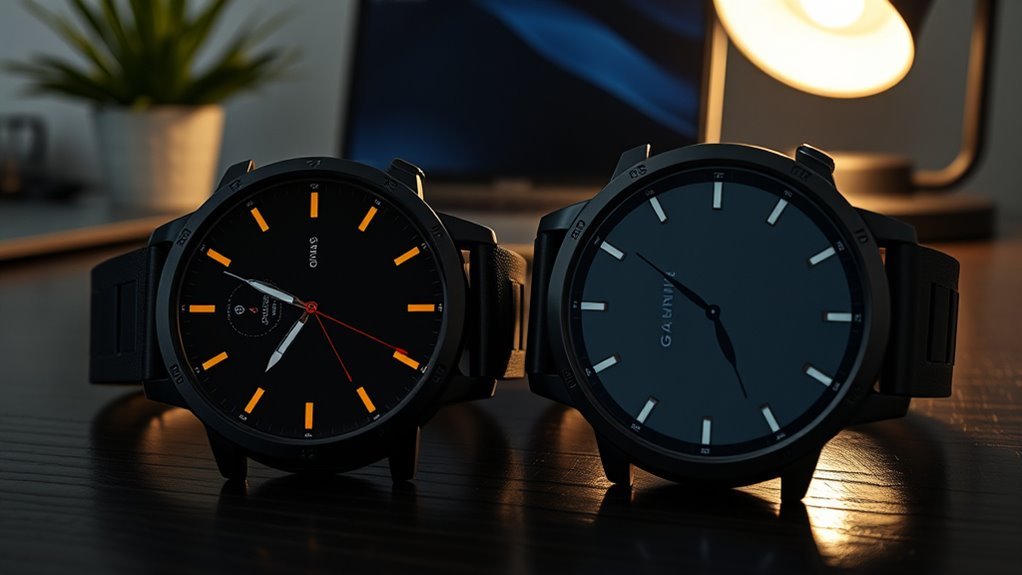
Garmin AMOLED and MIP displays are built around different priorities. AMOLED gives you higher resolution, richer color, deep blacks, and excellent low-light visibility. MIP uses a sunlight-visible, transflective design that becomes especially easy to read outdoors and pairs naturally with solar charging on compatible watches. Battery life still depends on the watch size, display settings, GNSS mode, sensors, music, connectivity, and solar exposure, so the display type alone does not determine runtime.
Quick Answer
Choose Garmin AMOLED if you want sharper maps, richer colors, better low-light viewing, and a more detailed everyday display. Choose MIP if bright-sun readability, solar charging, and long outdoor endurance matter more. For the fairest comparison, check the same watch family and case size instead of assuming every MIP watch lasts longer.
Key Takeaways
- AMOLED offers richer color, deeper blacks, and substantially higher resolution on many Garmin models.
- MIP is reflective and designed for strong sunlight visibility without needing an emissive screen to stay continuously lit.
- Current high-end Garmin AMOLED displays are also highly usable outdoors; the fēnix 9 Pro AMOLED reaches up to 3,000 nits.
- Always-On Display can significantly reduce AMOLED battery life.
- Solar-equipped MIP models can extend runtime substantially when Garmin’s required light conditions are met.
- Battery life must be compared by model, case size, settings, and activity mode—not by display technology alone.
Which Garmin Display Is Right for You?
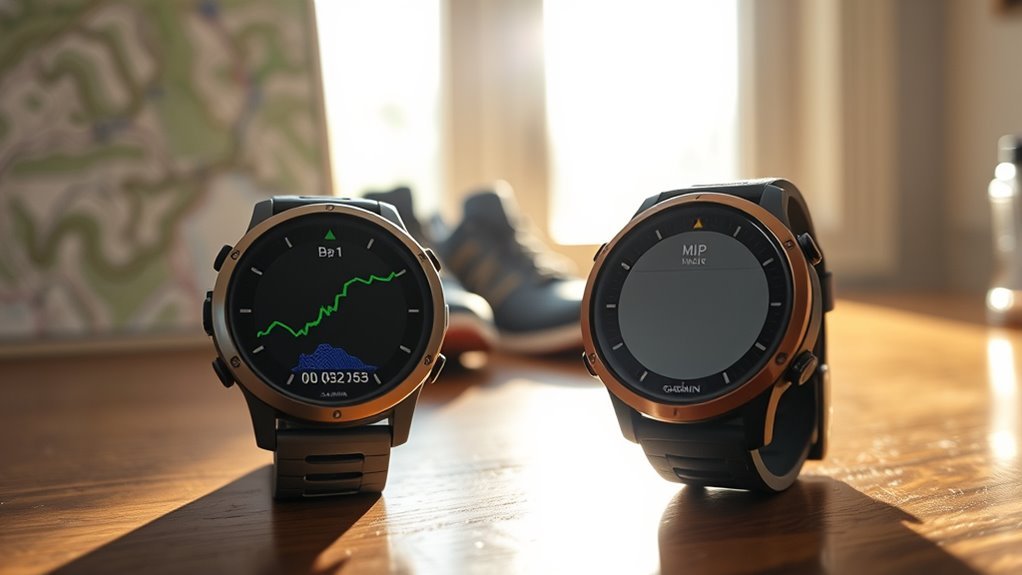
The best Garmin display depends on where you use the watch and what you value when you glance at it.
AMOLED is usually the better fit when you want crisp text, detailed maps, saturated colors, deep blacks, and a bright screen indoors or after dark. Garmin’s current AMOLED lineup includes watches such as the fēnix 9, fēnix 9 Pro, Forerunner 970, and AMOLED versions of other families.
MIP, short for memory-in-pixel, remains attractive for long outdoor activities because Garmin’s MIP panels are sunlight-visible and transflective. Rather than fighting bright ambient light, the display can use it to improve visibility. Current examples include the fēnix 9 Pro Solar and Instinct 3 Solar.
AMOLED prioritizes resolution, contrast, and visual richness; MIP prioritizes efficient always-visible outdoor viewing and works especially well with solar charging.
A useful current comparison is the Garmin fēnix 9 Pro battery table. The 47 mm fēnix 9 Pro AMOLED is rated for up to 18 days in smartwatch mode, while the 47 mm fēnix 9 Pro Solar is rated for up to 21 days normally or 34 days with qualifying solar exposure.
Note: Do not treat those figures as a universal AMOLED-versus-MIP rule. Garmin rates the 51 mm fēnix 9 Pro AMOLED for up to 31 days, while the 51 mm Solar model is rated for 30 days normally or 57 days with qualifying solar. Battery capacity, case size, settings, hardware, and solar exposure all matter.
MIP vs AMOLED: What Really Changes
The biggest practical differences are how the screen creates an image, how much detail it can show, how it behaves in sunlight, and how display settings affect power use.
| Feature | AMOLED | MIP |
|---|---|---|
| How it displays an image | Self-emissive pixels create their own light | Transflective display uses ambient light effectively |
| Color and contrast | Rich color and deep blacks | More limited color palette and contrast |
| Bright sunlight | Modern high-brightness models remain very usable but must produce their own light | Excellent; ambient light helps the reflective display |
| Low light | Excellent without external light | Usually needs a backlight |
| Always-visible watch face | Requires Always-On Display and more power | Naturally suited to continuous visibility |
| Maps and fine detail | Usually higher resolution and more visual detail | Lower resolution on many Garmin models but efficient outdoors |
| Solar options | Not the normal pairing in Garmin’s current fēnix lineup | Common on endurance-focused Solar models |
Resolution is one of the clearest measurable differences. Garmin’s Connect IQ compatible-device database lists the 47 mm fēnix 9 Pro AMOLED at 454 × 454 pixels, compared with 260 × 260 pixels for the 47 mm fēnix 9 Pro Solar MIP model. That higher AMOLED resolution can make map labels, icons, data fields, and watch-face graphics look smoother and more detailed.
Garmin Watches With MIP Screens
Garmin has used MIP extensively in watches designed for running, hiking, navigation, and long outdoor sessions. Examples include the Forerunner 255, Forerunner 955, older fēnix generations, Enduro models, Instinct Solar models, fēnix 8 Solar, and the current fēnix 9 Pro Solar.
The Forerunner 955 is rated for up to 15 days in smartwatch mode, while Garmin’s current 47 mm fēnix 9 Pro Solar is rated for up to 21 days normally and up to 34 days with qualifying solar exposure.
Garmin defines its solar smartwatch estimates using specific light assumptions. For the fēnix 9 Pro Solar smartwatch rating, the solar figure assumes all-day wear plus three hours per day outside in 50,000-lux conditions. Activity-mode solar estimates assume use outside in 50,000 lux.
MIP also works well as an always-visible display because it does not need an emissive panel to stay continuously lit. In dim conditions, however, you will normally rely on the watch’s backlight.
Garmin Watches With AMOLED Screens
Garmin introduced its first AMOLED smartwatch, the Venu, in 2019. AMOLED has since expanded across Garmin’s running, fitness, outdoor, aviation, and premium smartwatch families.
Current examples include the fēnix 9 and fēnix 9 Pro, Forerunner 970, Forerunner 570, Forerunner 265, Instinct 3 AMOLED, and Venu-family watches. Garmin’s current device database shows how much higher the pixel density can be compared with traditional MIP models.
AMOLED’s strengths are obvious when viewing maps, colorful widgets, charts, notifications, photos, or detailed watch faces. Pixels can turn fully black, creating high contrast in dark environments, while the higher resolution available on many Garmin AMOLED watches gives text and graphics smoother edges.
Modern Garmin AMOLED should not be dismissed as an indoor-only technology. Garmin says the current fēnix 9 Pro AMOLED reaches up to 3,000 nits, specifically improving readability in sunny conditions.
The main tradeoff is that an emissive display consumes power whenever it is lit. Always-On Display therefore has a meaningful battery cost.
Why MIP Excels in Sunlight
MIP remains especially effective in bright outdoor conditions because Garmin uses sunlight-visible, transflective memory-in-pixel panels. The display works with ambient light rather than depending entirely on emitted brightness.
As sunlight gets stronger, a reflective MIP screen can remain easy to glance at without increasing its brightness to the same degree an emissive screen would. That characteristic is valuable during hiking, cycling, trail running, paddling, and other activities where you repeatedly check the display under open sky.
This does not mean a current AMOLED Garmin becomes unreadable outside. Instead, MIP has an inherent efficiency advantage in bright ambient light, while high-brightness AMOLED compensates by producing more light of its own.
Sunlight Readability
Direct sunlight is the environment where MIP’s design is easiest to appreciate. A reflective screen can take advantage of the light already falling on the watch, keeping data fields and navigation information visible without running a bright emissive panel continuously.
- Trail metrics can remain visible during exposed midday runs.
- Navigation screens remain usable during long hikes.
- Solar-equipped MIP models can harvest additional energy while the user is outdoors.
AMOLED can still perform well, particularly on Garmin’s newest high-brightness models. The decision is therefore less about “readable versus unreadable” and more about reflective efficiency versus emissive brightness and detail.
Reflective Screen Advantage
MIP’s reflective behavior is particularly useful when the watch needs to show information for long periods. The display image can remain visible without an AMOLED-style Always-On mode continuously illuminating the panel.
This is also why MIP and solar charging make a logical combination. Garmin’s current fēnix 9 Pro Solar, for example, is rated for up to 21 days in smartwatch mode without the solar extension and up to 34 days under Garmin’s specified solar conditions on the 47 mm model.
Solar does not create unlimited energy in normal use. Actual gains depend on light level, exposure duration, enabled features, and activity mode.
How AMOLED Performs Indoors and Outdoors
AMOLED performs especially well indoors, at night, and anywhere high contrast and fine detail matter. Text can look smoother, colors are more saturated, and black backgrounds can be truly dark because individual pixels can switch off.
Outdoors, current Garmin AMOLED watches use high brightness to maintain visibility. This improves real-world sunlight performance compared with older, dimmer AMOLED implementations, although producing that light consumes power.
Indoor Readability
AMOLED normally has the clearer visual advantage in dim or indoor environments because it does not depend on ambient light to make the display visible.
- Dark room: bright text and deep black backgrounds are easy to distinguish.
- Gym: colorful data pages and animations can be read quickly.
- Office: notifications, charts, maps, and widgets appear sharp and detailed.
MIP remains usable indoors, but it generally relies more heavily on its backlight as ambient light decreases.
Outdoor Sunlight Performance
Both technologies are practical outside, but they reach readability in different ways.
| Display type | Outdoor behavior |
|---|---|
| AMOLED | Uses its own brightness; current premium models can be very bright and highly readable in sunlight |
| MIP | Uses ambient light effectively and remains naturally suited to prolonged daylight viewing |
| Best for maximum visual detail | AMOLED |
| Best for reflective daylight efficiency | MIP |
Always-On Display and Battery Life
Always-On Display is one of the most important settings when estimating AMOLED battery life. Garmin explains that enabling Always On keeps a dimmed watch face visible when the watch is idle, but shortens battery life between charges.
The fēnix 8 provides a useful concrete example. Garmin rates the 47 mm AMOLED model at up to 16 days in smartwatch mode with gesture wake, but only 7 days with Always-On Display.
MIP works differently. Its reflective image can remain visible without running a bright self-emissive display continuously, which is one reason it remains popular for endurance-focused watches.
Pro Tip: When comparing Garmin battery life, match the same case size and read the exact mode description. Gesture versus Always On, GPS-only versus multi-band GNSS, music, LTE, Pulse Ox, and solar exposure can change the result dramatically.
Cross-model comparisons can be misleading. The AMOLED Forerunner 965 is rated for up to 23 days in smartwatch mode, while the MIP Forerunner 955 is rated for up to 15 days. That does not mean AMOLED is inherently more efficient; it shows that the complete watch design matters as much as the screen technology.
AMOLED Image Persistence and Burn-In
Garmin’s owner manuals also acknowledge image persistence, or pixel burn-in, as normal behavior that can occur with AMOLED devices. Garmin recommends avoiding static images at high brightness for long periods and uses display timeouts and dimming behavior to reduce the risk.
For normal watch use, Garmin manages much of this automatically. The practical takeaway is simply to use the watch’s normal display behavior rather than forcing static, maximum-brightness content to remain on for extended periods.
MIP vs AMOLED for Ultra Running
Ultra running puts more emphasis on activity-mode battery life than ordinary smartwatch-mode figures. That makes model-specific GNSS runtime more useful than comparing how many days a watch lasts while mostly functioning as a smartwatch.
For anything shorter than an ultra the calculus changes again, because a race that fits inside a single charge removes the battery argument entirely. Our running watch comparison by runner type splits the picks that way rather than by screen.
For athletes expecting very long events, a Solar/MIP model can provide a meaningful endurance advantage. AMOLED, however, offers clearer fine detail and stronger low-light presentation, which can be useful for night stages and detailed navigation.
Battery Life In Ultras
Current fēnix 9 Pro figures show why the distinction matters. Garmin rates the 47 mm fēnix 9 Pro AMOLED for up to 32 hours in its Normal/Balanced activity mode. The 47 mm fēnix 9 Pro Solar is rated for up to 54 hours in the same broad activity category, or up to 81 hours with qualifying solar exposure.
Those are manufacturer estimates rather than guarantees. Actual runtime changes with GNSS accuracy, map use, music, LTE LiveTrack, sensors, temperature, display behavior, and other settings.
- For a race comfortably inside the AMOLED watch’s rated activity window, display preference may matter more than maximum runtime.
- For very long ultras, multi-day events, or remote trips, the additional endurance of a Solar/MIP model can reduce charging pressure.
- A power bank or race-approved charging strategy may still be sensible for events near the watch’s expected limit.
Sunlight Readability On Trail
MIP remains an excellent trail display because bright ambient light helps rather than hurts its reflective design. That is useful when reading pace, elevation, heart rate, course directions, or maps with quick wrist glances.
AMOLED provides more pixels for map detail and can be particularly attractive when navigation screens contain many labels or graphical elements. Current high-brightness models also reduce the sunlight disadvantage that characterized older AMOLED watches.
For trail use, the choice is therefore practical: choose MIP when maximum reflective visibility and endurance are the priority; choose AMOLED when higher-resolution mapping and richer visuals matter more and the watch’s activity battery rating comfortably covers your event.
MIP vs AMOLED for Hiking and Daily Wear
Hiking and daily wear place different demands on a watch, so this is where personal preference often matters most.
This split runs right through the current range, and the vivoactive and Venu lines sit on opposite sides of it. Our vivoactive versus Venu comparison puts the two screen types side by side in the same price bracket.
- Long backpacking trip: MIP/Solar is attractive for daylight visibility and extended runtime.
- Frequent map checking: AMOLED’s higher resolution can make labels and fine detail easier to distinguish.
- Office and gym use: AMOLED generally looks richer and more modern indoors.
- Always-visible time outdoors: MIP provides this naturally without an AMOLED-style AOD power penalty.
- Night use: AMOLED offers excellent contrast; MIP depends more on its backlight.
For an older apples-to-apples example, the 47 mm fēnix 8 AMOLED is rated for up to 16 days with gesture wake, while the 47 mm fēnix 8 Solar is rated for up to 21 days normally or 28 days with qualifying solar. The newer fēnix 9 Pro series follows the same general pattern on its 47 mm models while improving several specifications.
Current Garmin MIP vs AMOLED Comparison
As of September 2026, Garmin’s fēnix 9 Pro lineup provides one of the clearest current comparisons because buyers can choose AMOLED or a Solar model using a sunlight-visible MIP display.
| Specification | fēnix 9 Pro 47 mm AMOLED | fēnix 9 Pro Solar 47 mm MIP |
|---|---|---|
| Display technology | AMOLED | Sunlight-visible transflective MIP |
| Resolution | 454 × 454 | 260 × 260 |
| Smartwatch mode | Up to 18 days | Up to 21 days / 34 days with qualifying solar |
| Normal/Balanced activity mode | Up to 32 hours | Up to 54 hours / 81 hours with qualifying solar |
| Best fit | Sharper graphics, detailed maps, rich indoor/night viewing | Long outdoor sessions, reflective daylight viewing, solar-assisted endurance |
Garmin launched the fēnix 9 and fēnix 9 Pro on August 25, 2026. This current generation makes an important point: MIP and AMOLED are no longer simply “old efficient screen versus new pretty screen.” Garmin continues to develop both because each serves a different type of use.
How to Choose Between Garmin Displays
Start with your actual use rather than choosing by screen technology alone.
| Your priority | Usually the better fit | Why |
|---|---|---|
| Rich colors and premium-looking graphics | AMOLED | Higher contrast and resolution |
| Detailed maps | AMOLED | More pixels on comparable current Garmin models |
| Frequent direct-sun viewing | MIP | Reflective display benefits from ambient light |
| Long ultras or multi-day outdoor trips | MIP/Solar | Current Solar models offer very long activity runtimes |
| Indoor and low-light viewing | AMOLED | Self-lit pixels and deep blacks |
| Always-visible watch face with minimal display power demand | MIP | Does not require AMOLED-style Always-On illumination |
Before buying, compare the exact Garmin model and case size you are considering. A larger AMOLED watch can outlast a smaller MIP watch in some modes, while a Solar/MIP version may have a major advantage in another activity mode. Manufacturer battery tables are more useful than broad statements such as “MIP always lasts longer.”
Frequently Asked Questions
Which Is Better for Garmin Maps, MIP or AMOLED?
AMOLED is usually better for fine map detail because many current Garmin AMOLED models have substantially higher resolution. For example, Garmin lists the 47 mm fēnix 9 Pro AMOLED at 454 × 454 pixels versus 260 × 260 for the 47 mm Solar/MIP version. MIP can still be preferable for long navigation sessions in strong sunlight because its reflective screen is efficient and easy to view outdoors.
Which Garmin Do Navy SEALs Use?
There is no reliable public Garmin documentation showing that all Navy SEALs are issued or typically use one specific Garmin fēnix model. Garmin does sell the tactix family for tactical use; for example, tactix 8 includes tactical features and is built to MIL-STD-810 testing criteria. That should not be confused with proof of a standard Navy SEAL-issued watch.
What Is a Garmin MIP Display?
MIP means memory-in-pixel. Garmin describes its current MIP watches as using sunlight-visible, transflective displays. They use ambient light effectively, remain continuously visible without an AMOLED-style Always-On mode, and are commonly paired with Garmin’s solar-charging outdoor watches.
What Is Garmin AMOLED vs MicroLED?
Both are self-emissive display technologies, but Garmin now sells an actual MicroLED watch rather than treating the technology as hypothetical. Garmin introduced the fēnix 8 Pro MicroLED in September 2025 with more than 400,000 individual LEDs, brightness up to 4,500 nits, and up to 10 days of smartwatch battery life. AMOLED remains much more common across Garmin’s lineup.
Does Garmin AMOLED Burn In?
Garmin states that image persistence, or pixel burn-in, is normal behavior that can occur with AMOLED devices. Garmin recommends avoiding static images at high brightness for long periods and uses dimming and display timeouts to help reduce the risk.
Does MIP Always Have Better Battery Life Than AMOLED?
No. MIP is well suited to low-power always-visible outdoor use, but total watch battery life also depends on battery capacity, case size, software, sensors, GNSS mode, music, LTE, display settings, and solar exposure. Compare manufacturer figures for the exact models and sizes you are considering.
Conclusion
Garmin MIP and AMOLED displays serve different priorities rather than representing a simple winner and loser. AMOLED is the stronger fit for high-resolution maps, vivid color, deep contrast, indoor use, and users who value a richer screen. MIP remains excellent for prolonged daylight viewing, naturally always-visible data, solar-equipped watches, and outdoor endurance.
The most important buying rule is to compare the exact watch, size, and operating mode. Current Garmin models show that battery life depends on far more than display technology alone. If the watch’s battery comfortably covers your activities, choose the screen you prefer looking at; if maximum outdoor runtime is the priority, MIP/Solar deserves especially close attention.
Sources
- Garmin — fēnix 9 and fēnix 9 Pro announcement — current 2026 lineup, AMOLED brightness, and product positioning.
- Garmin — fēnix 9 Series Battery Information — smartwatch, activity, solar, and case-size battery figures plus solar assumptions.
- Garmin Connect IQ — Compatible Devices — display technologies and resolutions for fēnix, Forerunner, Instinct, and other Garmin models.
- Garmin Support — Always-On Display — AMOLED Always-On behavior and battery impact.
- Garmin — fēnix 8 Pro MicroLED announcement — MicroLED availability, brightness, and battery specifications.
